Google Ads Requires AI Disclosure Across All Advertiser Creative Starting July 2026

A new compliance requirement across Google Ads, Display & Video 360, Campaign Manager 360, Merchant Center, and Ads Editor now mandates that advertisers disclose when generative AI tools were used to create or modify ad creative, according to Search Engine Journal. The policy, rolling out throughout July 2026 across Google’s Search, YouTube, and Discover ad inventory, introduces a “How this ad was made” transparency panel visible to users through the three-dot menu or information icon on ads.
TL;DR: Google’s July 2026 policy requires advertisers to disclose AI usage in ad creative across all major ad platforms, with labels appearing automatically for Google’s tools and through manual controls for third-party AI applications.
The disclosure applies to any ad creative generated or edited using generative AI, whether written copy, visual assets, or modified imagery, and places responsibility on advertisers to determine when AI use triggers the requirement and to ensure compliance with applicable local transparency laws.
How the Disclosure Mechanism Works
Ads created using Google’s native generative AI advertising tools receive the disclosure automatically, with no additional action required from the advertiser. Campaigns built with third-party AI applications, including external copywriting assistants, image generators, or editing tools used before uploading creative to Google’s platforms, require advertisers to apply the disclosure manually through a new control introduced in the campaign setup workflow.
Google explained the split approach in its announcement: “When they create ads elsewhere, we’re introducing a control so they can easily indicate if they used generative AI.” The manual control appears during campaign creation and asset upload across all affected platforms.
The transparency information surfaces in the My Ad Center panel, which users access through the three-dot menu or information icon on ads. The panel indicates whether generative AI was used to create or edit the ad, though it does not specify which tool, vendor, or extent of AI involvement.
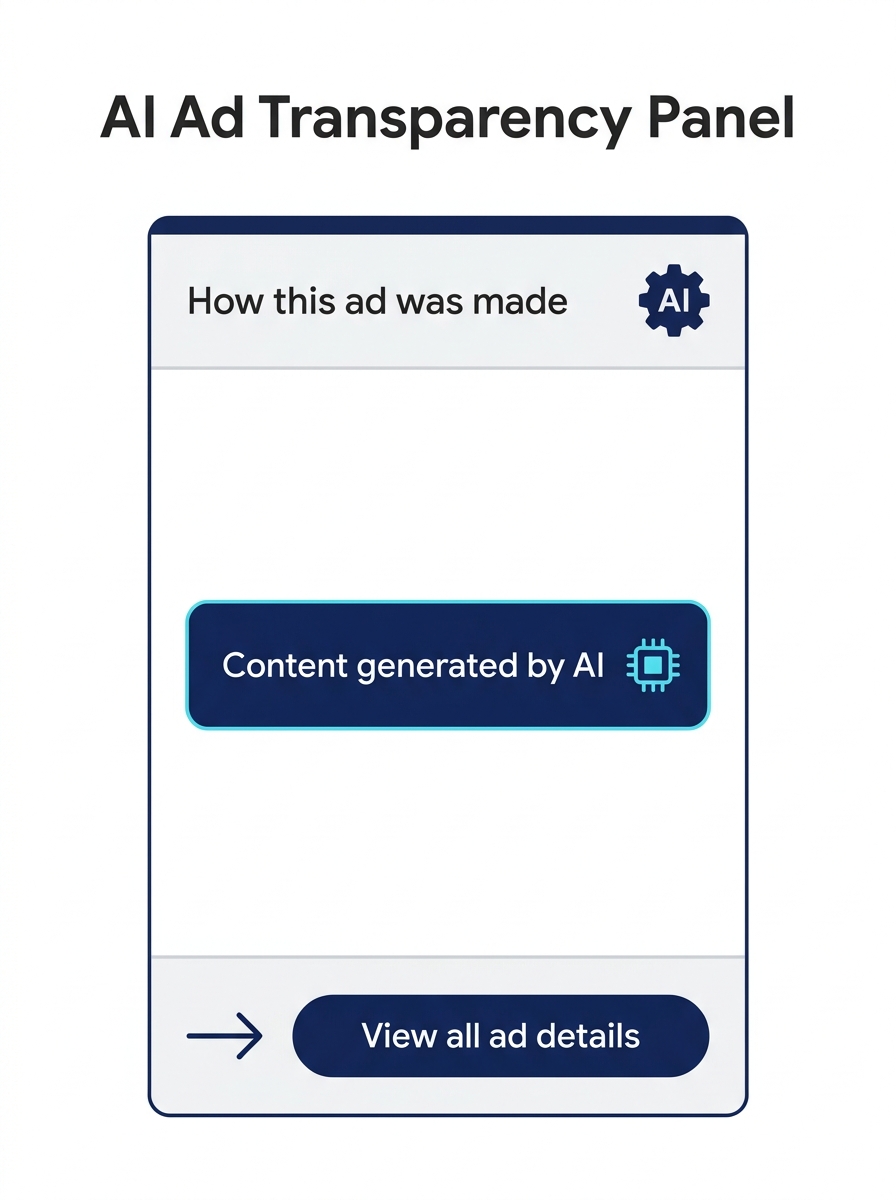
The requirement extends beyond Google properties to Google-served ads appearing on third-party websites. Users viewing those ads can access the same disclosure information through the AdChoices icon or the three-dot menu, maintaining consistency across all placements where Google controls ad delivery.
Jurisdictional Variations and On-Ad Labels
In jurisdictions with explicit AI transparency statutes, the disclosure may appear directly on the ad creative itself rather than only in the transparency panel. Google confirmed that on-ad labels will appear in the European Union, India, and New York State, where local laws mandate clear disclosure of synthetic media in advertising.
The company stated that advertisers remain ultimately responsible for determining when AI use requires disclosure under local law and for ensuring compliance across the markets where their campaigns run. This creates a two-tier disclosure system: the universal transparency panel available to all users globally, and mandatory on-ad labels in specific regulated markets.
Advertisers running campaigns in multiple regions will need to track which placements trigger on-ad labeling requirements and may face different performance baselines depending on whether the disclosure appears inline with creative or only in the information panel.
What This Means for, CMOs
Marketing leaders briefing agency partners on paid media campaigns now need to add AI documentation as a standard line item in creative approval workflows. If internal teams or third-party vendors use generative AI tools at any stage of copywriting, asset production, or creative editing, that usage must be flagged before campaigns go live, Google has placed compliance responsibility on the advertiser, not on the platform to detect undisclosed AI usage.
Organizations where creative production and campaign management sit in different departments face a structural gap: the team uploading ads may not know whether the asset they received was AI-assisted during concepting or editing phases. The cleanest fix is a declaration requirement upstream, anyone delivering finished creative to the paid media team documents which tools touched the asset, even if the final output was human-refined. This mirrors the brand differentiation challenges marketing executives have reported as AI content generation becomes widespread and asset provenance becomes harder to trace.
For campaigns running in the EU, India, or New York State, CMOs should also establish a monitoring protocol for performance data segmented by disclosure presence. It remains an open question whether on-ad AI labels influence user behavior, early data will matter for setting creative strategy in regulated markets versus markets where the label lives only in the transparency panel. Agencies managing multi-market campaigns should be prepared to report performance splits once sufficient volume accumulates.