The CTR Collapse Playbook: How Enterprise Brands Are Recovering Organic Traffic as AI Overviews Cannibalize Position #1 Rankings
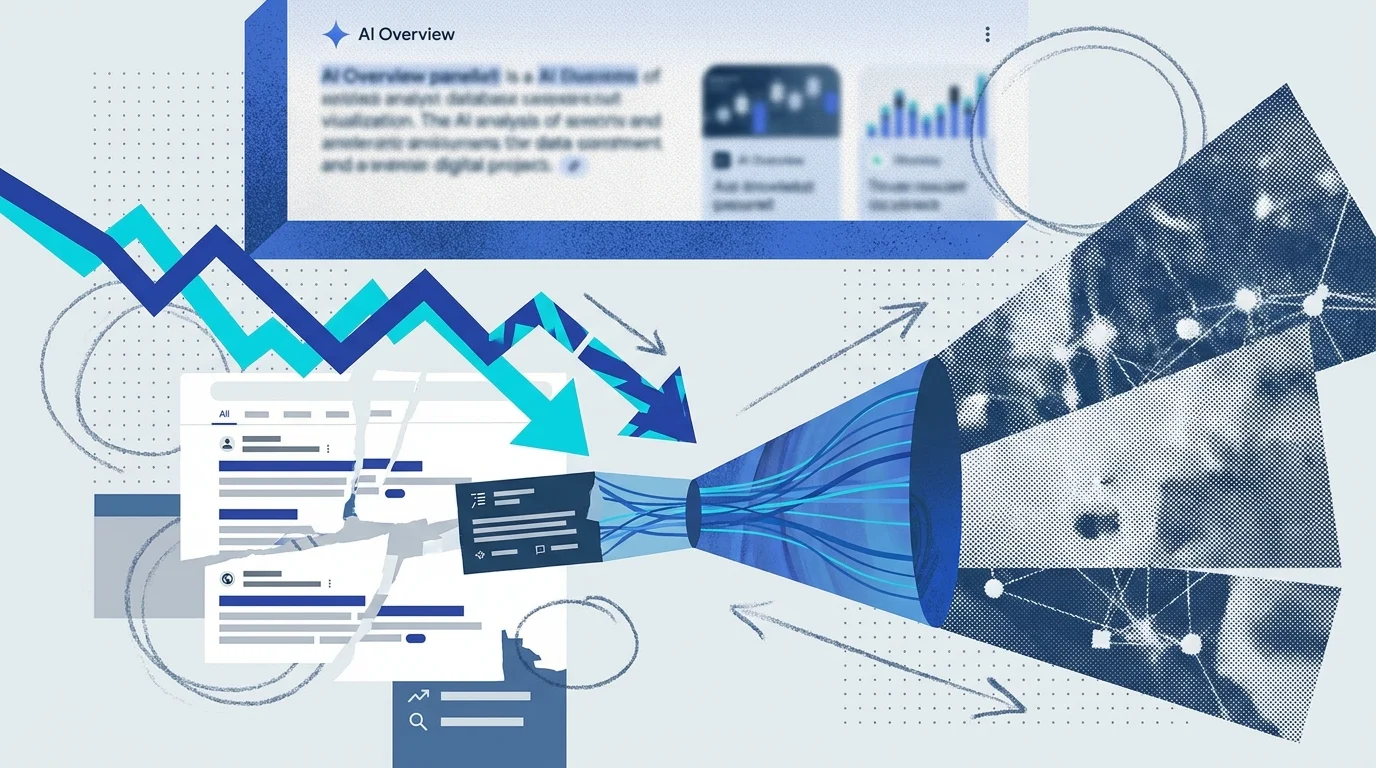
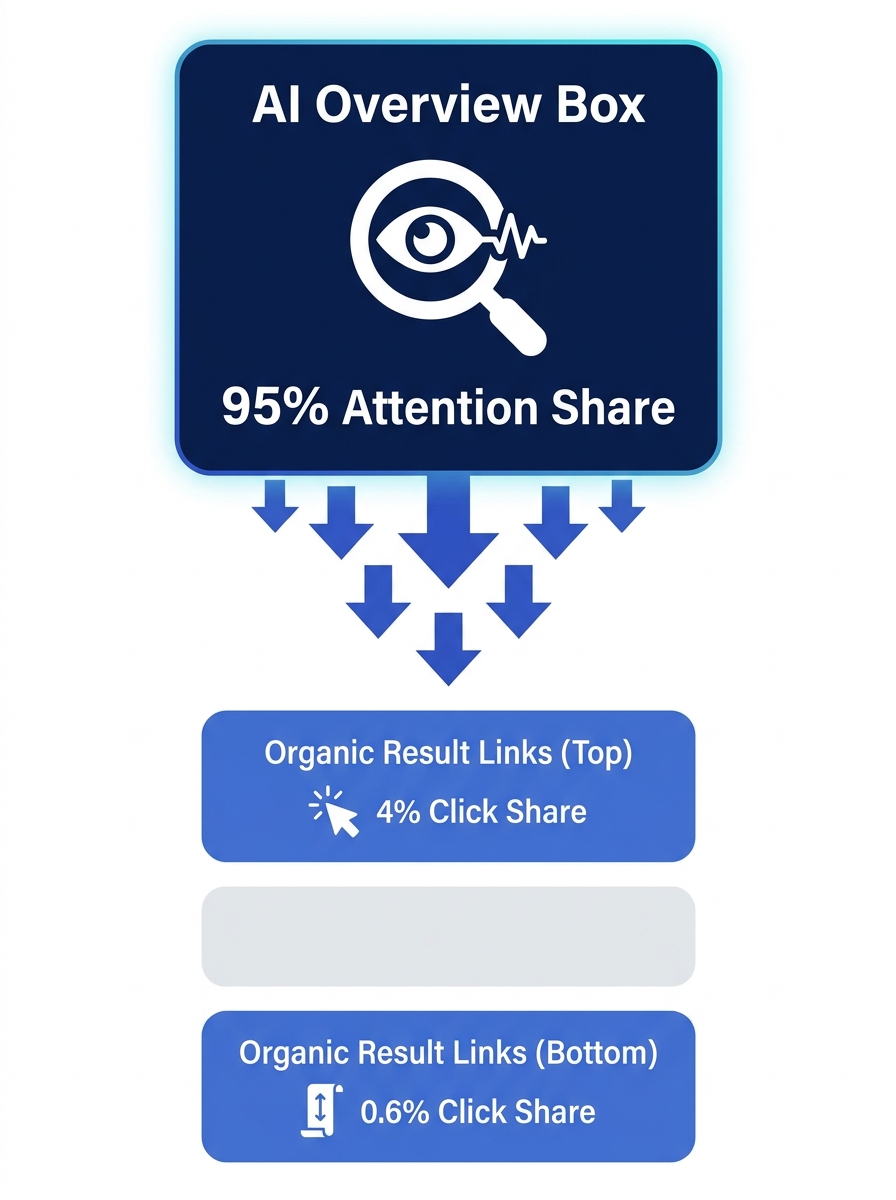
Google’s AI Overviews have driven a 61% drop in organic CTR for queries where they appear, with paid CTR falling 68%. Enterprise brands still hold position #1 rankings. But the clicks those rankings used to generate are absorbed by the SERP itself before anyone reaches a blue link. The organic CTR decline from AI Overviews follows a structural pattern, and understanding the mechanism behind it changes how brands respond.
TL;DR: Position 1 traffic loss on Google is a display-layer problem, not a ranking problem. AI Overviews answer queries inside the results page, collapsing click-through rates for top-ranked domains. Recovery requires brands to shift from ranking for clicks to earning citations inside AI-generated summaries — a process built on entity authority, structural extractability, and new measurement frameworks.
The Click Gets Intercepted Before the Blue Link
AI Overviews generate a summary paragraph directly in the SERP, synthesized from multiple sources. The user reads the answer without scrolling to any organic listing. The more definitively a query can be answered in a short paragraph, the fewer clicks pass through to any website.
The Digital Bloom’s 2025 organic traffic analysis reported that AI Overviews now trigger on 13.14% of all Google queries — more than doubling from 6.49% at the start of 2025. That 13.14% sounds small. It concentrates, however, on high-volume informational queries: the exact category enterprise content teams have spent years optimizing for.
The damage extends beyond those specific queries. Search Engine Land’s analysis found that even on queries without AI Overviews visible, organic CTRs fell 41%. Users are clicking less everywhere. ChatGPT, Perplexity, and social search platforms all contribute to a behavioral shift where users expect answers without visiting a site. “This suggests users are simply clicking less, everywhere,” Search Engine Land’s reporting team noted in their analysis of the CTR data, calling out AI platforms and social search as compounding factors.
Why Position #1 No Longer Means What It Did
The traditional model worked like this: rank first, capture 27–32% of clicks for that query. Every position below earned proportionally less. Enterprise brands built entire content strategies around capturing and defending those top slots.
That model assumed the blue link was the first thing users saw. AI Overviews broke that assumption by sitting above position #1, occupying 300-500 pixels of screen real estate. On mobile, the AI Overview often fills the entire initial viewport. Users who get a satisfactory answer from the summary have zero reason to scroll down.
This is why brand traffic recovery for enterprise sites can’t follow the old playbook of “improve rankings.” Many of these brands already rank first. The click cannibalization is happening at the SERP strategy layer, at the display level, where Google answers the query itself. A Contently analysis from April 2026 confirmed this split: informational queries lose the most clicks to AI summaries, while transactional and navigational queries retain more of their click volume. Contently’s editorial team described the pattern as “a split outcome rather than a collapse,” noting that referral traffic from AI engines is growing even as traditional organic clicks decline.
The brands seeing the steepest traffic drops built their strategy around answering “what is,” “how does,” and “why does” queries. Those are the exact queries AI Overviews absorb most completely.
How AI Overviews Select Their Sources
Understanding the citation mechanism is critical for any click cannibalization SERP strategy. AI Overviews don’t copy the top-ranking result. Google’s system synthesizes from multiple pages, pulling fragments from sources it considers authoritative on the specific entities and relationships in the query.
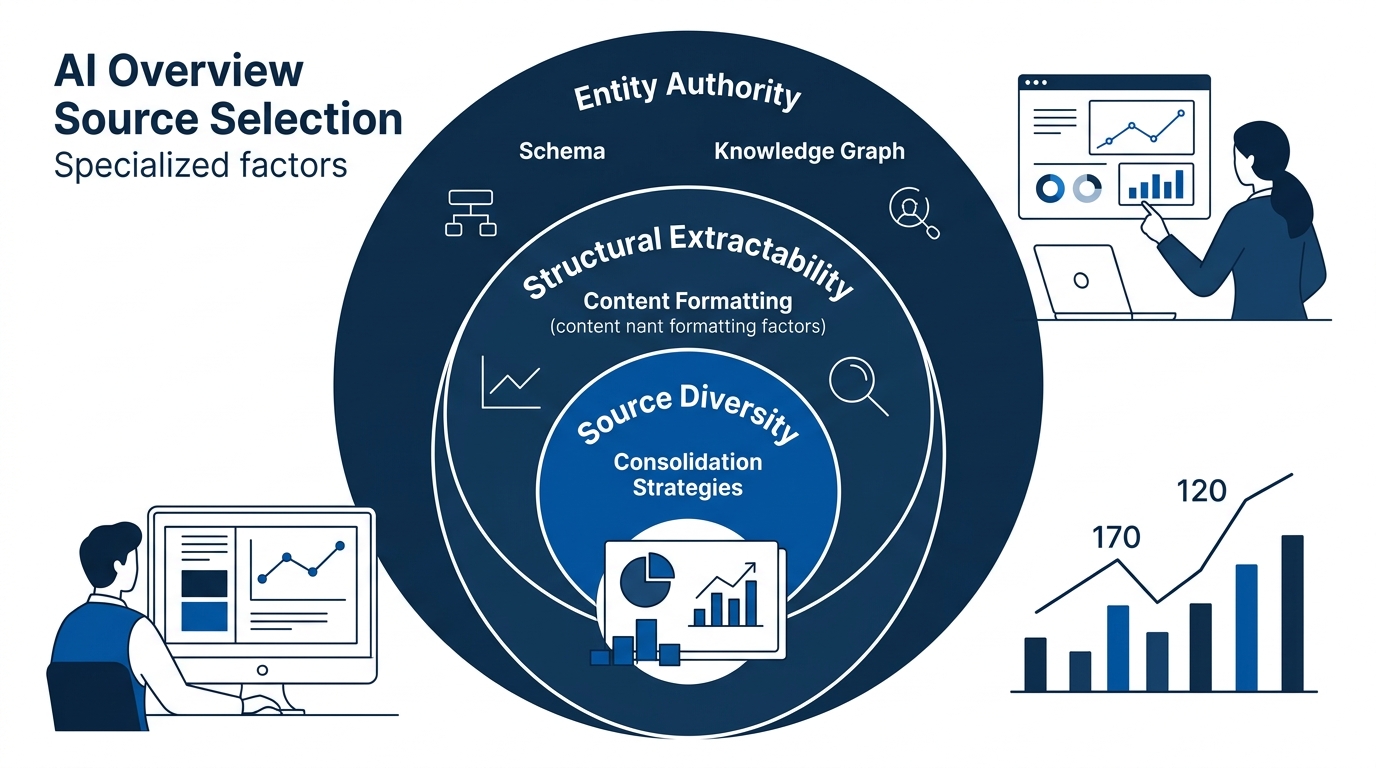
The selection factors, based on observed patterns across enterprise sites and confirmed by third-party analyses, operate in three layers:
Entity authority. Google needs to recognize your domain as a known entity connected to the topic. As Rank Math’s entity SEO guide defines it, entity-based SEO optimization “focuses on optimizing your content around well-defined entities like people, places, organizations, and concepts” rather than isolated keyword strings. Entity relationships show how concepts connect — a signal that matters for both traditional SERPs and AI-generated answers, according to HubSpot’s analysis citing Fractl research showing 66% of consumers believe AI will replace traditional search.
Structural extractability. The AI system pulls specific sentences and data points. Content formatted with clear H2/H3 hierarchies, direct-answer opening sentences per section, and HTML tables gives the system clean fragments to extract. Pages that bury answers in long narrative paragraphs rarely get cited.
Source diversity signaling. AI Overviews tend to cite 3-7 sources per summary. Google appears to prefer pulling from sources that represent distinct perspectives rather than near-duplicate content. This means high-volume publishing of similar pages works against you — Google picks one representative page and ignores the rest.
Enterprise brands still hold position #1 rankings. But the clicks those rankings used to generate are absorbed by the SERP itself before anyone reaches a blue link.
Entity Recognition as the Foundation Layer
Entity-based SEO optimization works differently from keyword-targeted content. Instead of creating a page that matches a query string, you’re building a knowledge graph node that Google and LLMs recognize as authoritative on a topic cluster.
The practical components for enterprise brands:
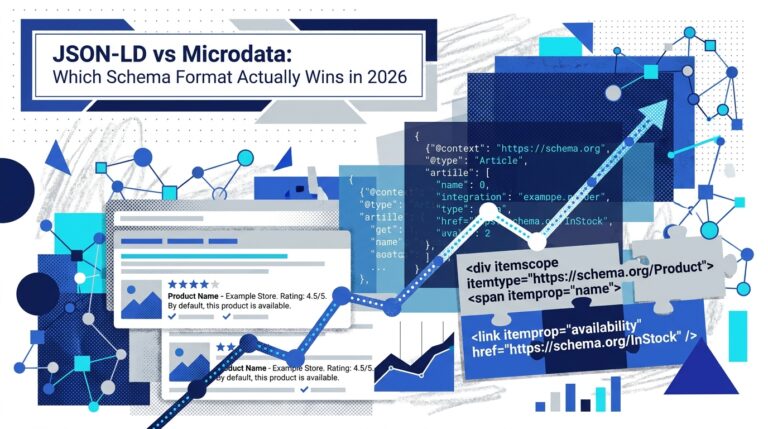
Your organization schema (JSON-LD) needs to define your brand as an entity connected to specific expertise areas. Author pages need to establish named individuals as entities with verifiable credentials. And your content needs to reference other known entities — named tools, published studies, industry organizations — in ways that build associative links the knowledge graph can map.
For enterprise brands managing hundreds or thousands of pages, this connects directly to how information architecture defines topic ownership. A fragmented site where twelve pages compete for the same topic cluster sends weak entity signals. A consolidated architecture where each topic maps to one authoritative page sends strong ones.
Brands cited inside AI Overviews see 35% higher organic CTR than brands that rank organically but aren’t cited, according to aggregated tracking data. The citation acts as a trust signal that influences click behavior even when the AI summary provides the full answer. And AI-referred visitors convert 4.4x better than standard organic visitors — smaller volume, dramatically higher value per session.
Reformatting Content for AI Extraction
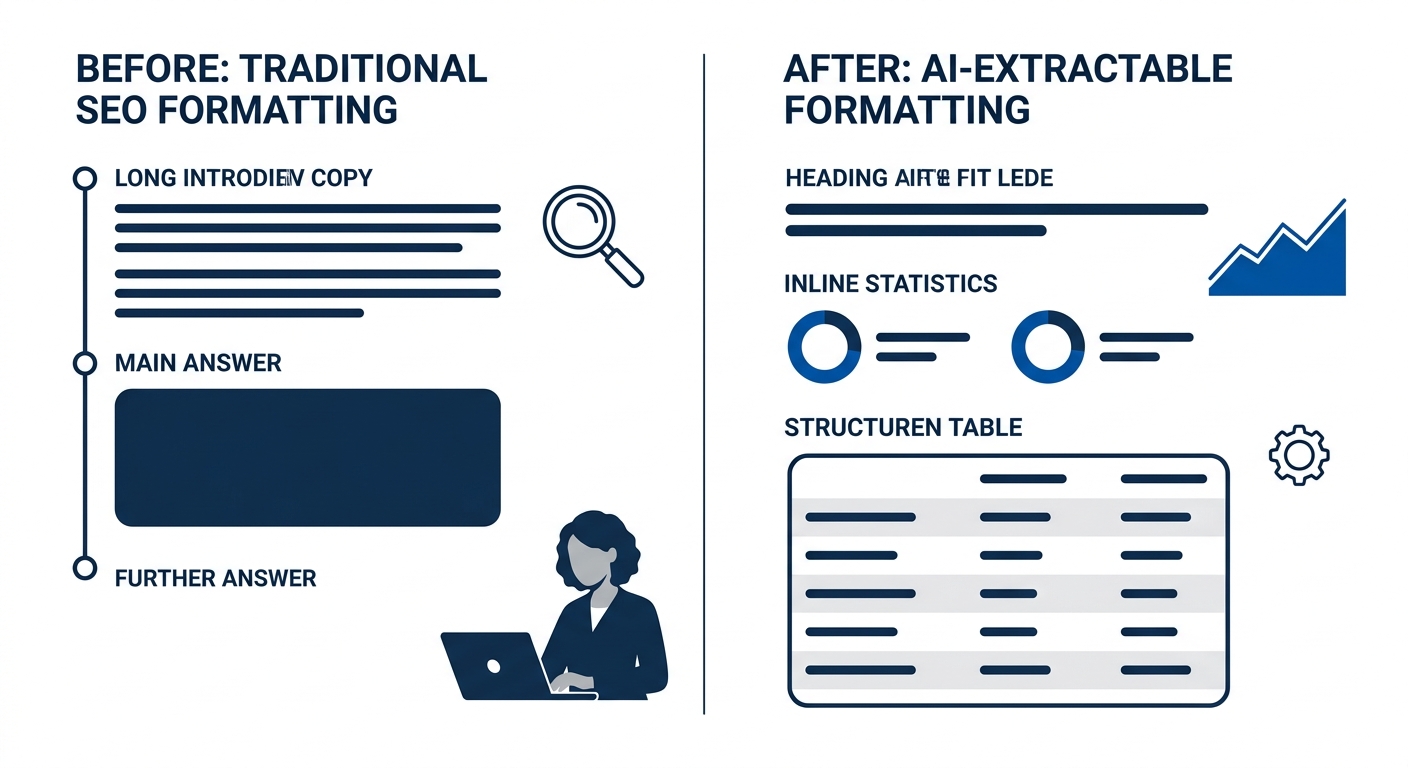
Earning a citation requires content that’s structurally easy for AI systems to parse and quote. This is where the gap between SEO-optimized content and AI-extractable content becomes visible.
Traditional SEO content buries the answer after an introduction, builds to a conclusion, and uses the inverted pyramid loosely at best. AI extraction systems need the answer in the first 40-75 words of each section. They need H2 headings that function as clear topic signals. They need data in HTML tables, not embedded in narrative paragraphs.
The Princeton/Georgia Tech GEO research measured specific citation lifts by content modification type. The results, ranked by impact:
| Content Modification | Citation Lift (PAWC) | Application |
|---|---|---|
| Quotation Addition | +42.6% | Named expert quotes with source and date |
| Statistics Addition | +32.8% | Specific numbers tied to named sources |
| Source Citation | +27.7% | Explicit attribution inline |
| Structured Format | +28-40% | Tables, TL;DR blocks, clear H2/H3 |
The single highest-impact change is adding attributed quotes. The second is adding specific statistics with citations. Both belong in the opening paragraph of each section — not buried in supporting text.
For brands already running structured SEO audit workflows, the adjustment means adding an AI extractability layer to the existing audit. Each priority page gets reviewed for direct-answer ledes, schema coverage, and table formatting.
Info: Reformatting doesn’t mean rewriting every page on the site. Start with the 50-100 pages that show the highest impression-to-click-ratio decline in Google Search Console, which indicates they’re appearing in AI Overviews but losing clicks.
Tracking Recovery With Different Metrics
Traditional organic traffic metrics miss the picture when AI Overviews absorb clicks. Impressions stay flat or rise — your page still appears in the index — but clicks drop because the SERP satisfies the query before users reach your link. Gartner projected a 25% drop in traditional search engine volume by 2026 as queries shift to AI chatbots, and that projection is tracking close to reality.
Brand traffic recovery for enterprise sites requires three additional metrics layered on top of existing reporting:
AI referral traffic. GA4 can segment traffic arriving from AI-specific sources: ChatGPT, Perplexity, Google’s AI features. The 4.4x conversion lift these visitors deliver makes citation capture a higher-value KPI than raw click volume for many informational content categories.
Citation frequency. Manual and semi-automated checks across ChatGPT, Perplexity, and Gemini reveal how often your brand appears in AI-generated answers. This replaces ranking position as the primary visibility indicator for informational queries.
Impression-to-click ratio by query category. Separating informational queries from transactional and navigational ones isolates the organic CTR decline from AI Overviews (concentrated in informational) versus broader ranking losses that need different fixes.
For brands whose content strategy aligns with revenue goals, the shift means reweighting investment from volume plays (more pages, more keywords) toward depth and extractability on pages that already carry authority.
Where This Recovery Model Breaks Down
The position 1 traffic loss on Google from AI Overviews doesn’t affect all queries equally, and the recovery approach described above has clear limitations.
Transactional queries remain mostly intact. “Buy running shoes” and “book hotel Manila” don’t trigger AI Overviews in most cases. Brands whose traffic comes primarily from purchase-intent queries won’t see the same CTR collapse and don’t need the same response.
AI citation tracking is still immature. No platform provides reliable, automated tracking of when your brand gets cited across all AI systems. Manual checks don’t scale for enterprise sites with thousands of pages. The measurement infrastructure is improving, but the gap is real today.
Google changes the rules constantly. AI Overview formatting, source selection criteria, and trigger rates have shifted multiple times since initial rollout. Any click cannibalization SERP strategy built around a specific citation mechanism risks breaking when Google adjusts the display layer. The post-search visibility landscape keeps moving.
Content reformatting is expensive at scale. Rewriting thousands of pages with direct-answer ledes, updated schema, and restructured tables requires significant editorial resources. Enterprise teams need to prioritize by traffic value and cannibalization severity, not attempt a site-wide rewrite in a single quarter.
The organic CTR decline from AI Overviews is structural and measurable. The recovery path runs through entity authority, structural extractability, and new measurement frameworks built for a SERP that answers queries itself. But the model works best for brands with existing domain authority and informational content already ranking well. For brands without that foundation, the prerequisite work — building strategic internal link architecture, consolidating topic authority, fixing site structure — still comes first. The AI extraction layer sits on top of fundamentals that haven’t changed, even as the surface they support looks entirely different.