Google Announces AI Search Redesign That Shifts Traffic From Websites to In-Platform Answers
Google announced a redesign of its Search interface on May 21, 2026 that shifts users away from clicking website links toward AI-generated answers and automated monitoring agents, according to details from the company’s I/O event, threatening organic discovery channels for SEO-dependent businesses across APAC markets.
TL;DR: Google is transforming Search into an AI concierge that answers questions, monitors topics, and reduces the need to visit websites directly, with AI Mode and information agents launching first to U.S. subscribers.
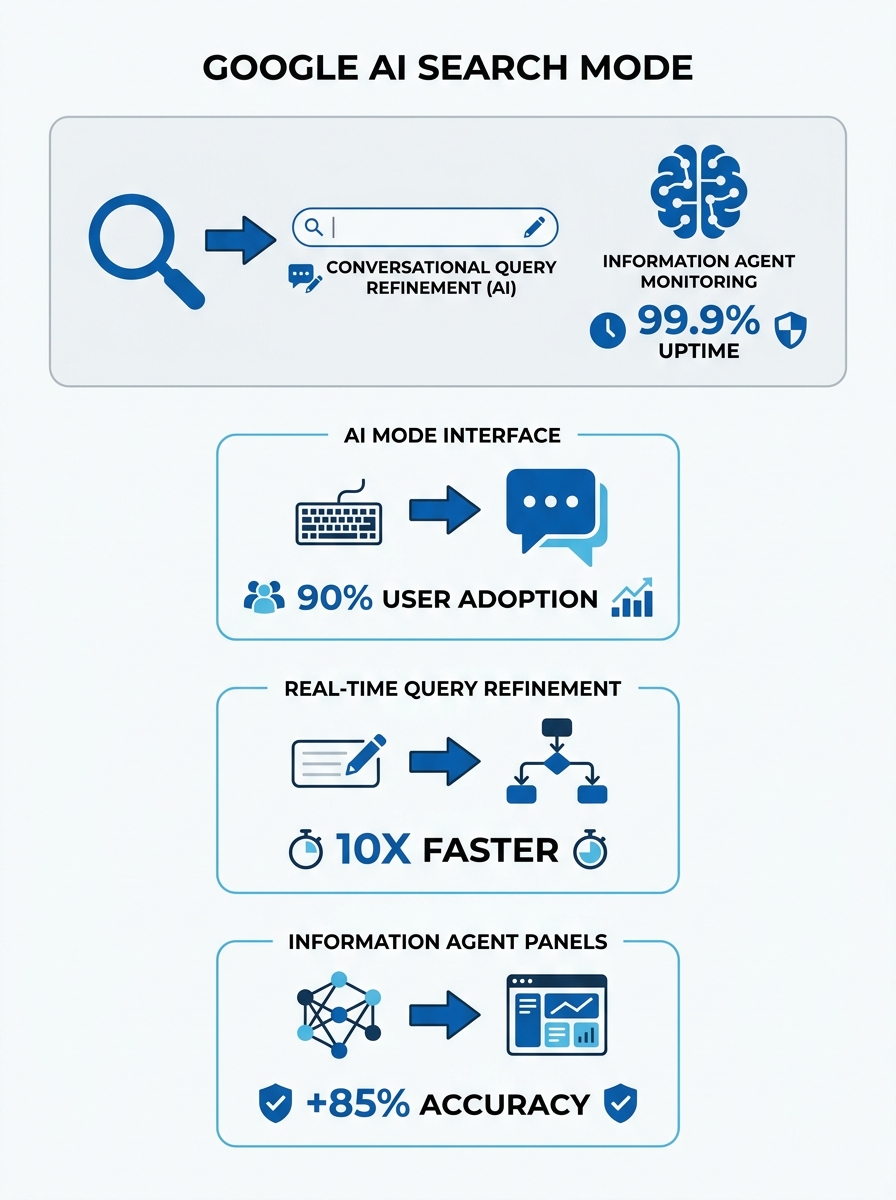
The upgrade introduces AI Mode, a chat-style interface that keeps users inside Google’s ecosystem rather than sending them to external sites, alongside background information agents that monitor topics over time and surface updates automatically. Google described the changes as “the biggest upgrade to our Search box in over 25 years” during the announcement, positioning the shift as a move toward AI agents that handle ongoing tasks instead of single queries.
The rollout begins with AI Pro and Ultra subscribers in the United States, with broader availability expected later. AI Overviews, which have been answering queries directly inside Google for more than a year, already pushed traditional organic links further down result pages. Information agents extend that pattern by automating the research, filtering, and summarization tasks users previously completed by visiting multiple websites.
AI Mode Replaces Click-Through Intent
The redesigned search box now handles longer conversational queries and accepts images, video, files, and open Chrome tabs as inputs. Google says the interface will “anticipate your intent” and surface AI-powered suggestions beyond traditional autocomplete, allowing users to refine and extend searches without leaving the platform.
AI Mode operates as an ongoing thread rather than a single query-and-response exchange. Users can ask follow-up questions, request deeper detail, or shift the focus of their search while staying inside the same conversation. Google positions this as central to the new Search experience, eliminating the need to toggle between a chatbot interface and traditional result pages.
The company has already demonstrated AI-assisted booking flows for restaurants, events, and appointments. These features allow users to compare options, check availability, and complete reservations without visiting the underlying service providers’ websites.
Information Agents Automate Ongoing Monitoring
Information agents represent a structural shift beyond answering individual queries. Users can create agents that monitor blogs, news feeds, social platforms, and real-time data sources in the background, then receive notifications when meaningful changes occur. Google describes this as “the era of Search agents,” where multiple AI agents can run simultaneously across finance, shopping, travel, and sports categories.
“These agents intelligently reason across information to find exactly what you need at exactly the right moment,” the company said in a blog post announcing the features.
Instead of re-running the same searches repeatedly to track price changes, product launches, or industry news, users delegate that work to an agent that reports back when updates surface. The agent decides which changes qualify as meaningful, filtering out noise and surfacing only actionable information.
Impact on SEO-Reliant Businesses
The changes create immediate challenges for comparison platforms, marketplaces, SaaS discovery tools, directories, and content-driven businesses that historically relied on Google sending customers to them for research and decision-making. Even if a company’s content, pricing data, or expertise shapes the AI-generated answer, the user increasingly experiences that as Google’s recommendation rather than visiting the originating website.
Startups built around organic discovery face the sharpest exposure. Information agents move comparison, monitoring, and recommendation tasks directly into Search itself. A user evaluating business banking accounts, accounting software, or energy plans may ask Google to track options and surface recommendations automatically, eliminating the need to click through to third-party platforms.
This pattern echoes broader challenges marketing leaders at Philippine enterprises evaluating SEO strategy have been navigating since AI Overviews began appearing in result pages. The underlying data and brand signals still matter, but the customer relationship risks staying with Google rather than the underlying platform.
Enterprise brands with established domain authority and direct customer relationships may retain some insulation through branded search and existing user bases. Growth-stage companies and startups competing primarily on organic discovery face a narrower path. E-commerce SEO services historically focused on capturing users at the research and comparison stage, but information agents automate much of that journey before a user reaches a product page.
What Happens Next
Marketing leaders briefing agency partners on 2026 SEO roadmaps should expect to reallocate budget toward branded search defense, direct traffic acquisition, and building the domain authority signals that AI agents reference when they surface recommendations. The shift does not eliminate SEO as a channel, but it compresses the part of the customer journey where organic visibility drives new customer acquisition.
Philippine enterprises with strong local market presence and existing customer bases retain leverage. Smaller competitors and new entrants face a structural disadvantage if Google’s agents filter discovery decisions before users reach third-party sites. SEO training programs will need to emphasize entity clarity, first-party data capture, and building trust signals that persist even when users interact with AI intermediaries rather than visiting websites directly.
The broader strategic question for CMOs is whether to treat this as a temporary ranking challenge or a permanent shift in how customers discover and evaluate brands. Companies that built growth models around capturing users mid-funnel through organic search should begin testing alternative acquisition channels now, before AI Mode expands beyond U.S. subscribers and information agents become the default research behavior across categories.