From Traffic Goals to Revenue Goals: Reframing Your SEO Strategy Beyond Vanity Metrics

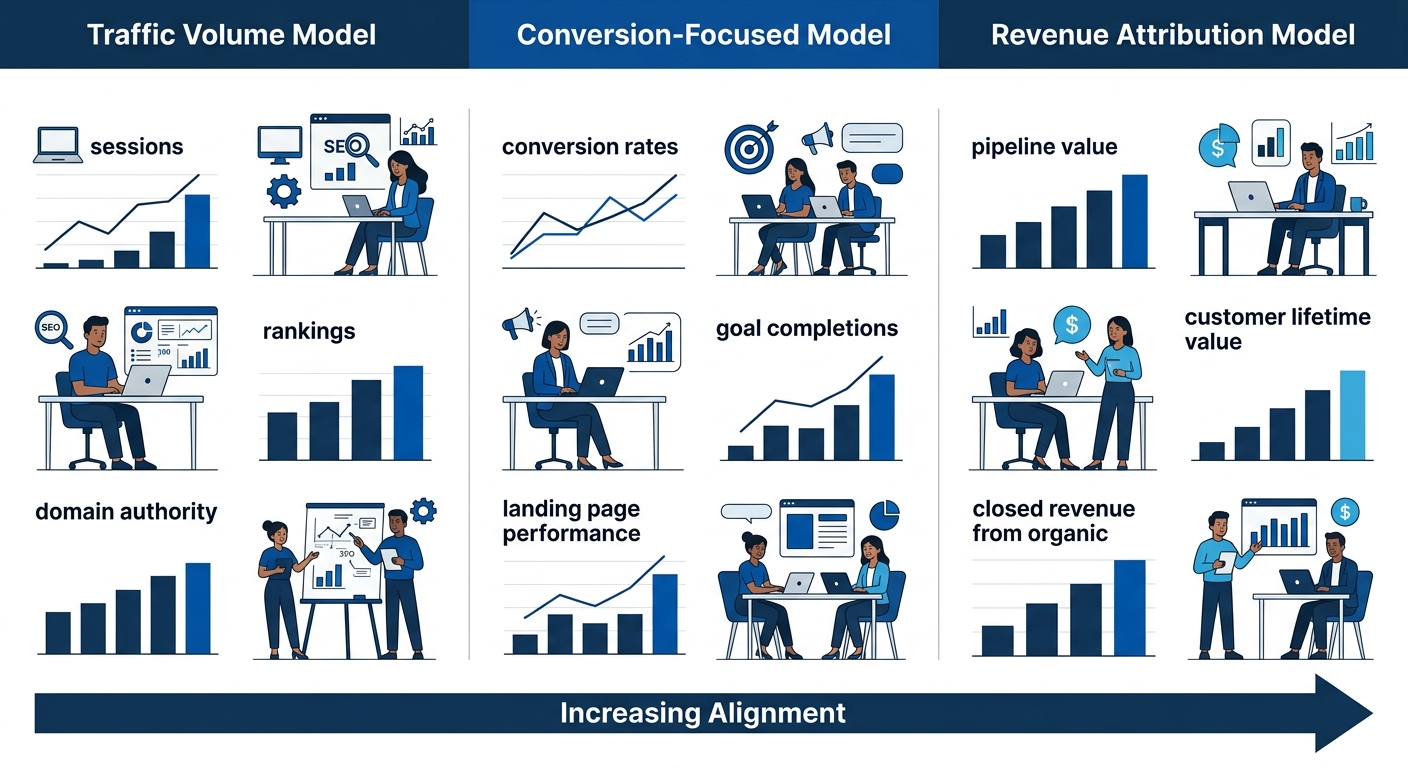
The gap between a healthy-looking SEO dashboard and actual revenue contribution has widened considerably as AI Overviews, zero-click results, and conversational search eat into organic click-through rates. Philippine brands evaluating their SEO partners now face a three-way choice in how they define success: optimize for traffic volume, optimize for conversions, or attribute revenue to organic search end-to-end. Each model demands different agency capabilities, produces a different kind of monthly report, and carries a different risk profile when a CFO eventually asks what SEO is worth.
This piece walks through all three approaches, their tradeoffs for enterprise and mid-market brands in the Philippines and across APAC, and which one actually fits your organization.
Traffic-Volume SEO and Where It Breaks Down
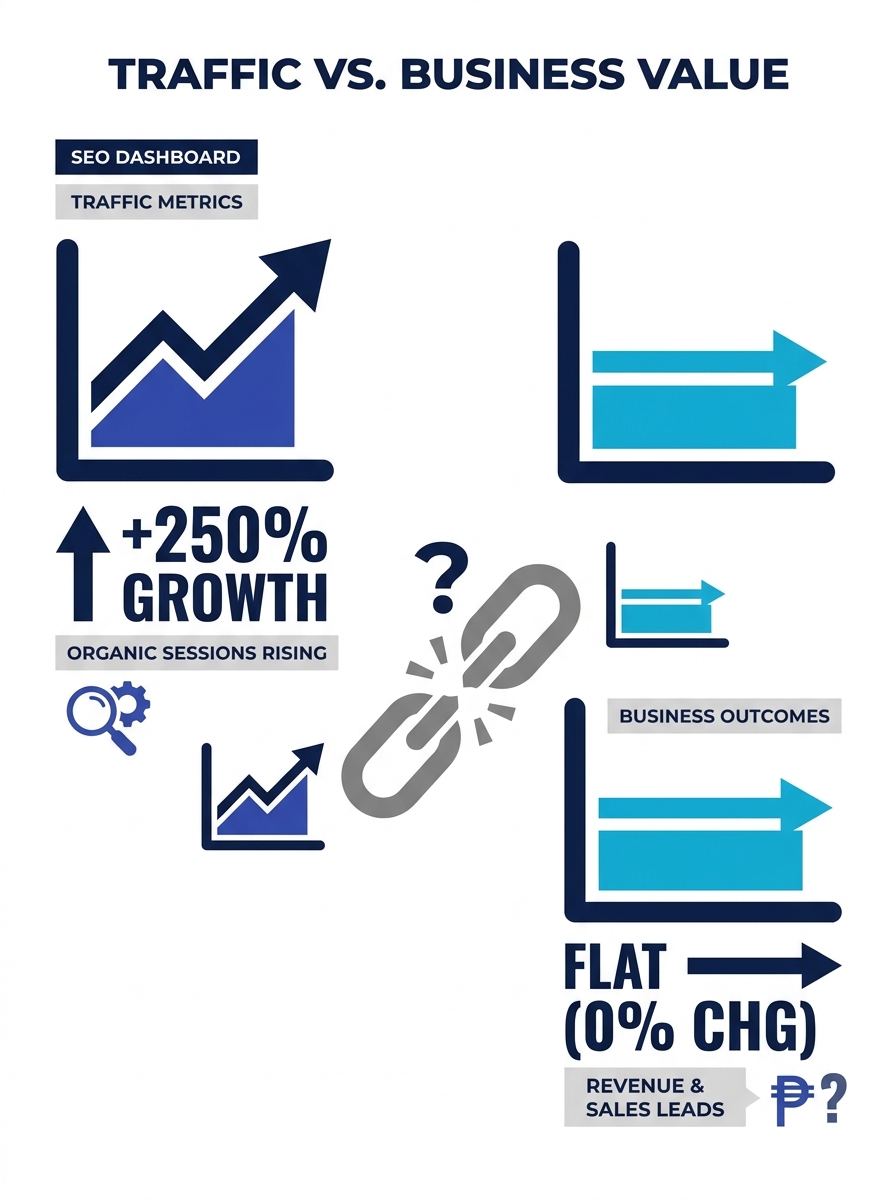
The default SEO model, still the most common in the Philippine market, defines success by organic sessions, keyword rankings, and domain authority scores. An agency delivers a monthly report showing sessions are up, rankings are climbing, and backlinks are growing. The CMO nods. Everyone moves on.
The metrics that dominate these reports (total organic sessions, average keyword position, number of top-ten keywords, domain authority) were designed to measure SEO activity, not business outcomes. In B2C contexts where the path from organic visit to purchase is short and trackable, traffic volume can correlate reasonably well with revenue. For longer sales cycles, service businesses, or lead-gen models, the correlation falls apart.
And the environment has shifted under everyone’s feet. With roughly 60% of Google searches ending without a click, the relationship between “ranking well” and “generating visits” is weaker than it was even two years ago. We covered how Google’s AI Mode is reshaping the trust signals that determine whether a user clicks through at all, and the implications for brands that still equate ranking position with visibility.
Where traffic-volume SEO still makes sense
Brand-new domains, pre-revenue startups, and companies that genuinely have a discovery problem belong here. Nobody knows they exist, and the first job is to generate awareness. If you’re a Philippine SMB launching your first real organic channel, tracking traffic growth for the first six to twelve months is reasonable. The danger is staying in that mode after the foundation is built.
Where it fails
The moment your business needs SEO to justify its budget against paid media, traffic-volume reporting becomes a liability. You can’t compare “20,000 organic sessions” against “these Google Ads generated X pipeline” without embarrassing yourself in a quarterly review. The traffic number doesn’t answer the question being asked.
Conversion-Focused SEO Gets You Closer to the Money
The second model integrates conversion rate optimization into the SEO workflow. Instead of reporting raw traffic, the agency reports organic conversion rates by landing page, tracks goal completions or e-commerce transactions from organic entry points, and optimizes pages for both ranking and user action.
This is a material improvement. Research from Directive shows that companies aligning SEO and CRO disciplines see meaningfully higher conversion rates from organic traffic, the kind of lift that shows up in pipeline reviews. The logic is straightforward: if your landing pages align closely with the search intent behind the keywords driving traffic, conversion rates improve without needing more volume.
For Philippine brands running e-commerce, this model works well when paired with proper event tracking in GA4. You can see which organic keywords lead to add-to-cart events, which product pages convert from organic versus paid, and where drop-offs happen. It’s a significant step beyond “sessions went up.”
The tradeoffs
Conversion-focused SEO requires a different agency skill set. Your partner needs UX capability alongside technical SEO: landing page testing, form optimization, content that guides intent rather than just ranking for volume keywords. Not every SEO agency in the Philippines has this bench depth, so ask specifically how candidates handle CRO integration and who on their team owns it.
The bigger limitation is that conversion-focused SEO typically stops at the form fill or the cart transaction. It measures the handoff to sales or fulfillment, not the outcome. A lead-gen business that generates 200 organic form submissions per month still doesn’t know which of those became customers, what their lifetime value looks like, or whether organic leads close at a different rate than paid leads. For sectors like digital marketing for banks or insurance marketing services, where the customer journey runs months and involves offline touchpoints, conversion-rate metrics alone understate or overstate SEO’s actual contribution.
Revenue Attribution End-to-End
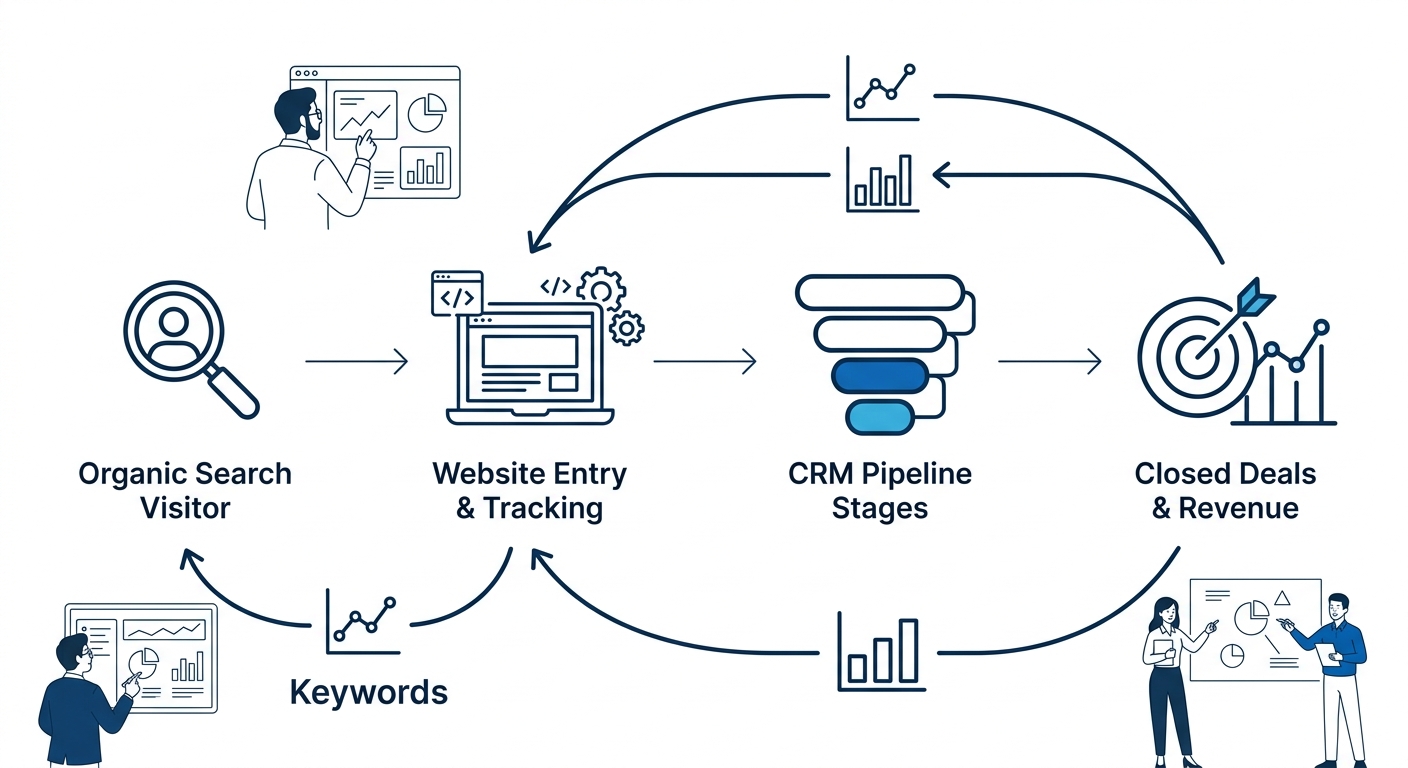
The third model connects organic search data to CRM and revenue systems. A visitor arrives from organic search, is tracked via UTM parameters, fills out a form or starts a purchase, enters a CRM pipeline, and is eventually tracked to a closed deal or a lifetime revenue figure. The SEO report then doesn’t say “organic traffic grew.” It says “organic search sourced or influenced this much pipeline, and this much of it closed.”
SaaS companies have led this approach, and industry benchmarks show why: the category reports outsized ROI on SEO when they can measure it properly, with break-even periods as short as seven months. But the model works for any business with a CRM and a sales process, including real estate developers, financial services, insurance companies, and B2B services.
What this requires from your agency and your organization
Revenue attribution demands cooperation between your SEO agency, your marketing ops team, and your sales team. The agency needs to tag organic entry points properly. Marketing ops needs to maintain attribution models in GA4 or your CRM. Sales needs to actually update deal records so the data flows back. If any of those three break down, the attribution model breaks with it.
This is the hardest model to implement and the most expensive to run. It requires tooling (GA4 with proper event configuration, a CRM like HubSpot or Salesforce), process discipline (sales reps marking lead sources accurately), and an agency willing to be held accountable to revenue numbers rather than activity metrics.
If your SEO partner can’t answer the question “what is organic search worth to our business?” with actual pipeline data, you’re paying for activity reporting, not growth management.
For Philippine enterprise brands, this model aligns SEO with how every other budget line item gets evaluated. It also changes the relationship between brand and agency. When both sides know the revenue number, the conversation shifts from “why did rankings drop on these five keywords” to “which content clusters are underperforming against pipeline targets, and what do we do about it.”
The tradeoffs
The model is unforgiving. If organic traffic doesn’t convert because the product is wrong, the pricing is off, or the sales team isn’t following up, the SEO report will reflect that. Some agencies prefer reporting traffic precisely because traffic growth is within their control. Revenue is influenced by dozens of variables the agency doesn’t touch.
For organizations pursuing sustainable organic growth across APAC markets with different languages, currencies, and sales cycles, the attribution model also gets more complex. A regional business needs to decide whether it’s building one attribution framework or multiple country-specific ones.
We’ve explored building an SEO dashboard that predicts revenue in a Philippine SMB context, and the mechanics apply at enterprise scale too. The tooling just gets heavier.
How To Choose Between These Three
The right model depends on three things: where your business is in its growth curve, how sophisticated your analytics and CRM infrastructure is, and what your CFO expects SEO to prove.
If you’re pre-revenue or early-stage, traffic-volume SEO is the honest starting point. You need to build domain authority, establish topical coverage, and generate enough volume to have statistically meaningful conversion data later. Trying to do revenue attribution on 500 organic sessions a month produces noise, not insight. Set a timeline of six to twelve months, and plan the transition to conversion-focused or revenue-attributed measurement before you get stuck in traffic-vanity mode.
If you have a functioning e-commerce operation or a clear online conversion event, the conversion-focused model gives you the best return on measurement effort. It’s achievable with GA4 and a disciplined agency, doesn’t require CRM integration, and immediately separates productive traffic from empty visits. This is where most Philippine mid-market brands should operate, and where a business-focused SEO strategy starts delivering provable results. For real estate marketing services where leads convert offline over months, this model is the minimum viable threshold: you need to at least know which organic pages generate qualified inquiries.
If you have CRM infrastructure, a sales team that updates records, and executive pressure to justify SEO spend against paid media, revenue attribution is the right target. It’s harder to set up, more expensive to maintain, and far more politically demanding. It’s also the only model that lets you defend an SEO budget in a room where every other channel is reporting pipeline contribution.
Tip: Ask your agency to present a sample monthly report in the measurement model you’re considering *before* you sign. If they can’t show you what a revenue-attributed report looks like with sample data, they probably can’t deliver one with your real data either.
The honest answer for most Philippine brands evaluating SEO ROI is that they’re stuck in model one and need to move to model two, with a roadmap toward model three if the business warrants it. The gap between organic traffic revenue alignment and the way most agencies actually report is wide, and closing it requires both the brand and the agency to agree on what “working” means before the engagement starts. Not six months in, when the CMO asks a question the dashboard can’t answer.