Google AI Mode in Chrome Shifts SEO From Ranking to Trust Signal, April 2026 Rollout Shows

Google introduced AI Mode in Chrome on April 16, 2026, enabling users to ask follow-up questions, compare sources, and navigate content without leaving the AI interface—a shift that changes when and why users click through to publisher sites, according to Search Engine Journal.
The announcement, made jointly by Google Search VP Robby Stein and Chrome VP Mike Torres, frames the feature as making it easier to “access and engage with content and dive deeper into what you find, all without losing your place or needing to switch tabs.” The side-by-side layout lets users view AI-generated responses alongside publisher pages while continuing to refine queries in the same window.
The shift affects how marketing leaders evaluate SEO performance. Clicks no longer mark the start of a user journey—they increasingly serve as verification moments after initial discovery happens inside Google’s AI layer.
Traffic Impact Already Measured Across Publishers
Index Exchange research cited in the report found that 69% of publishers experienced year-over-year ad opportunity declines throughout 2025, with an average drop of 14%. Ahrefs documented in February 2026 that AI Overviews now correlate with a 58% reduction in click-through rates for top-ranking pages, nearly double the 34.5% decline measured a year earlier.
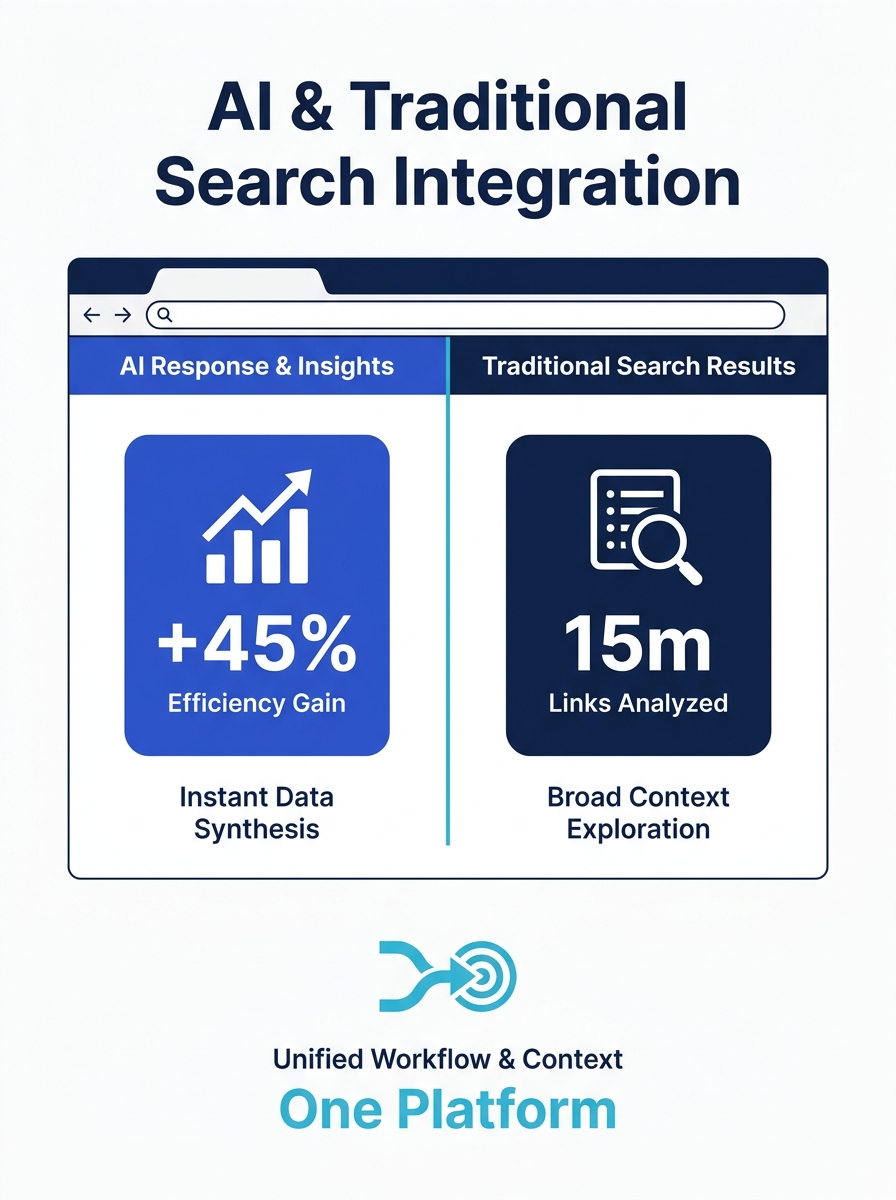
The traffic erosion creates reporting challenges for brands treating SEO as a traffic-only discipline. Last-click attribution models will reflect less of the actual discovery path when users evaluate multiple sources within the AI interface before ever landing on a single page.
Five Features That Predict Survival
Rand Fishkin published an analysis on April 20, 2026, identifying five strategic features shared by 400 websites that maintained performance during what he termed “the great traffic apocalypse of 2024-2026.” The survivors offered a unique product or service, enabled task completion, held proprietary assets, maintained tight topical focus, and built a strong brand.
Fishkin’s argument centers on whether a site offers something AI cannot summarize away. Letterboxd survived Google’s decimation of movie review sites because it offers proprietary user-generated data on movie popularity over time—something generative AI cannot replicate from its training corpus. Sites built on formulaic content templates face structural disadvantages under AI Mode’s design.
The distinction matters for enterprise brands evaluating SEO investment. Generic category content and thin product descriptions become easier to compress into AI summaries. Original reporting, proprietary data, firsthand analysis, and clear point-of-view editorial become harder to replace.
What Side-by-Side Design Signals
Google’s decision to display publisher pages alongside AI responses rather than replacing them entirely suggests the company still depends on the open web for content supply. Early testers told Google that “having both Search and the web side-by-side helped them stay focused on their tasks while exploring useful webpages,” the announcement stated.
The design creates a two-tier visibility environment. Sites that answer queries clearly enough for AI to parse and cite maintain presence in the summarized layer. Sites that offer depth, analysis, or proprietary assets become the click-through destination when users need to verify, explore further, or complete a task the AI layer cannot handle.
For marketing leaders overseeing content budgets, the implication is that SEO built on keyword targeting and volume-driven templates faces compression risk. SEO built on genuine expertise, structured data implementation, and editorial judgment that adds interpretive value aligns with what the side-by-side format rewards.
Attribution and Measurement Implications
The shift from linear search journeys to mediated discovery paths affects how brands measure SEO contribution. If AI Mode affects discovery earlier in the funnel, traditional last-click attribution will miss assisted conversions, branded demand creation, and cross-channel influence that begins in the AI layer.
Brands running managed Google Ads management programs alongside organic efforts face particular measurement complexity. Paid search may capture demand that SEO helped generate inside AI Mode but cannot claim credit for under current attribution models. Multi-touch models that track assisted conversions become necessary to understand how organic search presence drives downstream pipeline.
The change also affects how marketing leaders set expectations with executive stakeholders. Pure traffic metrics will increasingly underrepresent SEO value. Brands need to track brand query volume, direct traffic lifts following visibility in AI Overviews, and conversions that begin with AI-mediated discovery but complete through other channels.
What This Means for — CMOs
Marketing leaders overseeing SEO programs across enterprise brands and growth-stage companies face a strategic decision: whether to treat AI Mode as a traffic threat or a quality filter. The evidence suggests it functions as both, depending on content foundation.
Brands that invested in technical SEO excellence, structured data implementation, and original content creation maintain visibility in AI summaries and side-by-side placements. Brands that relied on volume-driven content templates and thin category pages face compression into AI-generated summaries with diminished click-through opportunity. The shift makes prior content investments either more valuable or more exposed.
For CMOs briefing agency partners, the priority shifts from pure ranking targets to content that earns citation inside AI layers and maintains differentiation when users click through. That means evaluating agency recommendations not just on keyword targeting but on whether the content offers something AI cannot summarize—proprietary data, firsthand expertise, unique analysis, or task-completion features. The brands that survive the zero-click environment are the ones that offer what Google’s AI layer needs but cannot replace.