The Hidden Cost of Cheap Backlinks: What Cleanup Looks Like in 2026

Disavowing a backlink does not delete it. The link stays live on whatever spam blog or hacked WordPress install originally pointed it at your domain. All the disavow file does is ask Google’s crawler to ignore that signal when calculating your rankings. This distinction between removal and disavowal is where most of the money gets burned during a toxic backlink cleanup, because the real work involves weeks of manual outreach, tool subscriptions, spreadsheet triage, and the uncomfortable possibility that your domain may never fully recover the authority it lost. Google’s own documentation on disavow files reinforces this: it’s an advanced feature meant as a last resort, not a quick undo button.
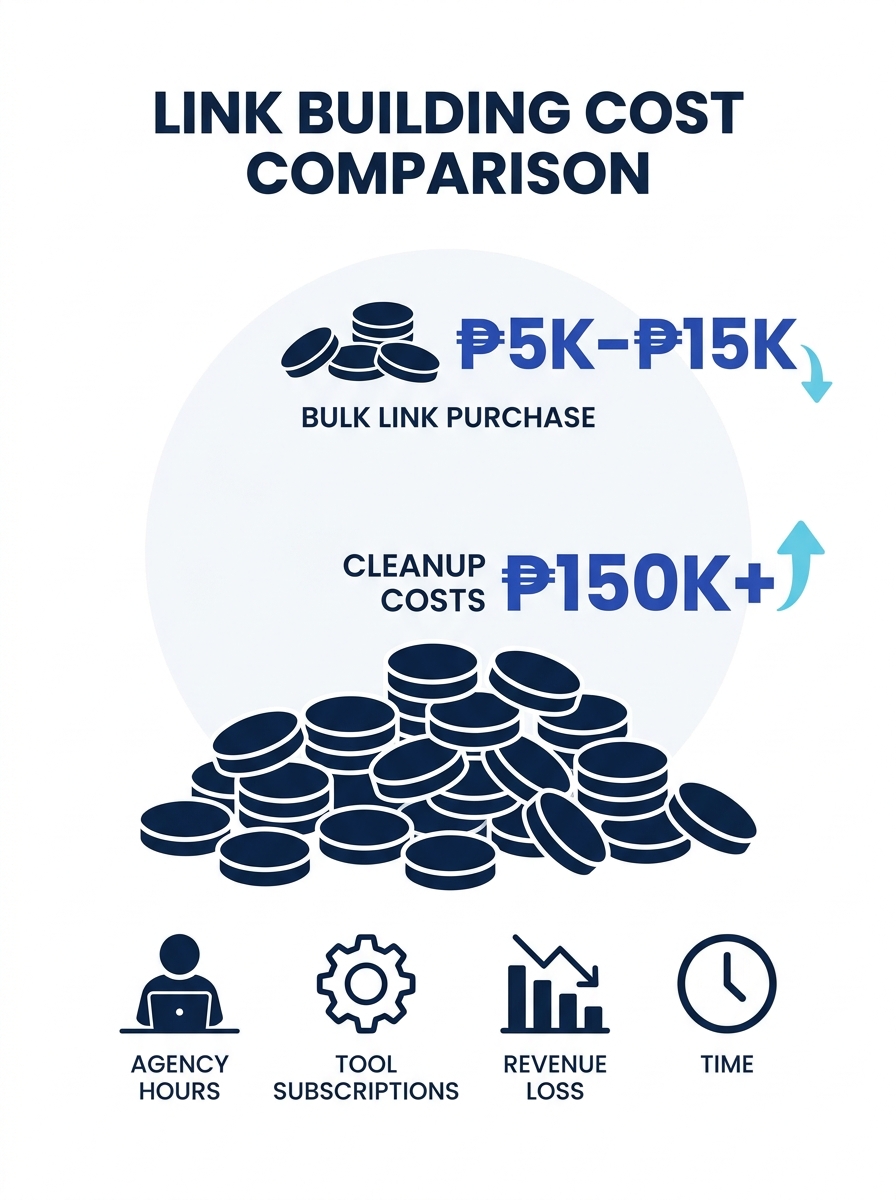
We’ve seen Philippine businesses spend ₱5,000 to ₱15,000 on bulk link packages, then spend ₱150,000 or more in agency hours and lost revenue cleaning up the mess those links create. The ratio is absurd. And the cleanup isn’t a one-week project. It’s a quarter-long slog at minimum, sometimes stretching to six months before rankings stabilize. The 2026 search environment, with SpamBrain integrated into Google’s Helpful Content system, has made this worse. Domains flagged for manipulative link patterns don’t just see certain links devalued. They get categorized as low-trust, and that categorization drags everything down: your organic traffic, your brand queries, your presence in AI-generated overviews.
How Cheap Links Become Expensive Problems
The mechanics of a backlink penalty have shifted in the past two years. Google’s Penguin algorithm has run in real time since 2016, but the consequences for manipulative link profiles have escalated. Where Google once quietly devalued suspect links (essentially ignoring them), SpamBrain now actively associates patterns of low-quality inbound links with reduced domain trust. Arctic Leaf’s 2026 analysis describes this as a categorization shift: toxic links can “quietly drag down your authority and visibility” by triggering low-trust signals that affect the entire domain, not individual pages. If your backlink profile is 40% spam-farm directories and casino blog comments, the damage spreads well beyond the pages those links point to.
For Philippine SMBs, the typical path into this mess follows a predictable pattern. A business owner hires a freelancer or a budget agency that promises “500 DA40+ backlinks” for a flat fee. The links come from private blog networks, article directories with no editorial standards, or hacked sites in completely unrelated niches. Rankings might tick up for a few weeks. Then a core update rolls through, and organic traffic drops 30% to 60%. The business owner doesn’t connect the traffic loss to the links because the purchase happened months ago, and by the time someone runs a link audit, the damage has compounded. If you’re in the process of choosing an SEO company, the single most important question to ask about their link building is whether they can name the specific sites where they’ll place links and explain why those sites are relevant to your industry.
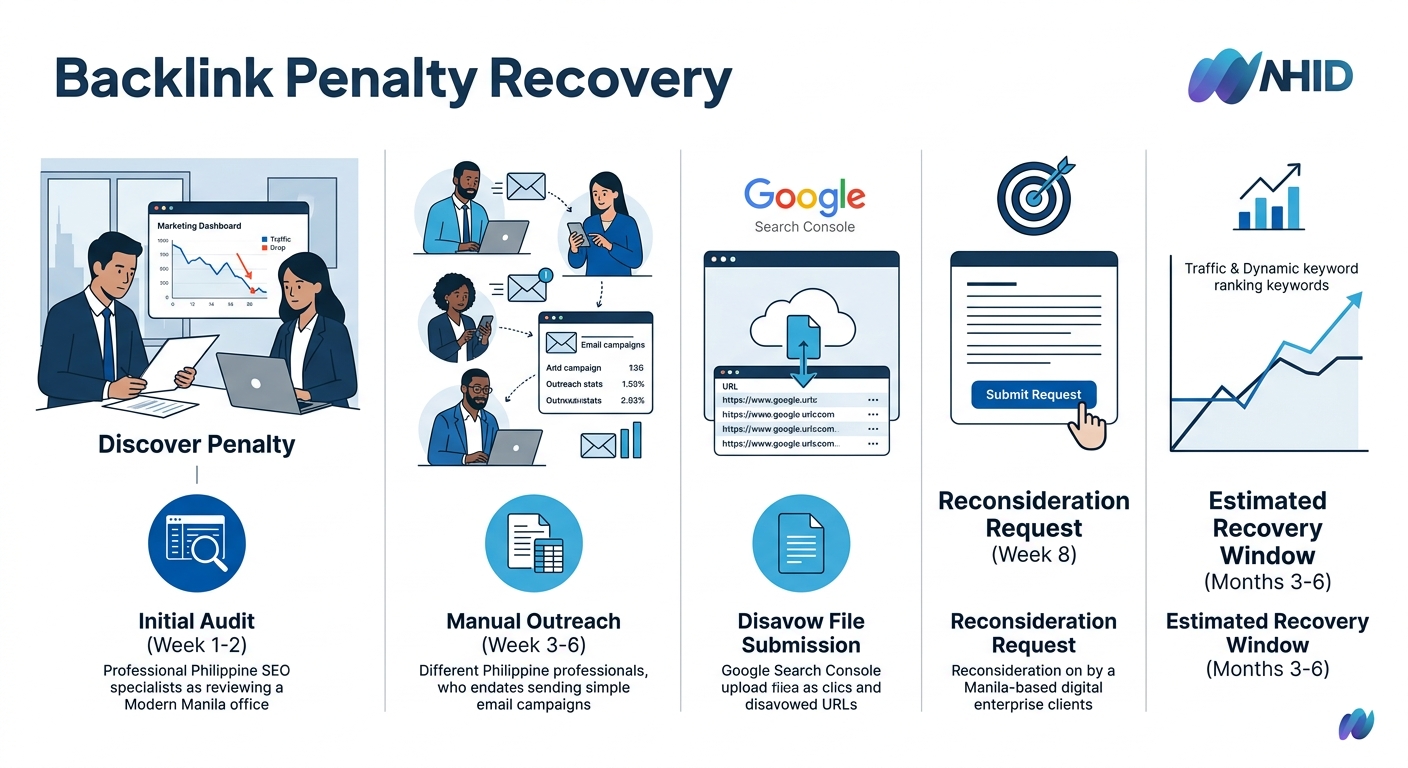
The financial math gets grim fast. A manual action for “unnatural links to your site” in Google Search Console means your rankings are suppressed until you file a successful reconsideration request. According to Google’s manual actions documentation, you need to demonstrate a good-faith effort to remove harmful links before resorting to the disavow tool. That means contacting webmasters one by one, documenting every outreach attempt, and waiting for responses that often never come. One documented case from Digital Kulture involved 398 domains that were either unresponsive or refused to remove links, all of which had to be compiled into a disavow file and submitted alongside evidence of the outreach attempts. That’s hundreds of emails sent, tracked, and screenshotted for a single reconsideration request.
The ratio between what businesses spend buying cheap links and what they spend cleaning them up is roughly 1:10. And the cleanup doesn’t guarantee full recovery.
What a Proper Link Audit Demands
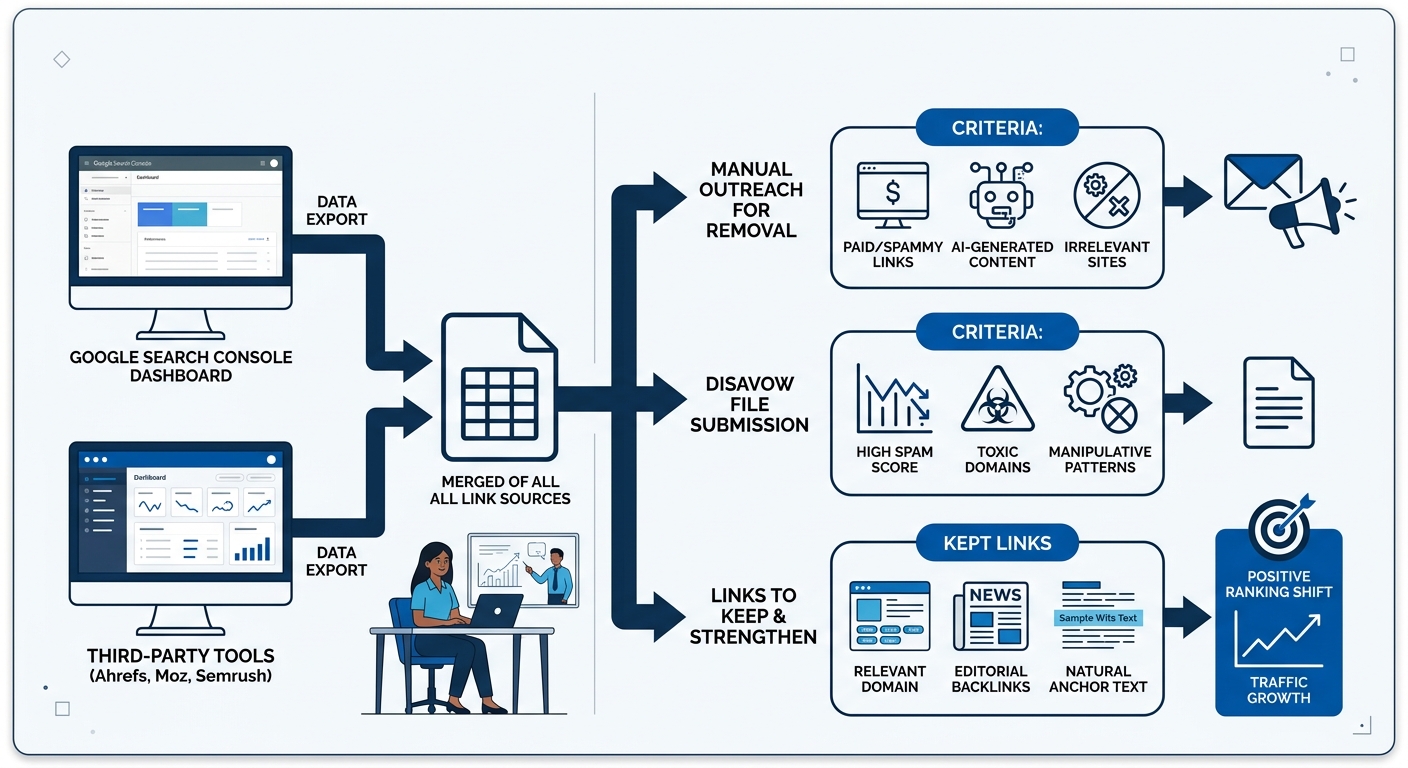
Running a link audit sounds straightforward in theory. Export your backlink profile from Google Search Console, cross-reference with a tool like Ahrefs or SEMrush, flag the toxic domains, and take action. In practice, the process is full of judgment calls that require experience, and getting those calls wrong makes things worse.
The first step is aggregating data from multiple sources, because no single tool captures every backlink. Google Search Console shows what Google knows about, but it deliberately samples rather than showing a complete list. Third-party tools crawl independently and often find links that Search Console misses, and vice versa. You need to merge these datasets, deduplicate, and then start evaluating each linking domain. The evaluation criteria include spam score, relevance to your niche, whether the linking site has any organic traffic of its own, the anchor text distribution pointing to your site, and whether the link appears within editorial content or is stuffed into a sidebar, footer, or comment section. A domain with a spam score above 60% in SEMrush is a red flag, but spam score alone isn’t enough to make a decision. Some legitimate niche sites trigger high spam scores because of thin design or low domain authority, and disavowing those links would actually hurt you.
Anchor text distribution is one of the clearest indicators of purchased links. When 35% of your inbound anchor text is an exact-match commercial keyword like “best condo Manila” or “cheap insurance Philippines,” that’s a pattern no natural link profile produces. Real editorial links use brand names, URLs, and varied descriptive phrases. Over-optimized anchors are the fingerprint of bulk link buying, and they’re one of the first things Google’s algorithms flag. If you’ve been exploring link building tools for SEO, the audit features in those platforms are often more valuable than the prospecting features, because finding problems in your existing profile should always come before building new links.
The triage phase is where most DIY attempts go wrong. Business owners tend to disavow too aggressively, flagging every domain under DA 20 as toxic. Low authority is not the same as toxic. A local blog with a DA of 12 that covers your industry and linked to you because they genuinely found your content useful is a good backlink. Disavowing it tells Google to ignore a legitimate vote of confidence. The opposite mistake is also common: keeping links from high-DA domains that are clearly selling placements to anyone who pays, because the number looks impressive. A DR 70 site that publishes unrelated sponsored posts across dozens of categories with no editorial vetting is a liability, not an asset.
The Disavow File and Its Limits
Google’s disavow tool accepts a plain text file listing domains or individual URLs you want the algorithm to ignore. The format is specific: one entry per line, with “domain:” preceding full domain disavowals. Submitting a disavow file is technically simple. The strategic decisions around what to include are not.
The standard recommendation, echoed in every guide from Google’s own help pages to agency playbooks, is to attempt manual removal first. You email the webmaster of each offending site, explain that you’d like the link removed, and document the attempt. For spammy link removal at scale, this is often futile. The sites hosting your toxic backlinks are frequently abandoned, auto-generated, or operated by people who have no incentive to help you. Response rates on removal requests hover around 5% to 10% for legitimate sites and essentially zero for spam properties. But the documentation matters enormously for reconsideration requests. Google wants to see that you tried, even if trying didn’t work. The Digital Kulture case mentioned earlier spent weeks on outreach before compiling its disavow file, and that effort was a key part of the reconsideration narrative.
The disavow file itself requires careful construction. A common mistake is exporting your entire backlink list from Search Console, removing the obviously good links, and submitting the rest. Google’s own documentation warns against this: “Be sure to remove any URLs from the downloaded file that you don’t want to disavow.” Over-broad disavow files can strip away legitimate link equity and leave you worse off than before. The file should include only links you’ve specifically identified as harmful through your audit, and the reasoning for each inclusion should be documented internally even if you don’t submit those notes to Google. If your business handles guest blogging as a link-building strategy, auditing the quality of sites you’ve guest-posted on should be part of this process too, because low-quality guest post placements are among the most commonly flagged link types.
A disavow file in 2026 carries weight, but it doesn’t produce instant results. Processing can take weeks to months. During that period, your rankings may fluctuate unpredictably as Google reprocesses your link profile. And if you’ve received a manual action, you still need to file a reconsideration request through Search Console, explain what happened, describe your cleanup efforts, and outline a prevention strategy to demonstrate you won’t repeat the behavior. Google reviews these manually, and rejection is common on the first attempt if the documentation is insufficient. Resubmission is possible, but each cycle adds more weeks to your recovery timeline.
Where Recovery Leaves You
Even after a successful reconsideration request and months of patience, most domains don’t return to their previous ranking positions. The link equity you stripped away through disavowal is gone. Whatever rankings those links were supporting, whether artificially or in combination with legitimate signals, have to be rebuilt through clean methods. And the domain carries a history. Google doesn’t publish whether past manual actions affect future algorithmic evaluations, but experienced SEOs observe that domains with penalty histories tend to be more sensitive to subsequent algorithm updates. The trust deficit lingers.
Prevention is the only strategy that consistently works, and it’s more expensive upfront than buying bulk links. Building a quarterly audit cadence into your SEO operations catches problems early, before they trigger manual actions. Evaluating every link-building opportunity against editorial standards rather than domain metrics alone keeps your profile clean. And investing in the kind of content that earns links organically, whether that’s original research, industry-specific tools, or genuinely useful guides, costs more per link but produces assets that compound in value rather than degrade into liabilities. If you’re a Philippine business weighing these tradeoffs, the framework for picking a local SEO agency should center on how the agency builds links, what their vetting process looks like, and whether they can show you the actual sites they’ll target.
The uncomfortable truth about toxic backlink cleanup is that full restoration is rare. You can remove the penalty. You can rebuild traffic. But the months of suppressed rankings, the lost conversions, the agency fees for cleanup, and the opportunity cost of redirecting your SEO budget toward damage control instead of growth all represent real money that doesn’t come back. Every ₱10,000 spent on cheap links carries an implicit bet that Google won’t notice or won’t care. In 2026, with SpamBrain and real-time algorithmic enforcement, that’s a bet with terrible odds. The businesses that avoid this cycle entirely aren’t the ones with the biggest budgets. They’re the ones that understood, before buying their first link, that the cheapest option in SEO is almost always the most expensive one in the end.