Why Core Web Vitals Still Matter for Philippine E-Commerce in 2026

Google replaced First Input Delay with Interaction to Next Paint as an official Core Web Vital in March 2024, and the fallout was immediate: an estimated 43% of websites that had been passing the old responsiveness test suddenly failed the new one. For Philippine e-commerce operators running product catalogs with dozens of third-party scripts for GCash integration, chat widgets, and remarketing pixels, the consequences played out in real time through dropped rankings, higher bounce rates, and flatter conversion curves. This is a walkthrough of that metric swap, what it exposed, and why it hits Filipino online retailers harder than most.
The Metric Google Killed and the One That Replaced It
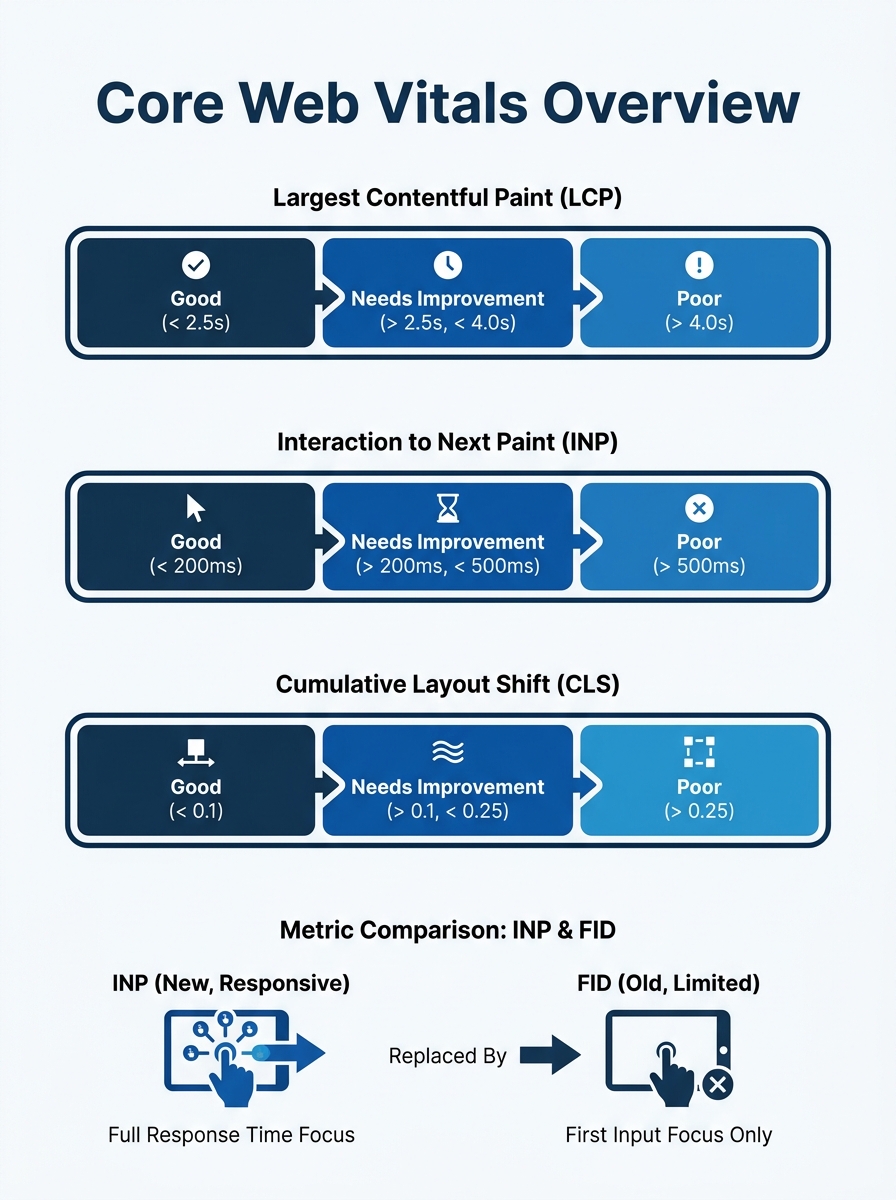
First Input Delay measured one thing: how long the browser took to respond to a user’s very first interaction on a page. Click a button within the first few seconds of loading, and FID would record the delay. The problem was that FID only captured the first interaction. If a shopper tapped “Add to Cart” after browsing for thirty seconds and the page froze for 400 milliseconds, FID never registered it.
Interaction to Next Paint (INP) fixed that gap by measuring responsiveness across every interaction during a session. Every tap, every keystroke, every click gets recorded, and Google’s own documentation defines a good INP score as under 200 milliseconds. Anything above 500 milliseconds is classified as poor.
The three Core Web Vitals now stand as: Largest Contentful Paint (LCP) under 2.5 seconds for loading, INP under 200 milliseconds for responsiveness, and Cumulative Layout Shift (CLS) at or below 0.1 for visual stability. The metrics themselves aren’t complicated. The difficulty is that INP exposed responsiveness problems FID had been hiding for years.
What INP Catches That FID Missed for Years
FID was easy to pass because it only cared about the first click. A page could load its critical resources quickly, respond to that initial interaction in 50 milliseconds, and then become sluggish as deferred JavaScript finally executed. Under FID, that page scored fine. Under INP, it fails.
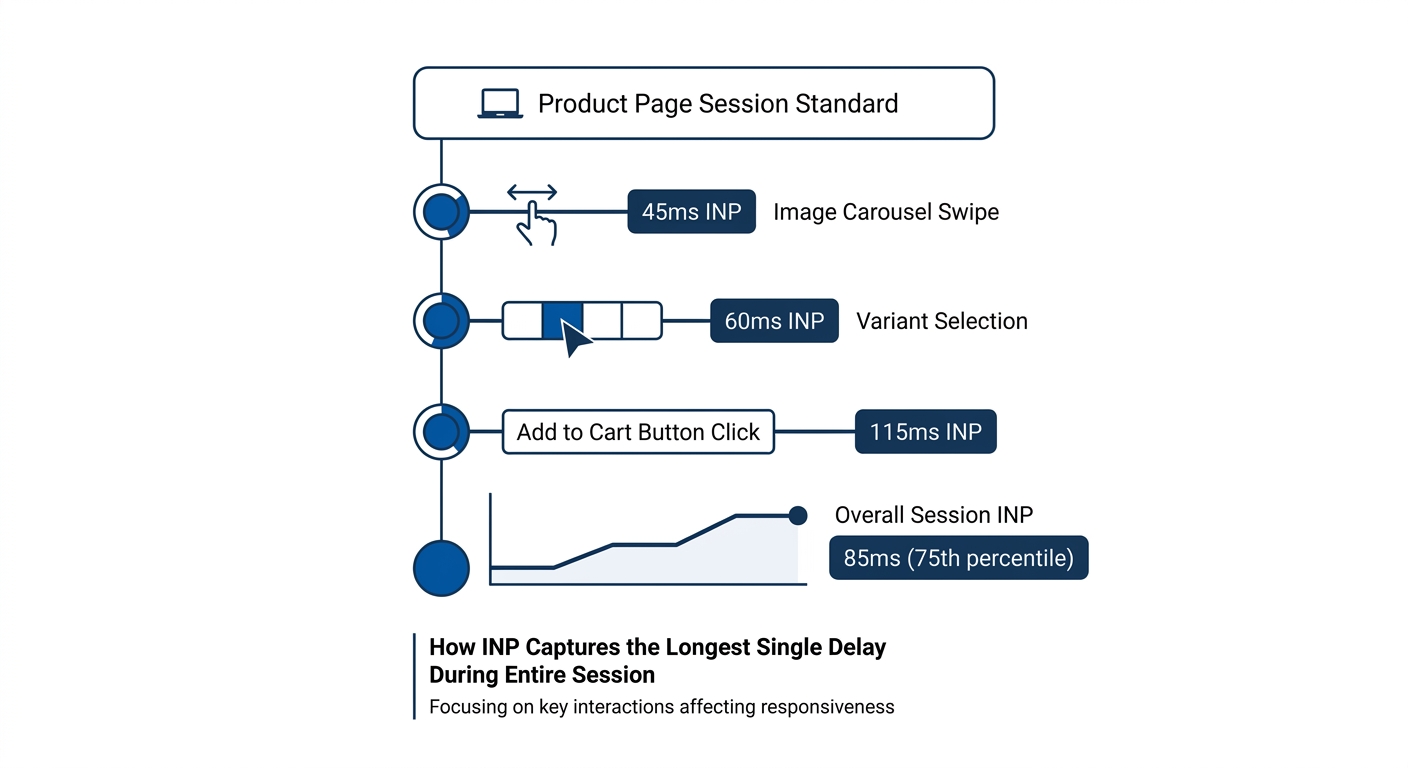
This is exactly what happened to a large share of e-commerce sites. Product pages are interaction-heavy by nature. A shopper lands on a product listing, scrolls through images, selects a size or variant, adjusts quantity, checks delivery options, maybe opens a size chart modal, and then taps “Add to Cart.” Each of those interactions is now measured. If the main thread is blocked by a third-party payment SDK or a lazy-loaded review widget, INP captures the worst delay across the entire session and reports it.
As White Label Coders documented in their 2026 analysis, Core Web Vitals directly correlate with business outcomes because they measure aspects of user experience that influence behavior. Fast-loading pages with LCP under 2.5 seconds keep visitors engaged rather than bouncing back to search results. When you combine slow LCP with poor INP on a product page, you’re compounding the damage at both ends of the user session.
The SEO community’s consensus has also settled into a clearer picture. As discussions on r/TechSEO reflect, Core Web Vitals in 2026 still impact rankings, but they function more as a ranking differentiator than a primary factor. Google uses them to break ties between pages of similar content quality. In competitive niches like Philippine e-commerce, where dozens of retailers sell the same SKUs from the same suppliers, those tie-breakers are the entire margin of visibility.
Philippine E-Commerce on 4G and Congested Networks
The Philippines presents a specific set of conditions that make Core Web Vitals failures more punishing than in markets with faster average connectivity.
The Philippine online retail market is valued at USD 15 billion, driven by rising internet penetration and mobile commerce. Online shopping is projected to account for 25% of total retail sales in the coming years. As of March 2026, Shopee.ph alone pulls in 34.08 million monthly visits, and the B2C segment dominates because Filipino consumers increasingly prefer the convenience and competitive pricing of mobile shopping.
Here’s where the technical reality gets uncomfortable. Most Filipino shoppers access these sites on mid-range Android devices over mobile data connections that fluctuate between 4G and congested LTE. A product page that loads in 1.8 seconds on fiber in Makati might take 4.5 seconds on a Globe SIM in a provincial area. That means LCP optimization for Philippine audiences requires thinking about the 75th percentile user, which is the actual threshold Google evaluates, rather than the best-case scenario.
In competitive niches where dozens of Philippine retailers sell the same SKUs from the same suppliers, Core Web Vitals tie-breakers are the entire margin of visibility.
The INP problem compounds in the Philippine context because of payment integrations. GCash, PayMaya, and Dragonpay each inject their own JavaScript. Add a chat widget, a Facebook Pixel, a TikTok tracking pixel, and Google Analytics 4, and you’re looking at a main thread that’s busy processing scripts instead of responding to taps. A shopper on a ₱6,000 phone tapping “Select Size” and waiting 350 milliseconds for the UI to respond may not consciously notice the delay, but they do feel the friction. Their next tap is the back button.
If you’re running a technical SEO checklist for a Philippine e-commerce site and skipping INP because “it’s new,” you’re overlooking the metric that captures exactly the performance failures your mobile shoppers experience most.
The Redbus Precedent and What It Proves About Mobile Commerce
The clearest documented case of Core Web Vitals optimization driving measurable revenue outcomes comes from Redbus, India’s largest online bus ticketing platform. The parallels to Philippine e-commerce are direct: mobile-first audience, variable network quality, heavy reliance on third-party payment SDKs, and product pages dense with interactive elements.
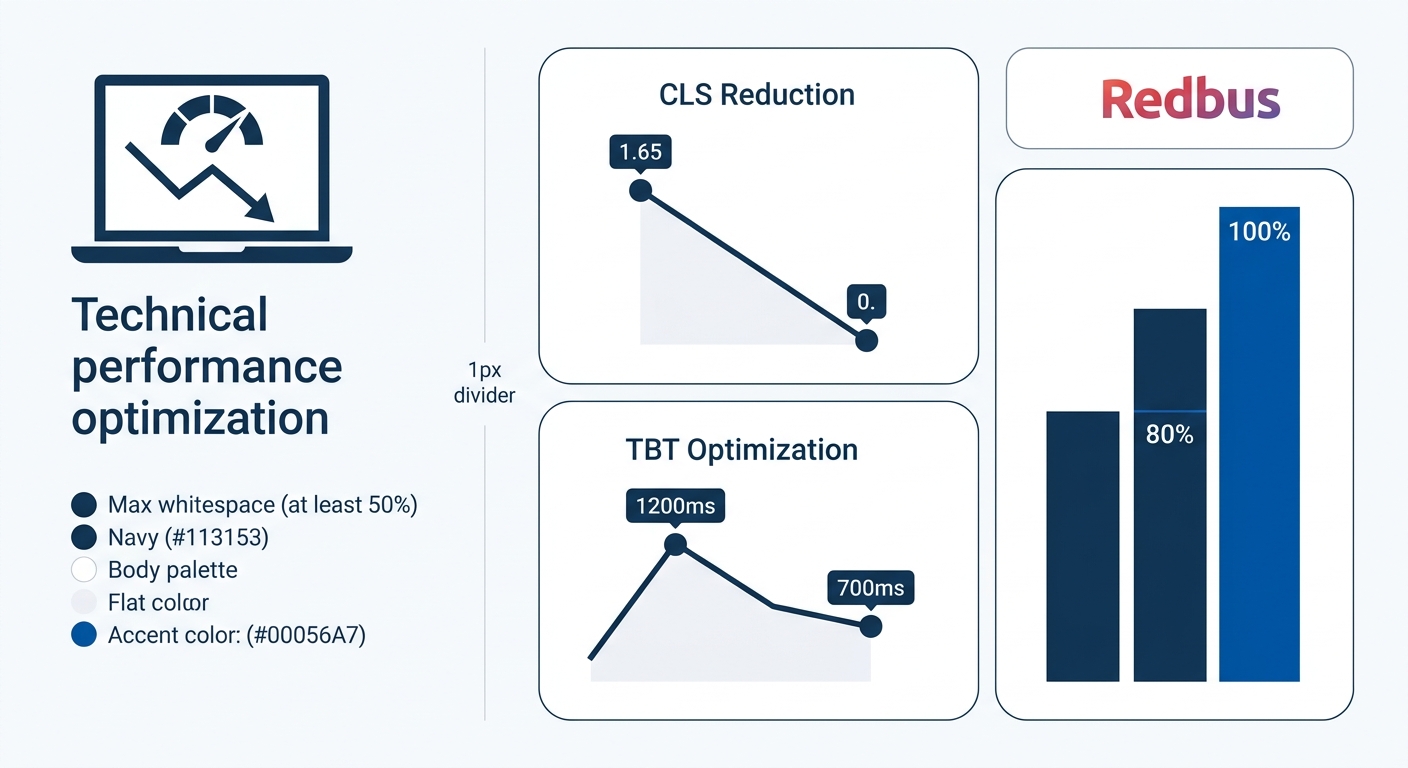
Redbus found that their CLS score was 1.65, far beyond Google’s 0.1 threshold. Layout elements were shifting as ads, images, and dynamically loaded fare tables rendered at unpredictable times. Their Total Blocking Time, which correlates strongly with INP, sat at 1,200 milliseconds, meaning the main thread was locked for over a full second during page loads.
The engineering team tackled both problems simultaneously. They set explicit dimensions for all images and ad containers, eliminating the layout shifts that pushed CLS to 1.65. They deferred non-critical JavaScript, broke long tasks into smaller chunks, and reduced Total Blocking Time from 1,200 milliseconds to 700 milliseconds. CLS dropped from 1.65 to zero.
The results were concrete: mobile conversion rates increased by 80 to 100 percent. That’s the kind of number that makes CFOs pay attention to performance engineering.
This matters for Philippine retailers because the technical stack looks similar. A Shopify or WooCommerce store serving Filipino shoppers typically runs GCash checkout integrations, a logistics API for J&T Express or LBC rate calculations, a live chat tool, social proof notifications, and multiple analytics scripts. Every one of those scripts competes for main thread time. Every one of them can push INP above 200 milliseconds if not properly deferred or loaded asynchronously.
If you’re working on e-commerce product page optimization, the Redbus case offers a blueprint: measure CLS and INP with real user data from Chrome UX Report, identify the scripts and elements causing the worst delays and shifts, and address them systematically rather than chasing a generic PageSpeed score.
The 200-Millisecond Threshold Filipino Retailers Can’t Afford to Miss
The practical question for Philippine e-commerce operators is whether Core Web Vitals work merits the investment when content quality and backlinks still dominate rankings. The answer depends on how competitive your category is.
If you’re selling niche handcrafted goods with minimal competition, your Core Web Vitals probably won’t make or break your rankings. But if you’re competing against Shopee, Lazada, and TikTok Shop for the same product keywords, you’re in a category where tie-breakers decide page-one placement. And the data shows that pages ranking in position one have roughly 10% higher Core Web Vitals pass rates than pages in position nine.
The investment case strengthens when you factor in what happens after the click. A 0.1-second improvement in load speed can increase conversion rates by up to 8%, according to industry benchmarks. Cdiscount, a major European retailer, documented a 6% revenue uplift during Black Friday after improving all three Core Web Vitals. Users are 24% less likely to abandon a page when Core Web Vitals thresholds are met.
For Filipino businesses evaluating where to put their technical SEO budget, the framework is straightforward. First, check your site’s actual field data in Google Search Console’s Core Web Vitals report. Lab tools like PageSpeed Insights give useful diagnostics, but Google ranks you based on real user data from CrUX. Second, prioritize INP if your product pages carry heavy third-party scripts. Defer what can be deferred. Break long JavaScript tasks into smaller async chunks. Third, audit CLS by checking whether images, ads, and dynamic elements have explicit dimensions set. These aren’t glamorous fixes, but they directly impact whether your pages convert traffic into revenue.
Tip: Don’t rely on lab scores alone. Google ranks based on field data from the Chrome UX Report. A PageSpeed score of 95 means nothing if your real users on mobile data in Cebu or Davao experience 4-second LCP and 400ms INP.
If you’re working with a marketing agency for ecommerce brands or evaluating mobile-first web design for a relaunch, Core Web Vitals should be baked into the project scope from the start rather than treated as a post-launch optimization task. The same goes for businesses rethinking their broader digital marketing strategy across channels. Performance engineering pays compound returns: SEO content ranks more visibly, paid traffic converts at higher rates, and the same ad spend produces more revenue because fewer users abandon slow pages.
The INP transition exposed a gap that FID had been papering over for years. Philippine e-commerce sits in a market where mobile dominance, variable connectivity, and script-heavy checkout flows converge to make that gap wider than in most countries. The 200-millisecond threshold isn’t arbitrary. It’s the line between a page that feels responsive and one that feels broken on a ₱8,000 phone riding congested LTE in Quezon City. For retailers competing at the scale the Philippine market now demands, falling on the wrong side of that line costs real money every day it goes unaddressed.