The Filipino Founder’s Guide to Picking a Local SEO Agency in 2026

Clutch.co lists over 240 SEO firms based in the Philippines as of its April 2026 rankings. GoodFirms carries another 180-plus. Add LinkedIn cold pitches, agency directories like Sortlist, and referrals from your investor’s cousin, and the average Filipino founder choosing an SEO partner faces a volume problem before anything else. The signal-to-noise ratio is brutal, and a large portion of the published “top agency” lists are pay-to-play or affiliate-driven.
This article traces the selection process from the moment you realize you need help, through each vetting stage, to the contract terms that actually protect you. Each phase has its own failure modes. Knowing them in advance is the whole point of a proper founder SEO checklist.
The Trigger That Starts the Search
Founders don’t call a Philippine SEO agency because they woke up excited about keyword research. Something forced their hand. Traffic dropped after a core update. A competitor suddenly outranks them for their own brand name. Or they’ve been running Google Ads for 18 months at ₱80,000 a month without building any organic equity at all.
The trigger matters because it determines what kind of partner you actually need. A founder recovering from a Google Business Profile suspension needs a completely different skill set than one launching a new D2C brand. If your GBP got flagged during Google’s 2026 enforcement wave, you’ll want to understand how Philippine SMBs can recover suspended profiles before you even talk to an agency. Hiring for GBP crisis recovery when you actually need content-driven growth wastes everyone’s time.
The mistake at this stage is hiring based on panic instead of fit. Slow down by one week. Define the problem in writing. That document becomes the foundation for everything that follows.
Writing a Brief That Forces Honest Answers
Before contacting any SEO agency Manila firm, you need a brief that does two things: communicates what you actually need and makes it impossible for agencies to reply with vague, templated proposals.
According to BrandLeap’s 2026 guide on hiring a Philippine SEO agency, a solid brief should include business goals and KPIs, baseline analytics access, target keywords and markets, a budget band, a timeline, decision criteria, and preferred contract terms. That’s a lot of items, but each one serves a filtering purpose.
Here’s why the budget band matters more than you think: if you share a range of ₱25,000–₱60,000 per month, agencies that only operate at ₱150,000 minimums will self-select out. You won’t waste a week in discovery calls with partners who were never going to work at your price point. And agencies that respond with a ₱15,000 counteroffer are telling you something about their margins (and likely their quality).
Include these elements in your brief:
- Your primary revenue model and how organic search connects to it
- Which pages or sections of your site generate the most revenue now
- Whether you have any existing content team or if the agency handles everything
- Your reporting expectations: weekly, biweekly, monthly
- Any past agency relationships and why they ended
That last bullet is uncomfortable, but it’s useful. An agency that doesn’t ask why your last engagement ended isn’t doing serious discovery.
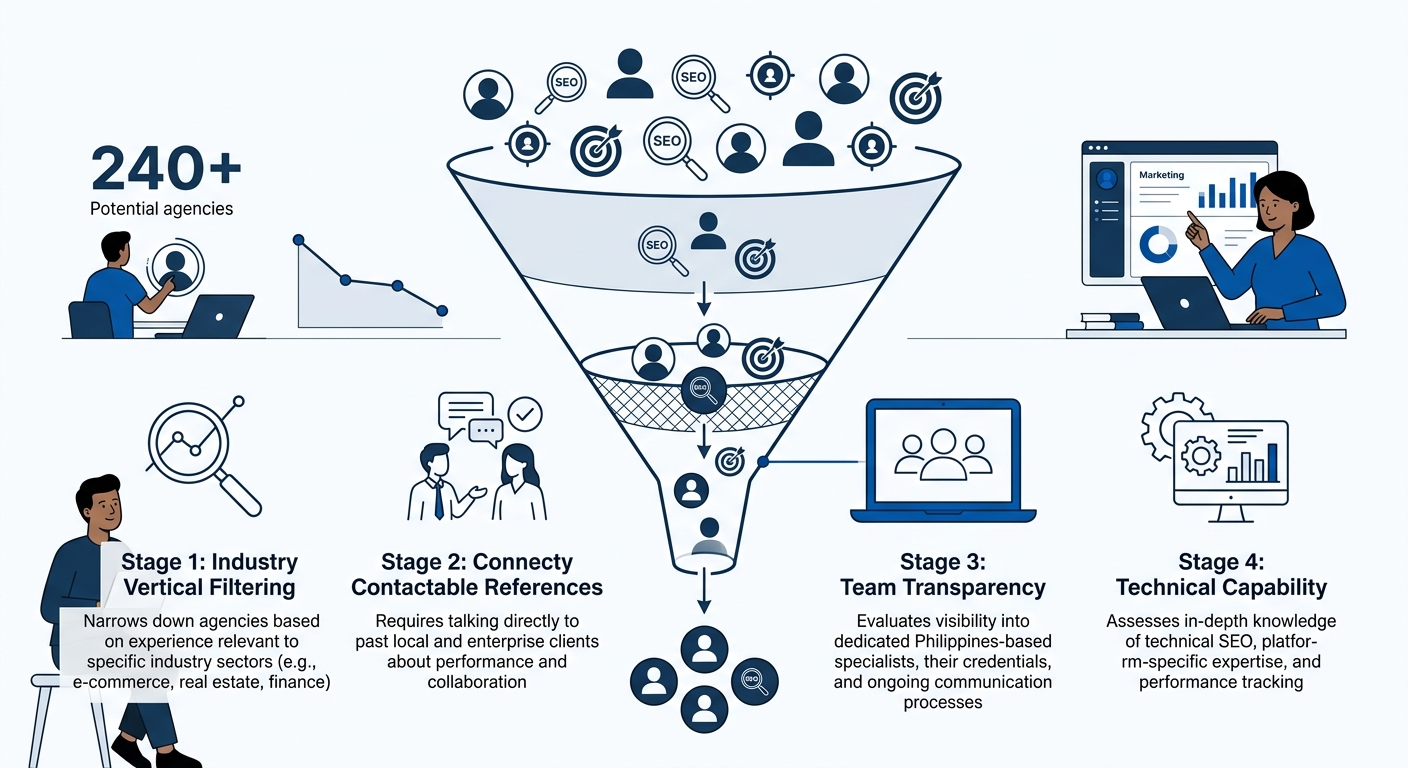
Cutting 240 Agencies Down to Five
The directory phase is where most founders get lost. You open Clutch, GoodFirms, or Sortlist, and you’re staring at a grid of logos with star ratings that all look identical. Here’s how agency vetting in the Philippines actually works when you do it well.
Filter 1: Industry vertical. If you’re in e-commerce, the agency needs to show work in that space. Ask for case studies with traffic and revenue data, not just rankings. A firm that specializes in e-commerce SEO services will structure their proposals around product page optimization, category architecture, and conversion paths. A generalist agency will talk about “increasing visibility” without connecting it to revenue.
Filter 2: Contactable references. As Digital Journal reported in its 2026 ranking of Philippine SEO specialists, the best agencies are differentiated by verified experience, public credibility, and consistent results across real client campaigns. “Real” means you can call or email the client. If every case study is anonymized, that’s a signal. Some clients require confidentiality, sure, but if every single one does, you’re looking at fabricated results.
Filter 3: Team transparency. Ask who will do the actual work. Many agencies in the Philippines sell with a senior strategist in the room, then hand execution to junior staff or offshore subcontractors. You want to know the name and experience level of the person who will touch your account on a weekly basis.
An agency that doesn’t ask why your last engagement ended isn’t doing serious discovery.
Filter 4: Technical capability. Any agency can write blog posts. Fewer can run a proper technical audit, fix crawl budget issues, implement structured data at scale, or diagnose why your Core Web Vitals tanked after a site redesign. If technical SEO is important to you, our technical SEO checklist covers the baseline you should expect from any agency you’re evaluating.
After these four filters, you should be down to three to five agencies worth a real conversation.
The Pitch Meeting: Separating Signal from Performance
Pitch meetings with SEO agencies follow a predictable pattern. The agency presents credentials, drops client logos, shows a few charts with upward-trending lines, and ends with a slide titled “Our Process” that includes four to six circles in a row. None of that tells you what you need to know.
Here’s what to ask instead:
“Walk me through a campaign that failed.” Every agency has one. If they can’t name a campaign where results didn’t land, they’re either lying or too new to have meaningful experience. The answer tells you how they diagnose problems and whether they take ownership.
“What will you do in the first 30 days?” Vague answers like “we’ll do an audit and develop a strategy” are table stakes. Push for specifics. Which tools will they use for the audit? What do they expect to find based on what they’ve already seen on your site? A good agency will have browsed your site before the meeting and will have preliminary observations ready.
“How do you handle AI Overviews and answer engine optimization?” This is where you separate 2024-era agencies from 2026-era ones. Google’s AI Overviews now appear across local, commercial, and informational queries, and they’ve changed what visibility means for Philippine businesses. If the agency’s answer is blank stares or “we focus on traditional rankings,” they haven’t adapted.
Red flags to watch for during the pitch, documented extensively by SEO industry practitioners: guaranteed rankings, vague strategies, cookie-cutter packages, lack of proof, mandatory long-term contracts, unusually cheap pricing, poor communication, and any mention of tactics that sound like link schemes.
Warning: If an agency guarantees page-one rankings or promises a specific number of keywords in the top three within 90 days, walk away. No one controls Google’s algorithm. Agencies that make these promises either plan to use risky tactics or plan to redefine the guarantee in the fine print.
Evaluating the Proposal
A serious proposal from an SEO agency Manila team should include a phased roadmap. The standard structure is 30-60-90 days, but the specifics matter far more than the format.
Days 1–30 should focus on technical audit completion, analytics verification (you should confirm they have direct access to your Google Analytics and Search Console, not screenshots from their own dashboard), and competitive benchmarking.
Days 31–60 should introduce content strategy based on audit findings, initial on-page optimizations for your highest-value pages, and Google Business Profile cleanup if you’re targeting local search.
Days 61–90 should show the first round of content production, link-building activity with named targets, and a baseline performance report against the KPIs from your brief.
If the proposal skips any of these phases and goes straight to “we’ll start creating content in week one,” the agency is skipping diagnosis. That’s like prescribing medication without running tests.
Pricing benchmarks for 2026 in the Philippine market:
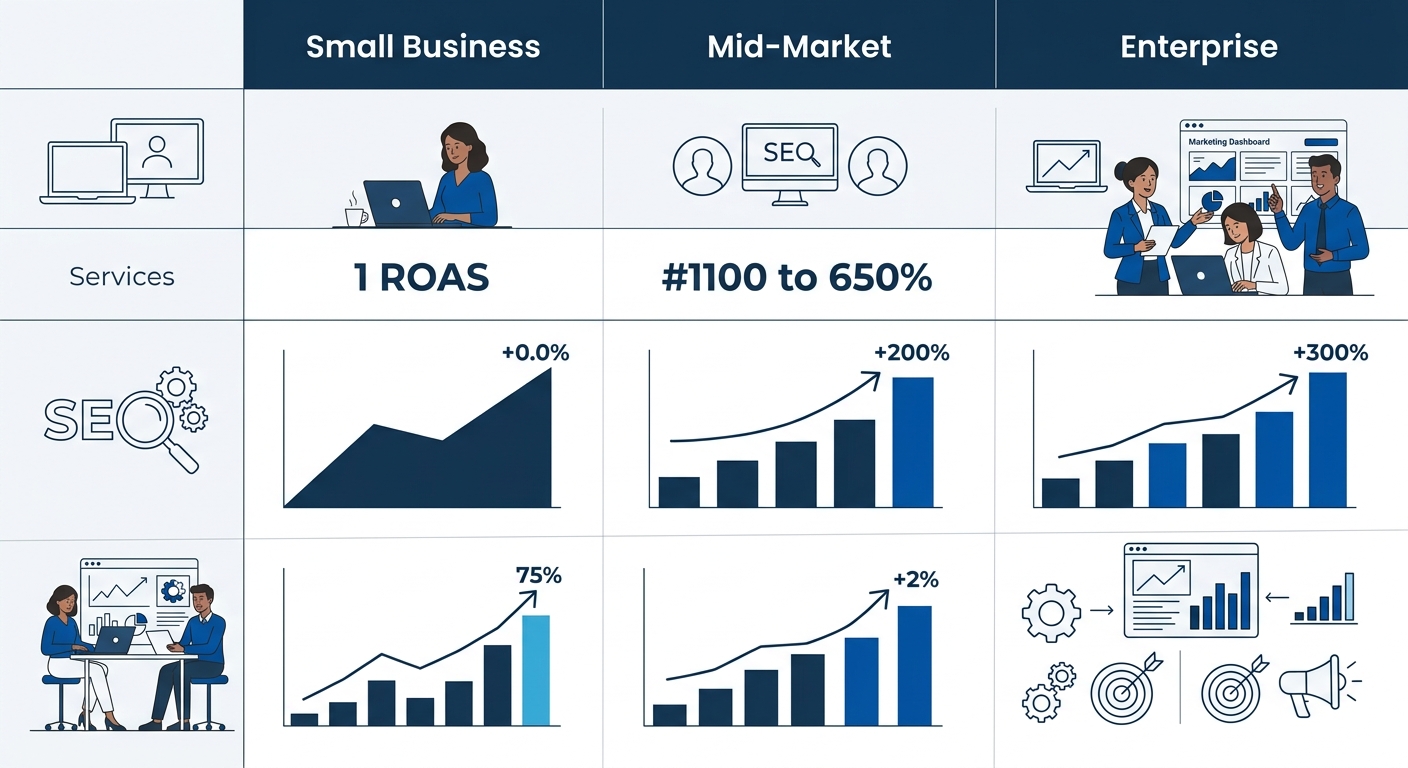
- Small businesses: ₱15,000–₱40,000 per month
- Mid-market companies: ₱40,000–₱150,000 per month
- Enterprise accounts: ₱150,000 and above, often with dedicated teams
Founders running multi-location businesses or working across several verticals will likely need enterprise digital marketing services that go beyond basic SEO into paid media, CRO, and content operations. Budget accordingly.
The First 90 Days After Signing
The contract is signed. Now what?
The first 90 days reveal whether you hired the right partner. Here’s what healthy agency relationships look like during this period.
Week 1–2: The agency requests access to your analytics, Search Console, Google Business Profile, CMS, and any ad accounts. If they don’t ask for access within the first five business days, escalate. An agency that operates without your data isn’t making decisions based on evidence.
Week 3–4: You receive the technical audit. It should be specific to your site, not a generic report auto-generated by a tool. Look for prioritized recommendations with effort estimates and expected impact.
Month 2: Content and on-page work begins. You should see drafts, keyword targets, and internal linking plans. If your team wants to build some SEO capability in-house alongside the agency engagement, asking about an SEO training program for your staff is a reasonable request at this stage. Good agencies welcome it because it makes collaboration smoother.
Month 3: The first performance review. Traffic and ranking changes at 90 days are early indicators, not final results. SEO compounds over months, not weeks. But you should see measurable progress on technical fixes, indexed content, and crawl health even if rankings haven’t shifted dramatically yet.
The agencies that earn long-term retention are the ones that build a real digital marketing strategy around your business model, rather than running a generic SEO playbook they apply to every client.
Where the Philippine Agency Market Stands Now
The Philippine SEO agency landscape has matured significantly. Five years ago, most local agencies competed primarily on price, positioning themselves as cheaper alternatives to Western firms. That dynamic still exists, with Filipino agencies offering senior-level talent at roughly 40–60% lower rates than US or European counterparts. But the better agencies have moved past the cost argument entirely.
The strongest firms in Manila and Cebu now compete on specialization, data infrastructure, and the ability to navigate AI-driven search. They understand Tagalog-English search behavior, seasonal Filipino buying patterns (Payday weekends, 11.11, Christmas season extending from September), and platform-specific quirks like how GrabFood and Shopee listings interact with Google’s local results.
For founders going through this process for the first time, the guide above works as a practical agency vetting Philippines framework. For those who’ve been burned before and want to understand how to choose the right SEO company with more rigor, the core principle remains the same: specificity beats promises. Ask for named clients, phased roadmaps, direct analytics access, and clear escalation paths when things go wrong.
The agencies worth hiring will welcome that scrutiny. The ones that push back on transparency are telling you everything you need to know about how the engagement will go.