How Manila SMBs Are Using AI to Cut Marketing Spend in Half
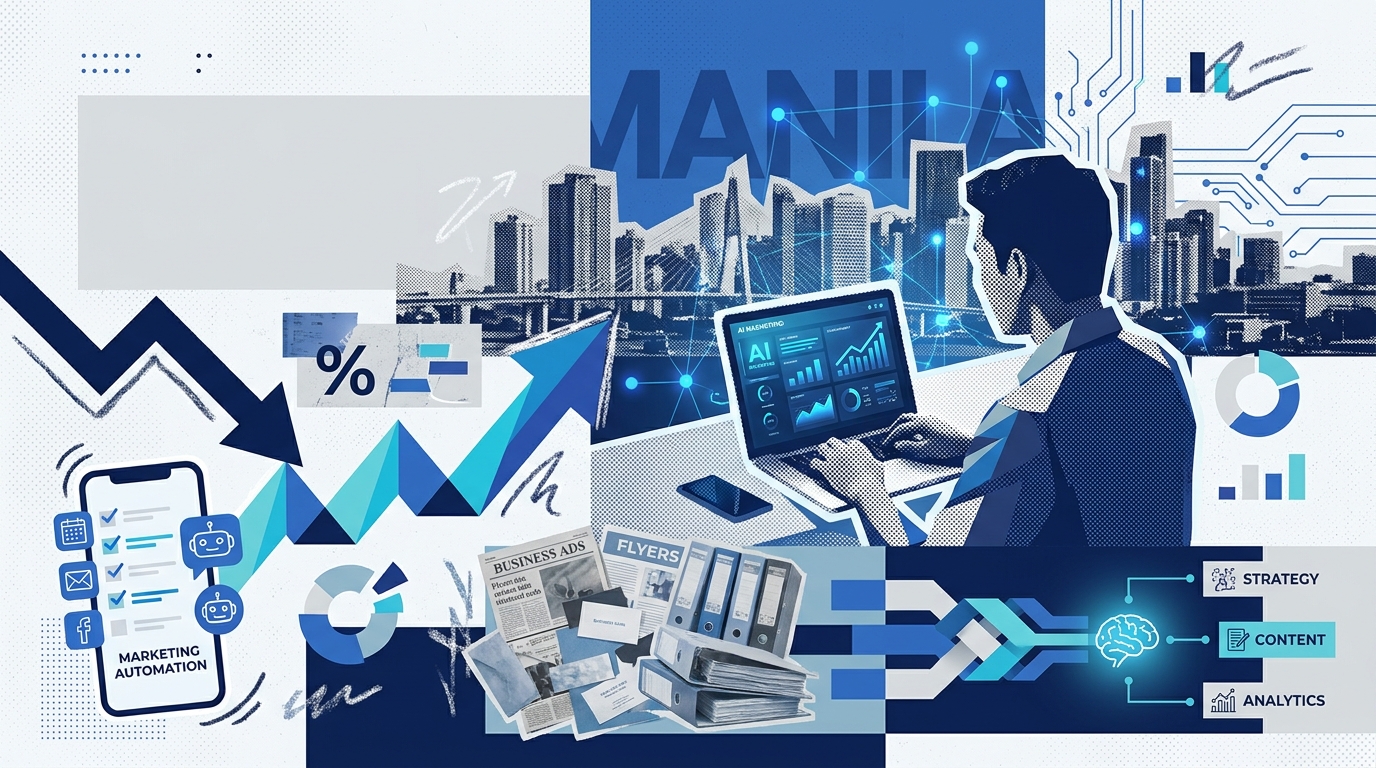
A five-person marketing team running AI across content drafting, ad targeting, and email segmentation saves roughly $4,739 per month in operating costs, according to Forbes research from mid-2025. And 89% of those teams say AI helps them compete against brands with ten times their budget. For a Manila SMB allocating between ₱200,000 and ₱500,000 monthly to digital marketing, that kind of efficiency gain changes the math on what’s possible.
The Philippine market is already moving faster than most business owners realize. Southeast Asian small businesses adopt AI tools at a 48% rate, compared to 37% in the United States. The Philippines sits at the center of this trend, with local platforms like Prosperna building AI capabilities specifically for Filipino SMEs and enterprise BPO providers integrating AI into e-commerce operations that show measurable ROI within four to six months.
The question for most small business owners in Manila isn’t whether to use AI in marketing. It’s which applications actually deliver savings versus which ones just add another subscription to the credit card.
Where the Real Cost Reductions Happen
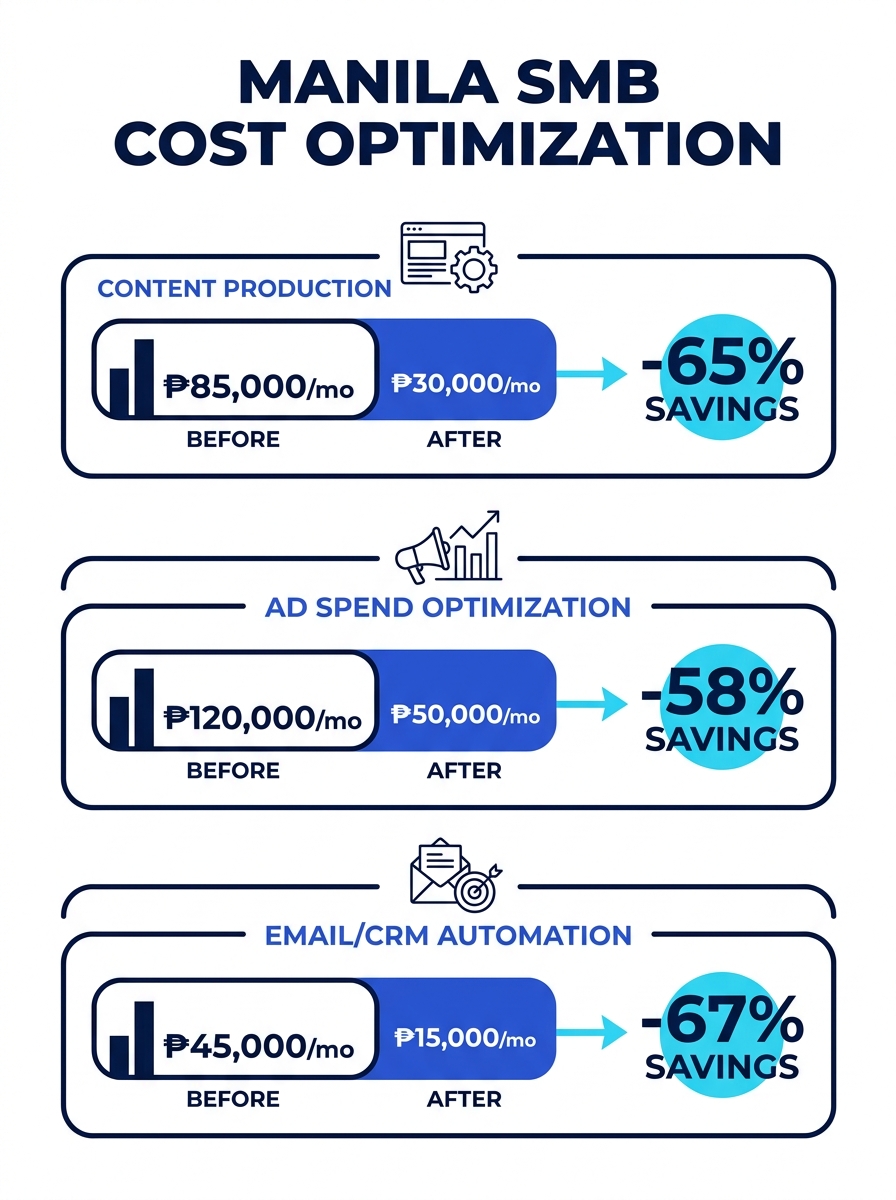
The headline claim of cutting marketing spend in half sounds aggressive. But when you break down where marketing budgets actually go for a typical Manila SMB, the savings become concrete across three areas.
Content Production
A restaurant chain in Makati that previously paid ₱15,000–₱25,000 per month for freelance copywriters to handle social media captions, blog posts, and email newsletters can now draft first versions of all that content using AI writing tools. The human writer still edits, adjusts for brand voice, and adds local context (because AI doesn’t know that your Poblacion location just renovated its rooftop). But the drafting time drops by 60-70%, which means you need fewer freelance hours.
This matters especially when you’re managing content strategy and production across multiple channels. AI handles the volume; humans handle the nuance.
Ad Spend Optimization
Philippine businesses running Google Ads already know the cost-per-click landscape is competitive. AI-powered bidding strategies and audience segmentation tools help SMBs stop wasting money on broad, untargeted campaigns. When you combine predictive audience segmentation with proper first-party data, the results are measurable: BCG and Google found that brands activating first-party data across their tech stack see up to 1.5 times cost savings on ad spend.
If you’re already spending on paid search, understanding what Google Ads actually costs in the Philippines is the baseline. AI tools help you squeeze more conversions out of whatever budget you’ve set.
Email and CRM Automation
Building and maintaining an email list used to require a dedicated person or at least significant hours from your marketing coordinator. AI-driven CRM tools now handle segmentation, send-time optimization, and subject line testing automatically. The Forbes data shows teams using AI daily save nearly 15 hours weekly, and most of those hours come from repetitive tasks like list management, A/B test setup, and reporting.
For SMBs that are still building an email list from scratch, AI tools lower the barrier significantly because they automate the segmentation work that used to require a specialist. This kind of SMB marketing automation used to be reserved for companies with six-figure tech budgets. Now it costs less than a junior hire.
The Southeast Asian Advantage
There’s a reason AI marketing adoption in the Philippines and neighboring countries outpaces the US. CNBC reported that Southeast Asian small businesses are using generative AI for personalized marketing messages and multilingual content, which is particularly valuable in a country where marketing copy might need to shift between English, Filipino, and Taglish depending on the audience segment.
A Manila-based e-commerce brand selling skincare products, for example, can use AI to generate product descriptions in conversational Filipino for Facebook and Instagram, formal English for the website, and Taglish for TikTok scripts. Doing that manually with copywriters costs three times as much and takes three times as long.
Sprout Solutions, a Philippine HR and business tech provider, has documented how agentic AI is driving measurable ROI for Philippine businesses by managing entire workflows rather than individual tasks. The shift from “AI as a helper” to “AI as a workflow manager” is where the biggest cost reductions emerge for Philippine small business AI adoption. When AI handles an entire campaign workflow from audience selection through creative testing to budget reallocation, the hours saved compound quickly.
When AI handles an entire campaign workflow from audience selection through creative testing to budget reallocation, the hours saved compound quickly.

What 62% Adoption Actually Looks Like
TechRadar reported in April 2026 that 62% of SMBs globally now use AI tools, with 67% planning to increase their AI budgets. But “using AI” covers a wide spectrum, from a store owner asking ChatGPT to write Instagram captions to a mid-sized manufacturer running AI-powered predictive analytics on its ad campaigns.
For Manila SMBs, the practical applications tend to cluster around four use cases:
- Social media content generation — drafting posts, creating caption variations for testing, and scheduling across platforms. Businesses working with managed social media campaigns can layer AI tools on top of agency expertise to stretch budgets further.
- Customer segmentation and targeting — AI tools analyze purchase history, browsing behavior, and engagement data to group customers into segments that convert at higher rates. One MDPI study showed this approach drove a 33% increase in e-commerce conversion rates and a 63% rise in return on ad spend.
- Chatbot-driven customer service — reducing the need for full-time customer service staff by handling FAQ-level inquiries automatically. For an SMB spending ₱20,000–₱30,000 monthly on a dedicated CS person, a chatbot handling 60% of queries cuts that cost substantially.
- Reporting and analytics automation — instead of spending hours compiling weekly performance reports from Google Analytics, Meta Business Suite, and email platforms, AI tools consolidate data and surface the metrics that matter.
That said, 70% of SMBs report needing external vendors to fully benefit from AI systems. The tools are accessible, but the strategy behind them still requires expertise. If your digital marketing strategy doesn’t have clear goals and KPIs, AI will optimize toward the wrong targets.
Warning: AI tools optimize toward whatever goal you set. If your targeting, attribution, or conversion tracking is misconfigured, AI will efficiently waste your money instead of saving it.
The Data Quality Problem Nobody Talks About
The biggest obstacle to AI cost reduction for Philippine small businesses isn’t the technology. It’s the data underneath it.
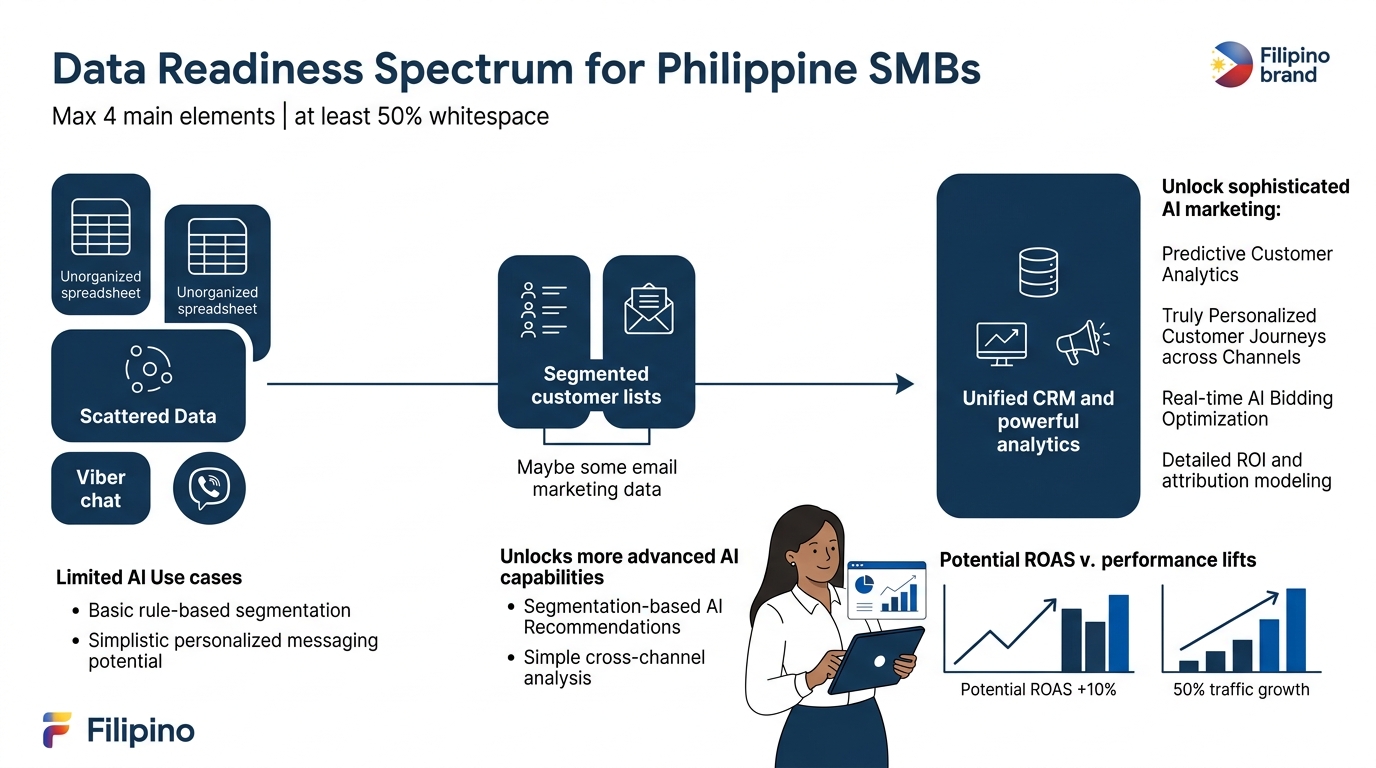
BCG and Google’s research on first-party data activation showed that the 2.9x revenue uplift and 1.5x cost savings only materialize when brands have clean, structured data flowing through their tech stack. A Manila SMB running customer data through a mix of spreadsheets, Viber group chats, and a half-configured CRM won’t see those results.
Prosperna, a Philippine e-commerce platform, has been educating Filipino SMEs on AI fundamentals precisely because the gap between “we use AI” and “AI is saving us money” almost always comes down to data readiness. You need your customer data, transaction history, and marketing performance metrics in one place before AI can do anything useful with them.
This is where conversion rate optimization and AI intersect in a practical way. AI identifies patterns in user behavior, but only if your tracking is properly instrumented and your data is reliable. Garbage in, garbage out applies to AI marketing in the Philippines just as much as it does anywhere else.
The Human Element AI Can’t Replace
Research on AI-powered marketing in Southeast Asia highlights a direct correlation between company size and how much customer engagement matters. Smaller businesses rely on personal relationships, and their customers can tell when communication feels automated and generic.
The SMBs getting the best results from AI in Manila treat the technology as a first-draft machine and an optimization engine, not as a replacement for the people who understand their customers. A bakery in Quezon City that knows its regulars by name can use AI to write promotional emails faster, but the tone, the inside jokes about their ube pandesal selling out every Saturday — that has to come from a human.
The successful formula we see among Philippine small businesses combines AI efficiency with human judgment: AI generates options, humans choose and refine, AI distributes and measures, humans interpret and adjust strategy. Companies that skip the human steps end up with marketing that feels hollow. And in a market where personal trust drives purchasing decisions, hollow marketing costs you customers even if it saves you pesos.
What Still Isn’t Settled
Several things remain uncertain about AI marketing adoption among Manila SMBs, and they’re worth tracking closely.
The regulatory landscape is still developing. The Philippines doesn’t yet have a full AI governance framework, which creates uncertainty for businesses handling customer data through AI tools. Industries like financial services and healthcare face additional compliance considerations that could limit which AI marketing tactics are available to them.
Cost predictability is another open question. Most AI marketing tools charge per seat or per usage tier, and costs scale as your marketing volume grows. The “cut spend in half” math works at current usage levels, but an SMB that triples its content output because AI makes it cheap may find its subscription costs climbing toward what it used to pay freelancers. It’s worth running the actual numbers for your business rather than assuming flat savings at higher volumes.
And there’s the competitive equilibrium problem. When every Manila SMB uses AI to optimize their Facebook ads and generate content, the cost advantages shrink because everyone is playing the same optimization game. Early movers get the biggest savings. As adoption crosses 62% and heads toward saturation, the advantage shifts from using AI at all to using AI more intelligently than your competitors, which brings us back to strategy, data quality, and the human decisions that no tool can automate.
For Philippine small businesses watching their marketing budgets carefully, AI delivers real, documented savings today. Whether those savings hold at the same level over the next two to three years depends on questions the market hasn’t answered yet.