Google Issues Manual Action Against Forum for Thin Content; SEO Community Suspects AI-Generated Responses Triggered Penalty

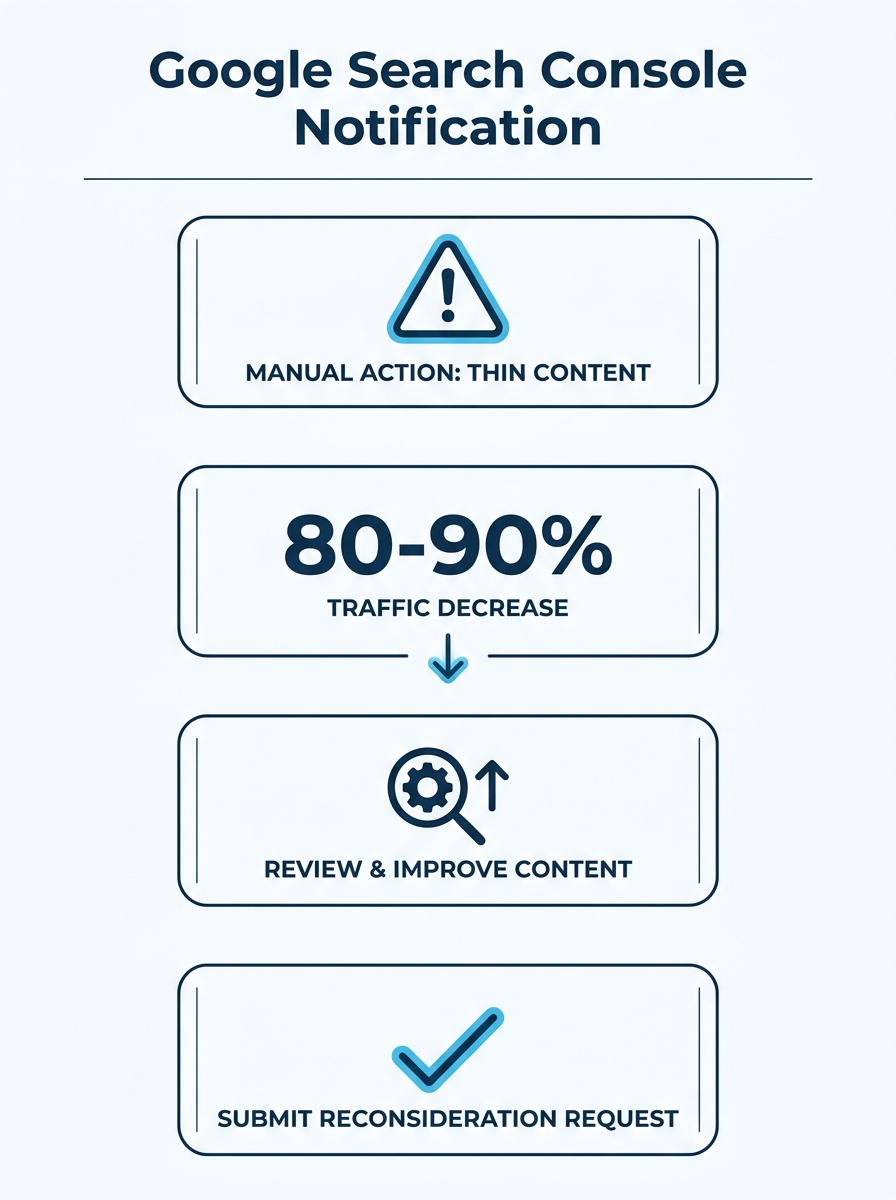
Google issued a manual action against a Windows-focused forum on July 17, 2026, targeting more than 500,000 posts for “thin content with little or no added value,” according to a disclosure posted to Reddit by the site’s operators. The enforcement targeted only the forum’s /threads/ section despite two other areas of the site containing syndicated headlines and archived material that more clearly fit Google’s historical definition of thin content.
TL;DR: A 20-year-old Windows forum received a manual penalty for thin content after deploying an AI chatbot that posted over 100,000 responses; SEO practitioners believe Google is now treating AI-generated forum answers as violating quality guidelines.
The manual action (designated WNC-651700) affects 168,290 visible threads and over half a million individual posts on windowsforum.com, the site operators reported. Google provided no example URLs in the notification and applied the penalty as a partial manual action, meaning a human reviewer evaluated a specific section of the site rather than the entire domain.
Why SEOs Suspect AI Content Triggered the Penalty
Australian SEO Gagan Ghotra identified a likely cause for the enforcement action: the forum operates an AI chatbot labeled as a staff member that has posted more than 100,000 responses to user questions since 2023, according to Search Engine Journal. The chatbot’s activity level and deployment timeline align with the section Google penalized, Ghotra noted in a Twitter post analyzing the case.
“Probably their AI bot auto replying to most of posts triggered this,” Ghotra wrote, sharing screenshots of the chatbot’s profile showing sustained posting activity across the affected thread category.
The forum’s operators expressed confusion about the targeting because two other sections of the site, a syndicated headline feed and an archived knowledge base comprising 11,927 threads with a mean age of 12.5 years, were not flagged despite fitting Google’s published definitions of thin content more directly. Both sections have remained inactive for three years yet survived the manual review.
What Google’s Thin Content Guidelines Traditionally Cover
Google’s quality guidelines define thin content primarily in the context of affiliate sites that republish merchant product descriptions verbatim without adding original insight, analysis, or supplementary material such as video reviews. Former Google search quality engineer Matt Cutts has explained that acceptable content requires authors to “write it themselves” and demonstrate actual expertise rather than aggregate information from other sources.
Other categories historically flagged as thin content include syndicated articles republished across multiple sites and article-marketing pages designed solely to manipulate search rankings. The windowsforum.com case diverges from these patterns because the penalized section contains user-generated discussion threads spanning two decades, not republished commercial content.
The Authenticity Gap in AI-Generated Forum Responses
The forum characterizes its AI chatbot as a staff member, but the bot generates responses from received knowledge, information sourced from documentation, other websites, or training data, rather than direct human experience with Windows system issues. That distinction matters in the context of AI search visibility and content quality assessment.
Users posting technical questions on forums expect answers grounded in firsthand troubleshooting experience or specific configuration knowledge. An AI system responding to a Windows 11 driver conflict does not possess actual experience with the hardware, the error state, or the resolution process. It synthesizes text that resembles an answer without the underlying authenticity that gives forum content value.
Marketing teams evaluating content marketing services or AI SEO strategies should note that Google appears to be applying its authenticity standards to AI-generated material even when that content is technically responsive to user queries. The penalty targets not grammatical quality or factual accuracy but the absence of genuine expertise and value add.
What Makes This Case Unusual
The forum survived 20 years of algorithm updates, including Panda (2011), Penguin (2012), and the September 2023 Helpful Content Update, without penalty despite maintaining the same thread structure and user-generated content patterns. The site also completed a domain migration during this period and continued ranking for technical support queries throughout.
The manual action arrived only after the forum deployed its AI chatbot staff member. No algorithmic penalty preceded the manual review, suggesting the enforcement stems from a policy decision about AI-generated responses in community contexts rather than a pattern detected by automated quality systems.
Reddit users responding to the disclosure expressed concern that Google’s enforcement is inconsistent, given that many forums and Reddit itself contain threads with minimal engagement or repetitive answers. One commenter noted that “some threads attract loads of interaction, some don’t at all, but it can’t be the solution to simply delete thin threads without the consent of whoever posted them.”
However, pruning outdated or low-engagement threads is a standard content maintenance practice for forum operators managing long-established communities, and the manual action targets a specific pattern of AI-generated activity rather than naturally thin user contributions.
Context and Outlook
Marketing leaders briefing agency partners on content strategy or digital marketing consultation engagements should understand that Google’s enforcement standards are now explicitly extending to AI-generated material in contexts where human experience and authenticity are the expected value proposition. This case suggests that deploying AI to scale content production in user-generated or community contexts carries SEO risk even when the output is grammatically correct and topically relevant.
The penalty’s structure, targeting only the AI-heavy forum section while leaving syndicated and archived material untouched, indicates Google is evaluating content against the expectations users bring to specific page types. A forum answer carries different quality thresholds than a news aggregation page. Brands operating community platforms or knowledge bases should evaluate whether AI-generated responses meet the authenticity standard users expect, not just whether the text is coherent.
For enterprises managing brand visibility in AI search and traditional organic rankings simultaneously, this enforcement confirms that Google’s content policies remain a binding constraint even as the company deploys its own generative AI features in search results. The company has stated that AI-generated content is not automatically penalized, but this case demonstrates that context and user expectations determine when such content crosses into thin-content territory under manual review.