Enterprise Localization Teams Spend 21% of Budget Fixing AI-Generated Content, Survey Finds

Twenty-one percent of enterprise localization budgets now goes to fixing AI-generated content before global deployment, a cost equivalent to one dollar in every five spent on multilingual adaptation, according to a survey of 200 enterprise leaders published July 29 by RWS CEO Benjamin Faes in Forbes Technology Council.
TL;DR: AI content creation speeds have exposed downstream bottlenecks in localization and validation workflows, with enterprises spending more than one-fifth of localization budgets on rework rather than new market expansion.
The survey identifies a structural mismatch between accelerated content production and the infrastructure required to adapt that material across languages, regulatory frameworks, and cultural contexts. Only 14 percent of surveyed enterprise leaders report having centralized content management systems in place, leaving most organizations scaling AI output atop disconnected workflows, the data shows.
Rework Spending Concentrates at Validation Stage
The 21-percent rework figure captures costs associated with correcting AI-generated material that fails to meet market-specific requirements—inconsistent terminology, cultural misalignment, regulatory non-compliance, and brand-voice drift across translations. “AI is being applied where the problem used to be, not where it now sits,” Faes wrote in the Forbes post. The survey did not break out rework costs by content type or market region.
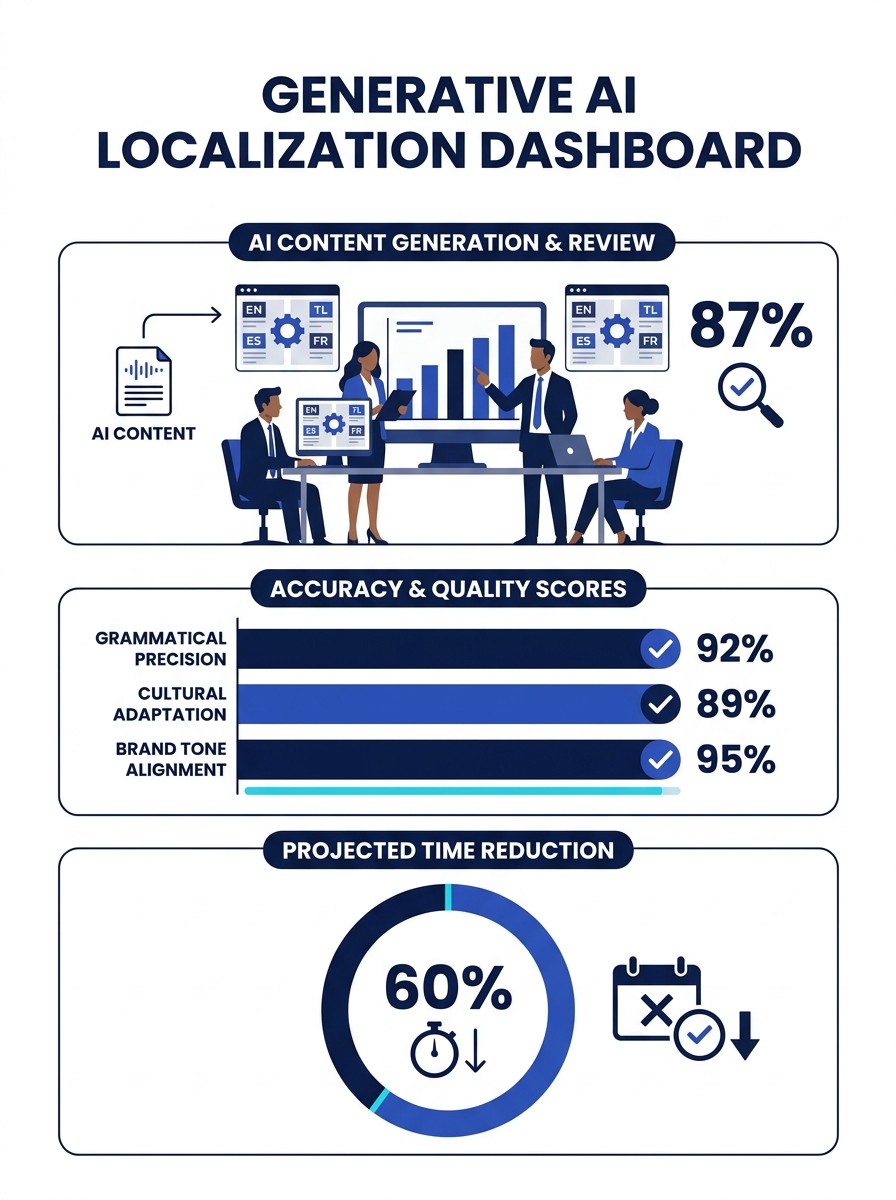
Enterprises running multi-market operations face compounding costs. A single product description or support article must function across languages, cultural expectations, regulatory regimes, and format constraints. AI produces language that reads fluently in isolation, but validation teams report material lift in time spent ensuring meaning, tone, and compliance hold when content crosses into a different market, according to the survey responses.
The finding aligns with earlier guidance from marketing executives who flagged brand-differentiation risk as AI content volume increases without proportional oversight infrastructure.
Infrastructure Gaps Block Scale Despite Creation Speed
The survey reveals a confidence gap between leadership expectations and operational reality. Most leaders believe their organizations will absorb higher AI content volumes without fundamental workflow changes, even as localization and compliance teams report capacity strain, Faes noted.
Fragmentation deepens as creation accelerates. Enterprises accumulate content across marketing campaigns, product documentation, and support libraries—often without unified taxonomy, versioning control, or approval hierarchies. “AI: not organizing the attic but filling it faster,” Faes wrote, describing how generative tools boost existing disorganization rather than resolve it.
Only 14 percent of enterprises have implemented centralized content management, leaving the majority to scale AI deployment on systems that lack governance structures to track who approves material, who owns versioning, and who accounts for market-specific adaptation. The absence of those controls turns increased AI output into a liability rather than a capacity gain, survey respondents indicated.
Cost and Ownership Complexity Delay Infrastructure Investment
Three barriers block enterprises from deploying the cultural-intelligence and validation infrastructure that would reduce rework spend, according to Faes. Cost concerns rank first, though leaders typically miscalculate the business case by treating cultural-review capabilities as a new line item rather than offsetting them against the rework expense already incurred. “Put the two numbers side by side, and the investment looks less like an extra cost and more like a correction to one already being paid,” Faes wrote.
Security scrutiny represents a second, more defensible concern. Handing customer data, regulated documentation, or competitive product details to any external layer—human or AI-mediated—requires clear answers on data custody, access control, and accountability. Organizations that resolve this requirement can specify precisely who touches sensitive material, where it resides, and who answers for breaches, Faes noted.
The third barrier sits outside vendor contracts: cross-functional ownership ambiguity. Content, localization, IT, and legal functions typically report to different budget holders, and cultural-intelligence infrastructure spans all four domains. “When a decision belongs to everyone, it tends to belong to no one,” Faes wrote. That structural ambiguity stalls procurement more frequently than cost or security objections.
Enterprise teams evaluating B2B digital marketing agency partners for AI-assisted content programs should expect proposals to address validation workflows and localization infrastructure explicitly, not only creation throughput. Agencies positioned to deliver multi-market content at scale require demonstrated capability in cultural adaptation, not solely generative-AI tooling access.
APAC. Implications
Marketing leaders briefing agency partners on content programs spanning APAC markets should structure scopes to quantify rework risk before finalizing AI deployment budgets. The 21-percent localization rework figure provides a baseline for modeling hidden costs—enterprises moving material across Philippine, Singapore, Indonesia, Vietnam, and Thailand operations face language, regulatory, and cultural variance that AI tools alone do not resolve. Brief requirements should specify how the agency validates tone, regulatory compliance, and brand consistency in each target market, and who carries accountability when content fails local review.
Organizations without centralized content-management infrastructure should expect AI acceleration to surface existing workflow fragmentation rather than bypass it. The 14-percent penetration rate for centralized systems suggests most Philippine-headquartered enterprises scaling regional content are doing so on disconnected platforms—multiplying rather than reducing coordination overhead. Senior marketers evaluating proposals need clarity on taxonomy, versioning, and approval hierarchies before committing to volume increases that the organization cannot operationally absorb.
The cross-functional ownership ambiguity Faes identifies applies directly to enterprise marketing structures in the Philippines, where content, legal, compliance, and IT often report through separate regional or global hierarchies. Resolving that decision-making gap before issuing the agency brief prevents scope stalls midway through execution. Marketing directors should secure explicit budget holder alignment on who owns cultural-intelligence investment and which function carries P&L accountability for rework costs.