Google Rolls Out August 2026 Core Algorithm Update as Marketing Teams Track Fourth Major Ranking Shift This Year

Google deployed its August 2026 core algorithm update, the fourth broad ranking recalibration this year, targeting pages with weak originality and thin evidence, according to guidance published by SEO Vendor on August 8, 2026. Historical data from the March 2025 update shows 45 percent of tracked sites experienced ranking shifts during comparable rollouts, while sites with strong Core Web Vitals scores gained between 12 and 28 percent more organic traffic during the same period.
TL;DR: Google’s August 2026 core update is live, with prior rollouts showing 45% of sites see ranking movement and Core Web Vitals compliance correlating with double-digit traffic gains for compliant properties.
The update arrives as marketing leaders prepare annual search budgets and evaluate whether existing SEO service partners have the diagnostic infrastructure to separate algorithmic volatility from structural site problems. Unlike manual penalties that target specific violations, core updates reassess how Google weighs expertise signals, content freshness, and user-task alignment across the index, changes that require agencies to audit entire content inventories rather than fix isolated pages.
Impact Scope Tracks Historical Rollout Patterns
December 2025 core update data shows concentrated impact across commercial verticals: 52 percent of e-commerce sites, 67 percent of health-sector properties, and 71 percent of affiliate sites registered measurable ranking changes, according to the SEO Vendor analysis. Top-three position churn reached 66.8 percent during that cycle, meaning roughly two of every three pages holding premium visibility experienced movement.
Sites relying on scaled AI content and expired-domain redirects lost visibility faster than properties with clear authorship and firsthand evidence, a pattern consistent with Google’s March 2026 core update that removed 24 percent of top-ten pages from search results. The March 2024 core update reduced low-quality content in search results by 45 percent, establishing the threshold that subsequent updates have reinforced.
Rollout duration varies significantly: March 2025 completed in 14 days, June ran 17 days, December extended to 18 days, and the August 2025 spam update required 27 days to stabilize. Marketing teams briefing agencies on recovery work should specify a hold period matching the longest historical rollout before approving site-wide content rewrites or structural changes that could introduce new variables during an unstable ranking period.
Diagnostic Priorities for Agency Partners
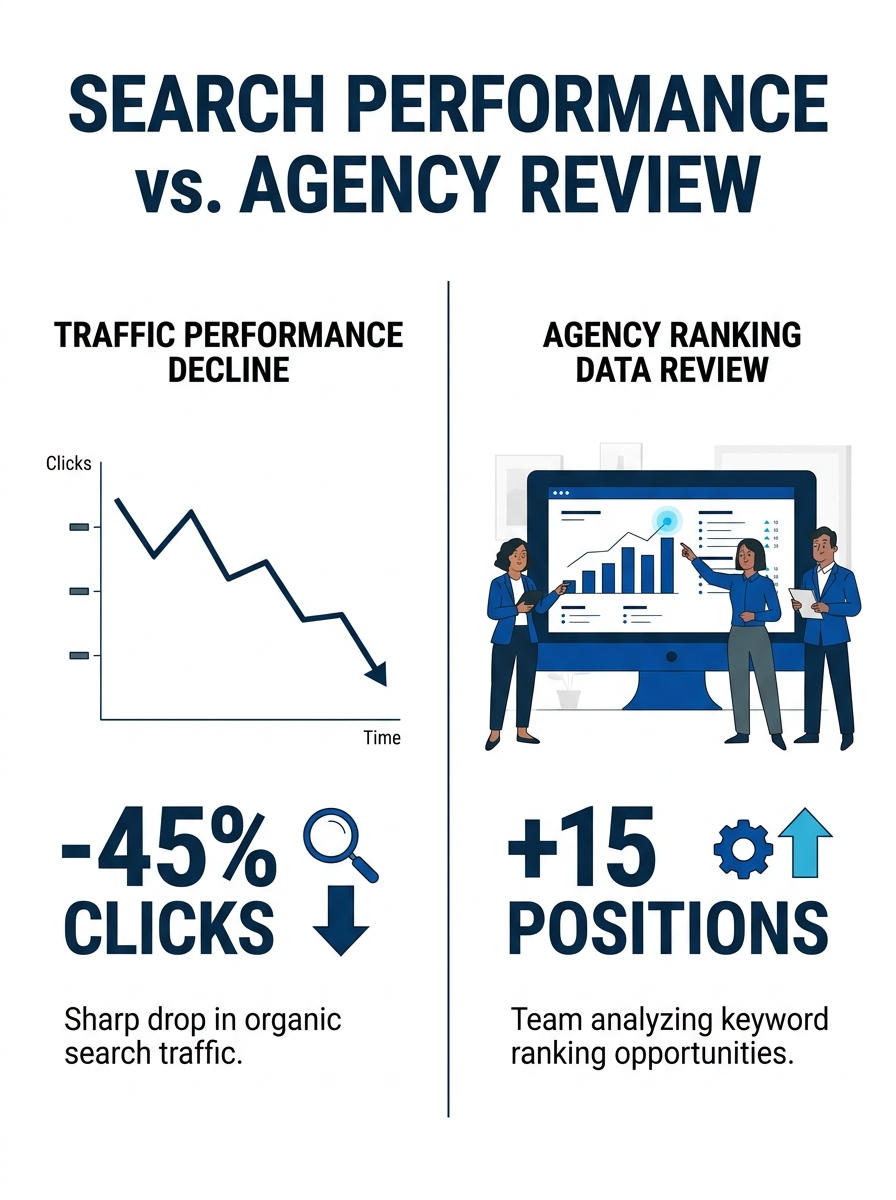
Marketing leaders directing agency response efforts should require Search Console performance comparisons spanning the 28 days before and after the update’s start date, isolating pages with the steepest average-position declines rather than absolute traffic drops. A page falling from position two to four represents minor volatility; movement from top-five to page-two visibility flags a content-quality reassessment that demands inquiry.
Query-level analysis reveals whether ranking losses cluster around a single topic or template type, patterns that surface across multiple pages indicate systemic issues rather than isolated content gaps. Google’s Query Deserves Freshness signal prioritizes recent information for searches where new data, product releases, or regulatory changes dominate user intent, meaning older evergreen content can lose visibility not because it degraded but because the result set’s requirements shifted.
The analysis should group affected URLs by topic, template, and search intent before agencies propose fixes. With more than 200 ranking signals in Google’s algorithm, pattern recognition across page cohorts identifies root causes more reliably than URL-by-URL audits. Marketing directors evaluating an agency’s diagnostic methodology should confirm that the partner is mapping thematic clusters rather than treating each URL as an independent recovery project.
Recovery Timeline and Content-Quality Thresholds
Agencies should delay broad site changes until the rollout completes, given that Google’s June 2025 core update brought some properties partway back during the stabilization window. The August 2024 core update incorporated feedback collected after the 2023 helpful content update, demonstrating that Google’s quality thresholds evolve across sequential releases rather than resetting with each cycle.
Content revisions must add firsthand evidence and tighten alignment between the search query, the page’s stated promise, and visible proof within the first screen of content. Pages competing for the same topic should be merged or pruned when they split ranking signals without serving distinct user tasks, a consolidation strategy that enterprise site architecture audits prioritize to recover lost organic revenue hidden in information-structure debt.
Google reported making 4,725 search changes in 2022 and 4,781 changes in 2023, meaning the ranking environment absorbs hundreds of minor adjustments between core updates. Marketing leaders should brief agencies that recovery work must meet the updated quality bar rather than restore pre-update approaches, particularly for pages monetizing through affiliate links, lead generation, or product sales where commercial intent boosts Google’s scrutiny.
Context and Outlook
The fourth core update in eight months signals that Google’s recalibration cadence remains faster than the annual or semi-annual cycles that prevailed before 2023. Marketing teams that wait for ranking stability before investing in content marketing services will find themselves perpetually behind properties that maintain continuous content-quality programs aligned with E-E-A-T principles and Core Web Vitals benchmarks.
For Philippine enterprises and APAC brands with local operations, the update’s emphasis on originality and firsthand evidence favors content programs that incorporate market-specific data, regulatory context, and customer evidence over templated material adapted from offshore markets. Agencies pitching recovery work should demonstrate capability in diagnostic tooling, pattern recognition across page cohorts, and content-consolidation strategy, not generic rewrites that chase keywords without addressing the underlying quality signals that triggered the ranking reassessment.
The historical correlation between Core Web Vitals compliance and traffic gains during core updates, 12 to 28 percent for strong performers, means technical SEO hygiene remains table stakes even as content-quality thresholds rise. Marketing leaders evaluating whether to retain or replace an agency partner should assess whether the current provider can execute both the immediate diagnostic work and the sustained content-authority buildout required to weather subsequent updates without repeating the same volatility cycle.