Branding Framework Published August 12 Argues Positioning Must Precede Visual Identity Work for Enterprise Marketing Leaders

A strategic framework published by Mind My Business NYC on August 12 argues that brand positioning decisions must precede visual identity development, challenging the common enterprise practice of commissioning design work before defining competitive market stance, according to the article posted to the New York-based consultancy’s blog.
TL;DR: The framework asserts that visual rebranding efforts fail when companies skip the strategic work of defining who they serve, what problem they solve better than alternatives, and why that claim holds up under scrutiny.
The guidance addresses a pattern familiar to marketing leaders overseeing rebranding projects: a new logo, refreshed color palette, and redesigned website launch without resolving the underlying confusion about what the company stands for and to whom. Mind My Business NYC frames this as a sequencing error rather than a design failure, arguing that visual identity can only boost strategic distinctions that already exist on paper.
Why Positioning Functions as Strategic Foundation
Positioning defines the specific space a company occupies in a customer’s mind relative to alternatives, the article states. In practice, this takes the shape of a single working sentence a company can articulate without hesitation, who the offer serves, what problem it solves better than competitors, and why that claim withstands scrutiny when tested against market evidence.
The framework distinguishes three commonly conflated terms. Positioning is a strategic decision about competitive stance. Branding refers to the accumulated perception built through everything a company says and does. Visual identity comprises the tangible system of logo, color, typography, and imagery that gives a brand recognizable form. The article summarizes the relationship: positioning defines strategy, branding shapes perception, and visual identity expresses both.
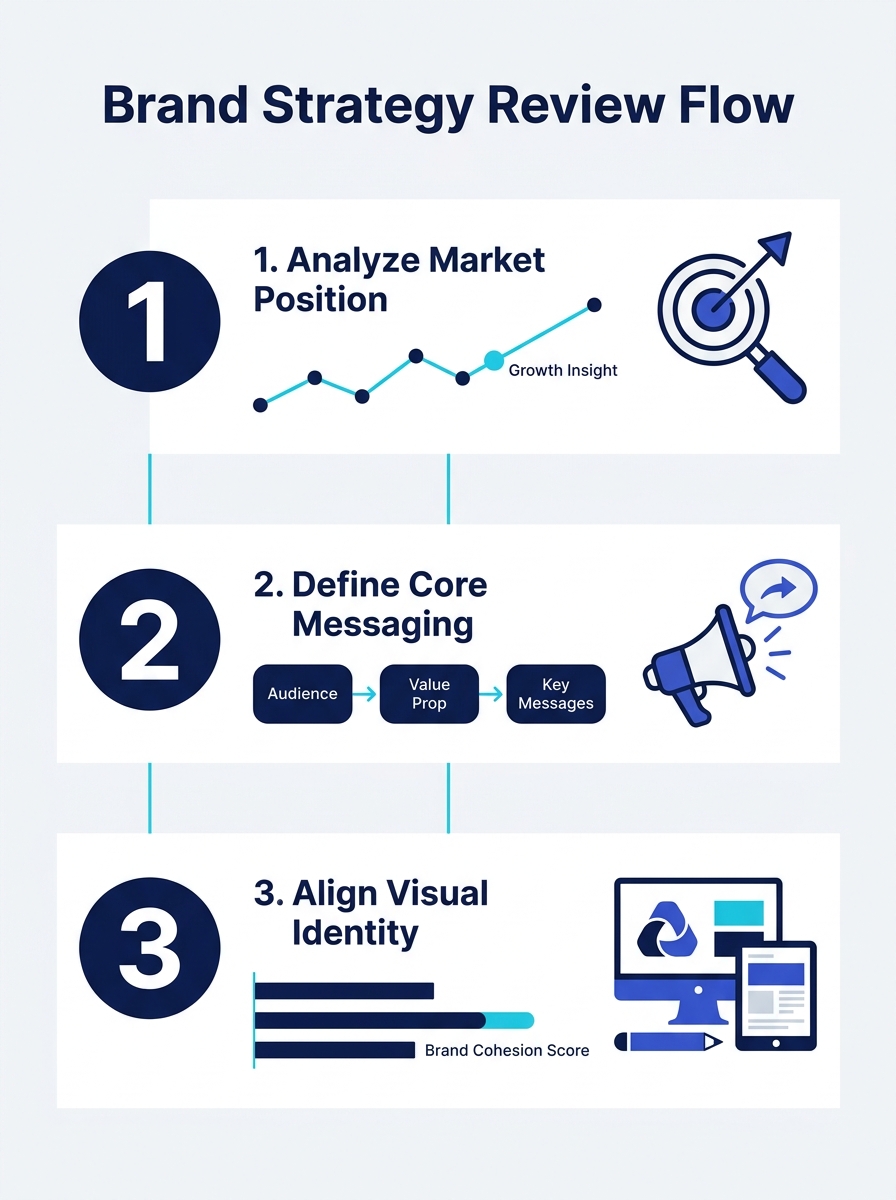
Design alone cannot invent differentiation, the piece argues. A striking visual system applied to an undifferentiated offer simply dresses up the same confusion. For design to differentiate anything, it requires a genuine strategic input to translate, a specific audience, a defined value, and a reason customers should care. Without that input, design defaults to aesthetic trends shared across an entire category.
Signals That Positioning Work Was Skipped
The framework identifies three patterns that surface when strategic groundwork is absent. First, the brand looks polished but communicates no clear value proposition. A company can have well-executed design and still fail to explain what it does, because visual design and strategic positioning are separate jobs. If the input lacks a defined value proposition, the output will not communicate one, regardless of execution quality.
Second, marketing messages become inconsistent across channels. Without an agreed-upon position, different teams describe the company differently, the website emphasizes low price, an email campaign emphasizes speed, a salesperson emphasizes product quality. Each message is written based on that team’s judgment of what sounds convincing, because no single documented position exists for teams to reference. Customers who encounter several of these messages in sequence receive contradictory information, which slows purchase decisions.
Third, price becomes the main competitive lever. When customers cannot identify a specific reason to choose one company over a similar competitor, price becomes the only remaining differentiator, the article states. This happens not because the company lacks other advantages but because those advantages were never articulated in a way customers can remember and repeat.
How Marketing Leaders Can Brief Agency Partners on Positioning Work
For CMOs and brand directors evaluating rebranding proposals, the framework suggests specific questions to separate positioning work from visual execution. The article recommends asking agency partners what they need to know about customer decision criteria, competitive alternatives, and internal consensus before design briefs are written. Agencies that jump straight to mood boards and visual concepts signal they are treating branding as an aesthetic exercise rather than a strategic one.
Marketing leaders briefing digital marketing consultation engagements should expect positioning work to surface as a discrete deliverable, a documented statement of competitive stance that internal teams can reference when writing copy, evaluating creative, or training sales staff. The framework argues that this statement becomes the input for every downstream marketing decision, from messaging hierarchy to channel selection.
Context and Outlook
The positioning-before-visuals sequence aligns with broader shifts in how brand authority signals are evaluated. As AI search systems cite specific claims and comparative advantages rather than aesthetic differentiation, marketing leaders overseeing rebranding work face pressure to document strategic rationale in forms that can be extracted and repeated. A visual identity can support recall, but it cannot substitute for a clear, verifiable statement of what a company does and for whom.
For Philippine enterprises and APAC-headquartered companies with multi-market operations, the sequencing question carries additional weight. Regional brand adaptations often begin with visual localization, translating color meanings, adjusting imagery for cultural context, while leaving the core positioning undefined. The framework suggests reversing that order: define the global competitive stance first, then adapt visual expression by market. That sequence reduces the inconsistency that emerges when regional teams interpret an unclear position through local design trends.
Enterprise marketing leaders evaluating agency partners for rebranding engagements should expect positioning work to precede visual development in the project timeline and to carry its own budget line. Agencies that bundle positioning into “discovery” without a separate deliverable often treat it as research rather than decision-making, leaving the strategic foundation undocumented when visual work begins.