Marketing Leaders Must Combine AI Strategy Tools With Human Judgment to Avoid Polished But Weak Plans, Adweek Framework Argues

Two global brand leaders published a framework on August 20 arguing that chief marketing officers must adopt a “hybrid” operating model—using AI to draft marketing strategies but applying human judgment to challenge assumptions and detect structural flaws—after finding that frontier AI models produce superficially professional plans with recurring strategic shortcomings, according to Adweek.
TL;DR: François Bazini and Laurent Florès published a CMO decision framework on August 20 identifying four failure modes in AI-generated marketing plans and recommending a challenge-based workflow where experienced leaders codify recurring review questions to scale executive oversight across brand portfolios.
François Bazini, a former BCG strategy consultant who held marketing roles at Danone, PepsiCo, and Suntory, and co-author Laurent Florès published the guidance as AI content generation reaches widespread enterprise adoption. The framework addresses a specific risk: AI models now produce business plans “in a few minutes” that arrive well-formatted and articulate, making weak strategic thinking harder to detect than when poorly conceived plans “used to arrive looking clumsy,” the authors wrote.
The piece comes as marketing leaders establish “human-only zones” to protect brand storytelling and enterprise localization teams spend 21% of budgets fixing AI-generated content.
Four Structural Failures in AI-Generated Marketing Plans
The authors identified four recurring shortcomings in AI-drafted strategies that experienced CMOs must detect before plans mislead organizations.
First, AI models summarize rather than synthesize, producing thorough competitive landscapes and SWOT analyses without answering “which facts truly matter for this brand, in this market, against this competitor, at this moment,” according to the framework. Second, AI systems favor novelty because they train on internet data that rewards newness, gravitating toward launches, extensions, and new consumer segments even when existing assets need sustained investment. “The result is motion without strategic direction,” Bazini and Florès wrote.
Third, frontier models prioritize superficially attractive ideas over economically relevant ones, recommending activations that don’t match brand fundamentals. Fourth, AI imports visible moves from successful brands “without the context and conditions that made them possible,” applying playbooks across different margin structures, shopper behaviors, and routes to market without analyzing fit.
The authors noted that marketing teams share the novelty bias, compounding the risk when AI-generated recommendations align with internal preferences for change over continuity.
The Hybrid CMO Workflow
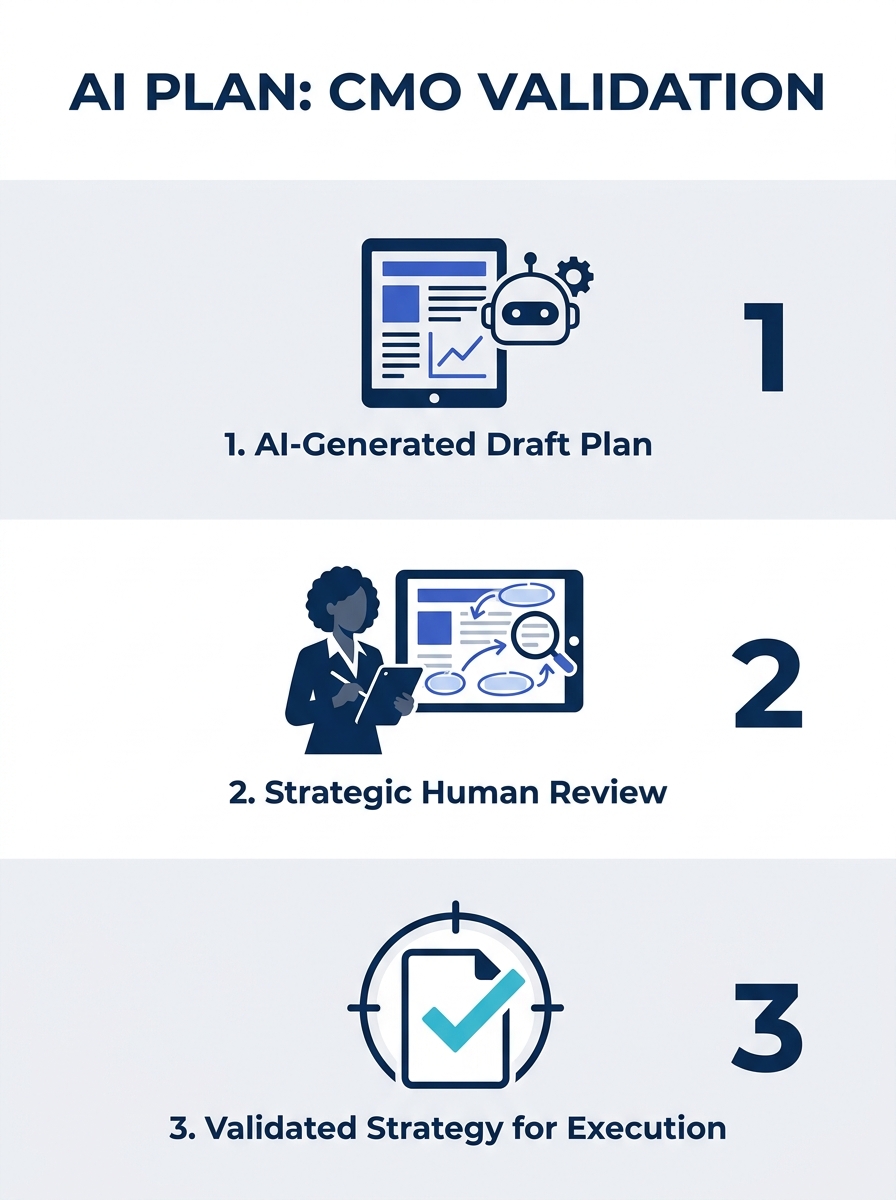
The framework recommends a three-step method for combining AI drafting with human oversight. First, CMOs task AI with producing the initial strategy. Second, they “push it” by forcing the model to reveal how it made choices—why it selected specific consumer targets, growth drivers, pricing assumptions, or competitive focus points. “Corner it until it tells you,” the authors wrote.
Third, leaders apply a personal set of questions derived from recurring planning mistakes, business philosophy, and “scar tissue” from failed launches, uncooperative retailers, and extensions that added complexity without growth. CMOs then task the model with improving the plan based on that critique.
The approach extends executive review beyond flagship brands and major markets. “If a senior leader is able to codify their own frequent review questions,” the authors wrote, AI can apply that logic across portfolios, giving every strategy “the executive review treatment” even when CMO time is constrained. This mirrors how digital marketing consultation services structure governance frameworks for enterprise clients managing agency partners across multiple brands.
Experience becomes most valuable in making trade-offs—balancing functional versus emotional benefits, product versus occasion messaging, core versus extension funding. “Having lived through the consequences of bad trade-offs, experienced leaders have developed an intuition for when a plan has become imbalanced,” according to the framework.
APAC. Implications
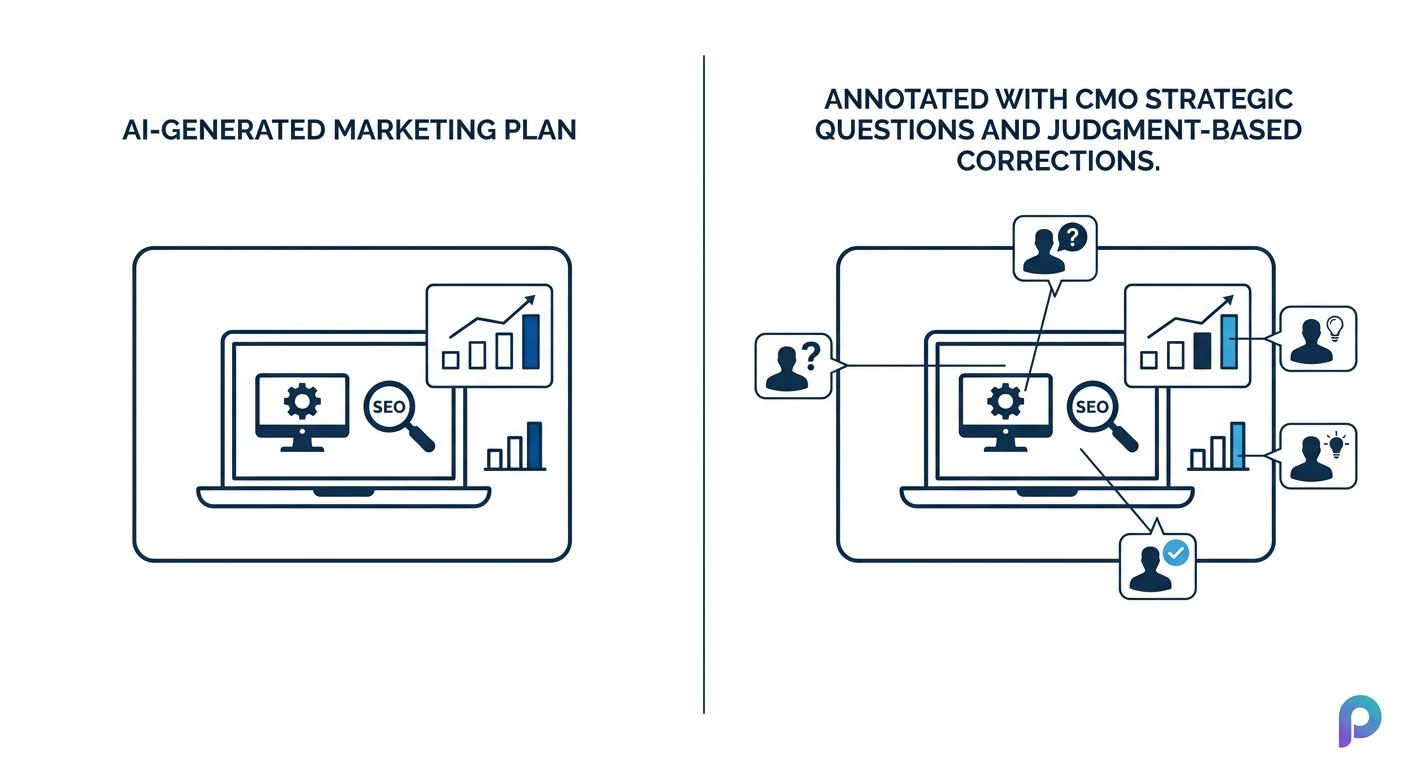
Philippine enterprise CMOs at banks, real estate developers, pharma companies, and insurers face this hybrid-oversight requirement when evaluating agency partners that pitch AI-accelerated strategy development and campaign execution. The framework’s core insight—that AI produces polished-looking work that hides weak strategic thinking—applies directly to brief evaluation and deliverable review.
Marketing leaders who don’t execute campaigns themselves must codify the specific challenge questions that stress-test agency recommendations. What consumer insight drove the target selection? Why this channel mix rather than sustained investment in proven assets? How does the creative brief reflect actual purchase barriers versus category best practices? Agencies using AI SEO tools or AI-assisted content marketing services deliver faster output, but CMOs need structured review criteria to separate genuine strategic thinking from well-formatted synthesis.
The “hybrid CMO” model also clarifies what enterprise clients should expect when briefing growth partners. Agencies handle execution; client-side leaders bring the scar tissue—knowledge of failed SKU launches, retailer negotiation realities, pricing elasticity lessons, and brand differentiation imperatives that can’t be scraped from online best-practice articles. That division requires marketing directors and VPs to document recurring planning failures and category-specific judgment calls so agency partners understand which strategic assumptions need explicit validation before campaign deployment.