Marketing Measurement Frameworks Enter Rebuild Phase as AI-Driven Commerce Erodes Attribution Signal

Eighty-four percent of CMOs now cite marketing return on investment as their primary metric for budget allocation, yet the measurement frameworks those executives rely on were designed for deterministic click-tracking models that no longer function in AI-driven commerce environments, according to analysis published by Forbes on June 4. The gap between executive scrutiny and measurement capability widened as 54.3% of AI users now deploy generative AI for internet search and 30.5% use it specifically for product and service shopping, according to Prosper Insights & Analytics survey data cited in the report.
TL;DR: Cookie deprecation and AI-agent commerce have collapsed last-touch attribution models while CFOs demand ROI proof, forcing CMOs to rebuild measurement through triangulated methods (MMM, MTA, incrementality testing) that require enterprise-grade data infrastructure most brands don’t yet operate.
Signal Loss Compounds as AI Agents Enter Purchase Flows
Browser restrictions, privacy regulation, and cookie deprecation eliminated the deterministic signals that underpinned digital marketing attribution for over a decade, the Forbes analysis noted. Consumer journeys now fragment across platforms that didn’t exist when current measurement frameworks launched, and AI-powered ad platforms operate as what the report characterized as “black boxes” that obscure post-click visibility even for the platforms themselves.
Fredrik Skantze, CEO of marketing intelligence platform Funnel, which processes approximately 11% of global digital advertising spend, stated that reduced signal availability affects advertisers and ad platforms equally. “Google and Meta have less visibility over what happens after the click with the same clarity they once did,” Skantze said in the report.
The shift extends beyond search. McKinsey research cited in the analysis projects AI agents will represent 15% to 20% of the e-commerce market by 2030, handling product discovery and transaction completion autonomously. Prosper Insights survey data showed that between 15% and 27% of Gen-Z, Millennial, and Gen-X consumers already use agentic AI for booking travel, purchasing groceries, and paying bills.
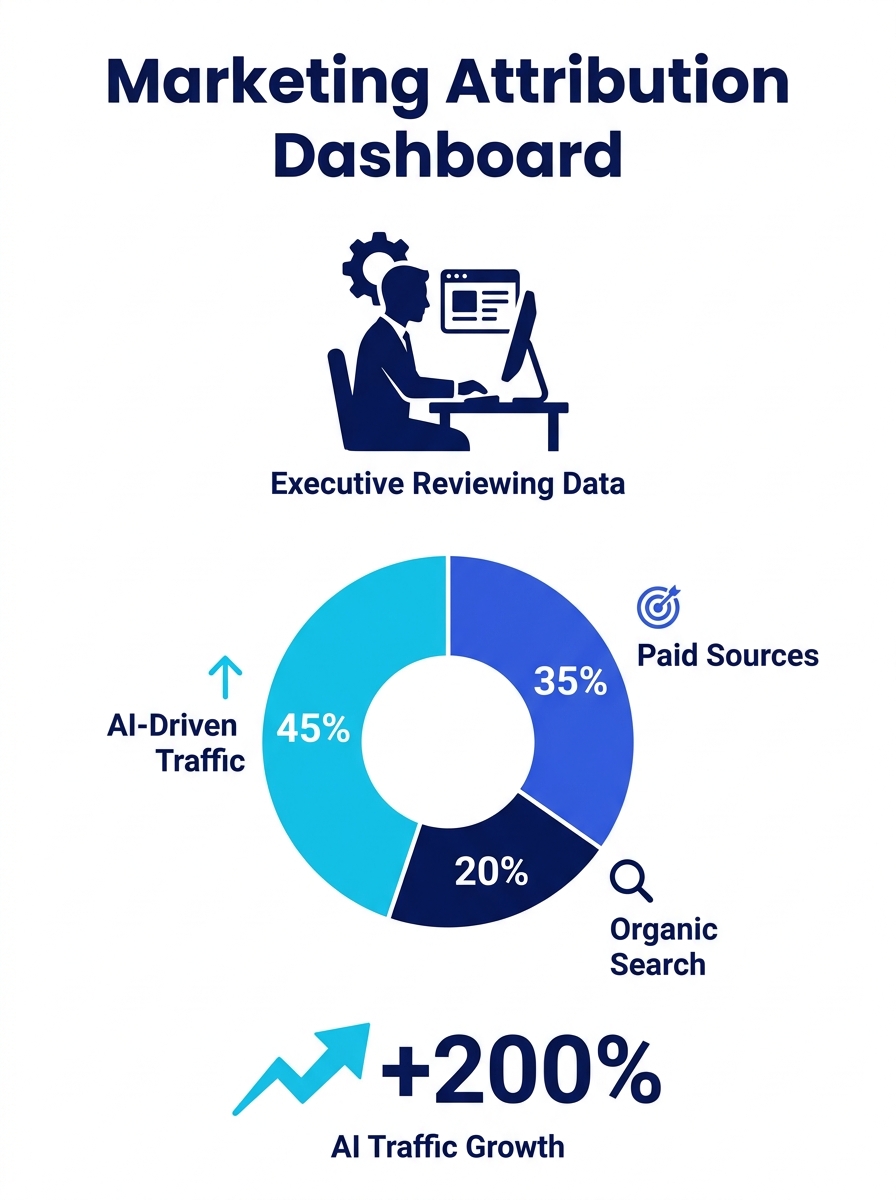
Measurement Approach Shifts from Single-Method to Triangulated Validation
The industry debate between marketing mix modeling and multi-touch attribution as competing approaches has largely concluded, according to the Forbes analysis. The emerging consensus centers on triangulation: operating MMM, MTA, and incrementality testing in parallel, with each method validating and informing the others.
Skantze explained the rationale for parallel-method deployment. “Measurement is really hard. There are so many variables, and you can’t control for all of them, but by using all the available data and applying different methods, including using a machine learning framework to triangulate between them, marketers can get the best estimate,” he stated.
SaaS-based MMM tools now refresh models daily, replacing the slow consultative process that previously delivered modeling projects months after the decisions they were meant to inform, the report noted. Cross-channel media planning now requires operational teams to monitor underperforming channels in near-real-time before material budget waste occurs.
Executive Data Advisor Dr. Tim Wiegels cautioned that increased tool accessibility does not resolve underlying data-quality constraints. “Measuring based on inconsistent data is a very expensive way to get wrong answers with more confidence,” Wiegels said, adding that companies positioned to benefit are those operating clean data flows, consistent definitions, and trustworthy tracking before deploying MMM, attribution models, and platform reporting.
AI Visibility Becomes Non-Negotiable for Brand Discovery
Brands now compete for the trust of AI agents thrust into end-to-end purchasing workflows, rather than solely for consumer attention, the analysis stated. Toby Coulthard, Chief Product Officer at AI-based enterprise marketing messaging platform Jacquard, characterized AI-driven purchasing as reinforcing existing consumer-behavior trends rather than creating entirely new patterns.
“Consumers, whether interacting directly or through AI agents, have developed sophisticated filters for inauthentic communication,” Coulthard said. “When an AI agent evaluates brand messaging on behalf of a consumer, it’s looking for genuine value signals, not manipulative tactics.”
János Moldvay, Chief Data Science Officer at Funnel, noted that brands lacking clean structured data face discoverability risk as AI agents prioritize parsable information over unstructured content.
The shift carries implications for paid search specialists managing Performance Max and demand-gen campaigns, where platform AI now controls significant targeting and creative-optimization decisions that were previously marketer-directed. Attribution for these AI-optimized placements requires modeling approaches that traditional last-click or even position-based attribution cannot accommodate, the report indicated.
What This Means for, CMOs
Marketing leaders evaluating agency partners in 2026 must confirm the partner operates measurement infrastructure capable of triangulated validation—not single-method reporting. The 84% of CMOs citing ROI as their primary budget-allocation metric face CFO scrutiny that cookie-based attribution once satisfied with last-touch reporting. That era ended. Agencies still presenting Excel-based MMM refreshed quarterly, or attribution dashboards that ignore AI-agent traffic, deliver answers to questions the business no longer asks.
The operational requirement is data-infrastructure hygiene before measurement-model deployment. Brands lacking consistent UTM taxonomies, clean CRM ingestion, and server-side tracking will generate triangulated models that confidently boost bad data across three methods instead of one. The agency-briefing question shifts from “What attribution model do you use?” to “Show us your data-validation workflow before models run.” Partners unable to answer that question build measurement on assumptions the CFO will dismantle in the first budget review.
AI-agent commerce projected to represent up to 20% of e-commerce by 2030 means brand-entity clarity, structured product data, and authentic value signaling become prerequisites for discovery—not search-rank optimizations. Agencies proposing SEO roadmaps focused solely on keyword rankings rather than entity markup, schema deployment, and how AI agents parse brand information operate in a framework already deprecated by platform rollout schedules. The measurement rebuild is structural, not incremental.