From Entity Clarity to Brand Authority: Why 2026 SEO Success Depends on Recognition Beyond Rankings

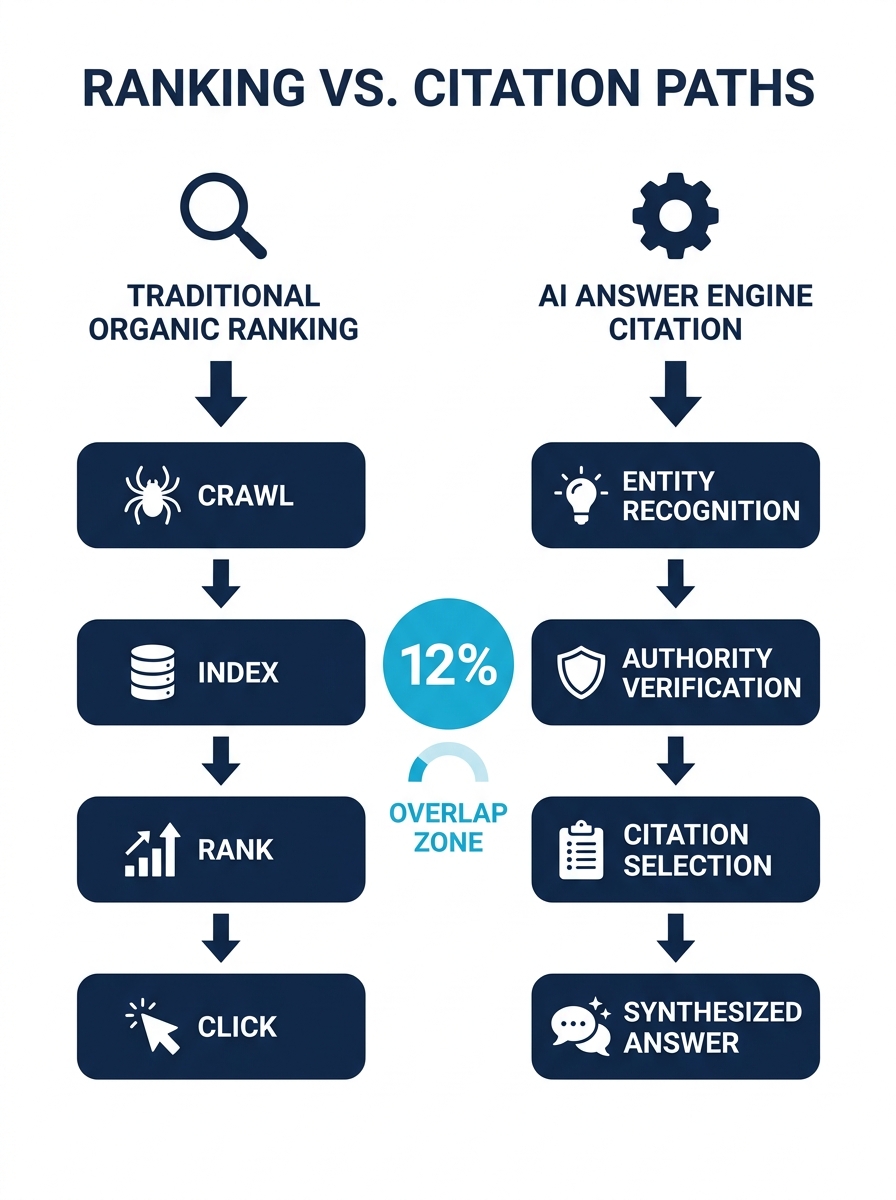
Only 12% of the URLs that appear in AI-generated search answers also appear in the corresponding organic top-ten results for the same queries. That gap reveals a mechanism most marketing teams still misunderstand: the system that decides which brands get cited in AI Overviews, ChatGPT, and Perplexity is fundamentally different from the system that ranks blue links. It runs on entity recognition, citation patterns, and trust signals that exist outside your website. If your enterprise SEO framework still treats ranking position as the primary indicator of search success, you’re optimizing for a scoreboard that fewer users are reading.
How AI Answer Engines Select Their Sources
Traditional organic search works like a library catalog. Google indexes pages, evaluates relevance and authority through links and on-page signals, and returns a ranked list. You can track where you sit on that list and measure clicks accordingly.
AI answer engines work differently. Large language models synthesize responses by pulling from training data, real-time retrieval sources, and entity relationships. They don’t rank pages; they select citations. And the criteria for selection depend on topical authority, content structure, and entity clarity rather than PageRank in the traditional sense.
The practical consequence: a brand can hold positions one through three for a query on Google’s organic results and still be absent from the AI Overview generated for the same query. Mission Media’s analysis of APAC markets found that 73% of brands ranking well on Google are invisible in AI Overviews, a gap wide enough to demand a different strategic response.
This is the distinction between ranking and recognition. Ranking is about your URL’s position in a list. Recognition is about whether AI systems understand who you are, what you’re an authority on, and whether your information is trustworthy enough to cite.
The Identity Layer That AI Systems Actually Read
Entity clarity is the foundation of this entire mechanism. An “entity” in Google’s Knowledge Graph and in LLM training data is a disambiguated thing: a brand, a person, a product, a concept. Your brand becomes an entity when search systems can confidently identify it by name, category, and attributes rather than treating it as one of many websites at a URL.
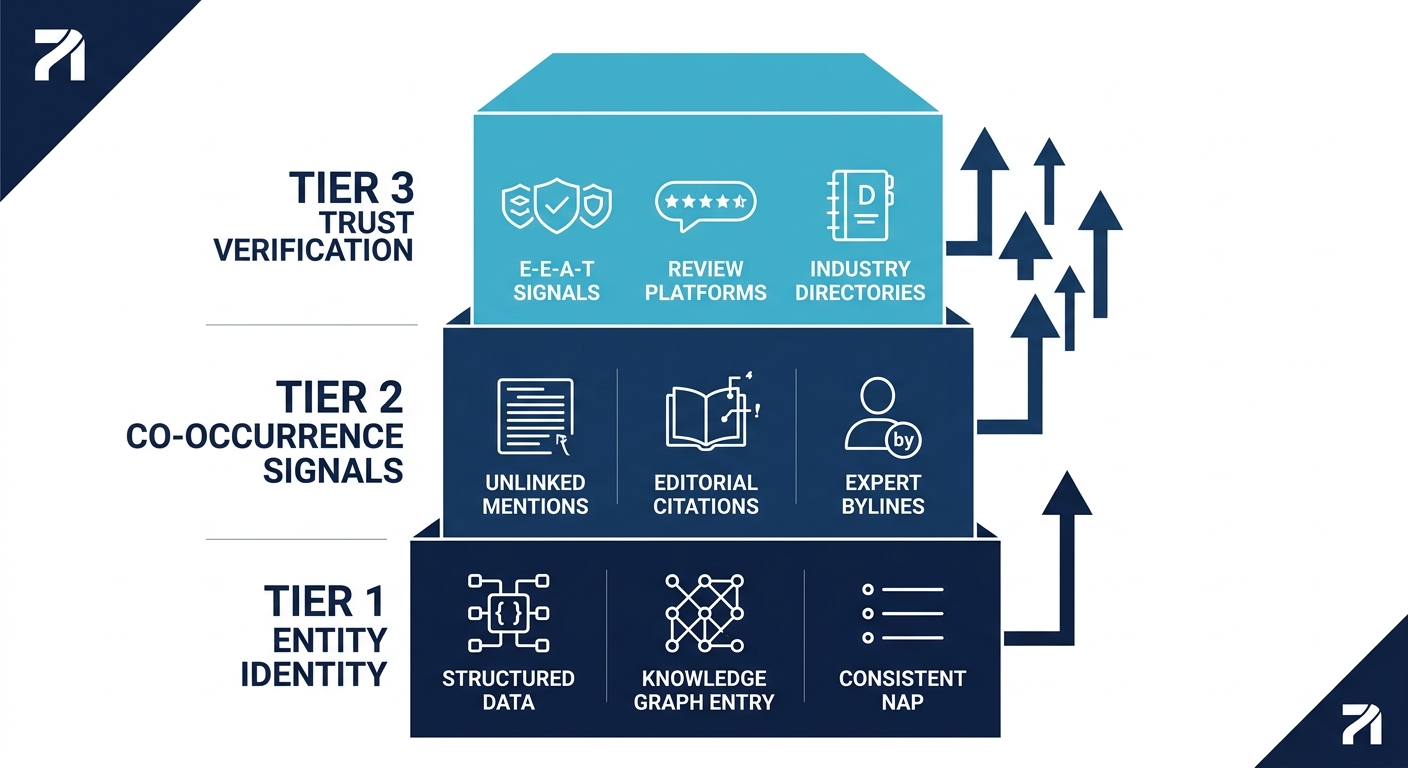
Building entity clarity means establishing consistent, verifiable identity signals across the web. Your Google Business Profile, your structured data markup, your Wikipedia presence (if applicable), your mentions on industry directories and review platforms, your social media profiles, your bylined content on third-party publications. When these all describe the same entity with consistent attributes, AI systems can resolve your brand’s identity with confidence.
Your structured data implementation decisions carry more weight than they used to, and the E-E-A-T signals (experience, expertise, authoritativeness, trustworthiness) that Google has emphasized for years now serve a dual purpose. They function as the verification layer AI systems use to decide whether your brand is genuinely trusted or merely indexed.
For enterprise brands in the Philippines, this translates into practical infrastructure work: ensuring schema markup is correct and consistent, auditing how your brand appears across directories and industry databases, and connecting your content to verified author entities with their own digital footprints.
A brand can hold positions one through three on Google’s organic results and still be absent from the AI Overview for the same query.
Co-Occurrence, Mentions, and the New Authority Graph
Backlinks still carry weight, but their role has shifted. A strong entity SEO strategy in 2026 increasingly values co-occurrence and unlinked brand mentions as authority signals. According to research on brand signals in Google’s ranking systems, brand authority is now driven substantially by co-occurrence patterns, where your brand name appears alongside relevant topic terms across the web, whether or not those mentions include a hyperlink back to your site.
Think of it this way: when your brand is mentioned frequently in the context of “enterprise digital marketing Philippines” or “performance media APAC” across industry publications, forums, and trusted platforms, the AI model absorbs that association during training and retrieval. That’s the kind of citation authority APAC brands need to build deliberately, through PR, thought leadership placements, industry event participation, and expert commentary in relevant media.
Brand mentions function as modern backlinks in this model, signaling authority and relevance to both AI and traditional search engines. They help AI associate your brand with trustworthiness, increasing the probability your content gets recommended when a user asks a related question.
This is why cleaning up low-quality backlinks has become more urgent than ever. A link profile cluttered with spam doesn’t just risk a penalty from Google’s traditional algorithm. It muddies your entity’s association graph, making it harder for AI systems to resolve your brand as a trusted source in a given domain.
What “Visibility” Means When Rankings Tell Half the Story
If search visibility beyond rankings is the goal, then you need measurement infrastructure that goes beyond your standard SEO dashboard. Rank trackers still matter for organic performance, but they capture nothing about how your brand appears (or doesn’t) in AI-generated answers.
The emerging framework involves tracking “generative visibility,” which means systematically querying AI systems with the prompts your customers use and documenting whether your brand gets cited. Search Engine Land’s framework recommends 250 to 500 queries for a mid-market brand, tested on a regular cadence. Other tools recommend a smaller core set of 20 to 50 priority prompts tested weekly, with a larger bank of 100 to 200 for monthly deep analysis.
Both approaches work. The wrong approach is testing ten queries whenever someone remembers. If you’re evaluating an agency or internal team on their ability to drive brand authority signals in 2026, ask them how they’re measuring AI citation rates, what tools they’re using to track generative visibility, and how often they’re running those audits.
Enterprise brands also need infrastructure-level monitoring. Standard dashboards rely on modeled data, and enterprises now require signals from CDN logs and bot-level monitoring to understand how AI crawlers interact with their content. This pairs well with the kind of visibility monitoring stack that catches drops before they become revenue problems.
Info: When evaluating generative visibility, compare your AI citation footprint against your organic rankings quarterly. They often tell very different stories about your brand’s actual presence in how customers discover products and services.
Why Content Structure Determines Whether You Get Cited
LLMs select sources based on how well content is structured for extraction, not for human scanning. This creates a tension that enterprise content teams need to resolve: your content must serve both human readers who skim and AI systems that parse.
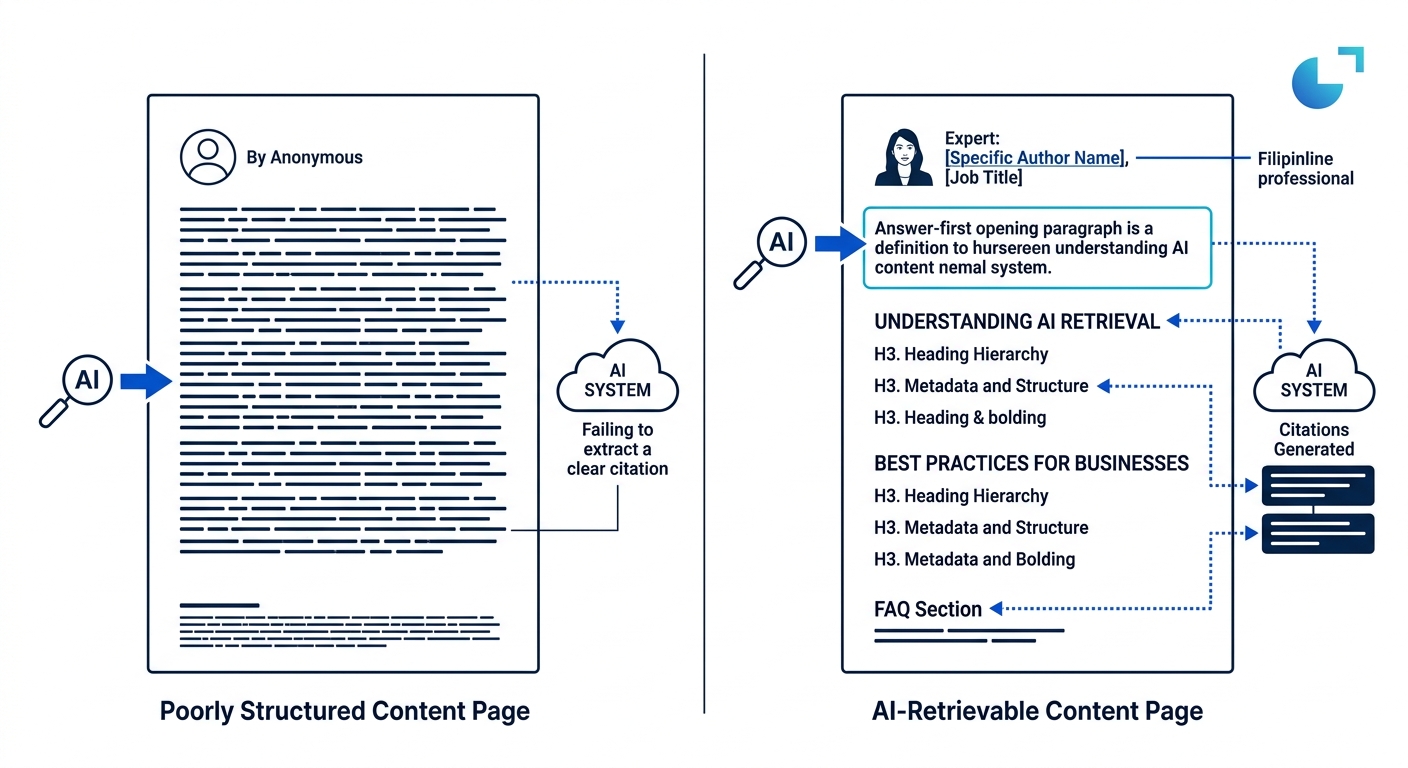
Answer-first content structure wins on both fronts. Each page should surface its key claim or answer within the first 100 words, then support it with structured evidence. Clear heading hierarchies, consistent use of lists for procedural content, and explicit attribution of claims to named experts all improve AI retrievability.
Every piece of content should be tied to a verified expert with an established digital footprint. Anonymous or staff-attributed content performs worse in AI citation selection because LLMs can’t verify authorship. This means your agency or content team needs an author entity strategy: building out author pages with structured data, linking those authors to their LinkedIn profiles and publication histories, and ensuring bylines are consistent across your owned and earned content.
The shift from ranking to trust signals that Google’s AI Mode rollout accelerated makes this content architecture the differentiator between brands that get cited and brands that get summarized away.
Where the Model Breaks
This entity-and-citation model has real limitations, and anyone selling it as a clean replacement for traditional SEO is overselling.
Generative visibility measurement is still immature. Unlike rank tracking, which has twenty years of tooling behind it, AI citation monitoring relies on scraping outputs from models that change their behavior frequently. Results vary by session, by user location, and by the temperature settings of the model. You can track directional trends, but you can’t get the precision that organic rank tracking offers.
The model rewards incumbents. Brands with existing Wikipedia entries, deep publication histories, and long-standing domain authority have a structural advantage in AI citation. Newer brands or those entering new verticals will find it harder to break through in AI answers than in traditional organic results, where a well-optimized page can still outrank established competitors on content merit alone.
The 12% overlap figure captures a snapshot, not a permanent structural divide. Google has every incentive to align its AI Overview citations with its organic index over time. Brands that abandon traditional SEO to chase AI citation alone are making a bet that the two systems will remain separate, and that bet might not age well.
And finally, the APAC context introduces additional complexity. Citation authority builds differently in markets where English-language content competes with Tagalog, Bahasa, or Thai. AI models trained predominantly on English-language data may under-represent brands whose primary content and mentions exist in local languages. For Philippine enterprises, this means bilingual entity strategies carry extra weight: your English-language entity footprint needs to be strong enough for LLMs to recognize, while your Filipino-language content serves your actual customers.
Both systems overlap and diverge in ways that shift quarterly. An enterprise SEO framework that accounts for traditional ranking signals and entity-driven citation signals simultaneously, with separate measurement for each, gives you coverage across the full surface area where your customers discover brands. The framework that ignores either side leaves a gap competitors will fill, probably sooner than you’d expect.