The Content Production Bottleneck: Why Filipino Agencies Lose 60% of Revenue to Workflow Chaos

Ogilvy consolidated its social media operations across 16 APAC markets into a single unified offering, with content production centers in Manila, Bali, and Wuxi serving as the execution backbone. As Campaign Asia reported, the restructuring was driven by a recognition that “the way brands show up on social media in APAC needs better connection—with culture, with brand, and with business.” That kind of centralization doesn’t happen on a whim. It happens because the alternative is bleeding money through fragmented workflows, inconsistent approval chains, and content that shows up late or off-brand. Every mid-size to large Filipino agency managing multi-platform content faces the same structural problem, even if few have named it as directly.
The Old Cadence: When Content Volume Was Manageable
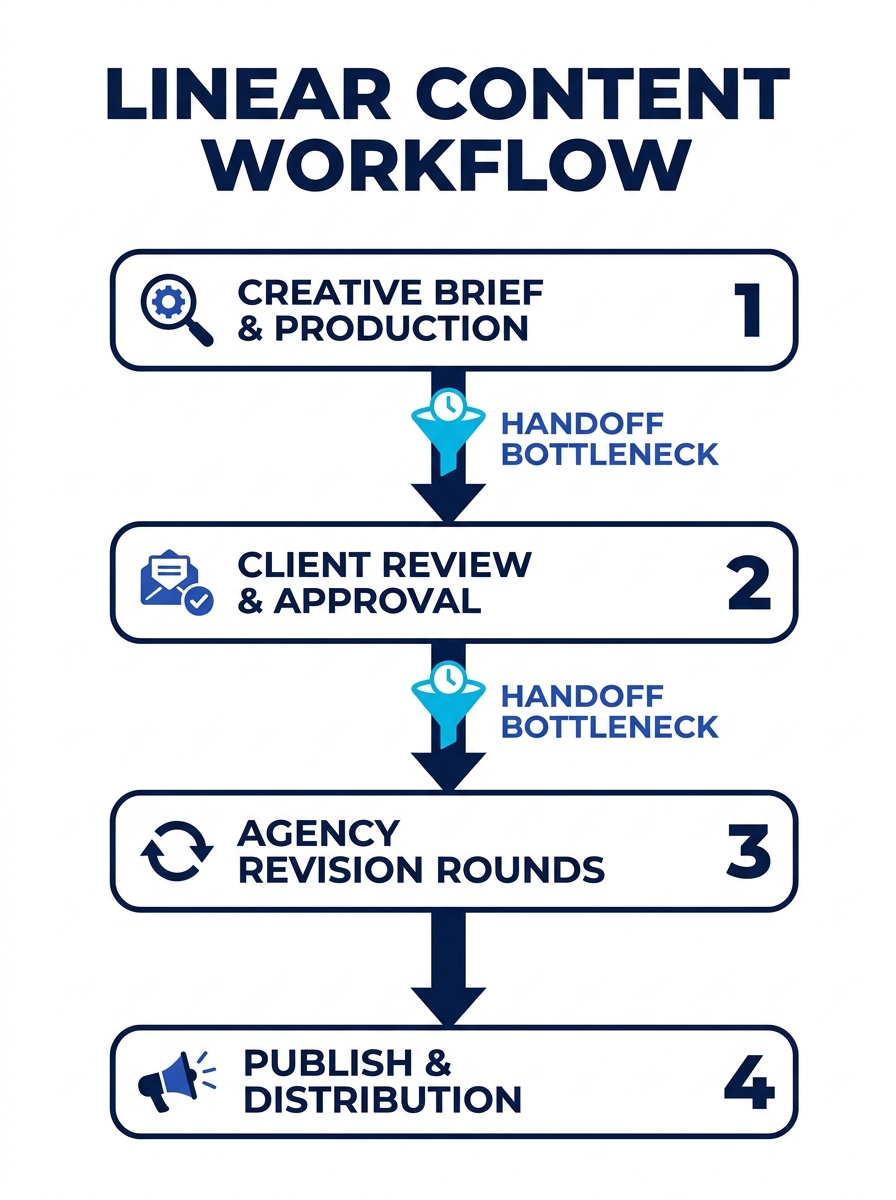
Philippine agencies operated comfortably under a model built for lower content volume through most of the 2010s. A brand might need a handful of social posts per week, a monthly blog cadence, maybe a quarterly campaign burst. The agency content management model looked like this: a creative lead received a brief, produced the work, sent it to a client-side marketing manager for approval, got feedback over email, revised, and published.
The workflow was informal. It worked because volume was low enough that one or two people on each side could hold the entire content calendar in their heads. Briefs lived in email threads. Approvals happened over Viber or text. Version control meant naming files “FINAL_v3_revised_ACTUAL.psd.” Nobody tracked time-to-publish because nothing moved fast enough to warrant it.
This was the operating model when most Philippine agencies were handling five to ten content pieces per client per month. It broke when that number climbed to thirty, fifty, or a hundred.
The Volume Spike That Exposed the Cracks
The shift happened gradually and then all at once. Platform algorithms began rewarding posting frequency. Instagram moved from a photo-first grid to Reels, Stories, carousels, and static posts, each requiring different formats and creative treatments. TikTok entered the Philippine market with an intensity that demanded near-daily publishing. Facebook, still the dominant platform in the Philippines, had already pushed brands toward video-heavy feeds.
Brands that had been comfortable with twelve posts a month suddenly needed forty to sixty pieces of content to stay visible across platforms. Each piece came with its own format requirements, copy lengths, aspect ratios, and platform-specific best practices.
The informal workflow didn’t scale. Creative teams that used to manage three active briefs at a time were now juggling twelve. The email-and-Viber approval chain that worked for a handful of posts per week collapsed under the weight of daily publishing schedules. Content sat in approval limbo while trends passed. Assets got lost between threads. Nobody could tell, on any given Tuesday, which posts were approved, which were in revision, and which were still waiting on client feedback.
As Sprout Social’s research into APAC social media leadership found, social media leaders across the region were juggling content calendars, project management, and reporting simultaneously, making it easy to miss emerging trends entirely. The Philippine market felt this acutely because agencies here tend to run leaner teams relative to the content volume they’re expected to produce.
The Eight-Day Approval Cycle
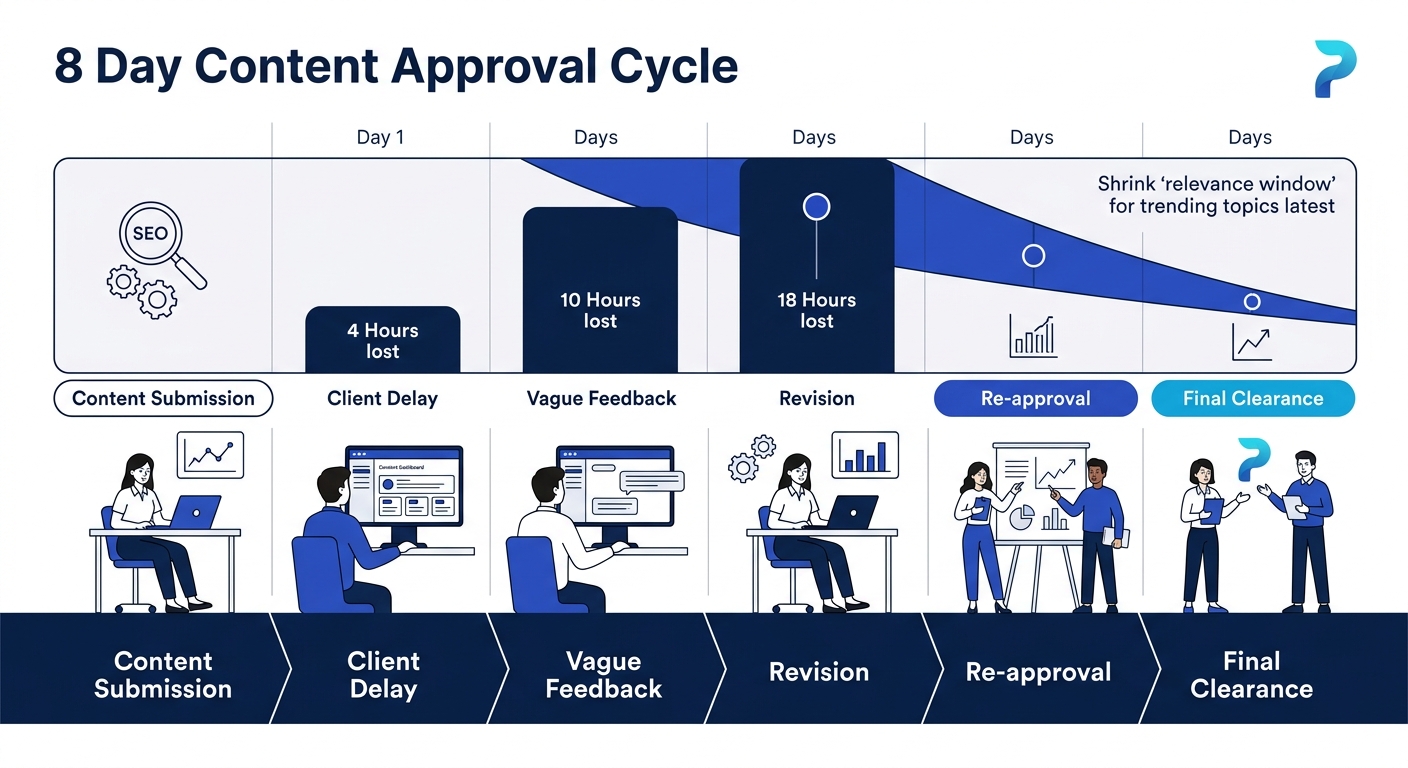
The content approval process became the single biggest drag on agency throughput. SocialPilot’s analysis of agency operations documented an average eight-day approval cycle for a single piece of content. Eight days from “content submitted for review” to “approved and scheduled.” For context, a trending topic on Philippine social media has a useful lifespan of roughly 24 to 72 hours.
That eight-day cycle has a specific anatomy. Day one: the content is submitted. Days two through four: the client-side contact is busy with other priorities and hasn’t opened the link. Day five: feedback arrives, but it’s vague (“make it more engaging”) or contradicts the original brief. Day six: the creative team revises. Day seven: the revision goes back for re-approval. Day eight: it’s finally cleared.
Multiply that cycle by forty pieces of content per month per client, and the math becomes punishing. Creative teams spend more hours on administrative coordination, chasing approvals, managing revision cycles, reconciling conflicting feedback, than on actually producing the work. Growth Rocket’s analysis of publishing workflows identified this pattern as one of the most underestimated causes of agency revenue loss and client churn.
When creative teams spend more hours chasing approvals than producing work, the agency’s revenue model inverts: you’re billing for coordination overhead, not creative output.
The revenue impact compounds. Slow approvals mean missed publishing windows. Missed windows mean lower content performance. Lower performance triggers client dissatisfaction. Dissatisfied clients either demand more content to compensate (increasing the workload without increasing the retainer) or leave entirely. The agency loses margin on the way down and loses the account at the bottom.
How APAC Content Operations Started Adapting
The response across the APAC region came in three overlapping waves.
Structured workflow adoption
Agencies began mapping their content production workflow from ideation through publication, tracking metrics that had previously been invisible. Average time-to-publish. Percentage of content that misses target publication dates. The ratio of team hours spent on administrative coordination versus creative work. As one workflow analysis recommended, tracking these metrics consistently is what separates agencies that can identify their bottlenecks from those that just feel busy all the time.
Filipino agencies that serve enterprise brands like Ayala, Metrobank, and Manulife were among the first to adopt structured content calendars with built-in approval gates, escalation paths for stalled reviews, and auto-publish rules for pre-approved content categories. The discipline required to serve these clients forced operational maturity that smaller agencies still struggle to implement.
Approval chain redesign
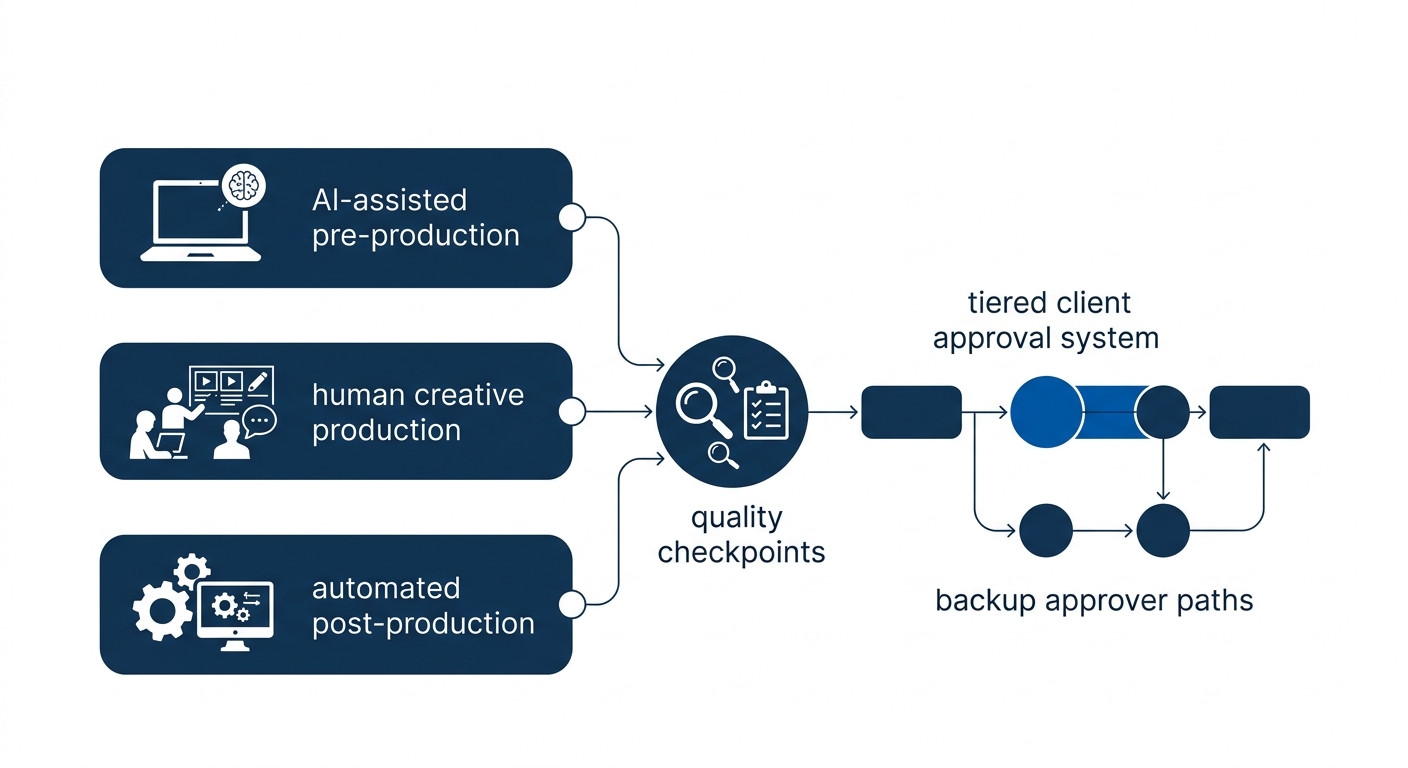
The single-approver problem turned out to be one of the most fixable bottlenecks in the social media content pipeline. When one person on the client side holds veto power over every piece of content, and that person is a VP of Marketing with seventeen other priorities, everything stalls. Agencies that introduced backup approvers, tiered approval authority (junior approvers for routine posts, senior sign-off only for campaign launches), and auto-approval triggers for content that hadn’t received feedback within 48 hours saw their time-to-publish drop by meaningful margins.
This matters especially for brands evaluating social media marketing services from Philippine agencies. The question to ask during a pitch isn’t “how good is your creative?” Every agency will show you beautiful work. The question is “what does your approval workflow look like, and what happens when my team doesn’t respond in time?”
AI-assisted production tiers
MartechAsia reported that more than half of APAC social media teams now view AI as important to their operations. Philippine agencies have been slower to adopt AI tools for content generation than their counterparts in Singapore or Australia, partly because labor costs are lower and partly because clients in the Philippine market remain cautious about AI-generated copy for brand communications.
Where AI has made the biggest difference in Philippine APAC content operations is in the pre-creative and post-creative stages: brief templates, metadata tagging, format adaptation (resizing a carousel for different platforms), caption variant generation for A/B testing, and automated QA checks. These tasks used to consume significant creative hours. Automating them freed teams to focus on the high-judgment, culturally specific work that Filipino creatives do well.
The Organizational Fragmentation Problem Underneath
Workflow tools and approval redesigns address symptoms. The deeper issue is organizational, and it’s one that Ekimetrics and the Marketing Society identified in their research on CMO challenges: fragmentation across teams, tools, and reporting structures creates drag that no single platform fix can resolve. We’ve written about how this organizational fragmentation affects marketing leadership broadly, and the content production version of the problem is a direct expression of that same dynamic.
In a typical mid-size Filipino agency, the social media team uses one tool for scheduling, the design team tracks assets in a shared drive (or worse, individual desktops), the account manager communicates approvals through a different channel than the creative brief, and the strategist measures performance in a dashboard disconnected from all three. Nobody has a single view of where content is in the pipeline at any given moment.
Warning: If your agency can’t tell you, on any given day, exactly how many content pieces are awaiting approval, in revision, or scheduled for the next week, that’s the bottleneck talking. The inability to answer that question is the problem.
When you’re building or revising your digital marketing strategy, the content production workflow deserves as much attention as the channel strategy or the media plan. A brilliant content strategy executed through a broken production pipeline delivers the same results as a mediocre strategy: late, inconsistent, and more expensive than it should be.
The State of Play
Philippine agencies sit at an inflection point. The ones that have invested in structured content production workflows, defined approval paths, measured time-to-publish, clear escalation protocols, and tiered AI assistance, are pulling ahead in client retention and margin stability. The ones still operating on the old informal model are burning creative talent on coordination work and losing clients to agencies that can publish faster and more consistently.
The gap between these two groups will widen as content volume demands continue climbing. Video-first platforms aren’t slowing down. Multi-format publishing across four or five channels simultaneously is baseline expectation for enterprise brands in the Philippines and across the broader APAC market. And Philippine agencies, positioned as they are within that broader APAC content operations landscape, will either build the operational infrastructure to match that demand or keep losing revenue to the chaos they’ve grown used to tolerating.
The agencies that thrive over the next few years won’t necessarily be the ones with the best designers or the cleverest copywriters. They’ll be the ones whose systems let those talented people actually do their work, instead of spending half their week chasing a Viber message that says “approved, but can we change the color?”