Platforming Social Media: Build Authority Fast

Platforming social media to build authority depends on platform-specific content formats, consistent posting cadence, and dialogue-driven engagement. Algorithms on every major network now prioritize content that stimulates conversation and community interaction over raw posting volume, according to expert consensus reported by Search Engine Journal.
Algorithms Have Shifted Toward Conversation Depth
The old playbook for platforming social media — post often, use trending hashtags, chase impressions — doesn’t compound into authority the way it once did. Platform algorithms across Meta, TikTok, LinkedIn, and X have evolved to measure engagement quality: replies, saves, shares into DMs, time spent reading comments. Search Engine Journal’s survey of more than 20 industry experts confirmed that qualitative metrics are now central, with platforms prioritizing content that ignites reactions and promotes community interaction. A single post generating 40 genuine comments outperforms 10 posts with scattered likes in terms of algorithmic lift, because the algorithm interprets sustained conversation as a signal that the content creator deserves wider distribution.
For Philippine brands evaluating how to approach this, the question to ask an agency partner isn’t “how many posts per week?” but “what’s the engagement quality benchmark per post, by platform?” The Institute for Public Relations documented that organizations need to carefully craft their social media teams and plans to facilitate personable interaction, and that failure to do so communicates distance and damages credibility over time. An agency that reports only reach and impressions without conversation metrics is measuring the wrong things. The right reporting framework tracks reply rates, average comment length, share-to-impression ratios, and DM-driven inquiries per platform on a weekly or biweekly cadence.
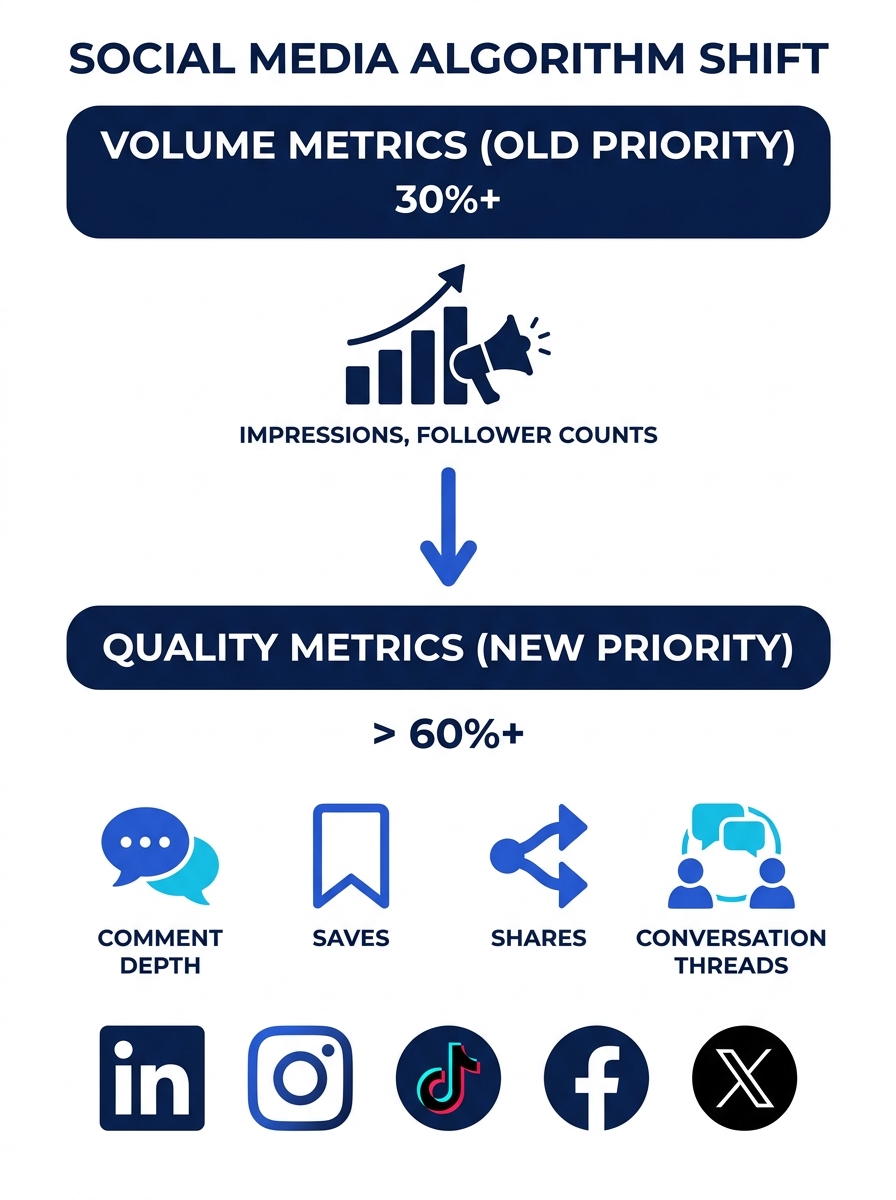
What does this look like in practice? It means brands that invest in responding to every comment, asking follow-up questions in replies, and designing posts that invite specific responses — opinion prompts, low-barrier challenges, direct asks — build authority signals that compound over weeks. Brands that schedule-and-forget see diminishing returns as algorithms deprioritize one-directional content. And the distinction matters most for brands in competitive Philippine verticals like financial services, real estate, and retail, where audience trust is the primary differentiator between brands that look similar on paper. When an enterprise brand like a bank or a property developer shows up in comments engaging with individual customer questions, the signal it sends to both the algorithm and the audience is that this account is run by people who care, which is the behavioral foundation that eventually converts followers into leads.
Platform-Specific Formats Determine Whether Authority Compounds
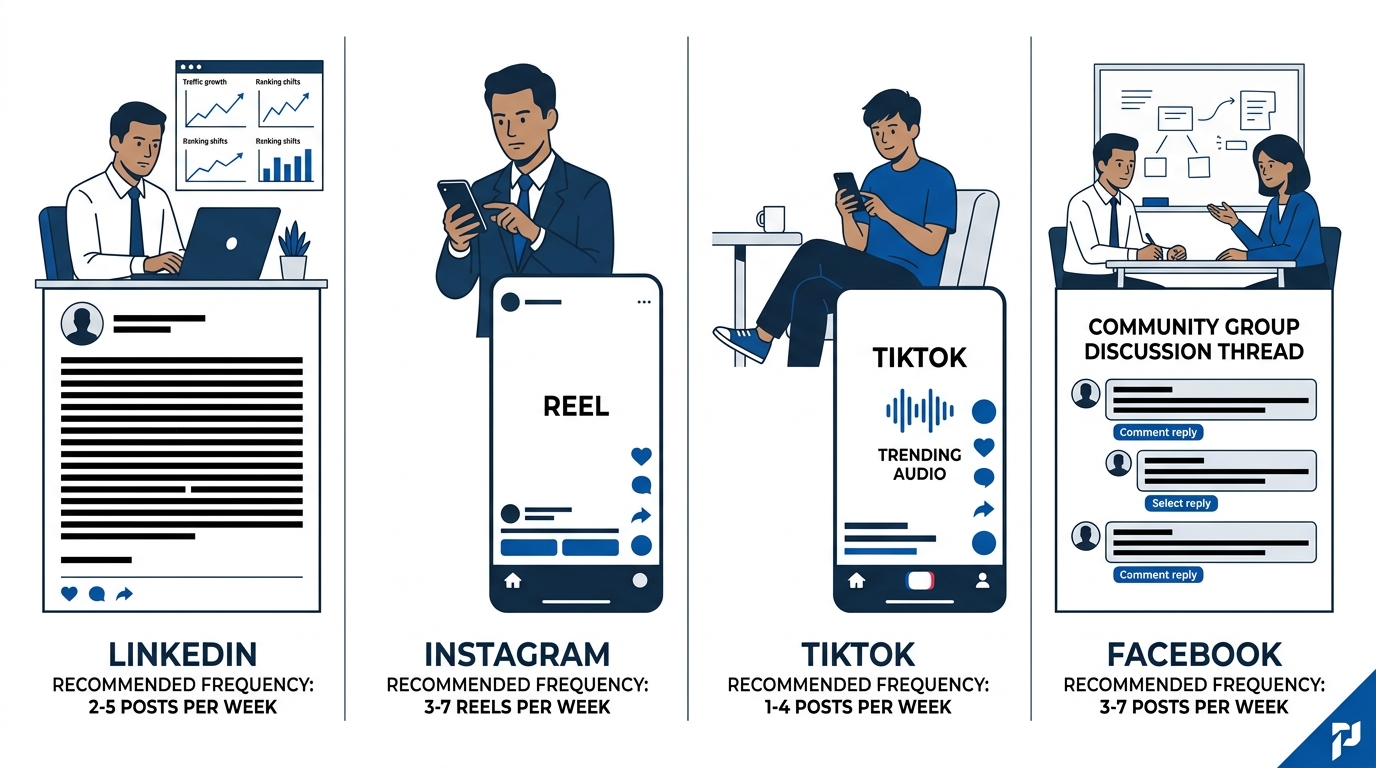
Why does the same brand voice land differently on LinkedIn than on Instagram or TikTok? Because each platform’s algorithm weights different content formats, and authority builds through format fluency. LinkedIn rewards long-form text posts with industry data and key takeaways, and 2-3 high-value posts per week outperform daily filler there. Instagram and TikTok reward Reels and short-form video at a cadence of 3-5 posts per week, with 3-5 niche hashtags per post to reach targeted rather than generic audiences. Facebook rewards community-building through Groups and authentic video discussion at 3-4 posts per week. X rewards real-time spontaneity and conversation threading at a higher frequency of 2-3 posts per day. These aren’t arbitrary recommendations; they reflect how each platform’s discovery feed selects content to surface to non-followers.
The strategic error most Philippine enterprise brands make when platforming social media is treating all channels as distribution outlets for the same content. Sprout Social’s branding research showed that brands like Chipotle build platform-specific identities, meme-forward on Instagram and community-responsive on X, and that this specificity creates brand awareness precisely because each platform audience encounters content shaped for how they browse. An Ayala property brand, for instance, would position thought leadership on LinkedIn for B2B partnerships while using TikTok to showcase lifestyle content aimed at a younger buyer demographic. Same brand, entirely different formats, different cadences, different success metrics. The agency delivering the work should present a content calendar that reflects these differences clearly, with distinct creative briefs per platform rather than a single set of assets resized for different aspect ratios.
“There is a lot of noise when it comes to social media, but the goal isn’t to be loud; it’s to be clear,” noted brand strategist Erica Papacosta in an interview with Business.com. Clarity means tailoring voice and format to each platform’s native behavior. When you’re evaluating an agency’s approach to social media marketing services, the first deliverable to scrutinize is the platform-specific content calendar. If every platform has the same creative and the same copy, that’s a warning sign. Authority builds through format fluency; it erodes through format laziness. And budget should follow performance: Salt Marketing’s guidance is to allocate budget strategically across platforms and campaigns, monitoring results per channel and shifting spend toward whatever drives the strongest quality-engagement signals rather than the largest raw reach numbers.
This connects to how brands should think about the relationship between entity clarity in search and brand authority. Google’s entity recognition systems increasingly treat strong, consistent social presence as a trust signal. A brand that shows up on LinkedIn with one voice, on Instagram with another, and goes silent on Facebook sends a fragmented signal both to human audiences and to the search engines trying to build a coherent entity profile. Platform-specific content doesn’t mean platform-inconsistent identity. The brand personality stays the same; the format and cadence adapt.
Consistency Compounds Authority When Paired With a Feedback Loop
Adobe’s research on posting habits found that consistent posting is one of the most critical factors for social media growth, yet remains one of the hardest habits for organizations to maintain. The reason it matters goes beyond algorithm favorability. Consistent output trains the audience to expect your content, and audience expectation is the behavioral foundation of authority. When followers anticipate your next post, they’ve already granted you a position in their attention economy, and that’s earned trust that converts followers into advocates over time.
When followers anticipate your next post, they’ve already granted you a position in their attention economy. That’s earned trust, and it converts followers into advocates.
Horizium’s research reinforced this, showing that brands maintaining a steady posting schedule improve their chances of appearing in discovery feeds, increasing visibility among users who don’t already follow them. Storykit documented a case where four years of consistent daily posting, without any single breakout campaign, drove compounding growth that no individual content piece could explain. A HockeyStack study analyzing data from 150 B2B SaaS companies found that consistent social engagement correlated directly with pipeline growth. The pattern across every dataset points the same direction: regularity beats brilliance when it comes to authority accumulation.
But consistency without a feedback loop is noise on repeat. Brands need quarterly analytics reviews tracking reach, engagement rate, and demographic shifts by platform. What worked on Instagram Reels in Q1 may underperform by Q3 as the algorithm adjusts its distribution weights. The difference between brands that build authority and brands that plateau is whether they adjust based on data or keep publishing on autopilot. This is also where social authority intersects with search: brands already investing in content that drives organic conversions should view social as a parallel compounding channel, not a separate silo. And sharing customer testimonials and reviews on social platforms builds credibility directly, creating a content format that serves both consistency (testimonials are easy to produce regularly) and authority (third-party validation is more persuasive than any first-party claim). When brands combine regular testimonial content with behind-the-scenes transparency and data-driven industry insights, they create a content mix that compounds across expertise, trust, and relevance simultaneously.
Where Speed and Sustained Authority Collide
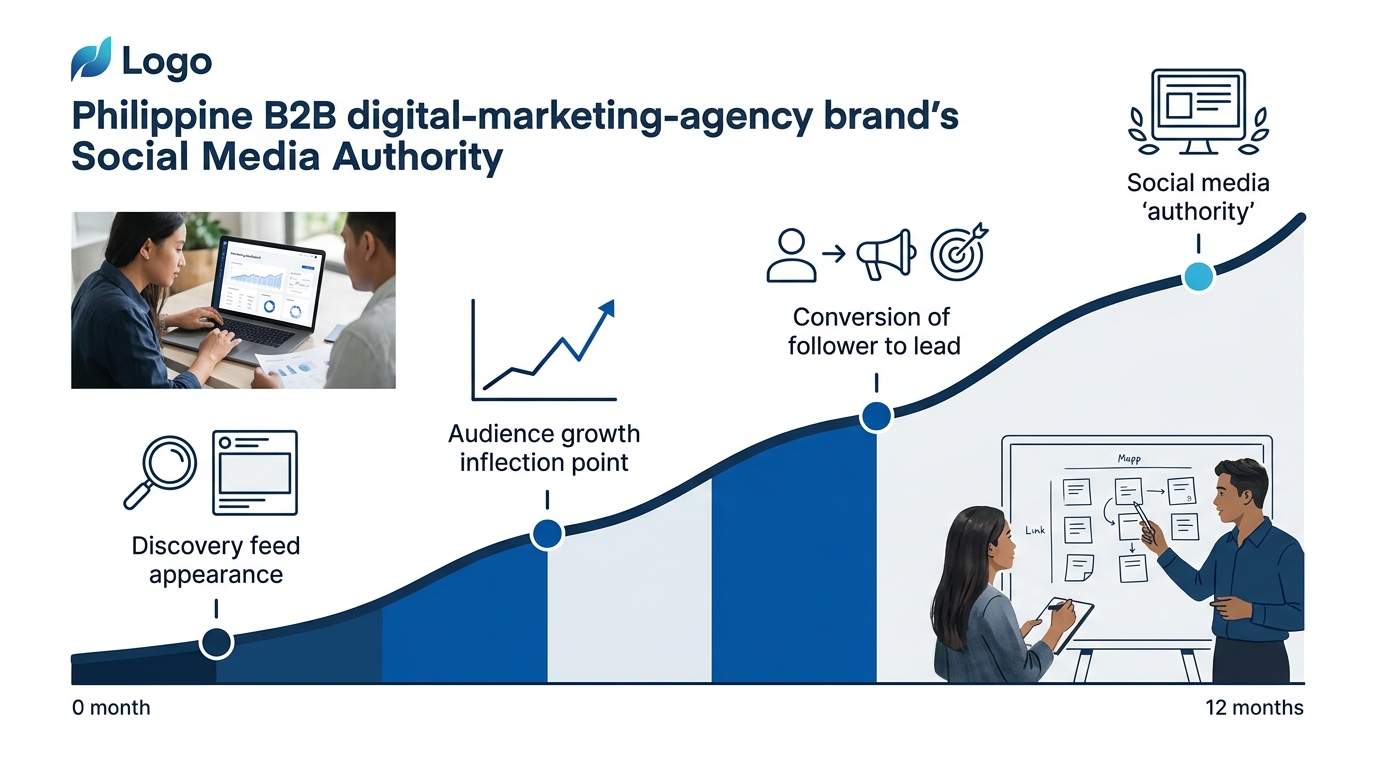
The promise of “build authority fast” has a tension baked into it. Speed favors early adoption of new platform features, aggressive posting cadences, and AI-assisted content production. Sustained authority favors patience, format mastery, and earned trust that comes from months of consistent value delivery. Both impulses are real, and they pull in different directions. Brands that sprint to claim early-mover advantage on a new feature — LinkedIn Live Events, TikTok Shop, Instagram Threads — do gain visibility bumps, because algorithms reward adoption of native tools. But that visibility converts to lasting authority only if the brand continues showing up after the novelty wears off, and most brands don’t.
AI-assisted content creation accelerates the first half of the authority equation: ideation, outline, first-draft copy, A/B headline testing. It does nothing for the second half: genuine voice, earned community relationships, the kind of brand distinctiveness that makes people follow you instead of a competitor saying the same things. Brands that use AI to get to the starting line faster and then invest the time savings in real engagement — replying to comments, joining conversations, adapting to platform shifts — are the ones pulling ahead. Brands that use AI to produce more content at higher volume without increasing engagement capacity are running faster on a treadmill. The output goes up but the authority stays flat, because algorithms measure audience response, not publisher effort.
For Philippine brands evaluating how to approach platforming social media with an agency, the honest framing is this: authority can be accelerated, but it cannot be manufactured. An agency can shorten the path by bringing platform expertise, content production systems, and analytics infrastructure that most in-house teams don’t have the bandwidth to build. But the brand still has to show up in the comments, still has to adapt its voice to what resonates, and still has to treat social as a long-term investment rather than a campaign with an end date. The brands building real authority right now, especially as Google’s AI search redesign shifts traffic away from traditional organic results, are the ones treating social as an owned-audience hedge against platform dependency. Search algorithms keep changing the rules. Social followers, if you’ve earned their attention through consistent, clear, platform-native content, stay yours. That’s the asset worth building, and the reason speed without substance never survives the first algorithm shift.