How to Build a Customer Data Platform Strategy

What Is a Customer Data Platform?
A Customer Data Platform (CDP) is a packaged software that creates a persistent, unified customer database accessible to other systems. Unlike traditional data management tools, a CDP collects data from all touchpoints, resolves customer identities across channels, and makes this unified view actionable for marketing and customer experience teams.
In an era where customer expectations for personalization continue to rise, having a coherent customer data platform strategy has become essential for businesses looking to compete effectively. This guide walks you through building a CDP strategy that delivers measurable results.
Why Your Business Needs a CDP Strategy
Before diving into implementation, understanding the strategic value of a CDP helps secure organizational buy-in and guides decision-making throughout the process.
Key CDP Benefits
Unified Customer View: Consolidate data from websites, apps, CRM, point-of-sale, email, advertising, and customer service into a single customer profile.
Better Personalization: With complete customer context, deliver relevant experiences across every channel and touchpoint.
Improved Marketing Efficiency: Reduce wasted ad spend by targeting the right customers with the right message at the right time.
Enhanced Customer Experience: Recognize customers across channels and provide consistent, contextual service.
First-Party Data Independence: Build your own data asset as third-party cookies phase out and privacy regulations tighten.
Data Democratization: Make customer insights accessible to teams across the organization without requiring technical skills.
Assessing Your Current Data Landscape
A successful CDP strategy begins with understanding where you are today. Conduct a thorough assessment of your existing data infrastructure.
Data Audit Questions
- What customer data sources currently exist?
- How is data currently stored and organized?
- What systems need to share or receive customer data?
- What are the current data quality issues?
- How do teams currently access customer information?
- What privacy and consent mechanisms are in place?
Common Data Sources to Inventory
- Website and app analytics
- CRM systems
- E-commerce platforms
- Email marketing tools
- Advertising platforms
- Customer service systems
- Point-of-sale data
- Social media platforms
- Survey and feedback tools

Defining Your CDP Goals and Use Cases
The most common reason CDP implementations underperform is a lack of clear use cases and success criteria. Define specific goals before selecting a platform.
High-Value CDP Use Cases
Customer Segmentation: Create dynamic segments based on behavior, preferences, and value for targeted marketing campaigns.
Personalized Recommendations: Deliver product or content recommendations based on individual customer profiles and behavior patterns.
Cross-Channel Orchestration: Coordinate customer journeys across email, SMS, push notifications, advertising, and on-site experiences.
Predictive Analytics: Identify customers likely to churn, convert, or increase spending and trigger appropriate interventions.
Customer Lifetime Value Optimization: Focus resources on high-value customer segments and develop strategies to increase customer value over time.
Marketing Attribution: Understand which touchpoints contribute to conversions and optimize channel mix accordingly.
Prioritization Framework
Rank use cases by:
- Business impact potential
- Implementation complexity
- Data readiness
- Organizational capability
- Time to value
Start with high-impact, lower-complexity use cases to build momentum and demonstrate value.
Building Your CDP Implementation Roadmap
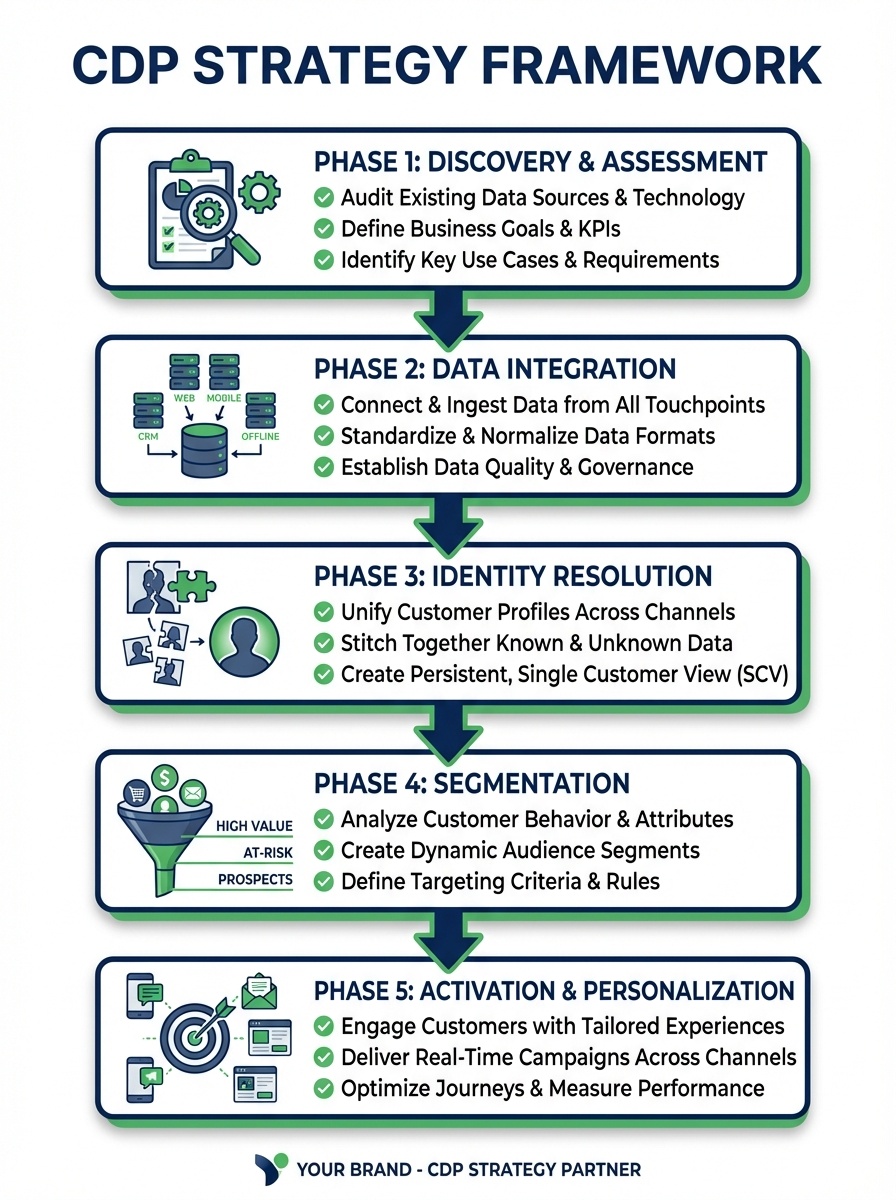
A phased approach reduces risk and allows for learning throughout implementation.
Phase 1: Foundation (Months 1-3)
Objectives:
- Establish data governance framework
- Define identity resolution rules
- Connect primary data sources
- Create initial unified profiles
Key Activities:
- Stakeholder alignment and governance setup
- CDP platform selection and deployment
- Integration with 2-3 priority data sources
- Basic identity resolution implementation
- Initial data quality assessment
Phase 2: Expansion (Months 4-6)
Objectives:
- Expand data source integrations
- Implement first use cases
- Establish operational processes
Key Activities:
- Additional data source connections
- Segment creation and validation
- First activation channel integrations
- Team training and enablement
- Performance baseline establishment
Phase 3: Optimization (Months 7-12)
Objectives:
- Scale successful use cases
- Implement advanced capabilities
- Optimize for performance
Key Activities:
- Advanced segmentation and predictive models
- Cross-channel journey orchestration
- Real-time personalization implementation
- Performance optimization
- Extended team adoption
Identity Resolution: The Core of Your CDP
Identity resolution—matching data from different sources to the same customer—is what transforms disconnected data into unified profiles.
Identity Resolution Approaches
Deterministic Matching: Uses unique identifiers (email, phone, login ID) to confidently match records. High accuracy but limited reach.
Probabilistic Matching: Uses statistical models to infer matches based on similar attributes. Greater reach but potential for false positives.
Hybrid Approach: Combines both methods, using deterministic matches as anchors and probabilistic methods to extend coverage.
Key Identity Resolution Considerations
- Which identifiers will serve as primary keys?
- How will anonymous visitors be handled?
- What matching threshold balances accuracy and coverage?
- How will conflicting data be resolved?
- What happens when customers share devices or accounts?
Building Identity Graphs
An identity graph visualizes the connections between different identifiers associated with a single customer. Understanding how your CDP builds and maintains these graphs is crucial for:
Profile Merging: When two profiles are determined to be the same person, your CDP must intelligently combine data, handling conflicts and maintaining data quality.
Profile Splitting: Sometimes initial matches prove incorrect. Your system needs mechanisms to separate incorrectly merged profiles.
Cross-Device Recognition: Customers interact with your brand across multiple devices. Connecting desktop, mobile, and tablet sessions to a single profile enables true omnichannel personalization.
Customer Segmentation with Your CDP
One of the primary use cases for any CDP is creating actionable customer segments. The quality and precision of your segmentation directly impacts marketing effectiveness.
Types of Segments
Static Segments: Fixed groups based on criteria at a point in time. Useful for one-time campaigns or analysis.
Dynamic Segments: Automatically update as customer attributes or behaviors change. Essential for ongoing personalization.
Predictive Segments: Use machine learning to identify customers likely to take future actions—purchase, churn, or respond to campaigns.
Segmentation Best Practices
- Start simple and add complexity as you learn
- Ensure segments are large enough to be actionable
- Document segment definitions clearly
- Regularly review and optimize segment performance
- Balance personalization with scalability
Example Segment Ideas
High-Value at Risk: Top 20% customers by lifetime value who haven’t purchased in 60 days
Cart Abandoners: Customers who added items to cart in last 7 days but didn’t complete purchase
Product Interest: Customers who viewed a specific product category 3+ times without purchasing
Loyalty Program Candidates: Customers with 3+ purchases who haven’t enrolled in your loyalty program
Data Governance and Privacy
With great data power comes great responsibility. A strong governance framework protects both your customers and your organization.
Governance Framework Elements
Data Quality Standards: Define acceptable levels for completeness, accuracy, timeliness, and consistency.
Access Controls: Determine who can view, export, or act on different data types and customer segments.
Consent Management: Track and enforce customer consent preferences across all data uses.
Data Retention Policies: Establish rules for how long different data types are stored.
Audit Trails: Maintain records of data access and changes for compliance and troubleshooting.
Privacy Compliance
Ensure your CDP strategy addresses:
- Data Privacy Act of 2012 (Philippines)
- GDPR (if serving European customers)
- Industry-specific regulations
- Platform-specific requirements (Apple, Google)
Selecting the Right CDP Platform
CDP platforms vary significantly in capabilities, complexity, and cost. Your selection should align with your specific needs and organizational readiness.
CDP Categories
Data CDPs: Focus primarily on data collection, unification, and integration. Best for organizations with existing marketing execution tools.
Campaign CDPs: Include data capabilities plus campaign execution features like email, journey orchestration, and personalization.
Delivery CDPs: Add real-time personalization and recommendation engines to campaign capabilities.
Evaluation Criteria
- Native integrations with your existing technology stack
- Identity resolution capabilities and flexibility
- Data modeling and transformation features
- Segmentation and audience building tools
- Activation channel support
- Real-time vs. batch processing capabilities
- Ease of use for non-technical users
- Implementation and ongoing support
- Total cost of ownership
Integration Strategy
Your CDP’s value depends on the data flowing into and out of it. Plan integrations strategically.
Data Ingestion Priorities
High Priority: Sources providing identity data and core behavioral information
- Website/app analytics
- CRM/customer database
- E-commerce/transaction systems
- Email marketing platform
Medium Priority: Sources enriching customer understanding
- Customer service interactions
- Social media data
- Survey responses
- Loyalty program data
Lower Priority: Sources for specific use cases
- Third-party data enrichment
- IoT/device data
- Partner data sharing
Activation Integrations
Prioritize integrations that enable your highest-value use cases:
- Email marketing platforms
- Advertising platforms (Google, Meta, etc.)
- Web personalization tools
- SMS/push notification systems
- Customer service platforms
Measuring CDP Success
Establish clear metrics to evaluate your CDP strategy’s effectiveness.
Operational Metrics
- Data ingestion volume and freshness
- Identity match rate
- Profile completeness score
- Data quality metrics
- Platform adoption rate by teams
Business Outcome Metrics
- Marketing campaign performance lift
- Customer acquisition cost reduction
- Conversion rate improvements
- Customer lifetime value increases
- Churn rate reduction
- Time to insight for marketing teams
Common CDP Implementation Challenges
Be prepared for these frequent obstacles:
Data Quality Issues: Garbage in, garbage out. Budget time and resources for data cleaning and standardization.
Organizational Silos: CDPs require cross-functional collaboration. Establish governance structures that bridge departmental boundaries.
Integration Complexity: Legacy systems may require custom development. Prioritize and phase integrations based on business impact.
Change Management: Teams need training and incentives to adopt new tools and processes.
Unrealistic Expectations: A CDP is not a magic solution. Set realistic timelines and communicate that value builds over time.
Building Your CDP Team
Successful CDP implementations require the right mix of skills and roles.
Key Roles
CDP Owner/Product Manager: Owns the strategy, roadmap, and stakeholder alignment
Data Engineer: Manages integrations, data quality, and technical implementation
Data Analyst: Creates segments, analyzes customer behavior, and measures performance
Marketing Technologist: Connects CDP capabilities to marketing execution
Privacy/Compliance Specialist: Ensures regulatory compliance and data governance
Getting Started with Your CDP Strategy
A customer data platform strategy is a journey, not a destination. Start with clear objectives, build incrementally, and continuously optimize based on results.
Immediate Next Steps
- Conduct a data source inventory
- Document current customer data pain points
- Identify 3-5 high-value use cases
- Assess organizational readiness
- Build the business case for stakeholder buy-in
For guidance on leveraging data for marketing success, explore our content marketing services and discover how we can help you turn customer insights into results.
Learn more about data-driven marketing with our guide to effective data-driven marketing in the Philippines, and explore our recommendations for the best digital marketing analytics tools to complement your CDP strategy.