Google Core Update Volatility Spikes Saturday as Two-Week Rollout Nears Completion

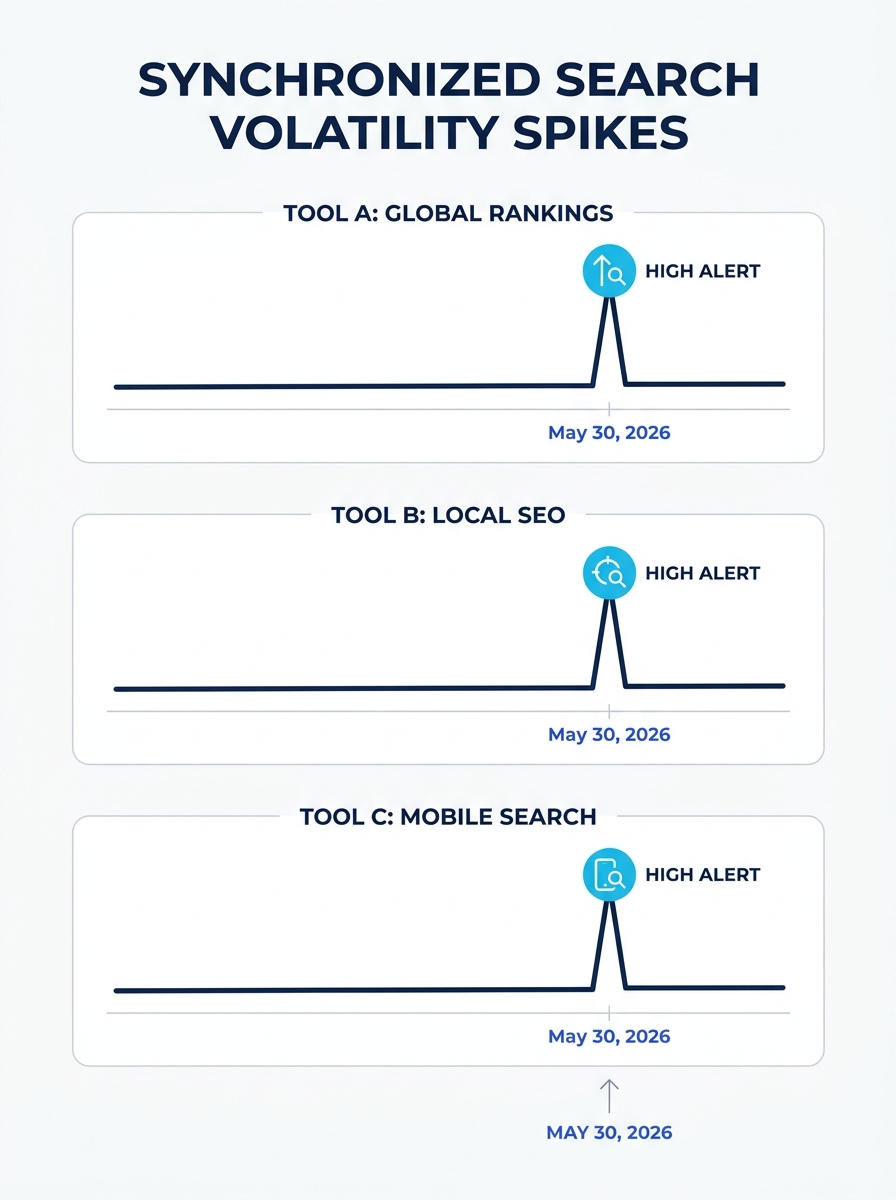
Multiple independent search-ranking monitors recorded sharp volatility spikes on Saturday, May 30, 2026, as Google’s May 2026 Core Update entered its final rollout phase, according to data aggregated by Search Engine Roundtable. The update, announced May 21 during Google’s I/O conference week, is expected to complete its two-week redistribution window in the coming days, with Saturday’s surge matching historical patterns of tail-end volatility before algorithmic stabilization.
TL;DR: Google’s May 2026 Core Update generated significant ranking volatility on May 30, 2026, across eleven independent tracking tools, signaling the update’s final redistribution phase before completion.
Saturday’s spike appeared across Semrush, Advanced Web Rankings, SimilarWeb, Zutrix, Wincher, SERPstat, Sistrix, Accuranker, Mozcast, Data For SEO, and Algoroo monitoring dashboards, with aggregated readings from Wiredboard’s cross-tool tracker confirming system-wide volatility. Search Engine Roundtable founder Barry Schwartz noted that while fluctuations began Friday, May 29, the more pronounced shifts materialized Saturday, consistent with what he characterized as “the tail-end spike we often see before Google announces that the update is done.”
Core Update Timeline and Intensity
Google initiated the May 2026 Core Update on May 21, 2026, stating the rollout would take up to two weeks to complete. The company described it as “a regular update designed to better surface relevant, satisfying content for searchers from all types of sites.” Earlier analysis of the update’s first week documented initial redistribution patterns concentrated among news aggregators and e-commerce platforms, though attribution remained complicated by concurrent AI Mode interface changes.
The update’s second weekend produced more pronounced volatility than its launch period, based on comparison of tracking-tool readings. Webmaster forums including WebmasterWorld and Black Hat World recorded increased discussion volume Saturday evening and Sunday morning, with site operators reporting sudden traffic drops and category-page ranking shifts. “We had 2 days of ‘good’ traffic and this night bahm biggest hit ever,” one forum participant wrote, describing datacenter-level fluctuations that materialized within seconds.
Glenn Gabe, search analyst, posted Saturday examples of “serious volatility in the gambling niche,” identifying the sector as a “hyper-YMYL category” that sees boosted swings during broad core updates. The examples Gabe shared showed multi-position ranking changes across competitive head terms within the sector.
Impact Patterns Across Verticals
Forum participants described varied impact depending on site type and vertical. One operator noted partial recovery of category pages several days after initial drops: “Feels like Google is still adjusting things in waves, honestly.” Another reported adherence to published guidelines, no link purchasing, full transparency, organic growth strategies, while acknowledging “significant” declines that typically reverse when updates conclude.
The volatility occurred as brands across regulated APAC sectors navigate broader ESG messaging scrutiny and adapt to Google’s shift toward in-platform answers over traditional blue-link traffic. Marketing leaders evaluating enterprise SEO services now contend with overlapping variables: algorithmic redistribution, interface redesigns, and AI-mode adoption that together complicate month-over-month attribution.
Enterprise SEO programs typically treat core-update cycles as visibility-redistribution events rather than deterministic ranking shifts. The two-week rollout window Google announced means final positions won’t stabilize until early June, making interim performance snapshots unreliable for strategic decisions. Organizations with managed programs monitor volatility through their agency partners but avoid reactive pivots mid-rollout, according to practitioners advising Fortune 500 clients in the Philippines market.
Verification Through Independent Tracking
The simultaneous spike across eleven independent monitoring platforms strengthens the signal that Saturday marked a distinct algorithmic shift rather than data-collection anomalies. Each tool samples different keyword sets and geographic regions, making synchronized spikes statistically significant. Semrush and SimilarWeb track broad commercial keywords; Accuranker and Wincher focus on rank-tracker clientele; Mozcast monitors Google’s own result-page features. Their convergence on May 30 as a high-volatility date narrows the interpretation window.
Google has not yet issued a completion announcement for the May 2026 Core Update. Historical precedent from March 2026’s update and prior cycles suggests the company typically confirms rollout completion within 24-48 hours after final algorithmic propagation, which Saturday’s tail-end spike pattern indicates may occur early this week.
What Happens Next
Marketing leaders overseeing agency SEO partnerships should expect final visibility positions to settle by mid-week June 2-4, based on the two-week timeline Google announced and Saturday’s tail-end volatility pattern. Brands that brief agencies to produce reactive content mid-rollout risk misallocating resources toward rankings that haven’t stabilized; the standard agency protocol waits for Google’s completion announcement before diagnosing whether drops reflect technical debt, content quality signals, or E-E-A-T gaps.
Organizations already tracking weekly organic sessions and conversion paths through their analytics stack can identify which page categories absorbed the heaviest impact, but the strategic diagnosis, whether to rebuild content, acquire authoritative backlinks, or restructure site architecture, depends on stability. Agencies managing enterprise SEO programs typically schedule post-update audits 7-10 days after Google confirms completion, when rankings have settled enough to map cause-effect relationships between on-page elements and visibility shifts.
The May update’s overlap with AI Mode expansion and interface redesigns means some traffic declines attributed to algorithmic penalty may instead reflect user-behavior shifts toward zero-click answers, a distinction that changes remediation strategy entirely. Marketing directors evaluating whether to escalate budget toward paid channels or double down on organic investment need their agency partners to separate these variables through segmented analysis, a task impossible until the core update itself stops moving the baseline.