Marketing Budget Contraction Hits 7.7% of Revenue as e.l.f. Beauty Demonstrates Counter-Cyclical Digital Allocation Strategy
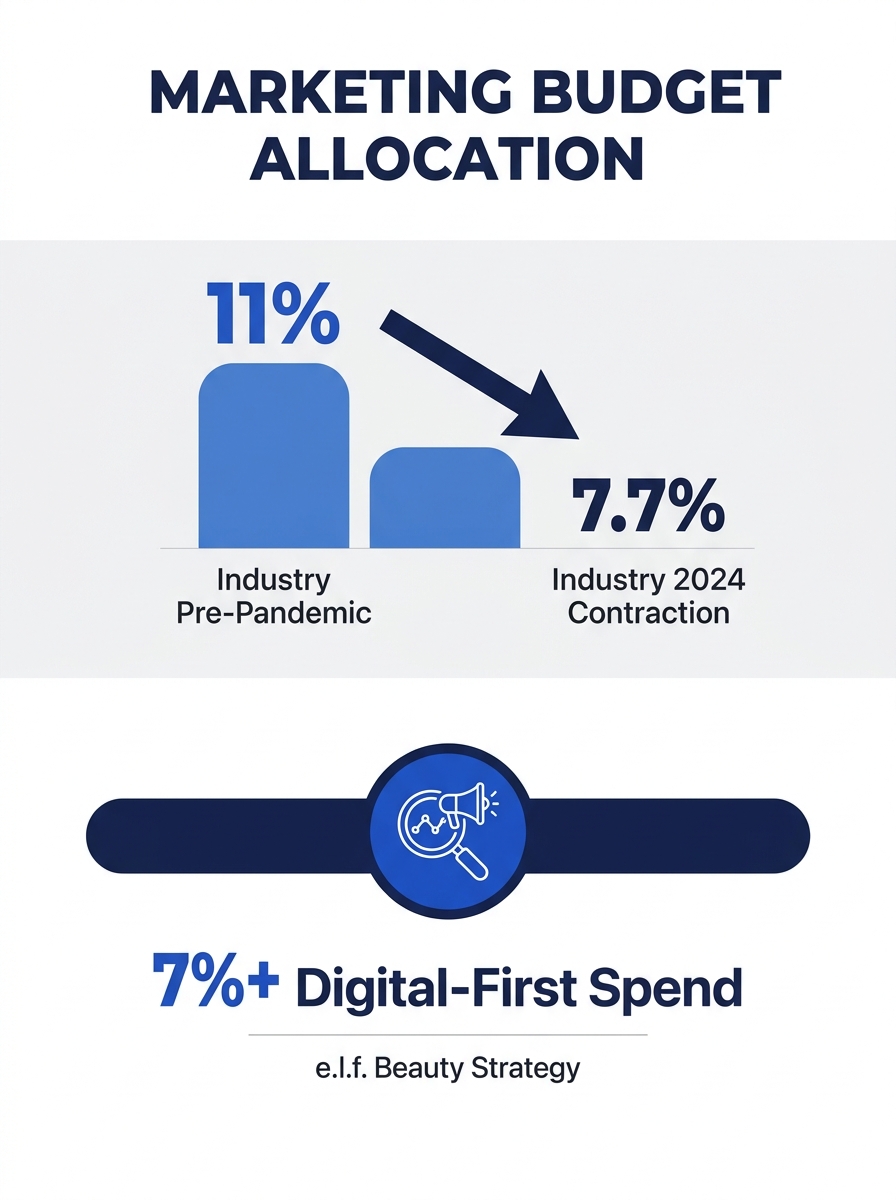
Average marketing budgets dropped to 7.7% of overall company revenue in 2024, down from 9.1% the previous year and marking a four-year post-pandemic average of 8.2% versus 11% in the preceding four years, according to Gartner’s annual CMO Spend Survey reported by markhub24.com. The decline reflects what Gartner VP Analyst Ewan McIntyre characterized as an industry posture of caution and consolidation, even as e.l.f. Beauty crossed the billion-dollar revenue threshold in fiscal 2024 by allocating disproportionately toward digital and social channels while competitors retrenched.
TL;DR: Marketing budgets contracted to 7.7% of revenue in 2024 from a pre-pandemic 11% average, while e.l.f. Beauty’s counter-cyclical digital-first allocation strategy drove consecutive quarterly market share gains and billion-dollar revenue milestone.
The survey data comes as marketing leaders face pressure to justify spend to executive teams and boards amid economic uncertainty. For CMOs evaluating agency partners and channel allocation, the e.l.f. case presents a documented contrast to category norms: the cosmetics brand treated digital and social investment as a compounding growth asset rather than an overhead cost, according to statements from Chairman and CEO Tarang Amin across multiple earnings calls.
Industry Budget Decline Context
The cosmetics category has historically treated marketing as a support function for retail placement, with legacy conglomerates such as L’Oréal, Revlon, and Coty commanding share of voice through broadcast media, department store shelf presence, and celebrity endorsements. That model reinforced incumbent position but left established players slow to reallocate toward digital platforms where Gen Z consumers had shifted media consumption.
E.l.f. Beauty’s marketing budget stood at approximately 7% of net sales five years before fiscal 2024, a figure characteristic of brands benchmarking spend against category convention. The strategic pivot began when leadership chose to treat social media marketing services as the primary growth lever rather than a supplementary channel, a bet premised on the insight that its core consumer was spending the majority of media time on platforms legacy competitors had largely dismissed.
Campaign Architecture and Performance
E.l.f.’s 2019 TikTok campaign anchored around an original commissioned song, “Eyes. Lips. Face.”, generated over five million user-generated videos and nearly ten billion views, making it one of the most successful beauty brand campaigns on the platform, according to verified performance data. Chief Marketing Officer Kory Marchisotto stated that the campaign established TikTok as the brand’s primary brand-building vehicle rather than a supplementary paid-media channel.
The brand extended digital credibility into broadcast with its first Super Bowl commercial in 2023 featuring Jennifer Coolidge, using the Power Grip Primer, a product that had achieved organic traction on TikTok before mass-media amplification. “The inspiration for the campaign came directly from the brand’s community, who had organically embraced the Power Grip Primer,” Marchisotto said in campaign communications.
The 2024 Super Bowl “Judge Beauty” spot featuring Gina Torres and Meghan Trainor delivered a 48% lift in brand search volume within weeks, according to campaign performance records. Marketing executives briefing enterprise digital marketing partners on similar sequencing strategies, social-platform credibility first, then mass-media amplification, now point to e.l.f.’s architecture as a documented case of channel layering that reinforces rather than replaces prior investments.
Strategic Allocation Decisions
E.l.f.’s approach differed from category norms in treating content marketing services as a harvest mechanism for user-generated participation rather than a one-way broadcast expense. The TikTok architecture was designed to generate organic participation from the target audience, with paid media serving to boost consumer-created assets rather than replace them.
Management identified three core growth pillars across investor communications: value proposition, product innovation, and what the company termed a “disruptive marketing engine.” The marketing budget strategy was constitutive of the business model, not incidental to it, according to Amin’s statements in official filings. The measurable objective was sustaining consecutive quarterly market share gains while crossing the billion-dollar revenue threshold, a milestone that validated the brand’s transition from challenger to category leader.
The consumer insight driving allocation choices was that Gen Z consumers were skeptical of traditional advertising but responsive to peer validation, creator endorsement, and brand participation in cultural conversation. Legacy beauty brands allocated the majority of budgets to broadcast and print, channels where Gen Z attention was declining, while underinvesting in social and digital environments where purchase decisions were being shaped.
Context and Outlook
The documented performance of e.l.f.’s budget strategy arrives as CMOs navigate a structural compression in marketing allocations, with the four-year post-pandemic average of 8.2% representing a 26% decline from pre-pandemic norms. Marketing leaders briefing agencies on 2026 and 2027 plans face the dual challenge of demonstrating ROI with constrained resources while allocating toward emerging channels where measurement frameworks remain less mature than broadcast and search.
For brands evaluating whether to shift budget from established channels toward social and creator-led programs, the e.l.f. case offers specific sequencing evidence: the brand built community participation first, then boosted through mass media, creating a self-reinforcing loop where each layer validated the other. That architecture required tolerance for organic reach-building before paid acceleration, a timeline discipline that conflicts with quarterly performance pressure many marketing organizations face when briefing stakeholders on why certain investments won’t show immediate lift.
The Gartner data suggests most marketing organizations responded to post-pandemic uncertainty by reducing spend as a percentage of revenue rather than reallocating toward higher-efficiency channels. CMOs evaluating agency partners for 2026 work will need to determine whether their category dynamics support replication of e.l.f.’s digital-first sequencing or whether their customer acquisition economics and brand-building timelines require different channel emphasis than a mass cosmetics brand targeting Gen Z consumers.