E-commerce Product Page SEO: A Complete Guide
Why Product Page SEO Matters for E-commerce Success
Your product pages are where purchasing decisions happen. While category pages and homepages drive traffic, product pages convert browsers into buyers. Yet many e-commerce businesses treat product page SEO as an afterthought, losing significant organic traffic and sales in the process.
Properly optimized product pages can rank for thousands of long-tail keywords, capture high-intent shoppers, and dramatically improve your return on ad spend by reducing customer acquisition costs. This guide covers everything you need to know to optimize your e-commerce product pages for search engines and conversions.
Keyword Research for Product Pages
Effective product page SEO begins with understanding how your customers search. Product page keywords differ from informational queries—they carry commercial intent.
Types of Product Page Keywords
Product-Specific Keywords: These include the exact product name, model numbers, and brand + product combinations. Example: “Nike Air Max 270 black”
Category + Modifier Keywords: Broader terms with qualifiers that indicate buying intent. Example: “waterproof running shoes women”
Problem-Solution Keywords: Terms that describe the need your product fulfills. Example: “best headphones for noise cancellation”
Comparison Keywords: Searches where users evaluate options. Example: “iPhone 15 vs Samsung S24”
Research Process
- Start with your product names and variations
- Analyze competitor product pages ranking well
- Use keyword tools to find related search terms
- Check search volume and competition levels
- Map keywords to specific product pages
Optimizing Product Page Titles
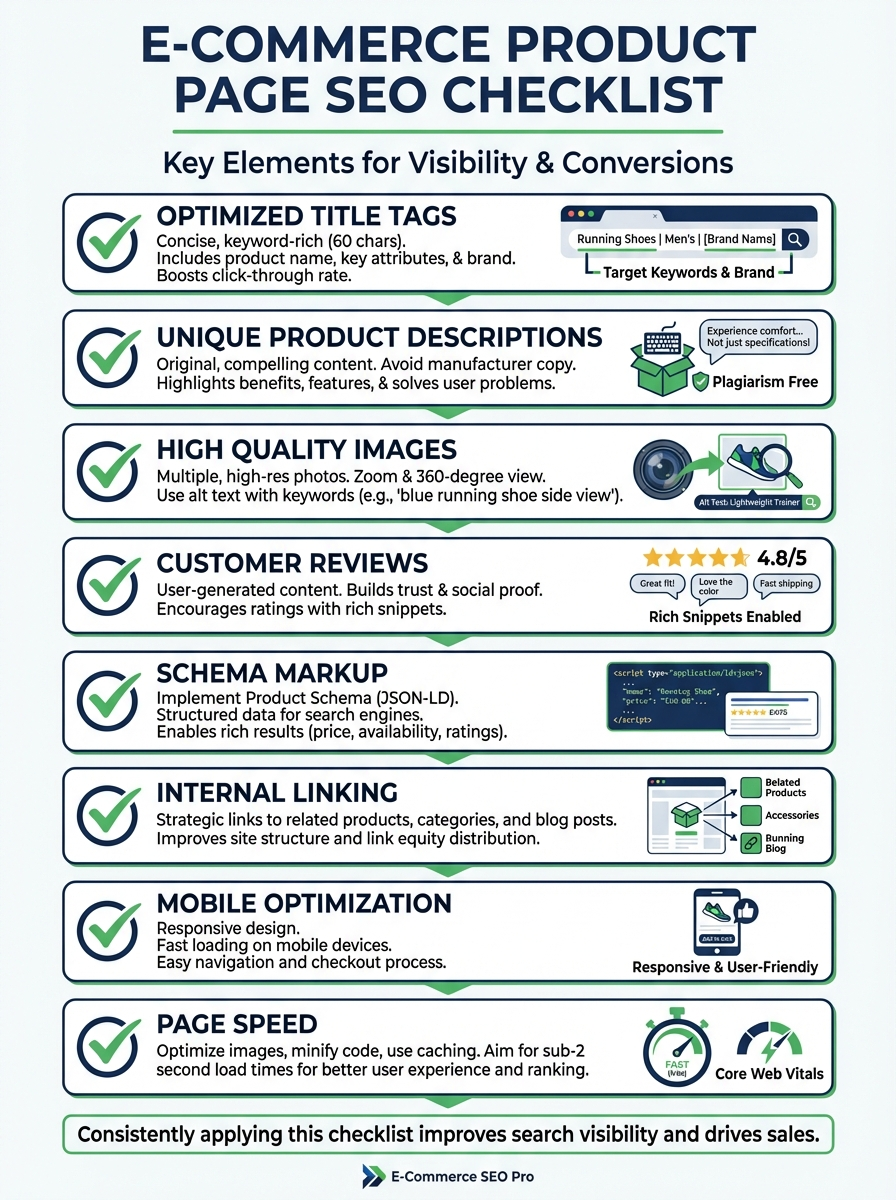
Your title tag is the most important on-page SEO element. It appears in search results and significantly impacts click-through rates.
Title Tag Formula
An effective product page title includes:
- Primary product name
- Key differentiator or feature
- Brand name
Example: “Wireless Bluetooth Headphones with Active Noise Cancellation | Sony WH-1000XM5”
Title Optimization Best Practices
- Keep titles under 60 characters to avoid truncation
- Front-load important keywords
- Make each product title unique
- Include the primary keyword naturally
- Add compelling modifiers when space allows
Writing Unique Product Descriptions
Duplicate content is one of the biggest product page SEO challenges. Using manufacturer descriptions that appear on dozens of other sites hurts your rankings and fails to differentiate your offering.
Product Description Framework
Opening Hook (2-3 sentences): Address the customer’s problem or desire. Why would they want this product?
Key Features (Bulleted list): Highlight the most important specifications and features buyers care about.
Benefits Expansion (2-3 paragraphs): Explain how features translate into real-world benefits. Use sensory language and help customers visualize using the product.
Use Cases (Optional): Describe ideal scenarios or customers for this product.
Technical Specifications (Structured): Include detailed specs for shoppers who need specific information.
Writing Tips
- Write for humans first, search engines second
- Use the primary keyword 2-3 times naturally
- Include secondary keywords in subheadings
- Add emotional triggers that drive purchasing decisions
- Keep paragraphs short and scannable
Optimizing Product Images
Product images directly impact both SEO and conversions. High-quality, well-optimized images can drive significant image search traffic and improve time on page.
Image SEO Essentials
File Names: Use descriptive, keyword-rich file names.
- Bad: IMG_4829.jpg
- Good: nike-air-max-270-black-mens-running-shoe.jpg
Alt Text: Write descriptive alt text that includes relevant keywords while accurately describing the image for accessibility.
Image Size and Format:
- Compress images without sacrificing quality
- Use WebP format with JPEG fallbacks
- Implement lazy loading for images below the fold
- Provide multiple image sizes for responsive display
Image Quantity and Quality:
- Include multiple angles of each product
- Show scale and context
- Include lifestyle/usage images
- Allow zoom functionality
Implementing Product Schema Markup
Schema markup helps search engines understand your product information and can generate rich results that dramatically improve click-through rates.
Essential Product Schema Properties
- Name
- Description
- Image
- SKU
- Brand
- Price and currency
- Availability status
- Review and rating data
Implementation Tips
- Use JSON-LD format (Google’s preferred method)
- Include AggregateRating when you have reviews
- Keep pricing information accurate and up to date
- Test with Google’s Rich Results Test tool
- Monitor performance in Search Console
Additional Schema Types for E-commerce
Beyond basic product schema, consider implementing:
BreadcrumbList Schema: Helps search engines understand your site structure and can display breadcrumb navigation in search results.
Organization Schema: Provides business information that may appear in Knowledge Panels.
FAQPage Schema: If your product pages include FAQ sections, this schema can generate expanded results with questions and answers visible directly in search.
Offer Schema: Use this within product schema to highlight special offers, discounts, and sale pricing.
Writing Compelling Meta Descriptions
While meta descriptions don’t directly impact rankings, they significantly influence click-through rates from search results.
Meta Description Best Practices
Length: Keep descriptions between 120-155 characters to avoid truncation on mobile and desktop.
Action-Oriented: Include action verbs that encourage clicks—”Shop now,” “Discover,” “Find out why.”
Unique Value: Highlight what makes this product or your store special—free shipping, exclusive features, or satisfaction guarantees.
Include Keywords: While not a ranking factor, keywords appear bold in search results when they match the query.
Urgency When Appropriate: Limited time offers or low stock can drive immediate action.
Example Meta Descriptions
Good: “Shop the Nike Air Max 270 in black. Free shipping on orders over ₱3,000. 30-day returns. Find your perfect fit with our size guide.”
Poor: “Nike shoes for sale. Buy now. Good prices. Fast delivery.”
The good example includes the product name, offers (free shipping), trust signals (30-day returns), and a helpful feature (size guide)
URL Structure for Product Pages
Clean, descriptive URLs improve user experience and help search engines understand page content.
URL Best Practices
Ideal Structure: yourstore.com/category/product-name
Guidelines:
- Use hyphens to separate words
- Keep URLs concise but descriptive
- Include the primary keyword
- Avoid parameters and session IDs when possible
- Use lowercase letters only
Avoid:
- Generic URLs like /product?id=12345
- Excessive folder depth
- Special characters and spaces
- Keyword stuffing
Leveraging Customer Reviews for SEO
Customer reviews provide unique, user-generated content that helps product pages rank for additional keywords while building trust with potential buyers.
Review Strategy
Generating Reviews:
- Send post-purchase email requests
- Make leaving reviews simple and quick
- Offer incentives where allowed
- Respond to reviews to encourage engagement
SEO Benefits of Reviews:
- Fresh content signals to search engines
- Natural language variations and long-tail keywords
- Improved click-through rates with star ratings in SERPs
- Increased time on page and engagement
Internal Linking Strategy
Strategic internal linking helps search engines discover and understand your product pages while distributing page authority throughout your site.
Internal Link Opportunities
Related Products: Link to complementary or alternative products
Category Breadcrumbs: Provide navigation paths back to category pages
Cross-Sells and Upsells: Feature related items that enhance the purchase
Blog Content: Link from relevant articles to product pages
“Customers Also Viewed”: Dynamic related product recommendations
Mobile Optimization
With mobile commerce growing rapidly, especially in the Philippines, mobile optimization is non-negotiable for product page SEO.
Mobile SEO Checklist
- Fast loading times (target under 3 seconds)
- Touch-friendly buttons and navigation
- Readable text without zooming
- Properly sized images that don’t slow loading
- Easy checkout process
- Click-to-call functionality
Page Speed Optimization
Page speed is a confirmed ranking factor and critical for conversions. Slow product pages lead to abandoned sessions and lost sales.
Speed Optimization Tactics
- Compress and optimize all images
- Enable browser caching
- Use a content delivery network (CDN)
- Minimize HTTP requests
- Defer non-critical JavaScript
- Consider AMP for product pages
Handling Product Variations
Products with multiple variations (size, color, style) require careful SEO consideration to avoid duplicate content issues.
Variation Strategies
Option 1: Single Page with Selectors
Best for products where variations don’t warrant separate pages. Use dropdowns or swatches to select options.
Option 2: Separate Pages with Canonical Tags
When variations have significant search volume, create separate pages but use canonical tags to indicate the primary version.
Option 3: Faceted Navigation
For large catalogs, implement faceted navigation with proper URL handling to prevent indexation of every filter combination.
Handling Out-of-Stock Products
How you manage out-of-stock products impacts both SEO and user experience.
Best Practices
- Keep the page live if the product will return
- Clearly display availability status
- Offer “notify me” options
- Suggest alternative products
- If permanently discontinued, redirect to relevant category or replacement
Measuring Product Page SEO Success
Track these metrics to evaluate and improve your product page optimization:
Key Performance Indicators
- Organic traffic to product pages
- Keyword rankings for target terms
- Click-through rate from search results
- Organic conversion rate
- Revenue from organic product page traffic
- Page load time
- Bounce rate
Common Product Page SEO Mistakes
Avoid these frequent errors that hurt e-commerce rankings:
Thin Content: Product pages with minimal text provide little for search engines to index.
Missing Meta Descriptions: Unique, compelling meta descriptions improve click-through rates.
Broken Internal Links: Regularly audit for broken links, especially after product changes.
Ignoring Search Intent: Ensure product pages match what searchers expect to find.
Poor Mobile Experience: Test all product pages on multiple mobile devices.
Start Optimizing Your Product Pages
Product page SEO is an ongoing process that compounds over time. Begin by auditing your highest-traffic and highest-revenue product pages, then systematically optimize based on opportunity and impact.
For expert assistance with your e-commerce SEO strategy, explore our search engine optimization services and technical SEO solutions.
Learn more about building a successful online store with our guide on how to build an e-commerce website, and discover how to build trust with search engines through our article on enhancing E-E-A-T for SEO.