Google’s August Spam Update Targeted Mass-Generated AI Content, SEO Community Reports Indicate

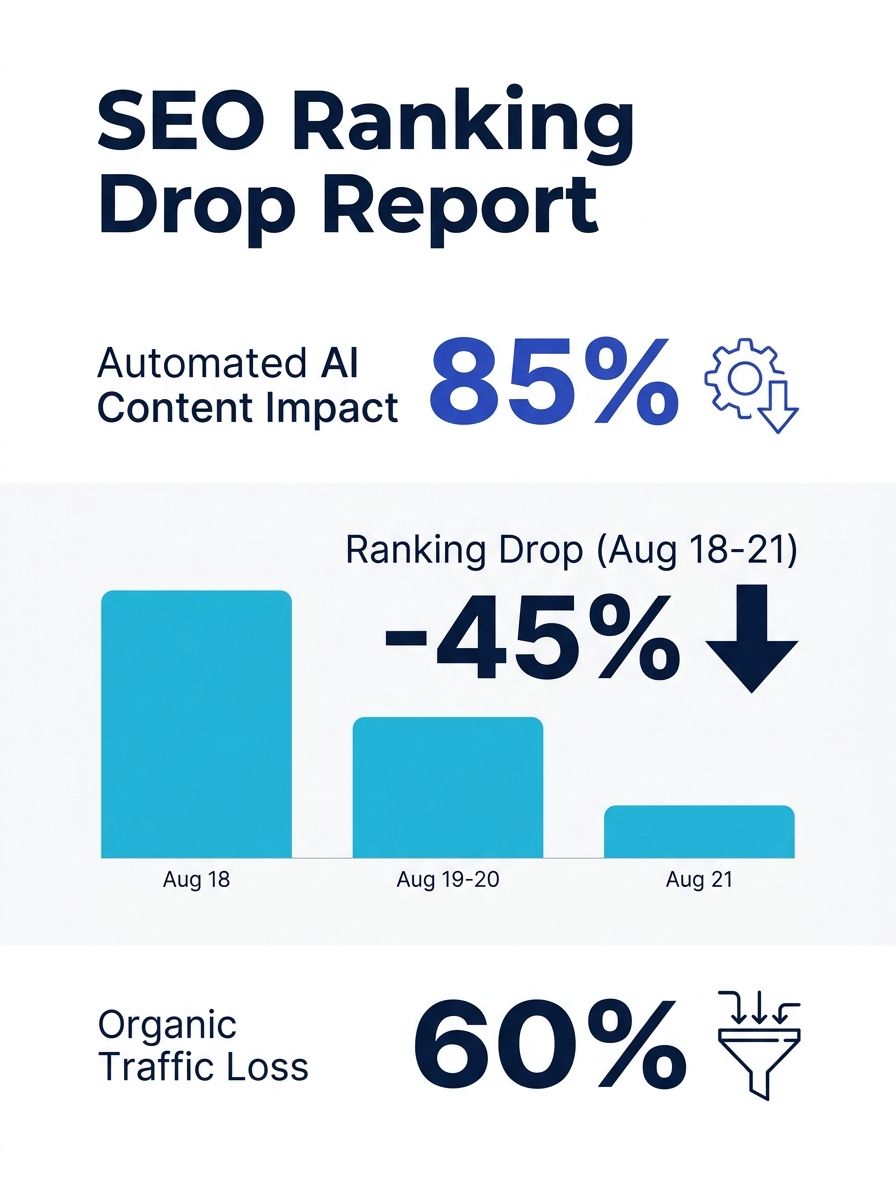
Google’s August 2026 spam update appears to have targeted websites deploying mass-generated AI content to manipulate search rankings, according to reports from SEO practitioners tracking ranking volatility between August 18 and August 21. The enforcement aligns with a recently published Google research paper addressing AI-generated spam networks.
TL;DR: Google’s August spam update reportedly focused on sites using automated AI content generation to manipulate rankings, particularly affecting sites that deployed Claude and similar tools for mass publishing without human review.
The timing coincides with Google’s publication of a research paper titled “Scalable Cluster Termination System (S-CTS)” designed to identify and remove networks of mass-generated AI spam. Marketing leaders overseeing AI SEO services and content partnerships now face clearer signals about what crosses the line from legitimate AI-assisted content creation into algorithmic manipulation.
Japanese SEO practitioner @OkaTakuma1 reported on social media that sites automatically publishing content through Claude and similar tools experienced widespread ranking drops during the update window. The observation drew attention to a pattern: sites that began with manual content creation before switching to automation appeared more likely to survive the update than sites launched entirely through automated systems from inception.
What the Spam Update Appears to Have Caught
Sites using fully automated AI content pipelines—publishing directly from language models to WordPress without human review—saw the most severe ranking losses during the August 18-21 window, according to community observations. The pattern suggests Google’s systems now distinguish between content created with AI assistance and content mass-produced specifically to capture keyword rankings.
“Companies operating media should check the rankings from August 18 to 21,” wrote @seiichi_satoweb in a social media post analyzing the update. The practitioner noted that Google defines malicious use of mass-generated content as creating large volumes of pages primarily to manipulate search rankings rather than support users.
The distinction matters for marketing leaders evaluating vendor proposals and content strategies. The issue is not whether AI tools participated in content creation but whether the production method prioritized algorithmic manipulation over user value. Sites that applied human editorial review before publishing AI-drafted content—including fact-checking, brand voice adjustment, and structural editing—reported fewer ranking impacts.
One Japanese publication using AI-generated content survived the update intact, according to reports, after implementing mandatory human visual checks before publishing and building initial domain authority through social media distribution and press releases.
Domain History and Trust Signals Factor Into Enforcement
Sites with established user engagement histories before deploying AI automation appeared to fare better during the update than newly launched domains built entirely through automated systems. The pattern aligns with Google’s broader spam detection approach, which treats signals of genuine user value as a buffer against algorithmic penalties.
The observation suggests Google’s systems weigh a site’s historical engagement data—time on page, return visits, direct traffic—when evaluating whether AI-generated content serves users or merely attempts to capture keyword traffic. Sites that accumulated these signals through manual operation retain what practitioners described as “trust savings” that provide some protection when transitioning to AI-assisted workflows.
Marketing leaders briefing content agencies should expect questions about production workflows, editorial oversight, and publication frequency. The August update makes clear that template-driven, mass-published AI content carries enforcement risk regardless of grammatical quality or topical relevance.
Community Response Highlights AI Slop Proliferation
Members of the Blackhat World Forums—a community historically focused on aggressive SEO tactics—expressed frustration with the prevalence of low-value AI content in search results. One member described encountering four consecutive sites with identical formatting, bullet structures, and 500-word expansions of three-sentence answers when searching for an application settings tutorial.
“AI slop pages is the new doorway page and Google is struggling to reel it in,” the member wrote, comparing the phenomenon to the doorway page spam Google targeted in previous algorithm updates.
The complaints underscore a challenge for marketing decision-makers: AI content tools lower the barrier to publishing at scale, but the same accessibility creates competitive pressure to publish more content faster. The August update suggests Google’s systems now penalize volume-first strategies that skip meaningful editorial oversight or unique value creation.
Reading Between the Lines
Marketing leaders evaluating agency partners or internal content teams should reframe AI conversations around workflow rather than tools. The question is not “Do you use AI?” but “What happens between the AI draft and publication?” Sites that treated language models as first-draft engines—requiring human editors to verify facts, adjust tone, add proprietary insight, and ensure alignment with brand strategy—navigated the update with minimal impact.
The enforcement also clarifies expectations for SEO training programs aimed at in-house teams. Content producers need explicit guidelines about what constitutes acceptable AI assistance versus prohibited manipulation. Publishing 50 AI-generated articles per day without review is different from using AI to outline a technical white paper that a subject-matter expert then writes and a brand editor reviews.
For enterprises managing large content libraries, the August update serves as a forcing function: audit existing AI-generated pages for genuine user value, consolidate or remove thin content, and establish editorial standards before Google’s systems make the decision for you. The Scalable Cluster Termination System research paper signals that Google can now identify and remove networks of related low-value pages at scale—making reactive cleanup harder than proactive quality control.