Marketing Leaders Struggle to Split Website Pages Between Brand Building and Conversion Goals, SEO Guidance Shows
Marketing leaders managing separate SEO and conversion optimization teams face recurring conflict over which website pages should prioritize search visibility versus immediate conversion actions, according to guidance published in Search Engine Journal’s Ask An SEO column Tuesday.
TL;DR: The column addresses a strategic briefing question on how to divide pages between brand-building content that generates traffic and conversion-focused pages designed to close transactions, a split that affects both team mandates and resource allocation.
The Strategic Question Behind Team Conflict
The question came from a practitioner managing both search visibility and conversion rate optimization work: “Should every page do all things? I’m struggling to work out which pages should be optimized for CRO and which should be to build the brand,” according to the Search Engine Journal piece.
The answer outlined a framework that treats blog posts and informative pages as brand-building assets meant to generate traffic and build remarketing audiences, while product pages serve as conversion tools not always intended to rank organically. The guidance specified that exceptions exist—comparison posts that advance the lead funnel, how-to guides that recommend complementary products, or product pages targeting specific branded queries—but those remain outliers rather than baseline strategy.
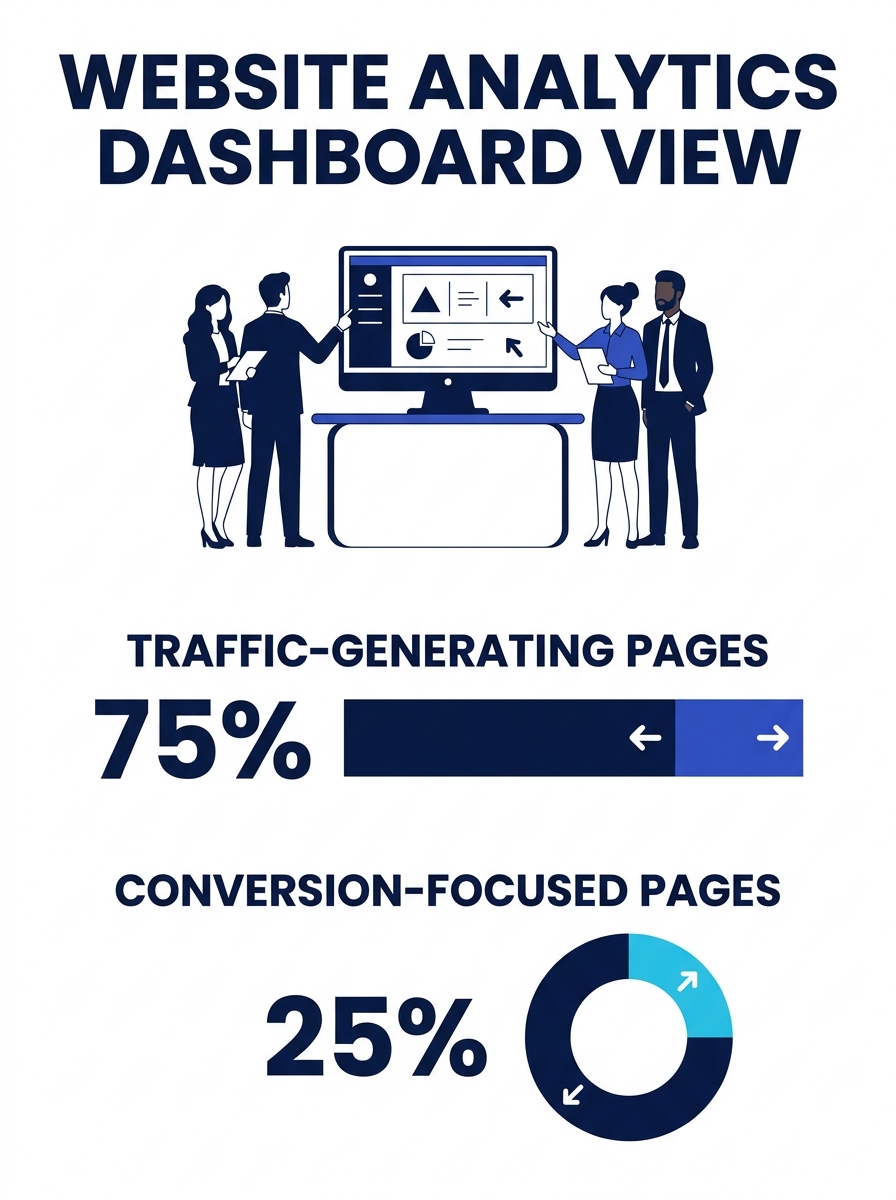
The column recommended documenting which pages serve which purpose and avoiding boundary crossovers where conversion-focused pages receive heavy SEO investment or vice versa. “This will make your life easier and give your website a better opportunity to grow in both traffic and revenue,” the guidance stated. “It also allows the CRO team to do their job while you do yours.”
How Conversion Optimization Conflicts With Search Visibility
Conversion rate optimization specialists deploy tactics that can undermine organic search performance, the column explained. CRO strategies commonly include deleting blocks of copy to reduce friction, weighing pages with video while moving SEO-critical elements, reinforcing brand messaging in headers rather than topical keywords, and repositioning video content to prioritize reviews and testimonials even when that damages video SEO performance.
Split testing presents additional technical risks when CRO teams launch experiments without validating canonical tags or meta robots directives. These interventions can stop pages from performing in both traditional search and AI-powered answer engines, according to the guidance.
The column advised marketing leaders to educate conversion rate optimization teams on which page elements remain off-limits: schema markup, internal link architecture, site structure, and positioning of specific semantic elements. “It’s the way you approach the situation and how you can be proactive vs. reactive,” the guidance noted.
One tactic the author uses when negotiating with CRO teams: “Reminding the CRO that without traffic from SEO, there are no users to convert and we’re both out a job.”
The Documentation Framework for Enterprise Teams
The column outlined a three-part reference guide designed for enterprise organizations where SEO and CRO operate as separate functions. The framework includes SEO and generative engine optimization best practices for each page type—product, blog post, how-to guide, comparison, listicle, homepage, and category pages—along with a map of folders and pages designated as completely off-limits for conversion optimization work.
The third component provides a quick-reference technical SEO guide for common CRO tasks, such as split-testing designs in ways that don’t trigger indexing or crawl issues. “If it gets too long or too complicated, it will get ignored, and your job becomes more difficult,” the guidance cautioned.
For how-to guides, mandatory SEO elements might include specific keywords in section headers (“tools you’ll need” in bullet lists, “the steps to do XYZ” in numbered lists), How-To schema implementation, and restriction on opening paragraphs with sales pitches or company background. Category pages on ecommerce sites may require copy blocks, breadcrumbs, and relevant FAQ sections.
The column emphasized creating alternative content paths when restricting certain formats. “When you say the blog cannot have X type of content, make sure to provide an alternative as a way to prevent pushback,” the guidance stated. That approach prevents self-serving content—company picnics, short-term promotions—from appearing in informative content streams meant to rank for evergreen solution queries.
Site Structure as Boundary Enforcement
One of the most effective tactics involves creating distinct site architectures for traffic-generating content versus conversion or corporate communication pages, according to the column. An enterprise site might maintain three separate blog structures: one for SEO-optimized informative content, one for company updates and product releases, and a third for support documentation.
The two non-SEO sections can remain open for CRO experimentation and brand messaging, while IT teams block them via robots.txt or apply noindex, follow directives. This internal linking authority separation prevents conversion-focused tests from cannibalizing organic visibility on pages meant to generate traffic.
The framework also addresses semantic consolidation risks: when too many pages compete for the same query intent, search engines struggle to determine which URL should rank. By clarifying page purpose upfront—this page converts, this page educates, this page ranks—marketing leaders can brief both SEO and CRO agency partners with clear mandates rather than conflicting objectives.
Why This Matters Now
The page-prioritization question surfaces at a moment when marketing leaders evaluate whether their existing web design and optimization infrastructure supports both visibility and conversion without internal conflict. The Information Gain signal Google emphasized in its March 2026 core update rewards pages with clear, specific purpose—a ranking factor that penalizes pages trying to serve all audiences simultaneously.
AI-powered answer engines compound the issue: pages optimized for immediate conversion often lack the depth and structured data that language models cite, while informative pages built purely for traffic may fail to connect readers to transaction paths. Marketing leaders briefing agency partners need documented page strategies that let SEO specialists build citation-worthy content and CRO teams optimize the pages that actually close deals, rather than forcing both teams to compete for the same real estate.
The framework also clarifies accountability when organic traffic plateaus or conversion rates decline. With documented boundaries, marketing directors can diagnose whether the issue stems from CRO changes damaging search performance, SEO investments on pages never meant to rank, or broader site architecture problems that require structural intervention rather than page-level optimization.