Social Selling Index: What It Is & Why It Matters

LinkedIn’s Social Selling Index assigns every user a daily score from 0 to 100 based on four equally weighted behaviors: building a professional brand, finding the right prospects, sharing relevant insights, and nurturing relationships. According to LinkedIn’s own sales research, sellers with high SSI scores are 51% more likely to hit quota and outsell peers who don’t use social selling by 78%.
TL;DR: The social selling index breaks into four pillars scored 0–25 each: professional brand, prospect targeting, insight engagement, and relationship building. The industry average hovers around 35, dedicated B2B sellers typically score between 51 and 70, and LinkedIn flags 75+ as thought-leader territory.
What LinkedIn’s Social Selling Index Measures
The Social Selling Index is LinkedIn’s proprietary metric that quantifies how effectively a person uses the platform for social selling. LinkedIn originally built SSI as an internal diagnostic for Sales Navigator subscribers, then opened it to all users for free. Anyone with a LinkedIn account can check their score at linkedin.com/sales/ssi.
The metric is updated daily. It doesn’t measure outcomes like deals closed or revenue generated. It measures activities and behaviors that LinkedIn’s data correlates with sales performance. Think of it as LinkedIn grading your platform usage against its own model of what effective social sellers do.
Each of the four pillars contributes a maximum of 25 points. A perfect score of 100 means you’re performing at the top of LinkedIn’s behavioral model across all four dimensions. The platform also benchmarks your score against two peer groups: people in your industry and people in your network.
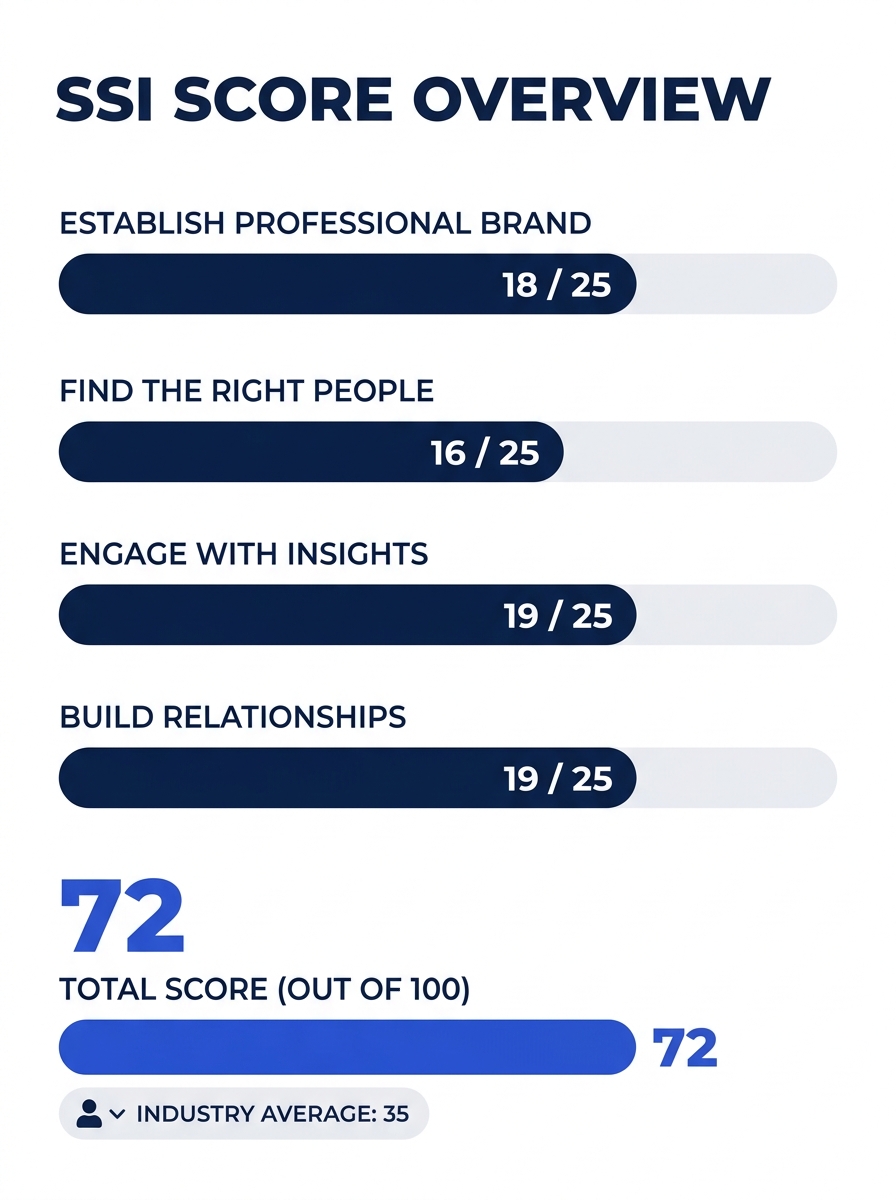
For brands working with a B2B digital marketing agency, SSI scores across a sales team offer a quick diagnostic. If the team average sits below 35 (the industry norm, according to NREV’s benchmark analysis), there’s a measurable gap between how the team uses LinkedIn and how the platform rewards activity.
The Four Pillars and How LinkedIn Weights Them
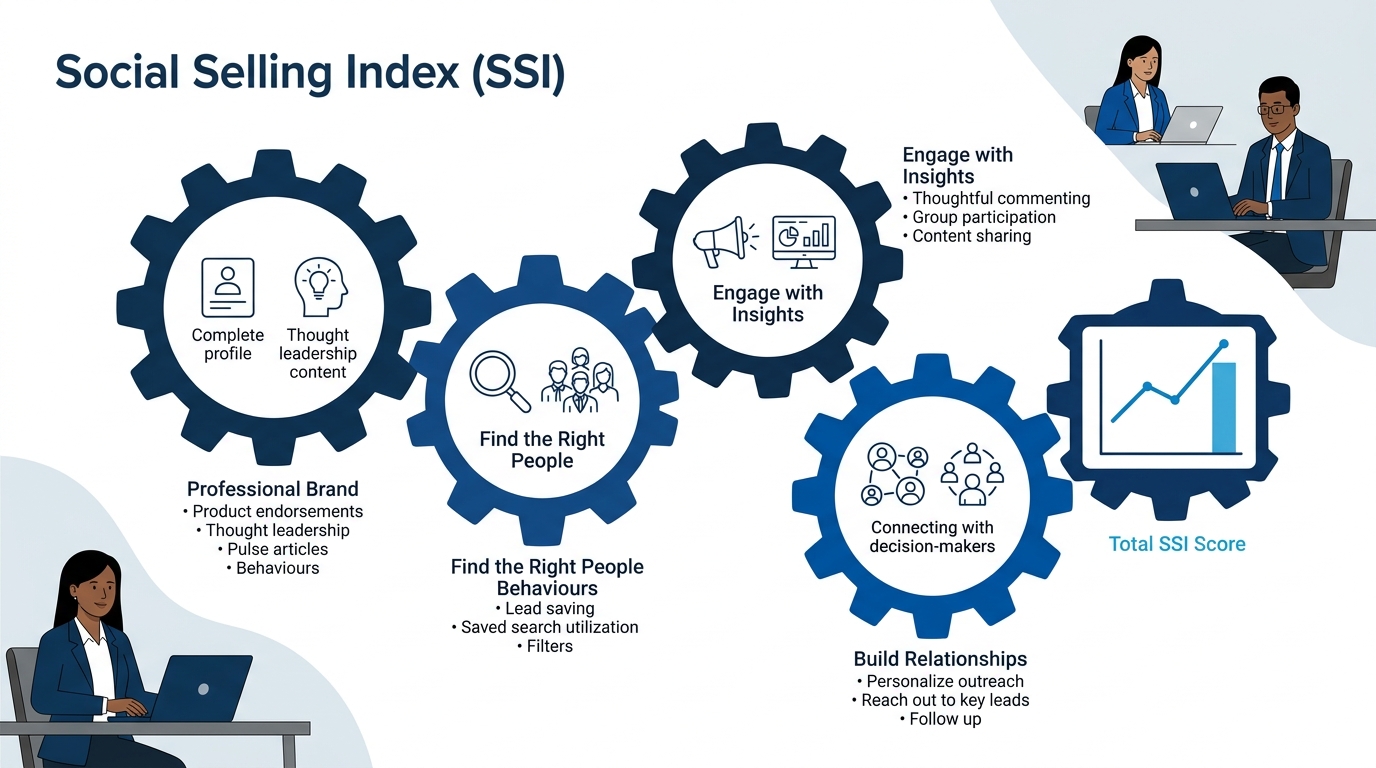
Each pillar carries equal weight (25 points), but the behaviors LinkedIn tracks within each one are neither obvious nor evenly distributed. Here’s what drives each score.
Professional Brand (0–25)
This pillar evaluates profile completeness and the quality of content you publish. LinkedIn looks at whether you have a keyword-rich headline, a professional photo, a detailed summary, media attachments, recommendations, and endorsements for relevant skills. It also factors in whether you publish long-form posts or articles and whether those posts get engagement.
The profile photo piece is underrated. Skylead’s analysis found that uploading a professional profile picture that conveys approachability and expertise creates an immediate SSI lift. A headless profile tanks this pillar regardless of how good the rest of your activity is.
Finding the Right People (0–25)
LinkedIn measures how effectively you use search and discovery features to identify decision-makers. Sales Navigator’s advanced filters, Boolean search, saved lead lists, and profile viewing patterns all feed this score. The platform rewards targeted prospecting over mass connection requests.
This is where connection request acceptance rate becomes critical. Expandi’s SSI research identified acceptance rate as the most overlooked SSI lever: sending high volumes of untargeted requests actively pulls your score down, because LinkedIn interprets low acceptance rates as poor targeting.
Engaging with Insights (0–25)
This pillar tracks whether you share content, comment on others’ posts, and participate in conversations. LinkedIn weighs the quality of engagement, too. A 3-word comment (“Great post, thanks!”) doesn’t carry the same weight as a substantive 15+ word response that adds perspective. The platform also looks at whether you’re sharing third-party content with your own commentary added.
For enterprise marketing teams evaluating how their organization shows up on LinkedIn, this pillar connects directly to broader search everywhere strategies where brand visibility extends beyond Google into social platforms and AI-powered discovery tools.
Building Relationships (0–25)
The final pillar measures your ability to connect with and maintain relationships with senior decision-makers, not just peers at your level. LinkedIn tracks the seniority of people who accept your connections, how often you message contacts, and whether those conversations are sustained over time.
Personal profiles drive this pillar far more effectively than company pages. LinkedIn’s data shows personal profiles generate 8x more engagement than branded company pages, which means relationship-building through individual accounts consistently outperforms institutional ones.
Reading Your Score: The Three-Layer Diagnostic
A raw SSI number means little without context. Sonarly’s SSI framework recommends reading your score in three layers: the total score, the weakest pillar, and the benchmark against your industry or network.
Layer 1: Total Score. The industry average for most LinkedIn users sits around 35. Scores between 51 and 70 indicate a dedicated B2B seller who’s active, targeted, and consistent. LinkedIn Sales Navigator recommends that industry leaders aim for scores above 75 to stand out and establish thought leadership in their field.
Layer 2: Weakest Pillar. A total score of 60 built from four scores of 15 each tells a very different story than a 60 built from three 20s and one 0. The weakest pillar reveals your specific behavioral gap. Most professionals score well on Professional Brand (it’s the easiest to set-and-forget with a complete profile) and poorly on Engaging with Insights (it requires daily effort).
Layer 3: Peer Benchmark. LinkedIn shows how you rank against others in your industry and your network. A score of 55 might be excellent in a low-engagement industry and mediocre in a competitive one. The peer comparison tells you whether your absolute number is actually strong relative to the people you’re selling against.
| Score Range | What It Means | Typical User |
|---|---|---|
| 0–25 | Minimal LinkedIn activity | Dormant profile or new account |
| 26–40 | Around industry average | Casual user, no social selling strategy |
| 41–70 | Active social seller | Dedicated B2B professionals |
| 71–85 | Strong social seller | Consistent content creators with targeted outreach |
| 86–100 | Top-tier performer | Power users, usually Sales Navigator subscribers |
The weakest pillar reveals your specific behavioral gap. A total score of 60 built from four scores of 15 each tells a very different story than a 60 built from three 20s and one 0.
Why Connection Volume Doesn’t Help (And Acceptance Rate Does)
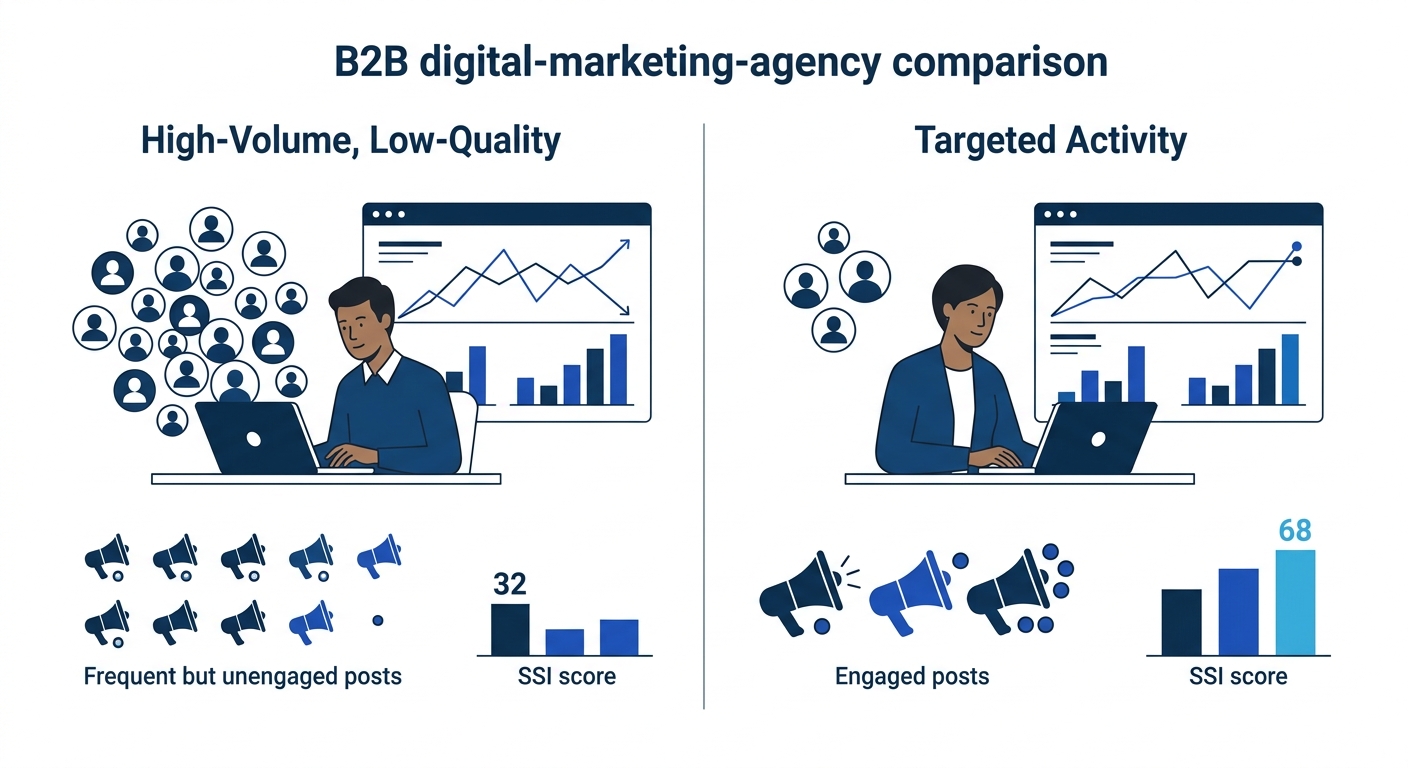
The biggest misconception about SSI is that more activity equals a higher score. It doesn’t. LinkedIn’s algorithm evaluates the quality and targeting of your actions, and in several cases, undisciplined volume will actively lower your score.
Connection requests are the clearest example. Sending 100 connection requests per week to random profiles results in a low acceptance rate, which LinkedIn reads as poor prospect identification. Your “Finding the Right People” pillar drops. Your “Building Relationships” pillar stagnates because the connections you do land tend to be low-seniority or irrelevant to your industry.
The pattern is similar for content. Publishing 5 posts per day that get no engagement can score lower than publishing 2 posts per week that generate substantive comments. LinkedIn rewards resonance, and the relationship between content volume and visibility breakdown that we’ve documented in SEO contexts applies here too: more isn’t better if the signal-to-noise ratio deteriorates.
For organizations that invest in social media marketing services, the implication is clear. A team’s SSI improvement plan should prioritize targeting precision and content quality over raw output metrics.
Where the Score Breaks Down
SSI is useful, but it has real limitations that you should understand before treating it as a definitive performance metric.
It measures activity, not outcomes. A person with an SSI of 85 who closes zero deals and a person with an SSI of 45 who runs a full pipeline are both real archetypes. Forbes contributor analysis of social selling versus traditional sales found that social selling generates more leads, while traditional methods still excel at converting leads into customers. SSI captures the lead-generation side and ignores the conversion side entirely.
It’s platform-locked. SSI only measures LinkedIn behavior. If your sales team builds relationships through WhatsApp, email, Viber, or in-person meetings (common in Philippine B2B sales), those activities are invisible to the index. A seller who’s exceptional at relationship-building offline but barely active on LinkedIn will have a low SSI that misrepresents their actual effectiveness.
It rewards LinkedIn’s preferred behaviors. The score is designed by LinkedIn to encourage the behaviors LinkedIn wants to see on its platform. Heavy Sales Navigator usage, frequent content publishing, active engagement, high-volume profile views. These behaviors are good for LinkedIn’s engagement metrics. They’re good for sellers too, but the alignment isn’t perfect, and the score will always be biased toward platform usage over business results.
The algorithm is opaque. LinkedIn doesn’t publish the exact weighting formula within each pillar. Two users with identical visible behaviors can have different sub-scores, and there’s no transparency about why. This makes it hard to diagnose specific score changes with confidence.
Info: SSI should be treated as one input in a broader diagnostic, alongside pipeline metrics, conversion rates, and deal velocity. Organizations building [content authority beyond Google rankings](/blog/answer-engine-optimization-enterprise-b2b-content-authority) already understand this multi-signal approach to measuring visibility. The same logic applies to social selling measurement.
Common Questions
Where do I check my Social Selling Index score?
Go to linkedin.com/sales/ssi while logged into your LinkedIn account. The score is free for all users, not restricted to Sales Navigator subscribers. You’ll see your total score, each pillar’s individual score, and how you rank against your industry and network.
How often does LinkedIn update SSI?
The score refreshes daily. Short-term behavioral changes (a burst of posting activity, a series of connection requests) show up within 24–48 hours. Sustained score improvement requires consistent activity over weeks, not a single day of heavy usage.
Does a high SSI guarantee more sales?
No. LinkedIn’s data shows a strong correlation between high SSI and quota attainment (51% more likely to hit quota, 78% more opportunities than non-social-sellers), but correlation and causation aren’t the same thing. Sellers who are disciplined enough to maintain a high SSI tend to be disciplined in other sales behaviors too. The score reflects habits that correlate with results, but it doesn’t cause them independently.
What’s a “good” SSI score for my team?
It depends on your industry and the competitive landscape on LinkedIn. As a rough guide: below 35 means your team isn’t using LinkedIn for social selling in any meaningful way. Between 51 and 70 means dedicated, consistent usage. Above 75 signals thought-leader-level activity. The peer benchmark comparison within the SSI dashboard is more useful than any absolute number.
Can I improve SSI without Sales Navigator?
Yes. Three of the four pillars (Professional Brand, Engaging with Insights, Building Relationships) are fully actionable with a free LinkedIn account. The “Finding the Right People” pillar benefits from Sales Navigator’s advanced search filters, but you can still improve it through regular LinkedIn search, strategic profile viewing, and targeted connection requests.