Google’s March 2026 Core Update Removed 24% of Top 10 Pages from Search Results, SE Ranking Data Shows
Nearly one in four pages ranking in Google’s Top 10 positions fell out of the Top 100 entirely following the search engine’s March 2026 core algorithm update, according to research published today by SE Ranking. The analysis of 100,000 keywords across 20 industry verticals in the United States market found 24.1% of high-performing pages disappeared from visible search results between March 27 and April 8, when Google deployed its most volatile ranking recalibration in over a year.
TL;DR: SE Ranking’s analysis of the March 2026 Google core update found 24.1% of Top 10 pages vanished from the Top 100, marking the most volatile ranking shift since late 2025 and affecting organic traffic pipelines for brands dependent on search visibility.
The March 2026 volatility exceeded December 2025’s core update by significant margins across all ranking tiers, according to SE Ranking’s comparative study. The firm tracked URL turnover in the Top 3 positions (79.5% in March versus 66.8% in December), Top 10 positions (90.7% versus 83.1%), and Top 100 positions (98.5% versus 96.9%). The March cycle also introduced 29.7% of current Top 3 pages from positions previously ranked outside the Top 20, compared to just 13% in December’s update.
Google deployed two overlapping ranking events during the period: the March 2026 Spam Update began March 24-25, and the March 2026 Core Update ran from March 27 through April 8, both confirmed on the Google Search Status Dashboard. The combined effect reshuffled the visible search landscape at a scale not observed in prior 2025 updates, creating immediate pipeline risk for enterprises anchored to organic acquisition channels.
What the Volatility Data Reveals About Ranking Stability
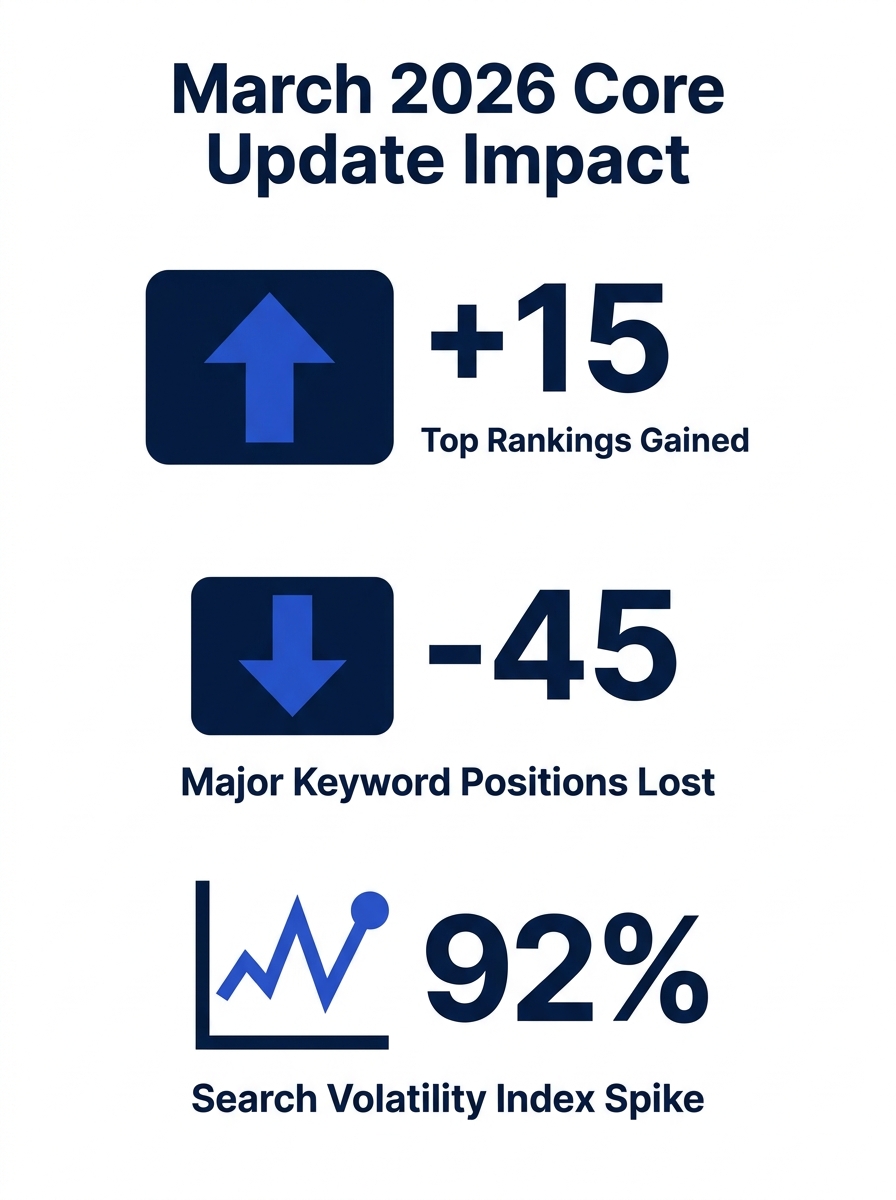
The SE Ranking dataset measured ranking position changes across industries including finance, health, e-commerce, and technology services. The 24.1% Top 10 disappearance rate, pages that lost 90 or more ranking positions, represented a 64% increase over December 2025’s 14.7% rate, signaling that Google applied stricter quality filters or recalibrated relevance scoring models between the two updates.
Movement at the top of search results proved equally severe. Of the URLs currently occupying Top 3 positions after the March update, nearly three in ten previously ranked outside the Top 20. This pattern suggests Google elevated pages it assessed as higher-quality matches for user intent, rather than simply reordering existing top-tier results. SE Ranking noted that the churn concentrated in commercial query categories, comparison pages, aggregator sites, and thin affiliate content experienced disproportionate drops, while official brand domains, government resources, and niche-specialist publishers gained ground.
The data also revealed that volatility did not uniformly penalize newer sites. While domains older than 15 years retained approximately 57% of Top 10 positions post-update, indicating persistent domain-authority advantages, the 29.7% of newly elevated Top 3 pages included a mix of domain ages. The distinguishing factor appeared less related to domain registration date and more aligned with content originality, source attribution, and topical authority signals.
Domain Trust Versus Page-Level Quality in Ranking Recovery
Google’s March recalibration separated domain-level trust from page-level content quality in ways that complicate traditional SEO recovery playbooks. Established enterprise domains retained positional advantages, but individual pages within those domains still faced relegation if content failed updated quality thresholds. SE Ranking’s analysis found that even pages on older, authoritative domains could fall from Top 10 to beyond Top 100 if they exhibited thin content, lacked original data, or duplicated widely available information.
This bifurcation matters for marketing leaders overseeing large content inventories. A strong root domain no longer insulates weak pages from ranking collapse. The March update appeared to evaluate each URL’s unique contribution to a search query, rewarding pages that provided original research, firsthand expertise, or substantive user value. Aggregator pages summarizing publicly available data, comparison tables pulling affiliate product feeds, and AI-generated summaries without verification saw the steepest declines.
Recovery patterns observed in April and May suggest that pages adding original data points, expert attribution, and user-generated proof (case studies, testimonials, proprietary benchmarks) regained positions faster than pages simply rewritten with additional word count. Several enterprise sites tracked by SE Ranking restored Top 10 visibility within 30 days by consolidating thin content, removing duplicate comparison pages, and adding named-source expert quotes to editorial pieces. For brands evaluating SEO visibility debugging approaches, the March data underscores the futility of volume-based content strategies in a ranking environment that prioritizes semantic consolidation and source authority.
Diversification Imperatives as Search Becomes Higher-Risk Distribution
The March volatility boosted a strategic shift already underway: organic search can no longer serve as a single-channel growth pillar for enterprise brands. Nearly one in four high-performing pages vanishing overnight creates pipeline risk that executive leadership must account for in annual planning. Marketing teams dependent on search for 50% or more of top-of-funnel volume now face quarterly volatility that materially affects revenue forecasts, customer acquisition cost calculations, and demand-generation headcount planning.
Brands that maintained traffic through the March turbulence typically operated diversified demand models, email audiences, brand search volume, partnership referrals, LinkedIn organic reach, and direct navigation traffic buffered the loss of non-branded keyword rankings. SE Ranking’s data showed that sites relying exclusively on non-branded organic search experienced the sharpest quarter-over-quarter pipeline drops, while brands with established email lists and loyal repeat traffic recovered faster.
The update also validated a search everywhere strategy that extends beyond Google’s primary blue-link results. With AI Overviews, ChatGPT, Perplexity, and Reddit threads fragmenting search behavior, the March core update’s impact compounds an already-shifting discovery landscape. Enterprises treating SEO as a standalone discipline, rather than one component of a multi-channel visibility architecture, now absorb disproportionate risk when Google recalibrates quality thresholds.
What This Means for, CMOs
The March 2026 update data forces a recalibration of how marketing leaders assess organic search as a demand channel. If one in four top-ranking pages can disappear in a single algorithm cycle, organic traffic projections become unreliable inputs for quarterly revenue planning. CMOs briefing agency partners on SEO work should now require explicit risk mitigation strategies: content audits that preemptively identify vulnerable pages, traffic diversification timelines that reduce dependence on non-branded keywords, and recovery protocols activated within 48 hours of ranking drops.
The volatility also clarifies what agencies should prioritize in 2026 SEO engagements. Volume-based content production, publishing more comparison pages, more category hubs, more AI-assisted articles, no longer correlates with ranking stability. The pages that survived March exhibited original data, named expert sources, and substantive user value that competitors could not easily replicate. When evaluating agency deliverables, marketing leaders should assess content uniqueness and source authority ahead of word count or publishing velocity.
Finally, the March data validates treating SEO as business model risk, not just a marketing tactic. Enterprises anchored to organic acquisition need board-level visibility into search dependence, scenario planning for ranking loss, and capital allocated to alternative demand channels before volatility events occur. The agencies equipped to support this work understand information architecture, semantic consolidation risks, and how to build visibility across answer engines and AI retrieval systems, not just Google’s blue links.