Search Everywhere Strategy: Winning Beyond Google Rankings in the AI-Powered Discovery Era
ChatGPT, Perplexity, and Google’s own AI Mode are pulling high-intent queries away from traditional result pages, and the gap between ranking well and actually getting cited is widening. Semrush’s 2026 AI Visibility Index, released June 26, analyzed 126 million AI search prompts and quantified that divergence for the first time at scale.
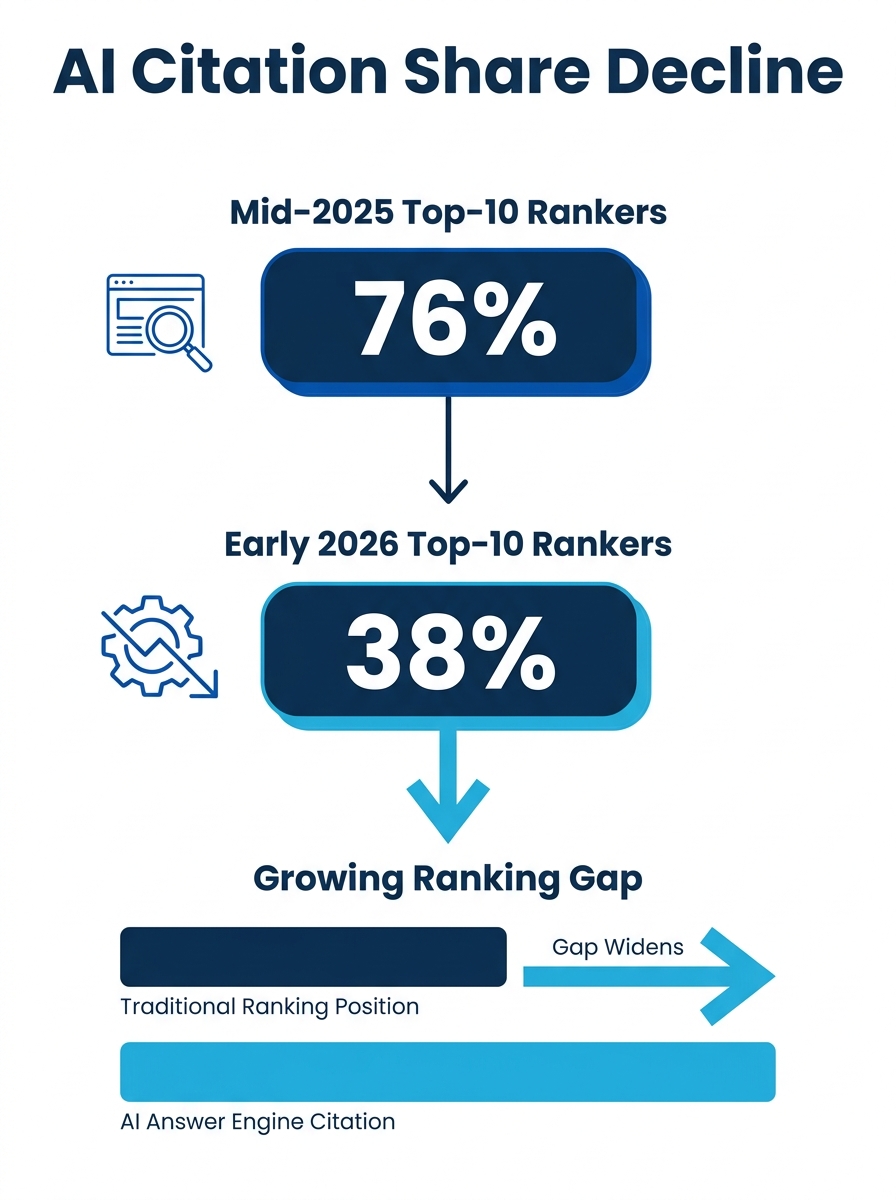
The implications ripple far past organic rankings. When top-10 Google rankers accounted for 76% of AI Overview citations in mid-2025, enterprise teams could treat ranking strength as a reasonable proxy for AI visibility. By early 2026, that share had dropped to roughly 38%. A strong SERP position now predicts AI citation about as well as a coin flip. For enterprise brands in the Philippines and across APAC, the message is hard to misread: search diversification enterprise SEO depends on presence across an ecosystem of discovery platforms, not dominance of a single channel. That shift in framing is what practitioners mean when they talk about a search everywhere SEO 2026 strategy, and this week’s wave of data and product announcements gives the concept sharper contours.
The Ranking-Citation Divergence
Google’s May 2026 core update and the global rollout of Gemini 3.5 Flash as the default AI Mode model accelerated a structural shift that had been building for over a year. Ranking in the top 20 organic results remains a prerequisite for AI Mode citations: research confirms that 99% of URLs surfaced in AI Mode come from that pool. But position alone no longer determines which pages get extracted. Passage retrieval, structural clarity, and cross-source corroboration now carry more weight than raw backlink count in determining which content earns the citation. We’ve covered how AI Overviews have already cratered organic CTR for queries where they appear, with paid CTR falling 68% in affected verticals. The citation divergence adds a second layer of pressure: even when your page ranks, it may not get quoted.
This is the core tension in AI answer engines vs Google rankings. The two systems draw from overlapping pools of content but apply different selection criteria. Google’s traditional algorithm rewards authority signals like backlinks and domain strength. AI answer engines reward retrievability, which means whether a passage can be pulled cleanly, whether the claim is independently corroborated across sources, and whether the content signals genuine first-hand expertise. Joe Toscano, writing for Forbes, put it directly: AI answer engines are “defining new visibility standards by becoming increasingly sophisticated at detecting and rewarding genuine expertise.” The practical consequence is that a brand can hold position #1 for a competitive keyword and still be invisible in the AI-generated answer sitting above it.
The June 2026 spam update, which targets tactics designed to manipulate AI Overviews and AI Mode results, reinforces this point from the enforcement side. Google is drawing a sharper line between pages that deserve traditional rankings and pages that deserve AI citation, and the overlap between those two sets is shrinking. Brands that invested in Generative Engine Optimization early are seeing citation rates hold or grow; brands relying on legacy authority signals without structural content optimization are watching their AI visibility erode even as their position-one rankings persist.
Where Discovery Is Actually Happening
The second half of the search everywhere argument is platform diversification, and the data from the past 30 days makes the case more concrete than the general exhortation to “be everywhere.” Google still controls roughly 90% of the global search market by query volume, as the USA Herald reported this week. But that 90% figure obscures a critical shift in where high-intent queries are going. AI chatbots are creating what the Herald called “the first meaningful challenge to Google’s long-standing dominance of internet search in years,” and the challenge is concentrated in exactly the query types that enterprise brands care about most: product research, service comparison, and decision-stage evaluation.
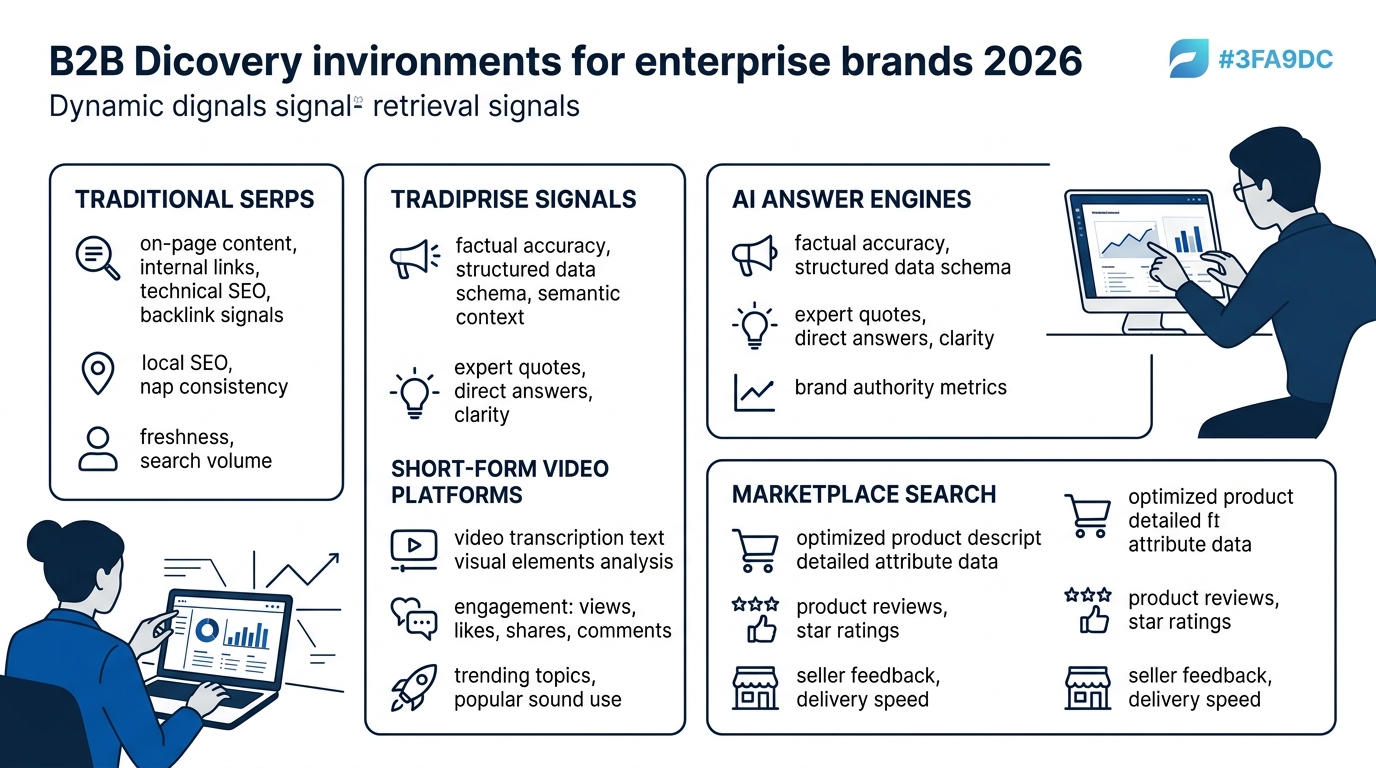
Cross-platform organic discovery now means showing up in at least four distinct environments: traditional SERPs, AI answer interfaces (AI Mode, ChatGPT, Perplexity), short-form video search (TikTok, YouTube Shorts, Instagram Reels), and marketplace search (Lazada, Shopee, Amazon). Each of these environments has its own retrieval logic. TikTok’s search algorithm weights engagement velocity and caption-keyword matching. Perplexity weights source freshness and citation density. YouTube’s algorithm prioritizes watch time and metadata alignment. A multi-channel visibility strategy requires content designed for reuse with purpose across these platforms, not a single blog post repurposed identically into six formats.
Quinn Schwartz, founder of Schwartz Marketing Lab, announced on June 24 that his firm launched specifically to help B2B companies “stay visible as AI search reshapes organic discovery.” The timing isn’t coincidental. FTI Consulting’s research on the “Great Visibility Reset” argued that companies need to “rapidly establish a baseline visibility strategy” and “prioritize high-impact AI search optimization opportunities” while adopting continuous test-and-learn cycles that keep pace with evolving platforms. For Philippine enterprise brands working with an enterprise digital marketing partner, that baseline increasingly means auditing not just Google performance but citation rates across ChatGPT and Perplexity, brand mention frequency on TikTok search, and discoverability in marketplace algorithms simultaneously.
The brands doing this well treat social media marketing services and SEO as interconnected discovery channels feeding the same funnel, rather than as separate line items managed by separate teams reporting separate metrics. A HubSpot analysis frames this as the “Amplify stage,” where distribution tactics now directly influence LLM citation volume. The implication is clear: your YouTube presence, your TikTok content, and your managed social media campaigns aren’t just awareness plays anymore. They’re feeding the AI systems that decide whether your brand appears in answer-engine results.
What an Ecosystem Approach Demands of Enterprise Teams
‘Why did our AI visibility drop when our rankings stayed flat?’ is the question that reveals whether an enterprise team has internalized the ecosystem model or is still treating AI as an extension of traditional SEO. The answer almost always involves one of three failures: structural content that AI systems can’t cleanly parse, absence from corroborating platforms that AI systems use to validate claims, or a content strategy that prioritizes volume over semantic consolidation. We’ve documented how high-volume publishing actually degrades enterprise SEO performance when AI retrieval systems prioritize consolidated, authoritative pages over sprawling content libraries.
The operational shift is significant. Marketing leaders spending 15% of budgets on AI tools while 70% lack measurement frameworks to assess returns are facing a compounding problem: they’re investing in AI-adjacent capabilities without the attribution infrastructure to know which cross-platform efforts are driving results. Self-reported attribution fields and platform-specific tracking segments for AI-referred leads are becoming baseline requirements, not optional enhancements. Google’s own May 2026 update documentation emphasized “continuous refinement” over one-off optimization events, which means enterprise teams need dashboards that track AI citation share alongside traditional ranking positions, updated weekly rather than quarterly.
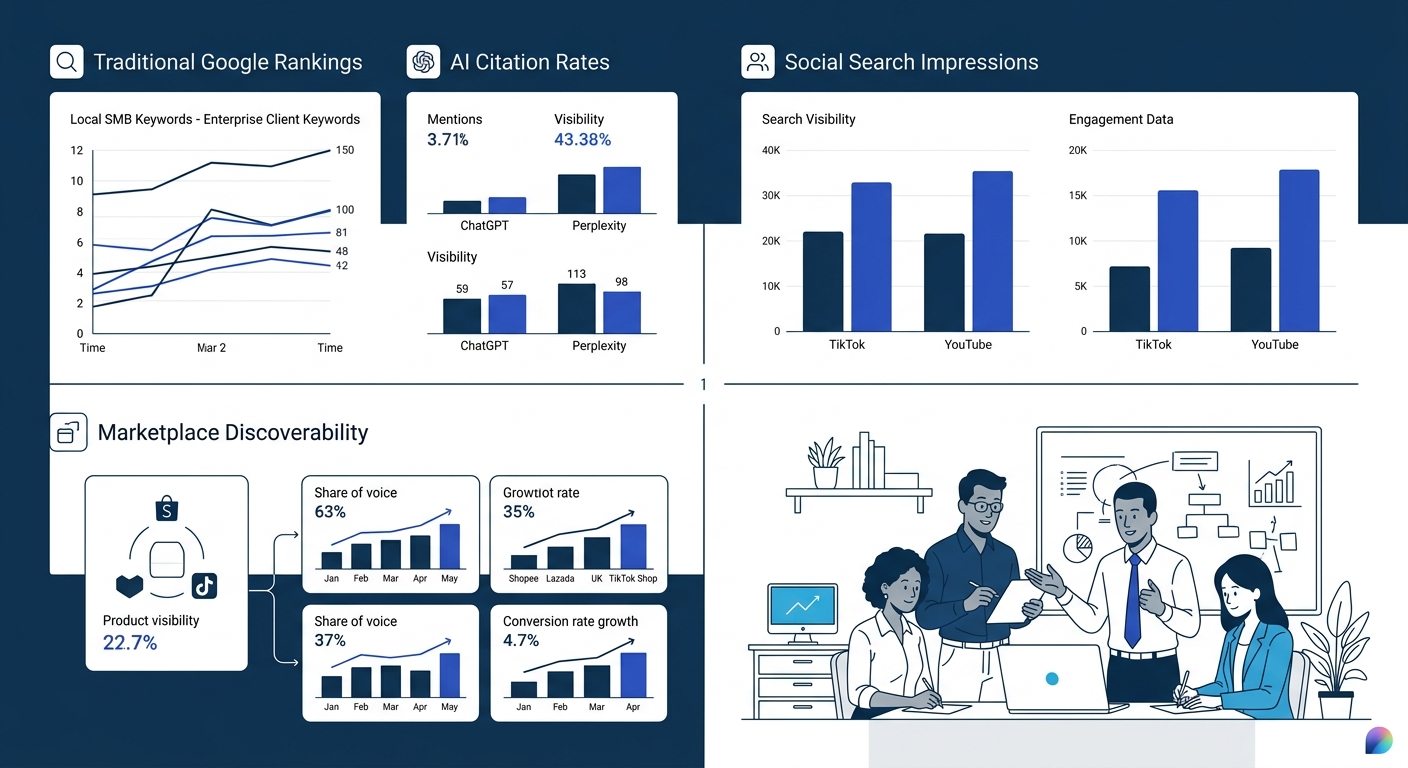
For the Philippine market specifically, this ecosystem approach carries an additional consideration. Local discovery behavior splits across Google, Facebook search, TikTok search, Lazada and Shopee, and increasingly ChatGPT and Perplexity for English-language commercial queries. A digital marketing consultation that only audits Google performance is examining less than half the discovery surface that matters. The brands we see gaining ground are the ones mapping their content against every platform where their customers actively search, then investing in conversion rate optimization across each entry point rather than funneling all traffic through a single landing page architecture.
The correlation between strong Google rankings and AI citation visibility dropped from 76% to 38% in twelve months. That’s the single most important number in search strategy right now.
Programmatic SEO, while still viable, is being held to materially higher standards. The May 2026 core update requires information consistency across independent sources before granting AI citations to programmatically generated pages. If your brand’s claim appears only on your own domain without independent corroboration, the AI system treats it as unverified. This reinforces why brands that have built authority across multiple content and channel touchpoints see their AI visibility compound while single-channel players watch theirs decline.
Where the Model Breaks Down
The search everywhere strategy sounds clean on a whiteboard, but its execution remains genuinely messy. Attribution across six or seven platforms is fragile, and the measurement tools haven’t caught up to the strategic framework. Semrush’s 126-million-prompt index is the most ambitious attempt yet to provide cross-platform AI visibility data, but it launched this week. The infrastructure for tracking how a TikTok video feeds a Perplexity citation that drives a Shopee conversion simply doesn’t exist yet in any reliable form.
There’s also an honest resource question. Philippine enterprise brands with established digital marketing teams can redirect existing SEO and social resources toward ecosystem-wide optimization. SMBs and mid-market brands typically can’t staff for six platforms simultaneously, and the advice to “be everywhere” without acknowledging that constraint borders on irresponsible. The more defensible version of the strategy involves ranking discovery platforms by actual customer usage data, choosing two or three beyond Google, and building genuine depth there rather than spreading thin across every possible surface.
And the pace of change itself is a problem. Google’s AI Mode citation logic has shifted at least three times in the past twelve months. Perplexity’s retrieval algorithm updates without public documentation. TikTok’s search ranking factors are largely undocumented. Enterprise teams building multi-channel visibility strategies are, to some degree, building on foundations that could shift in the next quarter. The teams handling this best treat their cross-platform strategies as living documents with built-in review cadences, not annual plans set and forgotten. That discipline is harder to maintain than any single technical optimization, and it’s where most search diversification efforts quietly stall.