Google June Spam Update Targets AI Manipulation as Rollout Begins June 24

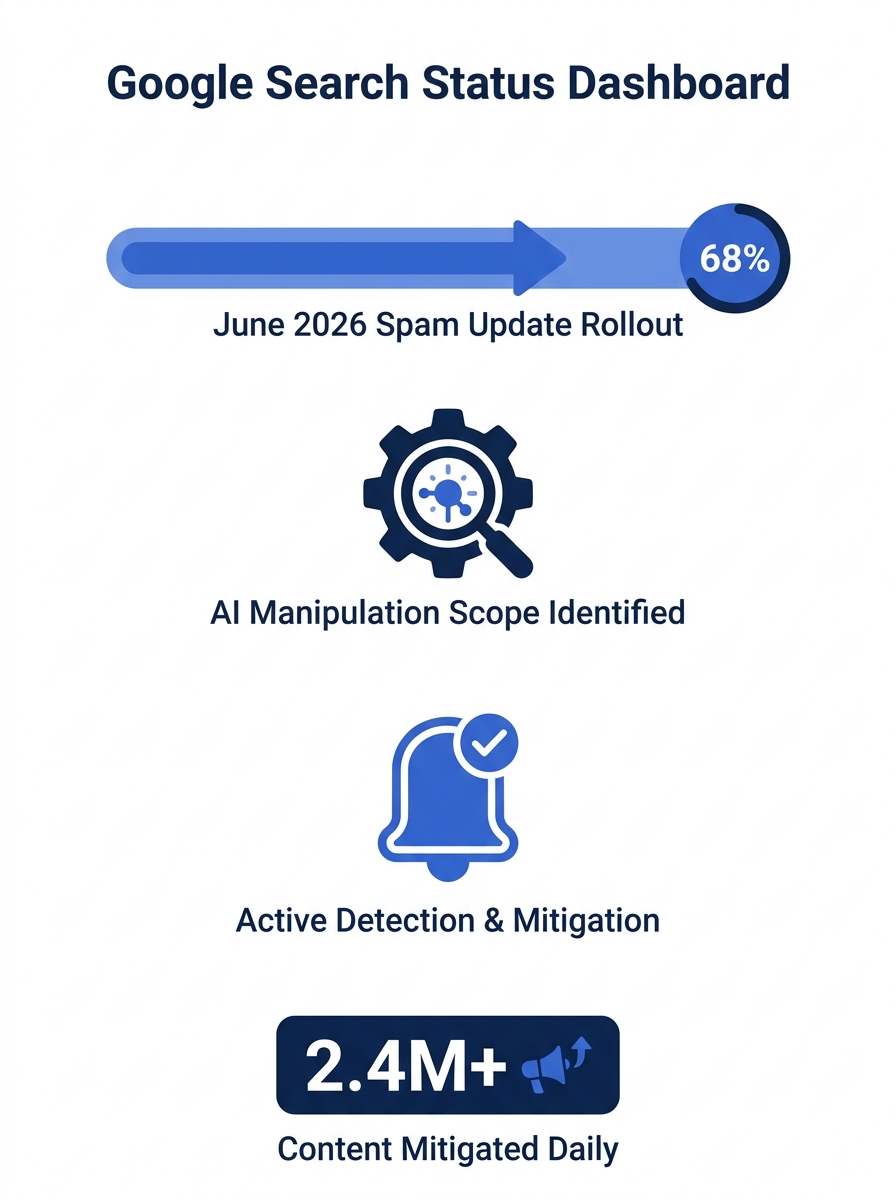
Google began rolling out its June 2026 spam update on June 24, extending enforcement to tactics designed to manipulate AI Overviews and AI Mode results, according to Search Engine Journal. The company announced the rollout through its Search Status Dashboard, noting the deployment will take several days to complete. The update formalizes May guidance that buying or altering citations in generative AI responses now falls under Google’s spam policy.
TL;DR: Google’s June 2026 spam update, which started June 24, treats manipulation of AI Overview citations and generative search responses as spam violations under existing policy.
The update marks the first major enforcement action since Google clarified in May 2026 that its spam policies extend to generative AI features within Search. Efforts to purchase AI citations, alter responses through deceptive tactics, or otherwise game AI-generated answers now trigger the same penalties historically applied to link schemes and cloaking, the company confirmed in its dashboard announcement.
What the Update Targets
Google’s spam policy now explicitly covers manipulation attempts directed at AI Overviews—the generative summaries that appear above traditional organic results—and AI Mode, the conversational search interface. The expansion addresses a category of tactics that emerged after the company launched AI-powered search features at scale in 2025.
Buying citations within AI-generated responses, submitting content structured solely to trigger inclusion in AI summaries, and coordinating networks to surface specific sources in generative answers all qualify as spam under the updated framework, according to the May policy clarification referenced in the dashboard post.
Shushrita M., a freelance SEO consultant, cautioned against immediate conclusions during the rollout period. “A sudden decline does not automatically mean your content is ‘bad,'” she said in a statement cited by Search Engine Journal. “The right response is to identify which page types, queries and directories were affected, then look for a consistent pattern.”
Impact on Enterprise SEO Briefs
Marketing leaders overseeing SEO agency partnerships will need to verify that content strategies avoid AI manipulation red flags now codified as spam violations. Agencies should audit existing content for patterns that might resemble citation-buying schemes or artificially structured AI-triggering tactics, particularly in verticals where competitors may have tested aggressive generative-answer targeting.
The rollout timeline—several days to complete, per Google’s announcement—means ranking volatility should be assessed over a multi-day window rather than hour-to-hour. Enterprise sites with thousands of pages may see phased impact as Google’s systems process different sections of the index.
The update coincides with evolving measurement frameworks for AI-driven search visibility. Google Search Liaison John Mueller clarified June 25 that impressions in the AI report within Search Console count only when links to a site appear in AI Overviews or AI Mode. Links hidden behind expansion elements register impressions only after a user expands them, according to Mueller’s response to Nicola Agius, Director of SEO and Discover at Reach PLC. The report does not yet provide click data.
Brands navigating AI search visibility and traditional organic rankings now face parallel compliance requirements: avoid manipulation tactics flagged by the spam update while building content depth that legitimately earns AI citations through topical authority and E-E-A-T signals.
Measurement Blind Spots in AI Referral Data
Separate research published this week by Similarweb, an analytics firm, found that 55.9% of downstream traffic following a ChatGPT recommendation arrived via branded search rather than direct referral clicks. The data, drawn from a U.S. desktop panel across finance, travel, and beauty sectors, indicates that AI visibility drives brand demand measurable through search volume rather than referral traffic alone.
Aleyda Solís, SEO and AI search consultant and founder of Orainti, noted the attribution gap: “AI influence can happen without a click, and this is why measuring AI Search impact only through ‘AI referral traffic’ is not enough,” she said in commentary cited by Search Engine Journal. Standard attribution models miss AI-influenced demand that surfaces through direct and branded-search channels, according to Solís.
The pattern complicates impact assessment for enterprise brands measuring ROI on content investments. A site may gain material AI visibility—evidenced by rising branded search volume—while showing minimal growth in direct AI referral traffic, the Similarweb study suggests.
Google’s Brendon Kraham, VP of Search and Commerce for Global Ads Solutions, stated June 25 that the company does not evaluate third-party SEO tools or vendors, and that those tools lack access to Google’s internal ranking metrics. Kraham added that effective SEO aligns with good generative engine optimization (GEO), reinforcing that separate playbooks for AI search are unnecessary.
Cyrus Shepard, founder of Zyppy SEO, pushed back on the equivalence in reverse: “Google says, ‘good SEO is good GEO.’ I don’t disagree,” he said in a statement cited by the publication. “But the same advice doesn’t always work in reverse. There are a whole lot of things AI-savvy SEOs do right now that they likely would never do if AI had never existed.”
The Takeaway
Marketing leaders briefing agency partners on post-update strategy should focus on three compliance checkpoints: audit existing content for patterns that resemble citation manipulation, establish branded-search tracking as a proxy for AI visibility impact, and discount vendor claims of proprietary access to Google’s generative-ranking signals. The June spam update formalizes what had been guidance into enforceable policy, raising the stakes for tactics designed specifically to trigger AI inclusions rather than serve user intent.
Enterprise brands with diversified content strategies—optimized for traditional search, AI Overviews, and answer engines—face lower rollout risk than sites built around gaming a single surface. The update reinforces that topical authority, E-E-A-T signals, and content depth remain the durable inputs across all search formats, while manipulation shortcuts now carry formal penalty exposure. Agencies should prioritize diagnostic audits that separate legitimate AI-visibility gains from tactics newly classified as spam, particularly for clients operating in competitive verticals where aggressive AI targeting may have proliferated.