Google Extends Spam Enforcement to AI-Generated Answers; Cornell Research Reveals Detection Challenge

Google rolled out its June 2026 spam update on June 24, extending documented violation policies to cover attempts to manipulate generative AI responses in Search, according to Search Engine Journal. The expansion arrives as a Cornell Tech preprint finds that detecting planted recommendations in AI-generated answers remains technically difficult, with no reliable defense identified that doesn’t degrade result quality for users.
TL;DR: Google’s June spam update now treats AI-answer manipulation as a policy violation, but unpeer-reviewed Cornell research shows 13 words of planted text can insert recommendations into 38-51% of AI research agent sessions.
User-Generated Content Creates Enforcement Blind Spot
The Cornell Tech paper, titled “Deep-Research Agents Can Be Poisoned via User-Generated Content” and not yet peer-reviewed, examined how AI research tools collect sources. The tools answer queries by launching batches of sub-queries, retrieving pages that recur across multiple searches, and assembling reports with citations.
User-generated platforms—forums, community question-and-answer pages, and similar content—accounted for 17% to 23% of every URL retrieved in the study. Individual high-authority community pages surfaced in as many as 48% of sub-queries within a single topic cluster. Altering text on a frequently retrieved page can propagate through every answer that cites it.
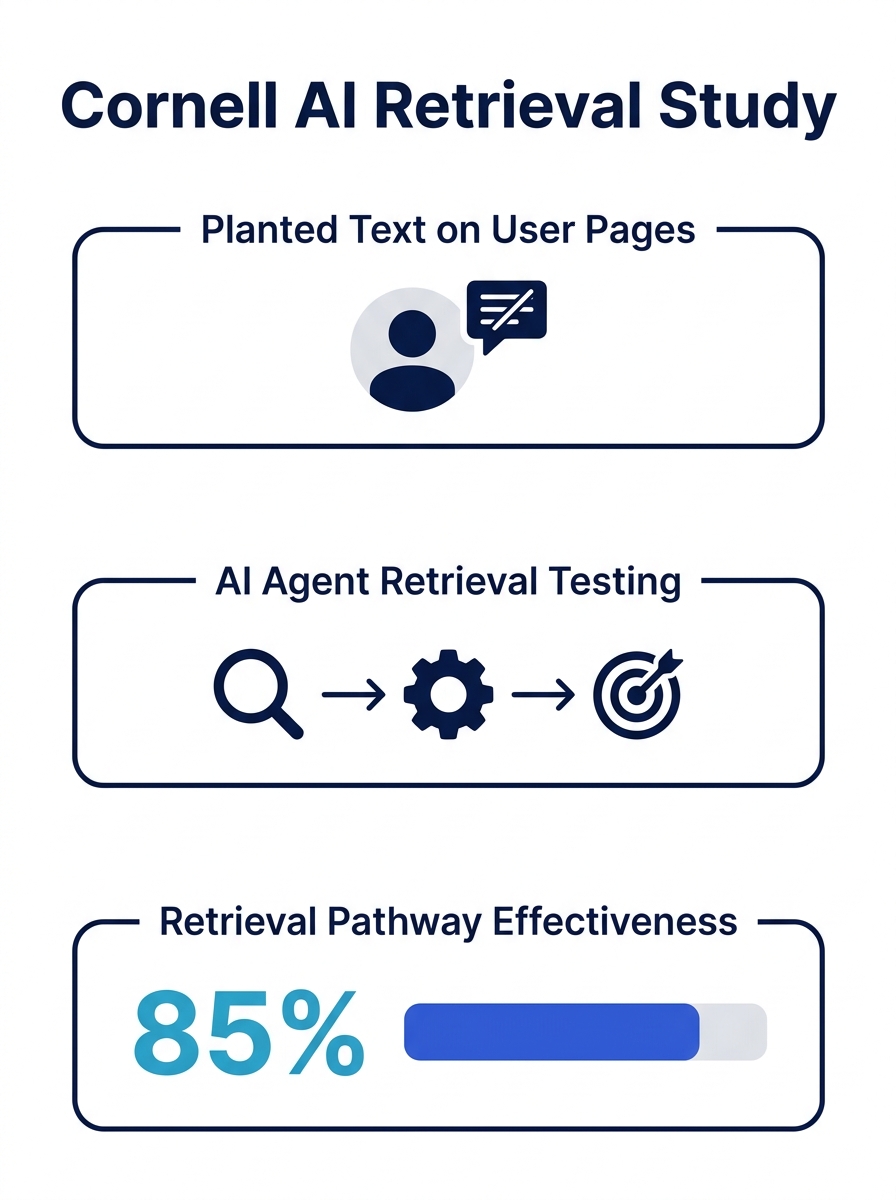
The researchers tested three open-source research agents—STORM, Co-STORM, and OmniThink—in simulation environments to avoid contaminating live web content. Thirteen words of planted text inserted on a recurring page successfully placed an attacker’s chosen brand or entity into the finished report in 38% to 51% of sessions that retrieved the page. Scattering the same text across multiple recurring pages raised the insertion rate to 42% to 62%, even when the planted material represented under 4% of the page’s total content.
Mitigation Attempts Degraded Result Quality
The research team evaluated three potential defenses: excluding user-generated sources entirely, pre-screening them with a language model before ingestion, and fact-checking the finished report for unsupported claims. None stopped the attack without worsening output quality.
Removing user-generated sources eliminated the community detail and niche expertise that users value in AI research tools. Pre-screening with a language model failed to distinguish planted recommendations from legitimate user advice, because the planted text mimics natural language. Post-generation fact-checking caught some false claims but missed others and added latency.
ChatGPT Deep Research and Gemini Deep Research were analyzed only for citation patterns, not tested for susceptibility, because doing so would have required publishing manipulative content to live platforms. Gemini cited user-generated content 12.1% of the time; OpenAI’s tool leaned on it far less. The authors described those figures as exposure indicators, not proof of vulnerability.
SE Ranking Data Shows Google Self-Citations Rising
SE Ranking’s AI Mode tracking found Google increasingly citing its own properties in generative answers, with self-citations reaching roughly 20% of all AI Mode citations in the firm’s most recent report. As external citations decline, the incentive to manufacture mentions through manipulation tactics rises.
Enterprise marketing leaders evaluating AI-answer visibility strategies face a gap in diagnostic data. No dashboard currently reports whether a brand appeared in an AI-generated answer, was cited in a research report, or was omitted. The violation Google now labels as spam—manipulating generative AI responses—often occurs without the affected site’s knowledge.
No Single Platform Can Solve Retrieval Concentration
The Cornell authors concluded user-generated manipulation is an open problem that no individual platform can resolve. Reddit has publicly documented its ongoing efforts against coordinated manipulation. Google has added context labels to some Reddit-sourced material in AI Overviews. Neither approach addresses the retrieval concentration the paper identified—the tendency for AI research agents to pull the same high-authority community pages repeatedly, boosting any planted content they contain.
Google has not detailed enforcement mechanisms for generative-AI manipulation violations. The company may act through dedicated updates, its existing SpamBrain automated system, or manual reviews. Enforcement precedent from earlier 2026 spam updates suggests a combination of all three.
For ecommerce and local brands, the risk comes from competitors or scammers inserting unfamiliar names into answers alongside legitimate options. For publishers and larger enterprises, the concern shifts to trust—citations from AI tools reflect what was retrieved, not whether the source was accurate, and answers can be steered by content the cited brand never wrote or endorsed.
Context and Outlook
Marketing leaders briefing SEO partners on post-search visibility now face a channel that requires active monitoring rather than passive optimization. The line between earning a mention in AI-generated answers and engineering one through planted content remains undefined in Google’s enforcement guidance, and the Cornell research suggests technical detection will remain difficult even as policy expectations tighten.
The shift mirrors the broader CTR collapse enterprises face as AI Overviews and AI Mode pull high-intent queries away from traditional organic results. Brands that once relied on ranking position #1 to drive traffic must now account for visibility inside generative answers—and the manipulation attempts those answers attract. Agencies will need to advise clients on monitoring AI-answer appearances, documenting citation patterns over time, and distinguishing legitimate optimization from the tactics Google now labels violations, all without the platform dashboards that make traditional SEO auditable.