How to Use AI to Amplify Your Marketing Strategy in 2026

A few years ago, experimenting with AI in marketing made you look cutting edge. In 2026, it just makes you functional.
Customer journeys are fragmented, channels keep multiplying, and expectations for personalization went from “nice to have” to “bare minimum.” No human-only team can keep up with that speed and volume without help. AI is no longer the shiny object in your stack. It is the plumbing that keeps the whole system running.
The real question now is not “Should we use AI?” It is “Where do we plug AI in so it actually moves the needle?”
2026: From AI Experiments to Everyday Marketing Infrastructure

How will AI change the way marketers compete in 2026?
For the last couple of years, AI sat in the “side project” bucket. Teams tried a few prompts, generated a few drafts, maybe ran an experiment on ad copy, then went back to business as usual.
That phase is over.
By 2026, AI is baked into how high-performing teams plan, execute, and measure campaigns. It is in their targeting, their content workflows, their reporting, even their budgeting. The gap is no longer between brands “using AI” and brands that are not. The gap is between teams that treat AI as infrastructure and teams that still treat it like a toy.
Practically, that shows up in three ways:
If your competitors can launch and optimize in days while you are still waiting for end-of-month reports, you are not playing the same game. The unfair advantage right now is not “having AI.” It is learning faster than everyone else while AI handles the busywork.
Make AI Work on Your Strategy, Not Just Your Stack
Where should you apply AI first in your marketing?
Most teams start with the wrong question: “Which AI tool should we buy?”
A better starting point is much less exciting and much more useful:
Those two answers tell you where AI should go first. That is your growth ceiling and your growth barrier.

Start with one workflow, not the whole department. For example:
You pick “campaign production” as the problem. Right now, it takes your team two weeks to brief, write, edit, and publish a full campaign. You plug AI into three parts of that flow: keyword clustering and audience research, first-draft copy, and repurposing into email + social variants. You do not let AI decide the strategy. You let it shorten the distance between idea and execution.
Then you measure two things:
If you cannot see a clear gain in at least one of those, you have not found the right use case yet or the process around the tool is wrong.
In 2026, “using AI” will not impress anyone. Using AI exactly where your strategy keeps stalling is what turns it into an advantage. For more ideas on how to implement this, check out our guide to AI-powered marketing strategies.
Design Content That AI Wants to Recommend (Not Just Rank)
How do you optimize content for AI overviews and generative engines?
The search landscape isn’t just shifting—it’s splitting.
Yes, Google still matters. But in 2026, the first “touchpoint” with your brand might not happen on a search results page at all. It might happen inside an AI overview, a chatbot answer, or a generative summary where the user never even types your name.
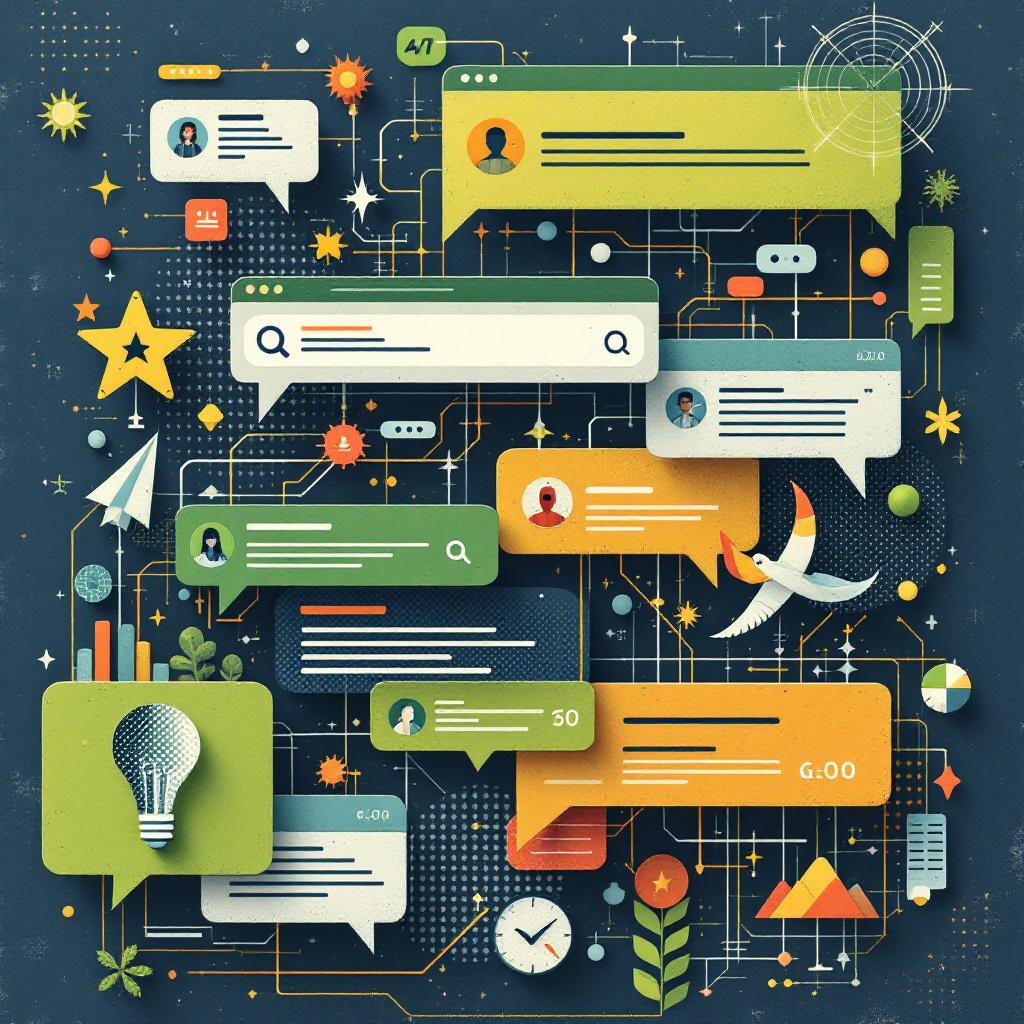
That’s where GEO—Generative Engine Optimization—comes in. It’s the natural evolution of SEO in a world where machines read first, and humans see the filtered version. If you want to dive deeper into this topic, read our guide on answer engine optimization.
The playbook is different, but the logic is simple:
Generative engines reward clarity, structure, and helpfulness. They pull from pages that don’t beat around the bush. So the more your content reads like a clean, useful answer to a real question, the higher your chances of being recommended.
A few principles shape this:
Write for questions, not just queries.
People no longer type “CRM software Philippines.” They ask, “What CRM should a small team use if they hate manual updates?” AI tools are trained on conversational language—so your content should mirror the way real people think and talk.
Make your structure obvious.
Think H1 as the topic, H2s as the steps or angles, and sections that get to the point fast. Long-form still works, but only when the reasoning is easy to extract. Lists, short explanations, light FAQs—these aren’t filler; they’re signals.
Avoid vague hooks that trick humans but confuse machines.
“You won’t believe what marketers are doing wrong” is basically a riddle to generative search. But “Common marketing mistakes businesses make when scaling with AI” tells the system exactly what you’re offering.
Educational content wins.
How-tos, explainers, frameworks, comparisons, and walkthroughs are the new authority pages. AI engines surface what feels trustworthy, not just what’s technically optimized. Our AI SEO services are designed to help you create exactly this kind of content.
When you write so that a model can cite you cleanly—and a human can skim you easily—you win twice. You become citable. You become discoverable. And that’s the real edge in 2026’s blended search ecosystem.
Let AI Handle the Repetition So Humans Can Handle the Story.
How do you keep your brand voice and ethics intact when using AI?
The fastest way to ruin your brand in 2026 is to sound like everyone else using AI. The fastest way to scale your brand in 2026 is to use AI without letting it write for you.
AI is incredible at the parts of marketing humans don’t exactly wake up excited to do. Rewriting variants. Repurposing a long article into three email drafts. Pulling insights from campaign data. Spinning one idea into ten formats. It’s the studio crew that keeps the lights on—not the director calling the shots.
The sweet spot looks something like this:
It’s a workflow where your voice sets the direction and AI removes the friction.
Here’s what that can look like in practice:
Instead of draining hours on the “grunt work,” you get to spend time sharpening the message itself.
But efficiency isn’t the only reason to keep humans in the loop. There’s also judgment. Context. Taste. The stuff AI hasn’t mastered and probably won’t for a while.
That’s where your guardrails matter:
Done right, AI amplifies your voice instead of flattening it. It helps you think faster, write cleaner, and execute with less drama—without stealing the parts of marketing that actually need a human pulse.
Start Small, Learn Fast, Scale What Works
What’s a realistic way to adopt AI in your marketing in 30 days?
A lot of teams get stuck here. They want an “AI transformation,” but what they really need is one good win. Not a new stack, not a six-month rollout—just one proof point that AI can make life easier and results better.
The simplest way to do that is with a 30-day experiment framed around one question:
“What part of our marketing slows us down the most?”
Once you’ve named that friction point, you build a small, controlled test around it.
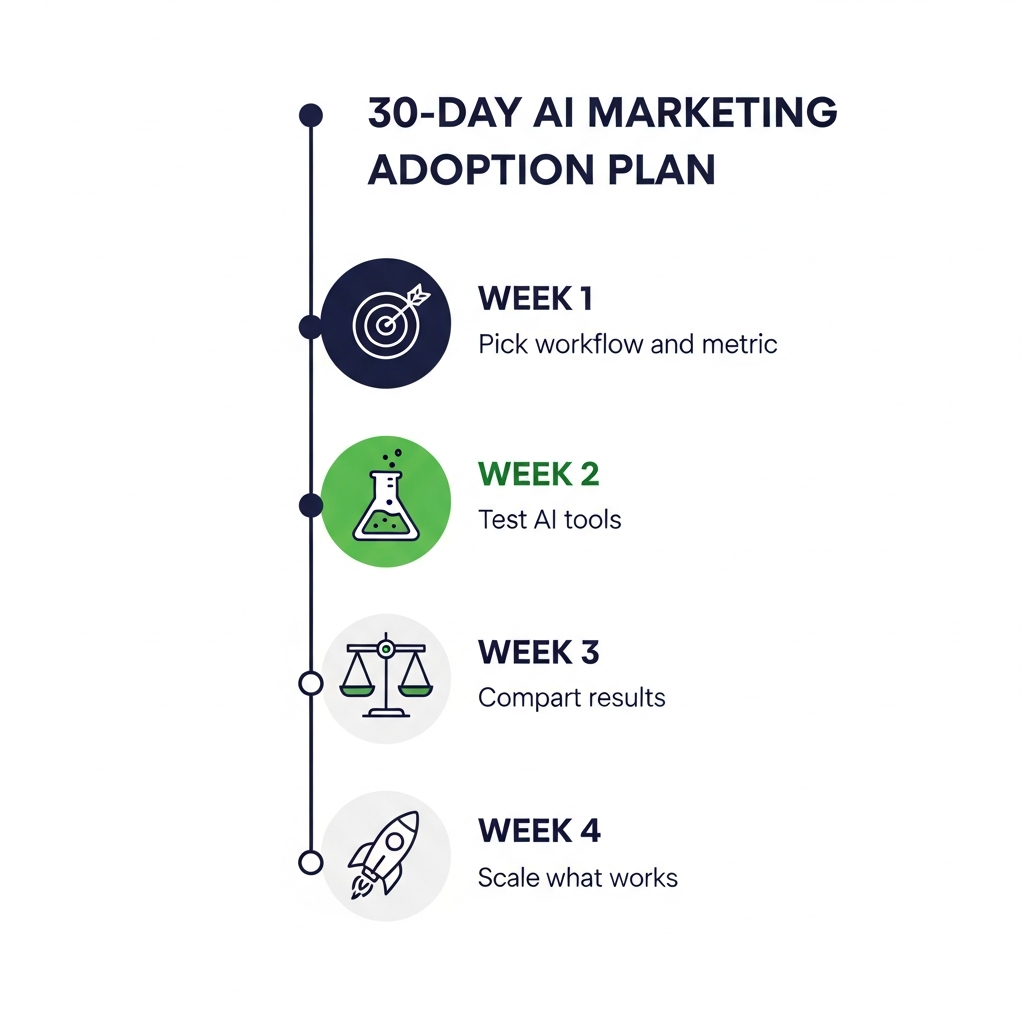
Week 1: Pick one workflow and define your success metric.
Week 2: Test 1–2 AI tools on that single workflow.
Keep the experiment contained. The goal is clarity, not chaos.
Week 3: Compare AI-assisted vs. your usual process.
Any improvement counts – time, cost, quality, or conversion.
Week 4: Decide what to scale.
If the experiment worked, expand it carefully.
If it didn’t, adjust and try a different workflow. Not all processes benefit equally, and that’s part of the learning curve.
The real shift in 2026 isn’t about “becoming an AI-driven brand.” It’s about working smarter, spotting insights faster, and showing up where customers actually look for answers—whether that’s a search result, an AI summary, or a conversation happening inside a chat window.
AI won’t replace your strategy or your voice. It will amplify both. And the brands that win this year aren’t the ones with the most tools—they’re the ones using AI on purpose. If you need help managing your marketing automation and CRM alongside AI, consider working with a certified HubSpot agency partner.
Wrapping Up
AI isn’t the thing that replaces marketers in 2026. It’s the thing that finally lets marketers do their best work again. The teams that thrive this year won’t be the ones chasing every new tool, they’ll be the ones who know where AI creates leverage, where humans need to lead, and how to build systems that learn faster than the competition.
If AI helps you answer questions more clearly, execute more consistently, and show up in the places where customers discover brands now, that’s already a strategic edge. Start with one workflow, one metric, one win. Scale from there.
The rest—consistency, momentum, and growth—follows once the basics click into place.