AI-Powered Marketing: Strategies for Filipino Brands in 2026
AI gives Filipino marketers the speed, personalization, and precision needed to compete and win in an increasingly crowded digital landscape.
Key Takeaways
- AI enables Filipino brands to automate repetitive tasks, personalize customer experiences at scale, and make faster, data-driven decisions that improve campaign performance and ROI.
- From chatbots and voice search to programmatic ads and SEO, there are at least 10 practical AI-powered strategies Philippine businesses can deploy right now to stay competitive.
- Brands that invest in AI marketing today build a stronger digital presence across both traditional search and AI-generated responses, reaching buyers at every stage of their journey.
Not so long ago, artificial intelligence was a concept best left to tech experts and sci-fi movies. Today? It’s on your phone, in your inbox, and in the ads you see online. For Filipino brands, Artificial Intelligence (AI) is no longer just a futuristic buzzword; it’s the here and now. AI marketing in the Philippines can help you promote your products and services smarter, faster, and better.
But while AI offers endless possibilities, it takes strategy and expertise to make it work for your business truly. As we make it halfway through 2026, here are personalized marketing strategies driven by AI that Filipino businesses can leverage to supercharge their campaigns.
How AI is Revolutionizing Marketing
AI has come a long way since chatbots and predictive text. Globally, 88% of marketers already use AI in their roles, with 83% of companies now prioritizing AI adoption in their workflows. Filipino companies have a unique opportunity to leapfrog digital strategies and accelerate their campaigns with AI.
It’s not hard to see how and why AI has emerged, and with it, AI marketing strategies. Originally developed to solve complex computational problems, AI has rapidly evolved into a powerful tool capable of mimicking human intelligence—analyzing data, recognizing patterns, and making decisions faster than any human team could. Its integration into marketing is a natural progression, as modern marketing demands speed, personalization, and precision at scale.
With today’s consumers expecting seamless, personalized experiences across every touchpoint, more agencies and brands are turning to AI tools to fuel their marketing efforts. This tech is becoming less of an option and more of a necessity in your marketing arsenal. AI provides the clarity and agility brands need to adapt and thrive. In short, AI isn’t replacing marketers—it’s making them better, faster, and smarter.
For businesses in the Philippines, it’s no longer a question of “if” but “how” AI will streamline their workflows and drive growth and revenue.
Why Smart Brands Let AI Take the Wheel (and Drive Results)
Let’s face it—digital marketing can be quite overwhelming, especially for clients with no related experience and expertise. You’re juggling Facebook ads, email campaigns, content calendars, SEO, influencer partnerships, TikTok trends, and the occasional viral meme. Keeping up manually? That’s a one-way ticket to burnout.
This is where AI in digital marketing comes in. Here’s why AI is crucial to marketers:
Efficiency at Scale
AI helps digital marketers achieve more in less time. It automates repetitive tasks such as email scheduling, social media posting, and even content generation, freeing up teams to focus on strategic work. Instead of spending hours manually adjusting campaigns, marketers can rely on AI tools to handle these operations quickly and accurately. This leads to faster execution, lower human error, and improved team productivity. Simply put, AI allows you to do more with less and scale faster without sacrificing quality.
Hyper-Personalization
AI enables brands to deliver tailored experiences at scale by analyzing customer data, such as browsing behavior, purchase history, and engagement patterns. With these insights, marketers can create dynamic content, personalized recommendations, and targeted messaging that resonates with individual users.
Data-Driven Decision Making
Digital marketing generates tons of data, but interpreting it effectively can be overwhelming. AI helps make sense of this data through real-time analytics and predictive modeling. It can uncover patterns that humans might miss and provide actionable insights for campaign optimization. For example, AI can suggest which keywords are most likely to convert or forecast which leads are worth nurturing. This data-backed approach minimizes guesswork, helping marketers invest budget more wisely and make smarter, faster decisions that are grounded in actual customer behavior—not just gut feel.
Smarter Ad Targeting
AI enhances digital advertising by identifying high-converting audiences and optimizing ad delivery in real time. It monitors performance metrics, analyzes user behavior, and automatically adjusts bids, placements, and creative elements to improve ROI. Whether you’re running ads on Facebook, Google, or TikTok, AI ensures your message reaches the people most likely to engage or buy.
Real-Time Customer Engagement
Modern customers expect speedy service and response times. Responding quickly can be the difference between gaining a customer and losing them to a competitor. AI ensures you never miss an opportunity to engage—day or night. AI enables brands to respond to customer actions as they happen. Through chatbots, recommendation engines, and AI-driven CRM systems, businesses can engage users in real time—answering questions, suggesting products, or nudging them to complete a purchase. This immediacy creates a seamless and satisfying customer journey.
Visibility Beyond the Search Results Page
Answer-generating engines like ChatGPT now act as discovery layers, delivering concise answers, summaries, and recommendations that save users time—and marketers too. By optimizing content for conversational formats, brands can scale content production and repurpose core assets (FAQs, knowledge bases, product descriptions) into many bite‑sized responses without having to recreate material each time. These engines favor trust signals, structured data, and sourceable facts, so investing in AI-powered marketing strategies improves citation likelihood and reduces wasted ad spend. AI tools can help marketers predict trends and adjust strategies, helping maintain efficient content workflows and improve visibility and overall performance.
10 Ways to Use AI in Your Digital Marketing Strategies
Now that you know the benefits of AI in marketing, how do you integrate AI into your strategies? The top three use cases of AI in marketing among marketers are content creation (93%), getting insights (81%), and faster decision-making (90%). But here are other ways you can utilize AI:1
1. Creating AI-Friendly Content
Content performs best in AI search when content is clear, well-organized, and genuinely useful. Begin with a direct answer, use descriptive headings, and keep paragraphs concise and easy to scan. To strengthen visibility in AI-generated results, include concrete examples, credible authorship, and enough depth to demonstrate real expertise.
2. AI-Driven Customer Insights and Market Research
Marketers can use AI to learn more about their audiences. AI models can analyze past behavior and data to forecast future actions—ideal for targeting, product recommendations, or campaign timing. This allows brands to anticipate what their customers want before they even know it. AI can also give insights about the market, including competitors and other factors that influence the buyer journey.
3. Email Marketing Automation and Personalization
Instead of blasting out the same email to your whole list, AI tools can analyze how your customers behave—what they click, when they open, what they buy—and send messages that match their interests and timing. Think subject lines they’re more likely to open and product suggestions they might actually want. No more templated messages that feel cold, distant, and impersonal. For Filipino brands looking to build relationships, this level of personalization helps turn a simple newsletter into a powerful driver of sales and loyalty. In fact, AI-powered personalization strategies can improve customer engagement.
4. Data Analysis
Modern marketing runs on data, but let’s face it: most of us don’t have time to dig through spreadsheets all day. AI steps in to handle the heavy lifting. It sifts through massive amounts of customer info—clicks, likes, shares, purchases—and pulls out patterns that actually matter. It’s like having a super-smart analyst on your team 24/7, helping you understand what’s working and what needs fixing.
5. Chatbots and Virtual Assistants
No more generic responses. AI chatbots now use NLP (Natural Language Processing) to understand intent, emotions, and context, and RAG (Retrieval-Augmented Generation) to retrieve relevant, up-to-date information. Chatbots and virtual assistants can handle FAQs, take orders, or even recommend products—all in real time, all without needing a person behind the screen. They’re not just convenient for customers; they also free up your team to focus on the more complex stuff.
6. Voice Search
As more Filipinos use voice assistants like Siri, Alexa, or Google Assistant, optimizing for voice search is becoming essential. People speak differently than they type, and AI helps you adapt your content. Tools can predict voice search trends, suggest question-based keywords, and make sure your brand shows up. Tapping into voice search with AI can help you stand out in a growing, on-the-go market where consumers have no time to type in their search queries.
7. Social Media Marketing
AI enhances digital advertising by identifying high-converting audiences and optimizing ad delivery in real time. It monitors performance metrics, analyzes user behavior, and automatically adjusts bids, placements, and creative elements to improve ROI. Whether you’re running ads on Facebook, Google, or TikTok, AI ensures your message reaches the people most likely to engage or buy.
8. Paid Media
Running ads is easy. Running effective ads? That’s where programmatic media buying shines. It can automate bidding, choose the best-performing creatives, and target the right audience—all in real time. AI tools learn from every click and scroll, optimizing campaigns as they go. For Filipino marketers with limited budgets, using AI-powered marketing means every centavo is put to better use. Whether it’s a Google ad, a Facebook campaign, or a promoted TikTok, AI helps ensure your paid media dollars go where they’ll get the biggest bang for your buck, without constant monitoring.
9. Video Marketing
With the continued prevalence of short-form video content, AI makes video creation smarter. From editing tools that cut reels automatically, to AI scripts and voiceovers, to platforms that tell you the best video length for engagement, there are tons of ways AI can improve your workflow. 90% of consumers report watching short-form videos on their phones daily, so not leveraging video marketing is a missed opportunity.
10. Paid Media
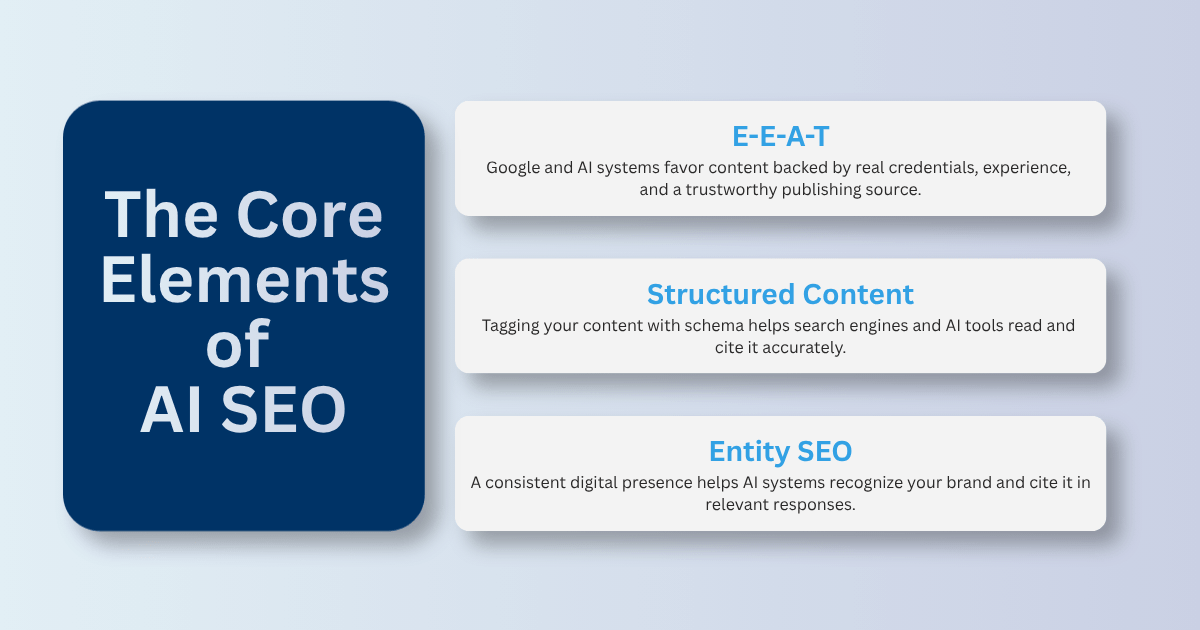
Search engine optimization is about understanding user intent, content quality, and real-time changes in search trends, and creating content that matches those to gain Google’s trust and rank at the top. At its bottom line is visibility, which means showing up in two places: traditional search results and AI-generated responses
SEO today also needs to account for AI. Beyond keyword research and backlinks, it now involves making your content easier for LLMs to recognize your brand as a credible, citable source. That requires structured data, clear content formatting, strong E-E-A-T signals, and consistent brand representation across the web.
For Philippine businesses, investing in AI in SEO now means building a digital presence that performs across both traditional and AI-powered search, giving your brand more touchpoints with buyers at every stage of their journey.

AI Is Not the Future of Marketing. It Is the Present.
The brands winning in the Philippine market right now are not the ones with the biggest budgets. They are the ones using AI strategically, to personalize at scale, respond in real time, create content efficiently, and show up where their audience is searching.
From AI tools to AI-powered marketing strategies, there is no doubt that AI amplifies what good marketing already does. It does not replace strategy. It sharpens it.
The question for Filipino brands in 2026 is no longer whether to use AI. It is whether your AI strategy is sophisticated enough to keep pace with brands that have been building on it for years.
Truelogic helps Philippine businesses integrate AI across their digital marketing strategy, from SEO and paid media to web development and analytics. If you want to put AI to work for your brand, we are ready to help.
Frequently Asked Questions
How much does it cost to implement AI in digital marketing for a small Filipino business?
AI marketing tools vary widely in cost. Many platforms offer tiered pricing, with affordable entry-level plans. Small businesses can start with affordable tools for email automation or social scheduling before scaling up to more comprehensive AI-powered platforms as their needs and budgets grow.
Is AI-generated content safe to publish without human review?
AI can produce content quickly, but human review remains essential. AI tools can miss cultural nuances, produce factual errors, or generate copy that feels generic. Treat AI-generated content as a strong first draft and have a human editor refine it before publishing.
How do I know if my AI marketing strategy is actually working?
Track key digital marketing metrics aligned to your goals—conversion rates, engagement, customer acquisition cost, and organic search rankings are good starting points. Most AI platforms include built-in analytics dashboards. Review performance regularly and adjust your strategy based on the data, rather than waiting for a campaign to run its full course before making changes.