What Is WebMCP? A Guide for Filipino Brands

Filipino brands have spent the last few years adapting to a mobile-first, social-first, and now AI-shaped customer journey. That shift is getting sharper. In Google’s 2025 Philippines e-Conomy report, the country’s digital economy reached $36 billion in 2025, while e-commerce alone hit $24 billion. The same report found that 74% of Filipinos say they interact with AI tools and features every day, and 65% say they already ask questions to AI chatbots.
That matters because the next version of digital experience will not be limited to a human user scrolling, tapping, and filling forms manually. More journeys will start with an AI assistant helping a person compare products, shortlist services, ask support questions, or complete transactions.
For brands, that raises a practical question: is your website ready for an AI agent to use it properly?
WebMCP is one of the clearest early answers to that question. It is not a buzzword for marketers to throw into decks. It is an emerging browser standard aimed at making websites easier for AI agents to understand and act on with more speed, reliability, and precision.
For Filipino brands competing in crowded categories such as retail, banking, telecom, education, healthcare, property, and B2B services, this is worth watching now. Not later.
What Is WebMCP?
WebMCP is a proposed browser-side standard that helps websites expose structured actions to AI agents. According to Chrome for Developers, WebMCP aims to let websites expose tools so browser agents can perform tasks with more speed, reliability, and precision than raw DOM clicking alone.
A simpler way to think about it: WebMCP gives a website a cleaner way to say, “Here is what this part of the interface is for, here is the action available, and here is how an agent should use it.”
That is different from today’s common automation pattern, where an agent tries to figure things out by looking at buttons, forms, labels, and page structure. That approach can work, but it breaks easily. Change a button label, move a field, or redesign a page, and the agent may fail.
Chrome’s March 2026 guidance makes the distinction even clearer. WebMCP is not a replacement for MCP. MCP is mainly for backend systems and external tools. WebMCP is for the browser frontend. In other words, MCP helps an AI system talk to services. WebMCP helps an AI system use your website.
That is why this matters for marketing, UX, ecommerce, and growth teams, not just developers.
Why Filipino Brands Should Pay Attention Now
The Philippine market is unusually well positioned for AI-assisted journeys.
The audience is mobile-heavy. Digital commerce is growing fast. Consumers are comfortable with chat-based behavior. And many categories already rely on assisted buying, whether through chat, live selling, social commerce, or agent-like service interactions.
There are three reasons this matters.
First, Filipino consumers already show strong openness to AI help. Google’s 2025 Philippines e-Conomy report found that 51% expect AI to help them make decisions faster and with less mental effort. It also found that saving time on research and comparison is the top reason people use or would pay for AI features.
Second, the broader market is digital enough for agent-ready experiences to matter commercially. The Philippine Statistics Authority reported that the digital economy contributed 8.5% to the Philippine economy in 2024. On top of that, PSA also reported that two in every three Filipinos aged 10 and over used the internet in 2024. That is not edge-case behavior anymore. It is mainstream.
Third, many Philippine brand websites are still optimized mainly for human navigation, not agent-assisted completion. They may be visually polished but operationally fragile. Long forms. Ambiguous buttons. Layered menus. Too many branching paths. Those issues hurt conversion even with humans. They become worse when an AI assistant tries to help the user finish the task.

This is the real business case for WebMCP. It is not about chasing novelty. It is about reducing friction in the next wave of digital journeys.
What WebMCP Changes on a Brand Website
Without WebMCP or similar structured approaches, AI agents depend heavily on inference. They try to guess:
WebMCP reduces that guesswork by declaring intended capabilities more explicitly. Chrome describes this as structured tool discovery, predictable execution, and clear intent. That means an AI agent does not have to reverse-engineer the page just to complete a basic task.
For brands, the upside is straightforward:
5 WebMCP Use Cases for Filipino Brands
1. Ecommerce product discovery and checkout
Philippine ecommerce is already shaped by high comparison behavior, promo-driven buying, and cross-platform journeys. If an AI assistant is helping a shopper choose between product options, WebMCP can make it easier for the website to expose structured actions for search, filtering, variant selection, and checkout.
For a local beauty brand, that could mean an assistant helping users find the right sunscreen based on skin type, budget, SPF range, and preferred format. For an electronics retailer, it could mean helping a buyer compare laptops by processor, battery life, and installment availability.
The business value is simple: fewer dead ends, fewer wrong configurations, and better assisted conversion paths.
2. Customer support for telecom, banking, and utilities
Support journeys in the Philippines often begin in chat, then move to forms, portals, and ticket queues. That creates friction. WebMCP can help brands expose a cleaner support path so an AI agent knows how to file a concern, provide the right technical details, and route the user to the correct workflow.
Think of a broadband provider handling line issues, a digital bank managing card disputes, or a utility company processing service requests. Structured support actions could reduce unnecessary back-and-forth and improve completion quality.
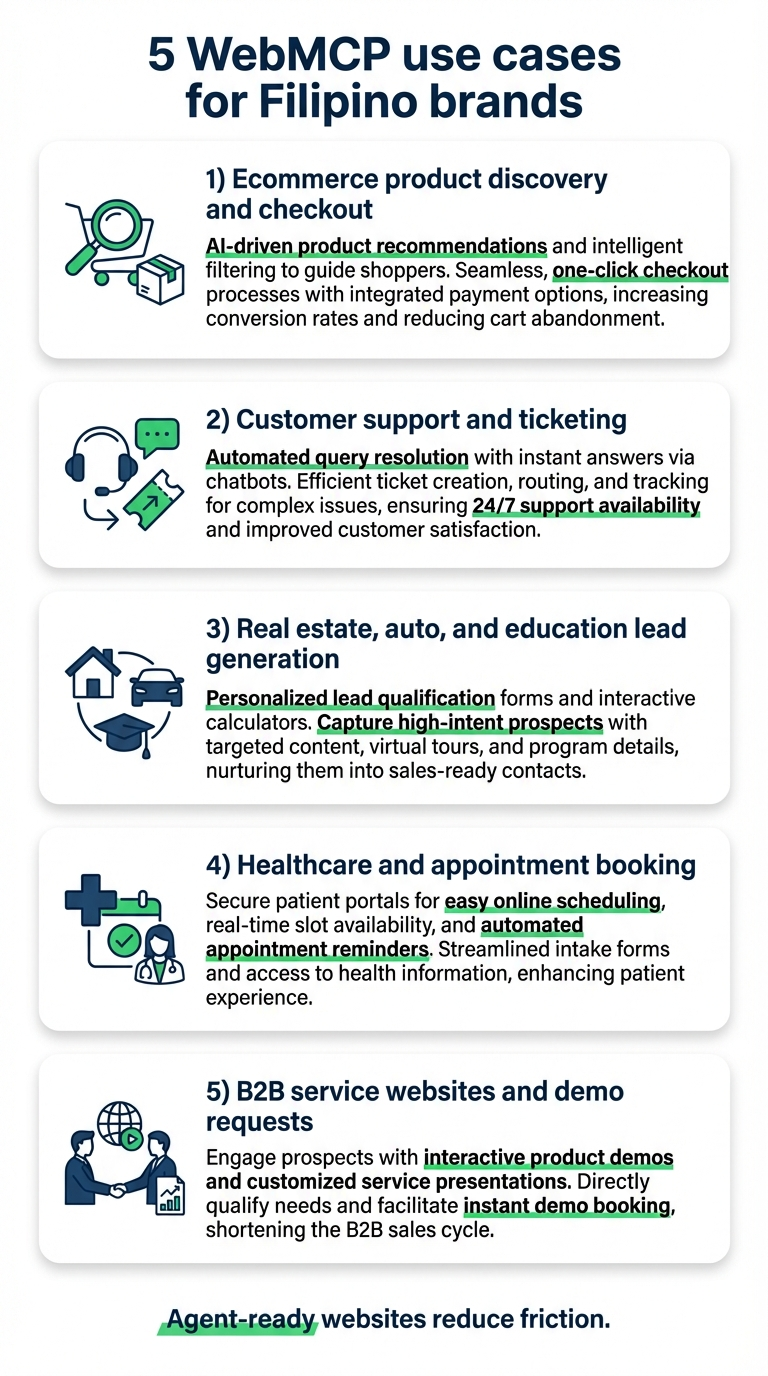
3. Real estate, automotive, and high-consideration lead generation
Some categories do not sell in one click. They qualify. They shortlist. They nurture. In these sectors, AI agents are likely to become a front-end assistant for users comparing options and booking next steps.
A property developer, car brand, or private school could use WebMCP-aligned workflows to help AI agents narrow options based on budget, location, payment terms, and intent. Instead of dumping users into a generic inquiry form, the site can make each step more structured and easier to complete.
That does not replace human sales. It improves the handoff.
4. Healthcare and education appointment flows
Hospitals, clinics, diagnostic centers, universities, and training providers usually have layered service menus. Patients and students are not always sure which path to take. AI assistance can help, but only if the website is clear enough.
WebMCP could support better guided actions for appointment booking, service selection, intake forms, and program inquiries. For Filipino organizations serving large mobile audiences, that could turn a messy navigation flow into a clearer guided one.
5. B2B service brands and enterprise websites
This is the use case many agencies and professional service firms should take seriously. If your prospects are researching solutions with AI support, your website should not be hard to interpret.
A B2B buyer might ask an AI assistant to compare agencies, shortlist vendors, understand service packages, or book a discovery call. Brands that make those actions easier to complete will have an edge.
For companies investing in AI SEO services, WebMCP represents the next layer after visibility. It is not just about being discovered in AI-driven search. It is about being usable when the user or agent reaches your site.
How Brands Can Prepare Even Before WebMCP Becomes Mainstream
WebMCP is early. Most Filipino brands do not need to implement it tomorrow. But they do need to get their websites ready for the kind of interactions it supports.
That starts with practical cleanup.
Audit your highest-value journeys
Look at the pages that matter most: product pages, quotation flows, lead forms, branch locators, support journeys, booking pages, and account tasks. Ask where a human gets confused and where an AI agent would likely struggle even more.
Simplify forms and branching logic
If the only way to finish a task is through a maze of dropdowns, hidden fields, and inconsistent labels, your UX is already weaker than it should be. Structured agent interactions start with clean human interactions.
Invest in semantic clarity
Good labels, meaningful headings, consistent page architecture, and predictable actions all help. So does technical hygiene. Brands already improving technical SEO are in a better position because many of the same habits that help search engines also help agents understand the page.
Connect visibility to usability
Getting cited by AI systems is valuable, but it is not enough. Once users land on your site, the experience has to convert. That is why brands should think of WebMCP as part of a broader AI-readiness plan alongside content, search visibility, UX, analytics, and site architecture.
If you want the search side of that picture, our articles on SEO trends in the Philippines and AI-powered marketing strategies are useful starting points.
Key Takeaways for Filipino Brands
FAQ
Is WebMCP already widely used?
Not yet. It is still early. But the direction is clear: browsers and AI platforms are moving toward more structured website interactions.
Does WebMCP replace SEO?
No. SEO helps brands get discovered. WebMCP is more about what happens when an AI agent or assistant is trying to use the website itself.
Should Philippine brands invest in this now?
They should at least prepare for it now. The best next step is not a rushed implementation. It is cleaning up key journeys, improving site structure, and aligning UX, development, and search teams around AI readiness.
Final Thought
The real opportunity for Filipino brands is not just showing up in AI results. It is becoming easier for AI-assisted users to buy, book, ask, compare, and convert on your site.
That is why WebMCP matters. It points to a web where websites do not just present information. They expose usable actions.
And for brands in the Philippines, that shift could become a competitive advantage faster than most teams expect.