AI SEO in the Philippines: What Actually Changes for Local Businesses in 2026

AI has changed the way people search, but it has not made SEO obsolete. If anything, it has made weak SEO more expensive.
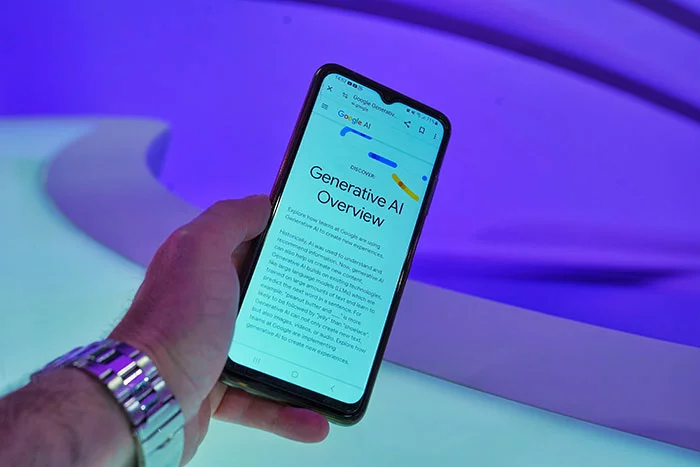
For Philippine businesses, that matters now. Search behavior is getting more layered. Users still click traditional organic results, but they also scan AI summaries, compare options faster, and expect clearer answers before they ever visit a website. Google says AI Overviews and AI Mode are designed to help people explore a wider range of helpful links and discover more diverse sources, not replace the web outright. Google’s documentation on AI features makes that point directly.
If you run marketing for a local company, the practical question is not “Is SEO dead?” It is simpler than that: what should you keep doing, what should you change, and where should you stop wasting time?
What AI actually changes in search
AI changes the shape of discovery. A user can ask a longer question, get a synthesized response, then either refine the search, compare providers, or click through to a source that looks trustworthy. That compresses the research journey. It also raises the bar for content quality because generic articles are easier for search systems to summarize and easier for users to skip.
That is the real shift. Businesses are no longer competing only for the blue link. They are competing for visibility across the whole answer journey: citation, mention, click, and conversion.
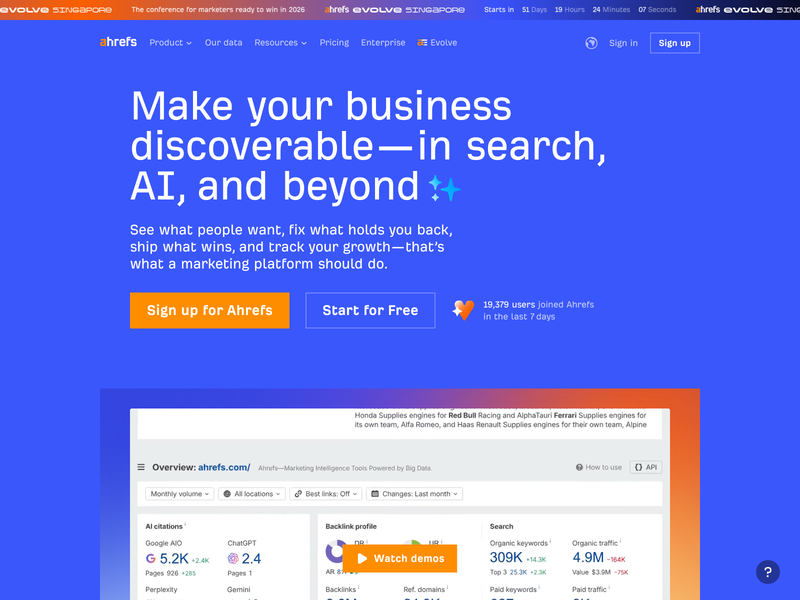
This also affects traffic expectations. Ahrefs’ 2026 update found that the presence of an AI Overview correlated with a 58% lower click-through rate for the top-ranking page on the keywords they studied. That does not mean rankings stopped mattering. It means rankings alone are no longer the full story.
For local businesses in the Philippines, the impact is uneven. High-intent searches like “SEO agency Philippines,” “B2B lead generation services,” or branded searches can still drive strong clicks. Informational queries, though, are more likely to get absorbed into AI-generated summaries unless the page offers something specific, credible, and worth clicking for.
What still matters in AI SEO
Here is the part many brands overcomplicate: most of the foundations still hold.
Google’s guidance for performing well in AI search experiences sounds familiar for a reason. The company continues to emphasize crawlability, indexable content, strong page experience, useful structured data, and helpful original content. In other words, the same basics that made a site strong before AI are still the basics that help it surface now. Google’s Search Central guidance explicitly says site owners should focus on unique value, technical accessibility, and a good user experience.
If your site already has strong search engine optimization services support, clean site architecture, and pages that answer real buyer questions, you are not starting from zero. You are refining the system.
Why this hits Philippine businesses differently
The Philippine market has two realities at once. Search demand is rising, and AI usage is rising, but advanced AI adoption across businesses is still uneven. According to the Philippine Institute for Development Studies, only 14.9% of firms use AI tools, with adoption concentrated in larger urban companies. That gap matters because early movers can improve content production, research speed, and search visibility faster than slower competitors.
There is also a consumer-side shift. Semrush’s Philippines ranking for AI websites reported that ChatGPT drew roughly 110.99 million monthly visits in the Philippines in early 2026. You do not need to believe every new AI tool will dominate customer acquisition to accept the obvious point: Filipino users are already comfortable getting answers from AI interfaces.
That means your brand has to be discoverable in more than one environment. Your website still needs to rank in Google. Your brand also needs clear expertise signals, structured information, and strong local relevance so that AI-assisted journeys still lead back to you.
Local intent becomes more valuable
AI summaries are most dangerous to shallow informational content. They are less likely to fully replace local, service-driven, or trust-sensitive searches where people still need a provider, proof, pricing context, or a way to contact someone. That is good news for Philippine businesses with actual service depth.
A law firm, dental group, enterprise SaaS provider, or real estate developer will still need strong pages for service categories, locations, FAQs, and commercial intent terms. If your site does not clearly explain what you do, who you help, where you operate, and why you are credible, AI will not fix that for you.
The five pillars of AI SEO for local businesses
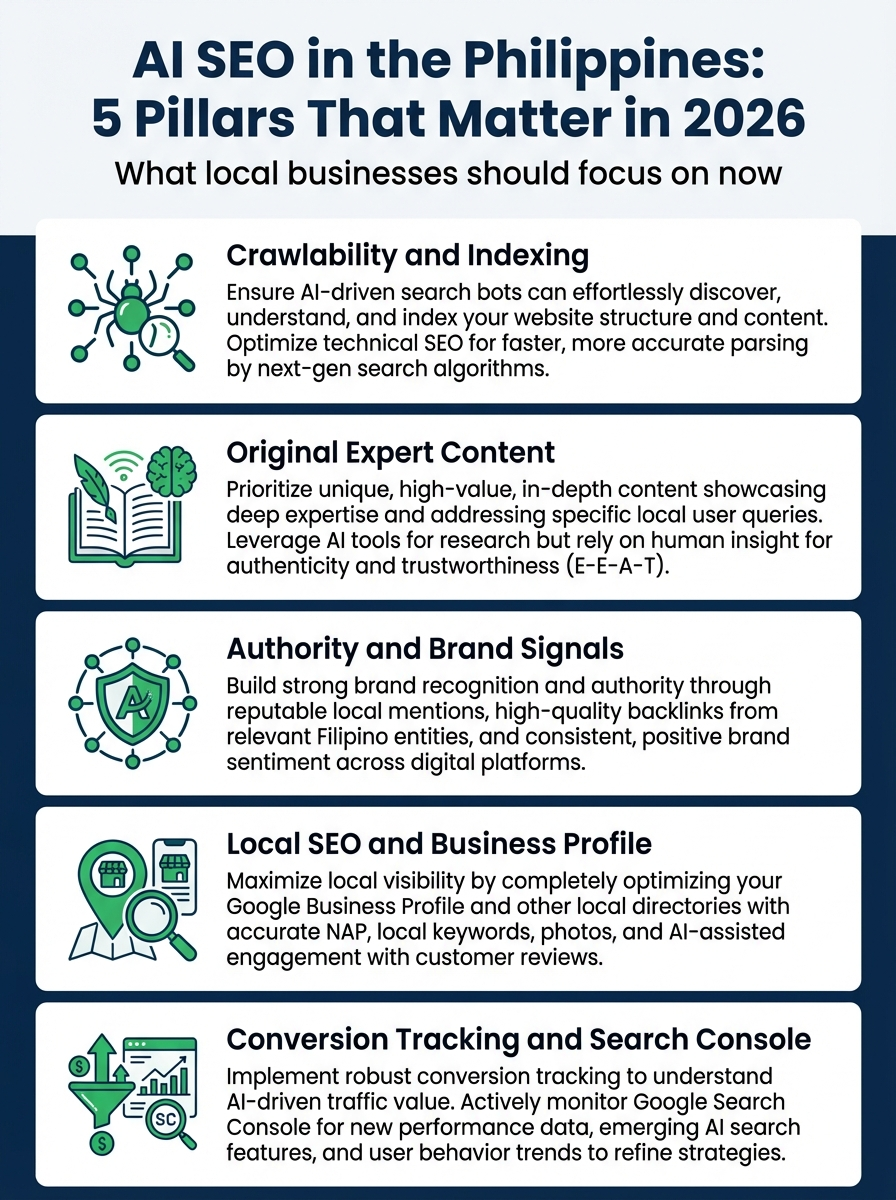
1. Crawlability and indexation
If important pages are blocked, buried, duplicated, or slow, you limit your visibility before strategy even starts. Review crawl paths, internal links, canonicals, XML sitemaps, schema alignment, and Core Web Vitals. If you need a place to start, this technical SEO checklist covers the core fixes that prevent avoidable losses.
2. Original expert content
Generic content is now a losing game. Publish pages with real experience, local examples, differentiated opinions, and practical depth. Not more words. Better information. A useful page should answer the obvious question and the follow-up question, then give the reader a reason to trust the source.
3. Authority and brand consistency
AI search favors brands that look coherent across the web. Your service pages, author signals, mentions, backlinks, case studies, and business details should tell the same story. This is one reason companies investing in AI SEO services are also tightening thought leadership, PR, and content quality at the same time.
4. Local SEO signals
Your Google Business Profile, service area signals, review profile, and location pages are still major trust assets. For many Philippine businesses, especially those selling regionally or with branch networks, local search remains one of the clearest bridges from visibility to lead generation.
5. Measurement beyond rankings
Track branded search growth, assisted conversions, form fills, call leads, page-level engagement, and query shifts. AI search can reduce clicks while increasing exposure, so leadership teams need better KPIs than rank position alone.
One tool every team should use right now
Google Search Console
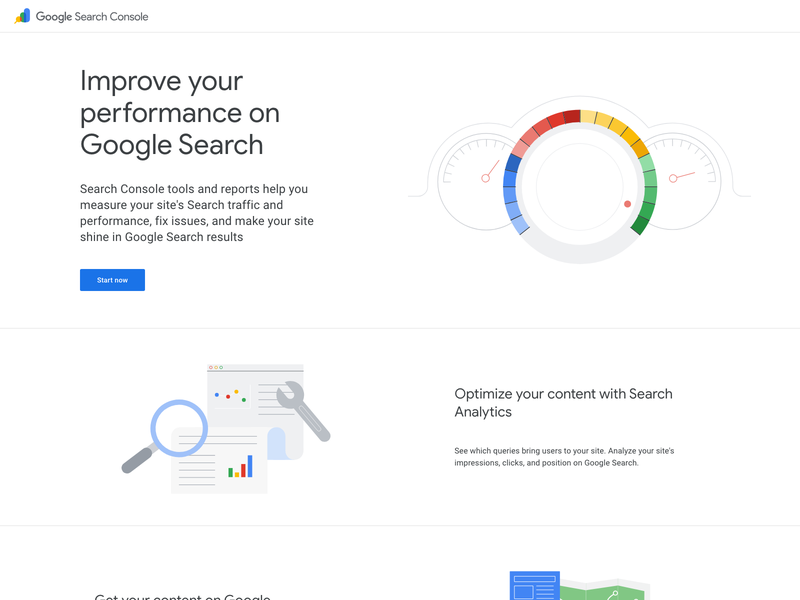
Google Search Console should be part of every AI SEO workflow because it still shows how Google is discovering, indexing, and surfacing your pages. It will not answer every AI-visibility question, but it gives you the clearest direct signal on query trends, click changes, indexation issues, and page performance.
In practice, that means watching for three things:
A practical 90-day plan
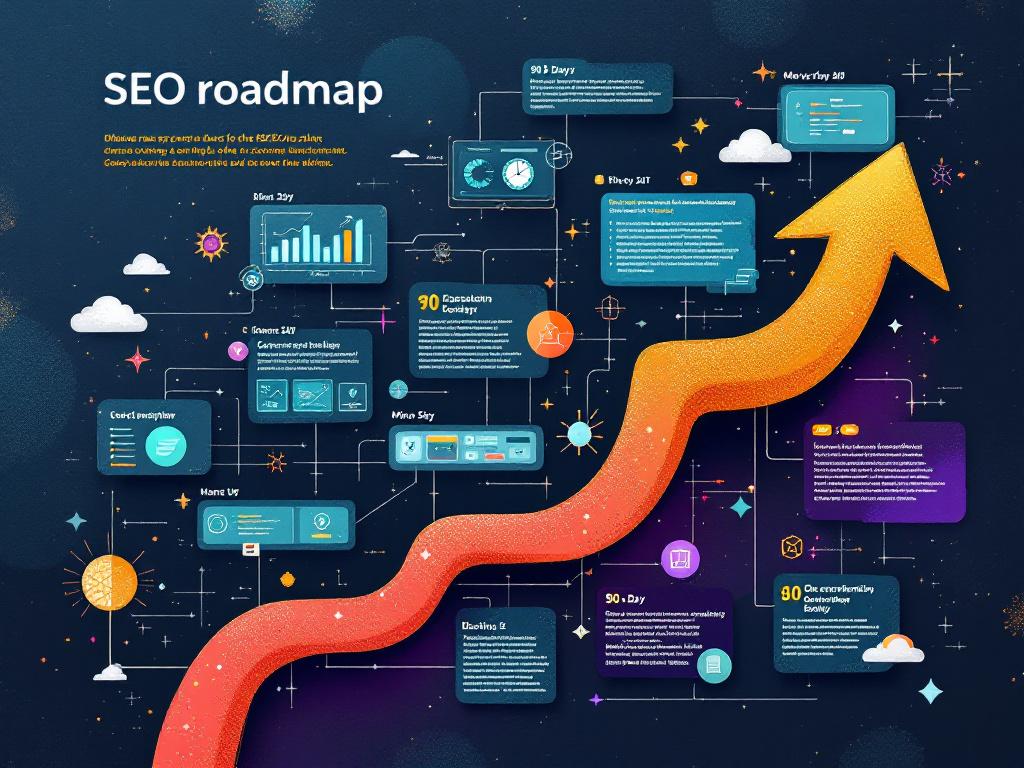
If you want an AI SEO plan that is useful in the real world, keep it simple.
Days 1 to 30: Fix the foundation
Audit technical issues, clean up duplicate pages, tighten internal links, refresh metadata on key commercial pages, and make sure service pages actually answer buyer intent. If your broader channel mix is weak, align this work with a stronger digital marketing strategy so search is not operating in isolation.
Days 31 to 60: Upgrade high-intent content
Rewrite thin service pages. Add FAQs. Add proof. Add clear differentiators. Publish two to four expert-led articles on buyer problems you can credibly own. The goal is not volume. The goal is better coverage of the questions that lead to revenue.
Days 61 to 90: Build authority and track outcomes
Promote your best content, strengthen backlinks, improve local signals, and build dashboards around lead quality, branded demand, and assisted conversions. For bigger organizations, this often connects naturally with a more mature enterprise SEO program where governance and measurement matter just as much as rankings.
Common mistakes to avoid
Final takeaway
AI SEO is not a brand new discipline for Philippine businesses. It is SEO with less room for weak content, vague positioning, and technical neglect.
The companies that will win are not the ones publishing the most AI-assisted articles. They are the ones with cleaner websites, sharper service pages, better local signals, stronger authority, and clearer proof of expertise. That work is less flashy. It is also what compounds.
If your business wants to stay visible as search keeps changing, start with the fundamentals and upgrade the parts of your site that already drive commercial intent. That is still where the leverage is.