Marketing Leaders Spend 15% of Budgets on AI Tools But 70% Lack Measurement Frameworks to Assess Returns

Marketing leaders now allocate an average of 15.3% of their budgets to AI initiatives, yet only 30% report having the mature measurement capabilities needed to determine whether those tools generate returns, according to Gartner’s 2026 CMO Spend Survey. The gap between AI spending and AI accountability has widened as 70% of CMOs identify becoming an “AI leader” as a critical 2026 goal while 56% acknowledge they lack the budget to execute their broader strategy.
TL;DR: Gartner’s 2026 survey reveals marketing organizations are channeling 15.3% of budgets into AI tools while only 30% possess the frameworks to measure whether those investments deliver measurable business outcomes, exposing a structural measurement crisis across enterprise marketing operations.
The survey data surfaces a measurement crisis that has grown in lockstep with AI adoption: marketing teams are renewing tools quarter after quarter based on perceived time savings rather than documented contribution to revenue, lead generation, or cost reduction. The consequence is budget allocation driven by activity metrics, blog posts produced, social posts scheduled, emails drafted, rather than by verified impact on pipeline or customer acquisition cost.
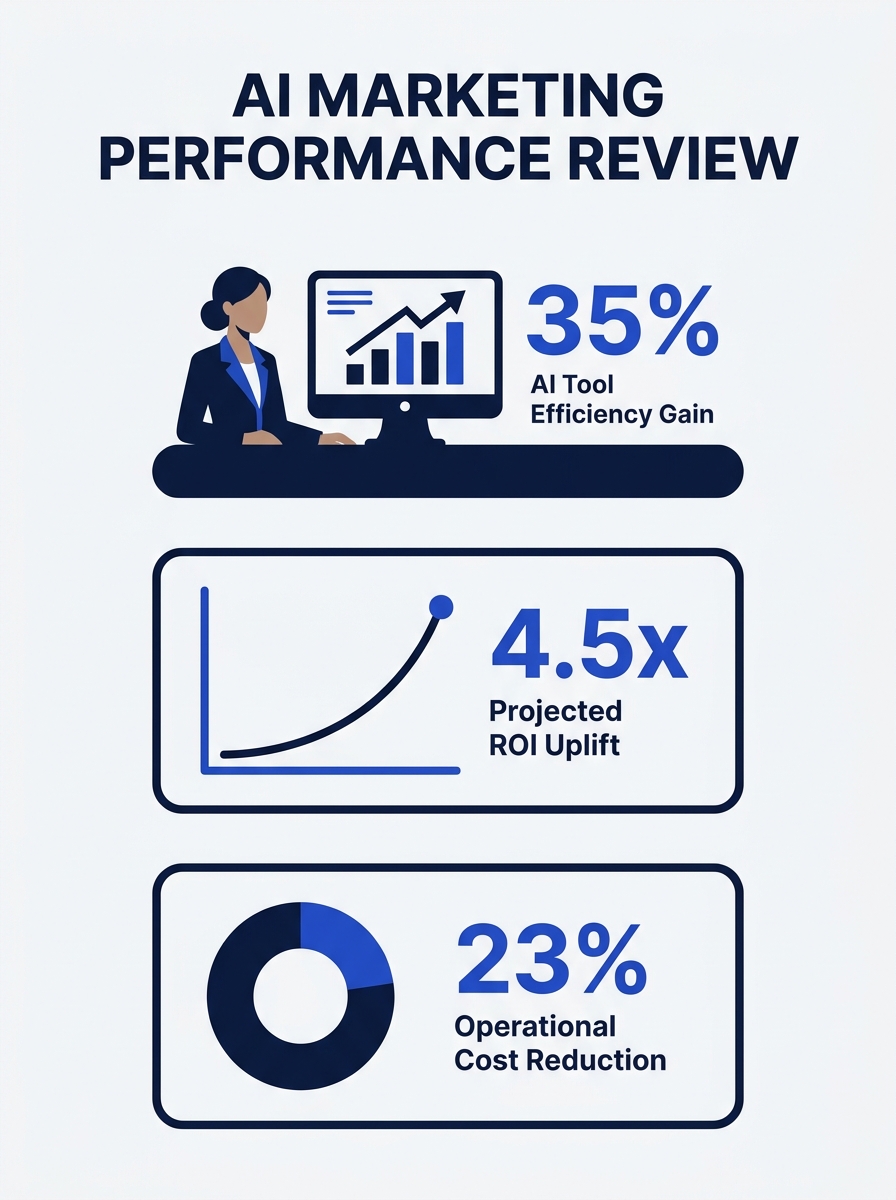
The Total-Cost Blindspot Inflating AI Spend
The subscription fee listed on a tool’s pricing page represents a fraction of what that tool ultimately costs an organization, according to implementation data cited in the Knowledge Hub Media analysis. Integration and setup work add 20% to 30% to first-year costs, a figure that excludes training time, workflow redesign, API overage charges, and ongoing maintenance. A $99-per-month AI writing assistant can become a $2,500 first-year investment once setup time, team training, workflow disruption, and maintenance hours are valued at internal labor rates, the analysis found.
Marketing leaders evaluating AI tool proposals from vendors or enterprise digital marketing partners typically review only the licensing or subscription line item. The Gartner survey suggests this partial-cost view explains part of the measurement gap: teams that don’t track total cost of ownership can’t calculate return on investment, because they’re working from an incomplete denominator.
Process Change Drives 70% of AI Value, Not Algorithms
The majority of value from AI marketing tools originates not in the algorithms themselves but in how teams redesign workflows around the technology, according to BCG research referenced in the analysis. Approximately 10% of AI value comes from the underlying algorithms, 20% from the technology infrastructure required to deploy them, and 70% from process and organizational changes that accompany implementation.
The implication for measurement: tracking tool output, content pieces generated, keywords analyzed, audience segments created, captures at most 30% of the value equation. The remaining 70% lives in process improvements that may not surface in the tool’s native analytics dashboard: faster speed-to-market, reduced error rates in campaign setup, reallocation of senior staff from repetitive tasks to strategic work. Organizations measuring only what the tool itself reports will systematically undercount returns.
Marketing teams that pair AI tool deployment with clearly defined KPIs and redesigned workflows were three times more likely to achieve better-than-expected ROI from their AI investments, according to an Accenture study cited in the report. The correlation points to a structural advantage for organizations that treat AI adoption as a measurement and process-design project rather than a procurement decision.
What Effective Measurement Looks Like in Practice
A rigorous AI ROI framework tracks both subscription costs and total cost of ownership against two categories of returns: hard metrics such as revenue generated, costs reduced, and hours saved, and soft metrics including quality improvements, faster speed-to-market, and reduced error rates. The Knowledge Hub Media analysis emphasizes that effective measurement is tool-specific rather than portfolio-wide, a $500-per-month AI writing assistant, a $200-per-month analytics platform, and a $150-per-month social scheduling tool serve different functions, impact different KPIs, and should be evaluated independently.
Marketing measurement frameworks built for pre-AI channel attribution don’t naturally accommodate AI tools, which often act as productivity multipliers rather than discrete demand-generation channels. Teams evaluating AI investments need baseline performance data captured before tool deployment, content production volume, campaign setup time, error rates in audience targeting, to quantify lift. Without pre-deployment baselines, post-deployment measurement reduces to anecdote.
The Gartner survey finding that 56% of CMOs report insufficient budget to execute their AI strategy suggests a circular problem: teams that can’t measure AI returns struggle to justify expanded budgets, while teams without budget can’t deploy the tools at sufficient scale to generate measurable returns. Organizations that break this cycle typically start with a single high-impact use case, build a rigorous measurement framework around that deployment, document returns in hard currency (hours saved × internal labor rates, or lead volume increase × average deal value), and use that case study to unlock incremental funding.
Reading Between the Lines
The 15.3% budget allocation figure positions AI as a top-three marketing investment category for many enterprises, yet the 30% measurement-maturity rate reveals that most organizations are flying blind on whether that capital is working. For marketing leaders overseeing digital marketing consultation engagements or agency relationships, the Gartner data clarifies what to require from vendors proposing AI-driven services: not just a demo of the tool’s capabilities, but a measurement framework that maps tool costs (including integration and training, not just licensing) to specific business outcomes the organization already tracks.
The BCG finding that 70% of AI value comes from process redesign rather than algorithms also reframes the brief. Agencies or internal teams proposing AI tools should be prepared to specify which workflows will change, which roles will shift responsibilities, and which KPIs will move as a result. A vendor that can’t articulate the process-change hypothesis behind the tool recommendation is selling software, not strategy.
The measurement gap Gartner documents is solvable, but it requires treating AI adoption as a finance and operations problem rather than a technology problem. Marketing leaders who demand total-cost accounting, pre-deployment baselines, and tool-specific KPIs before signing contracts will separate the 30% who can measure returns from the 70% who are renewing subscriptions on faith.