The Enterprise SEO Audit Bottleneck: Why 1,400+ Tickets Mean Your Site Architecture Is Broken (And How to Fix It in Priority Order)

An SEO backlog that crosses 1,400 tickets signals a site architecture failure, not an under-resourced dev team. The ticket count is a symptom: when crawl paths, template logic, and URL structures are sound, audits produce dozens of findings, not thousands. The architecture itself is replicating errors across every template instance on the site.
TL;DR: Enterprise SEO backlogs balloon past 1,000 tickets when broken templates and URL logic replicate errors across thousands of pages. Fix architecture at the template and CMS level first, and 60–80% of individual tickets resolve themselves. Triage the rest by crawl-and-index impact, then revenue-weighted page priority.
That second paragraph matters for marketing leaders evaluating the health of their organic channel. When your SEO partner or in-house team surfaces a four-figure ticket count, the instinct is to throw more developer hours at the list. But the enterprise SEO audit prioritization conversation should start elsewhere: why did the audit generate that many discrete issues in the first place? As enterprise SEO governance research from Primary Position notes, “At enterprise scale, governance is performance. It defines who implements what, when, and how.” Without that structural clarity, tickets pile up while implementation stalls.
We’ve written before about how enterprise SEO backlogs accumulate when resource allocation breaks down. This piece goes one layer deeper: the architecture itself, and the priority sequence that turns a 1,400-ticket backlog into a 90-day implementation plan.
Why the Ticket Count Itself Is the Diagnosis
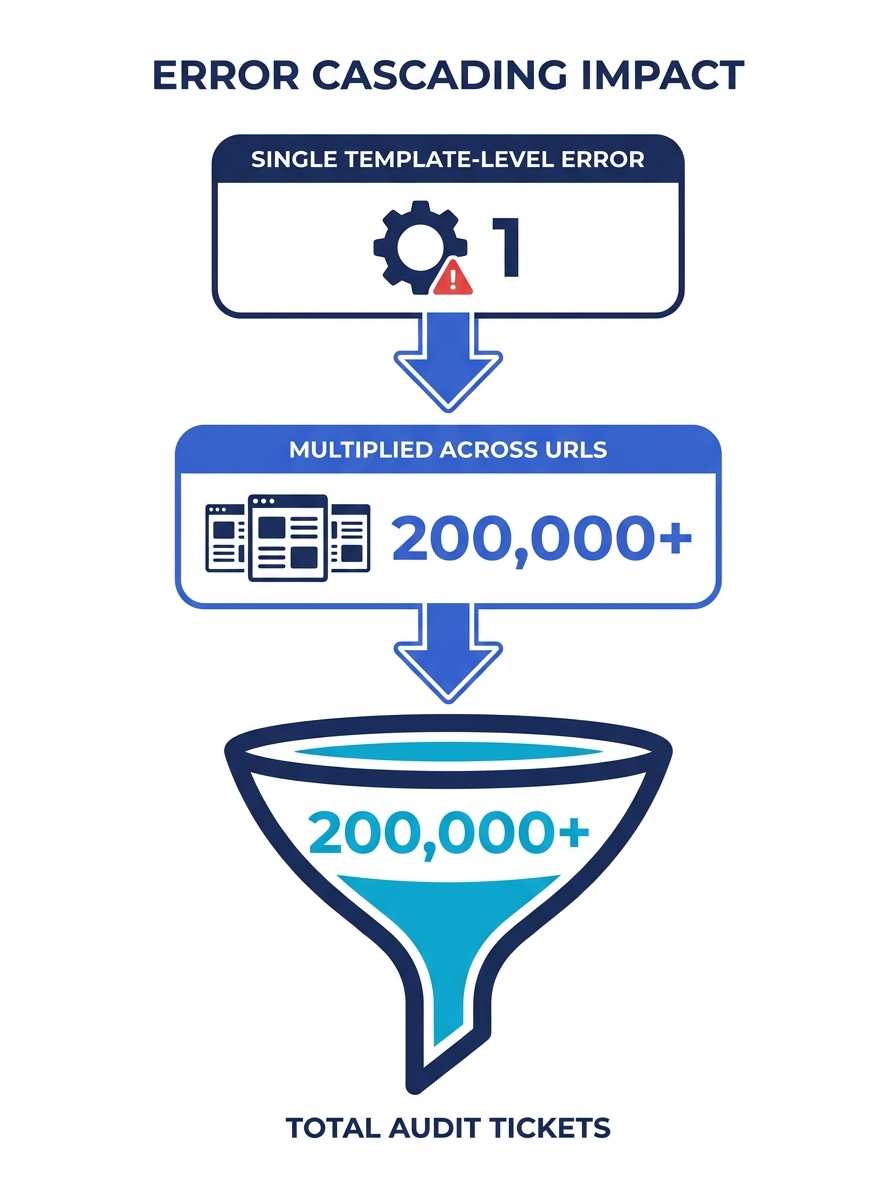
A site with 200,000 indexed URLs and a single misconfigured canonical tag template doesn’t produce 1 ticket. It produces 200,000 variations of the same underlying error, each flagged individually by crawl tools like Screaming Frog, Sitebulb, or Lumar. The same multiplication applies to faceted navigation that leaks crawl budget, breadcrumb markup that misreferences parent categories, and hreflang tags with malformed locale codes.
This is the core insight behind any effective SEO ticket triage system: most of those 1,400 tickets trace back to 15–25 root causes. According to enterprise SEO audit analysis from MyProfitEngine, audits at this scale take a hard look at “team workflows, approval bottlenecks, development cycles, and compliance requirements,” producing “a roadmap you can actually ship” rather than a flat list of page-level fixes.
The practical test is straightforward. Export your full ticket backlog into a spreadsheet and tag each ticket by the template, CMS module, or URL pattern it belongs to. If 70% or more of your tickets cluster around fewer than 20 distinct template-level or architectural issues, your problem is structural. The individual tickets are echoes.
The Four-Tier SEO Ticket Triage Framework
Why does a technical SEO implementation bottleneck persist even when teams agree on the diagnosis? Because flat ticket lists obscure the relationship between effort and impact. A missing alt tag on a product image template and a noindex directive blocking your entire /resources/ subdirectory look like equal-weight tickets in Jira. They are not.
The triage framework below organizes site architecture fixes by ROI, grouping tickets into four tiers ranked by their downstream effect on crawlability, indexation, and revenue-carrying page visibility.
| Tier | Category | Example Issues | Typical % of Backlog | Expected Impact |
|---|---|---|---|---|
| 1 | Crawl & Index Blockers | Robots.txt blocking key directories, noindex on revenue pages, server 5xx errors on 30%+ of URLs, broken XML sitemaps | 5–10% | Without resolution, no other fix matters. These prevent Google from accessing and storing your pages entirely. |
| 2 | Template-Level Cascading Fixes | Canonical tag logic errors, faceted navigation leaking 60%+ of crawl budget, internal link structures orphaning high-value pages, duplicate title/meta patterns | 15–25% | Each fix resolves hundreds or thousands of individual tickets simultaneously. Highest ROI per engineering hour. |
| 3 | Revenue-Weighted Page Repairs | Core Web Vitals failures on top-50 revenue pages, missing structured data on product/service templates, thin content on category pages carrying 40%+ of organic sessions | 20–30% | Directly tied to KPI movement. Prioritize by page-level revenue contribution. |
| 4 | Compliance & Best-Practice Polish | Alt text gaps, minor redirect chains, non-critical Schema warnings, heading hierarchy inconsistencies | 35–50% | Low individual impact. Batch these into quarterly sprints, not urgent dev cycles. |
The distribution above is typical across the enterprise audits we’ve conducted for brands ranging from financial services to retail. Tier 4 issues constitute the bulk of any backlog by volume, but they generate the least organic-visibility improvement per ticket resolved. Tier 2 issues, by contrast, represent a fraction of the ticket count but collapse the backlog when addressed, because a single template fix cascades across thousands of URLs.
This mirrors the prioritization logic Search Engine Journal recommends: a practical framework for tackling SEO fixes when “technical debt and limited development resources stand in the way.”
Template-Level Fixes Collapse the Backlog
Tier 2 is where enterprise SEO audit prioritization produces its most dramatic returns. Consider a common scenario: a retail site with 45,000 product pages running faceted navigation (color, size, price, brand filters). If the CMS generates unique, crawlable URLs for every filter combination, a single product category with 12 color options, 8 sizes, and 5 price brackets produces 480 indexable URL permutations per category. Across 300 categories, that’s 144,000 near-duplicate URLs consuming crawl budget.
The fix isn’t 144,000 tickets. It’s one: update the faceted navigation logic to apply canonical tags to filtered URLs and add a robots meta noindex or parameter-handling directive at the template level. Deployed once, it resolves every downstream ticket associated with faceted crawl waste.
The same principle applies to internal linking architecture. If your site’s template generates breadcrumbs that skip intermediate category levels, thousands of pages lose their link-equity pathways to parent nodes. We covered how internal linking architecture compounds organic growth in detail; the short version is that a broken breadcrumb template can orphan entire subdirectories from the site’s authority flow. One template repair reconnects them all.
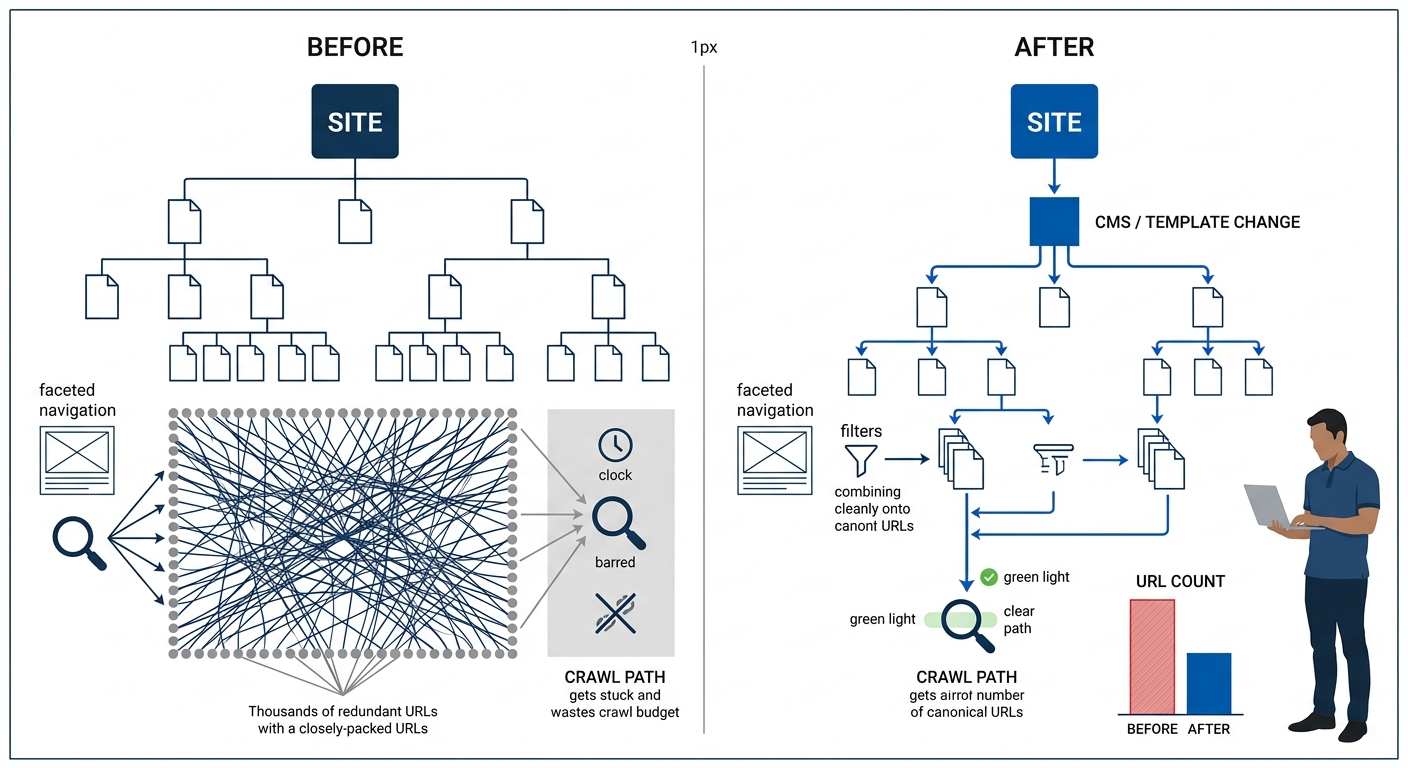
Tip: When briefing your development team or agency partner on Tier 2 fixes, frame each ticket around the template or CMS module that needs modification, not the individual page. Include the estimated number of URLs affected, the crawl-budget or indexation metric it impacts, and the expected change in Googlebot behavior post-deployment. This is the difference between a ticket that sits in sprint backlog for 6 months and one that ships in the next cycle.
Writing Tickets Engineering Teams Will Ship
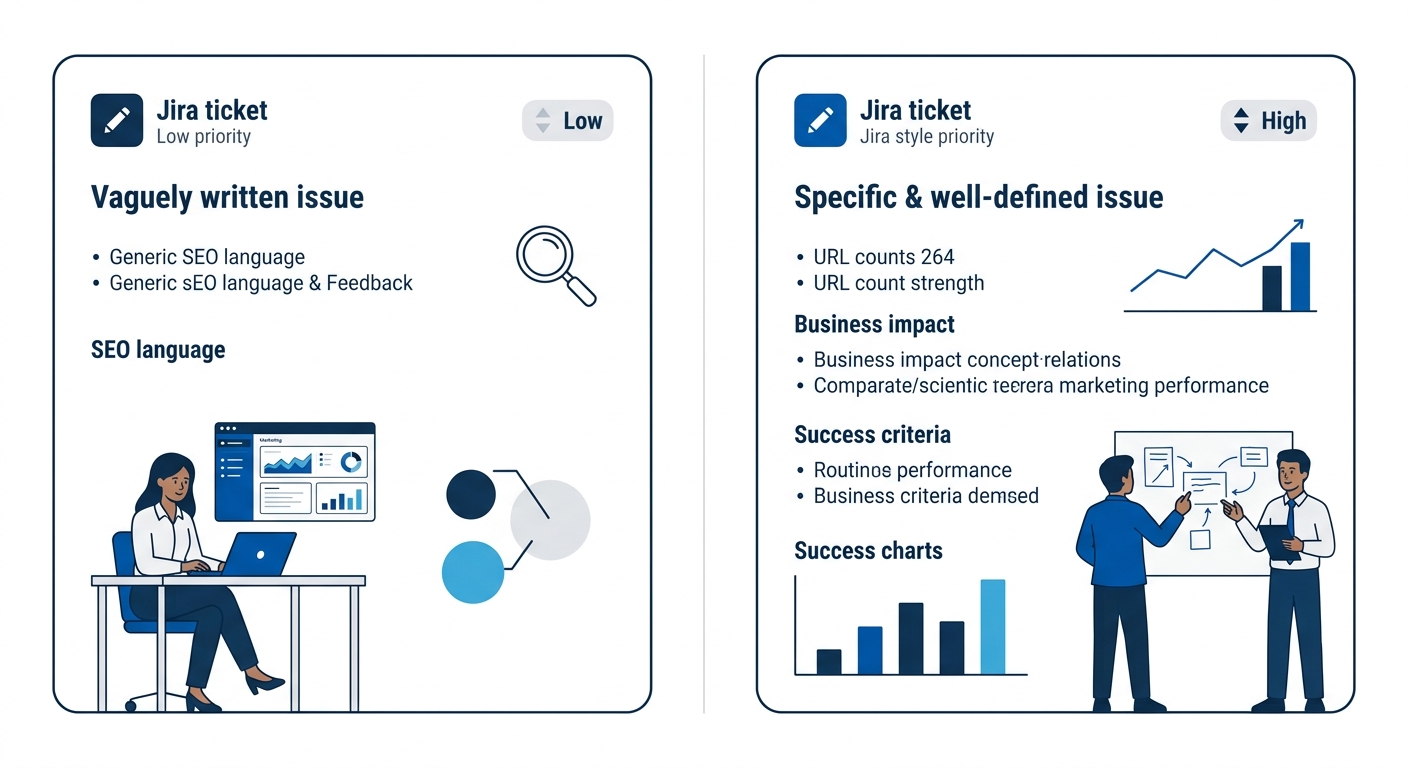
The technical SEO implementation bottleneck persists in part because SEO teams and engineering teams speak different languages about the same site. A ticket that says “fix canonical tags on /products/ pages” tells an engineer nothing about scope, technical approach, or business justification. According to Gray Dot Co’s engineering ticket guidelines, effective SEO tickets “adopt internal language, align with the SEO roadmap and business cases, and focus on the ‘what’ vs. the ‘how.'”
Three structural elements separate tickets that ship from tickets that stagnate:
- Business-impact framing. Engineering sprint planning prioritizes work that aligns with current executive narratives and measurable business outcomes. A ticket labeled “SEO best practice cleanup” loses to “conversion funnel improvement” every time. Reframe technical SEO work as infrastructure improvements: “site search reliability,” “crawl-efficiency gains that reduce server costs,” or “page-speed fixes on revenue-carrying templates.”
- Scope definition with URL counts. “Affecting approximately 12,000 URLs across 4 product category templates” gives an engineer a concrete sense of blast radius. “Various pages” does not. Include the specific template file or CMS component name if you can identify it.
- Measurable success criteria. Define what “done” looks like in technical terms the dev team can verify: “Googlebot crawl of /products/ faceted URLs drops from 45,000 requests/day to under 5,000 within 14 days of deployment,” or “Google Search Console coverage report shows 0 ‘Excluded by noindex’ entries for /resources/ subdirectory within 30 days.”
Sitebulb’s guide to writing SEO tickets for developers recommends using crawl tool exports to show engineers exactly what the rendered vs. response HTML discrepancy looks like. The visual evidence accelerates buy-in dramatically compared to abstract descriptions of the problem.
For organizations that need a structured approach to building SEO information architecture at enterprise scale, the ticket-writing discipline is foundational. Every architectural decision eventually becomes an engineering ticket; the quality of that ticket determines whether it gets built.
Governance Converts Audits Into Deployed Changes
Even well-written tickets stall without governance infrastructure. Primary Position’s enterprise audit framework identifies three governance mechanisms that separate organizations where SEO changes ship from those where they accumulate: change logs for robots.txt and template edits, approval flows for SEO patches that bypass full dev-team sprint cycles, and cross-team playbooks that prevent content duplication and noindex errors from recurring after the initial fix.
The governance layer matters most for Tier 2 and Tier 3 fixes, where a single deployment affects thousands of URLs. Without a documented approval flow, a template-level canonical tag change sits in review limbo while three teams debate ownership. A clear RACI matrix (who’s Responsible, Accountable, Consulted, Informed) for each ticket tier eliminates that ambiguity.
For brands evaluating whether to manage this process in-house or engage a partner, a digital marketing consultation focused on audit governance should precede the audit itself. The implementation plan is only as strong as the organizational structure supporting it. And if the site architecture problems extend to the front end, web design services scoped around SEO-informed template design prevent the same errors from regenerating in the next redesign cycle.
The audit is never the bottleneck. The bottleneck is always the distance between the audit’s findings and the engineering team’s next deploy.
Brands that have invested in a technical SEO triage system already have the diagnostic layer. What typically remains is connecting that diagnostic output to sprint-planning rhythms, QA processes, and post-deployment monitoring loops that confirm each fix actually took effect in production.
What Still Isn’t Settled
The triage framework above assumes the organization has a clear SEO-to-engineering handoff. Many don’t. Google’s ongoing core update cadence, including the May 2026 core update’s redistribution of visibility, raises the stakes for implementation speed: sites that fix architectural issues within one update cycle compound gains into the next, while those stuck in approval limbo lose ground to competitors whose governance moves faster.
Two open questions remain for most enterprise teams. First, how aggressively to automate ticket creation and triage using crawl-monitoring tools that flag regressions in real time versus batch audits conducted quarterly. Second, whether the emerging category of AI-assisted code deployment can safely handle Tier 2 template changes without introducing new regressions, particularly on sites running legacy CMS platforms with heavily customized template layers.
The backlog will always exist in some form. A 200,000-page site will always generate findings. The measure of a healthy enterprise SEO operation isn’t an empty ticket queue. It’s a queue where Tier 1 issues are resolved within 48 hours, Tier 2 fixes ship within a single sprint, and Tier 3 and Tier 4 work moves steadily through a cadence the engineering team has agreed to sustain. That’s the difference between an audit that gathers dust and one that compounds into measurable organic growth, quarter over quarter.