The SEO-PPC Content Trinity: Unifying Search Strategy Across Channels in the AI Search Era
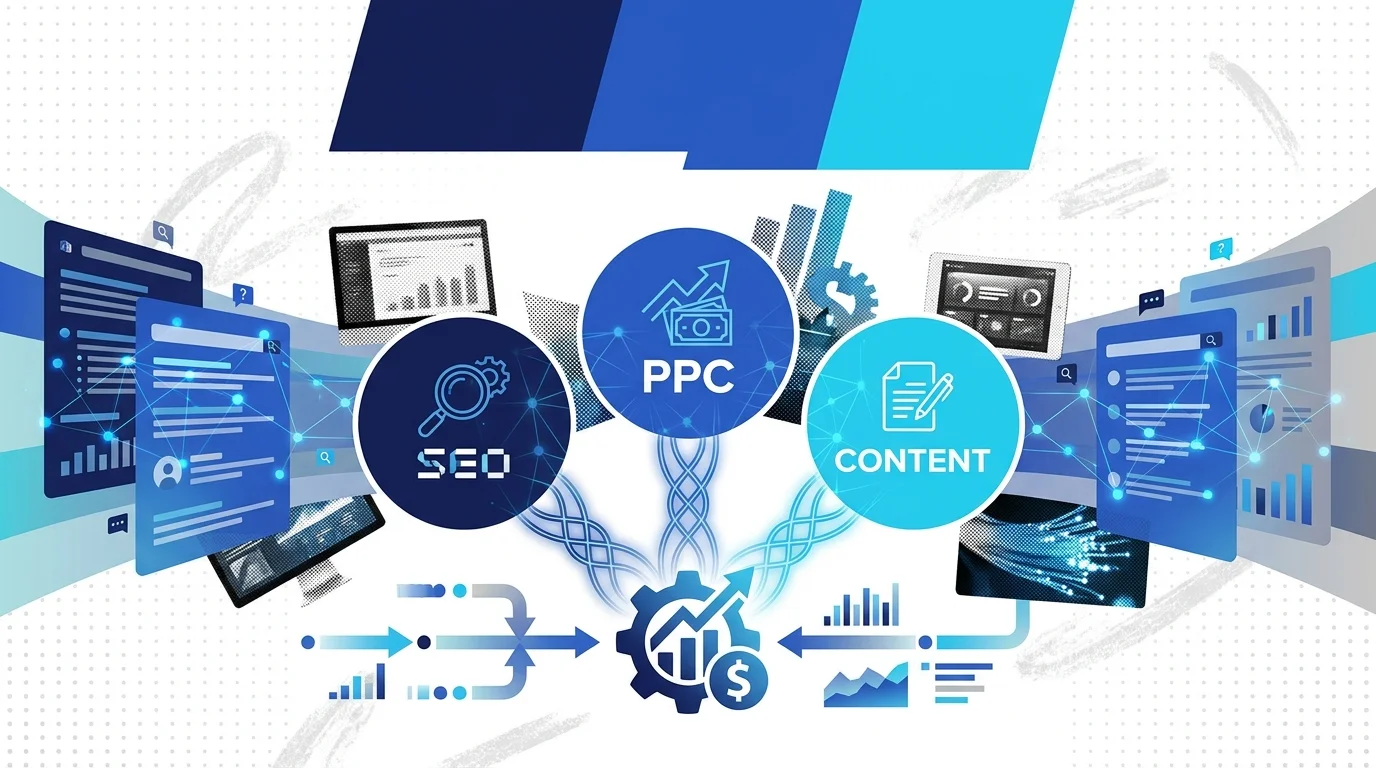
Brands cited in AI Overviews receive 35% more organic clicks and 91% more paid clicks on the same SERP. Those numbers demolish the case for running SEO and PPC as separate operations. An integrated search brief that coordinates intent mapping, content creation, and bid strategy across organic and paid delivers measurably lower acquisition costs than either channel working alone.
TL;DR: AI Overviews now cover 60% of Google searches, restructuring SERP economics in ways that punish siloed teams. Enterprise brands that coordinate SEO, PPC, and content through a shared intent-channel-asset framework report 18% lower acquisition costs and 22% stronger organic lead generation. PPC and SEO coordination has become a prerequisite for profitable visibility.
The SERP Economics That Forced This Shift
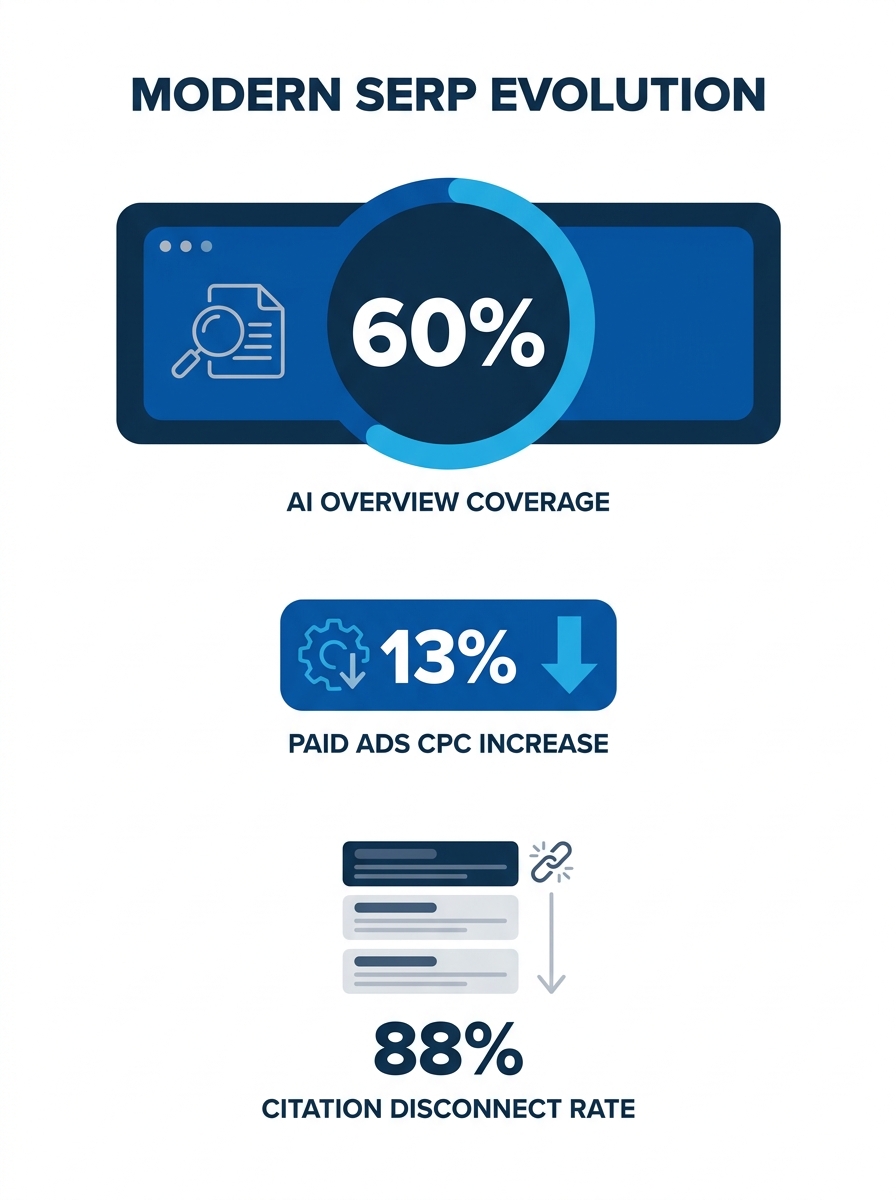
AI Overviews appear on 60% of Google searches, pushing traditional organic listings below the fold and compressing paid ad placements into fewer visible slots. That compression has driven average CPCs up 13% year-over-year. Organic visibility has contracted to two or three links beneath the generative summary. And 88% of AI Mode citations don’t appear in the traditional organic SERP for the same query, which means the content Google’s AI surfaces and the content that ranks organically are frequently different pages.
For enterprise brands, this creates an expensive problem. SEO teams optimize for ranking signals that may never appear in the AI summary. PPC teams bid on queries where AI Overviews absorb the click intent before the ad loads. Content teams produce assets that satisfy one channel’s requirements while actively undermining the other’s. The result is fragmented spend, conflicting landing page strategies, and a growing gap between search investment and revenue return.
The shift toward AI-generated search answers has accelerated this fragmentation. When 68% of B2B buyers now start their research in AI tools like ChatGPT or Perplexity before ever reaching Google, the old playbook of optimizing for position one and bidding on high-intent keywords independently falls apart.
Why Siloed Teams Bleed Budget
The mechanics of waste in a siloed search operation are specific and measurable. Organizations running disconnected SEO and PPC programs have reported paid CPCs up 22% while organic traffic for branded queries declined simultaneously. Both teams responded to the same market shift by spending more in their own channel, with neither aware the other was doing the same thing.
This pattern repeats across three common failure modes:
Duplicate intent coverage. PPC bids on keywords where the brand already holds strong organic positions, paying for clicks that would have arrived without ad spend. As Search Engine Land’s analysis of unified search strategy noted, SEO and PPC teams should share dashboards that include organic impressions, AI snippet appearances, and ad visibility. Without that shared view, neither team knows the overlap exists.
Conflicting landing page strategies. SEO optimizes a page for E-E-A-T depth and long-form authority content. PPC routes the same query to a stripped-down conversion page. Google’s quality score penalizes the PPC page for thin content, driving CPCs higher. The SEO page converts poorly because it wasn’t built for bottom-funnel action. Both teams report underperformance.
Intent stage mismatch. Content produced for top-of-funnel awareness never gets incorporated into PPC audience-building strategies. Bottom-of-funnel PPC landing pages never feed their conversion data back into SEO content prioritization. The user journey fragments at the channel boundary, and attribution models that rely on last-click reporting make the problem invisible.
Unifying paid and organic strategies has been shown to lower acquisition costs by 18% and boost SEO-attributed leads by 22%. The savings come from eliminating these redundancies, not from increasing spend on either channel.
The Intent-Channel-Asset Framework
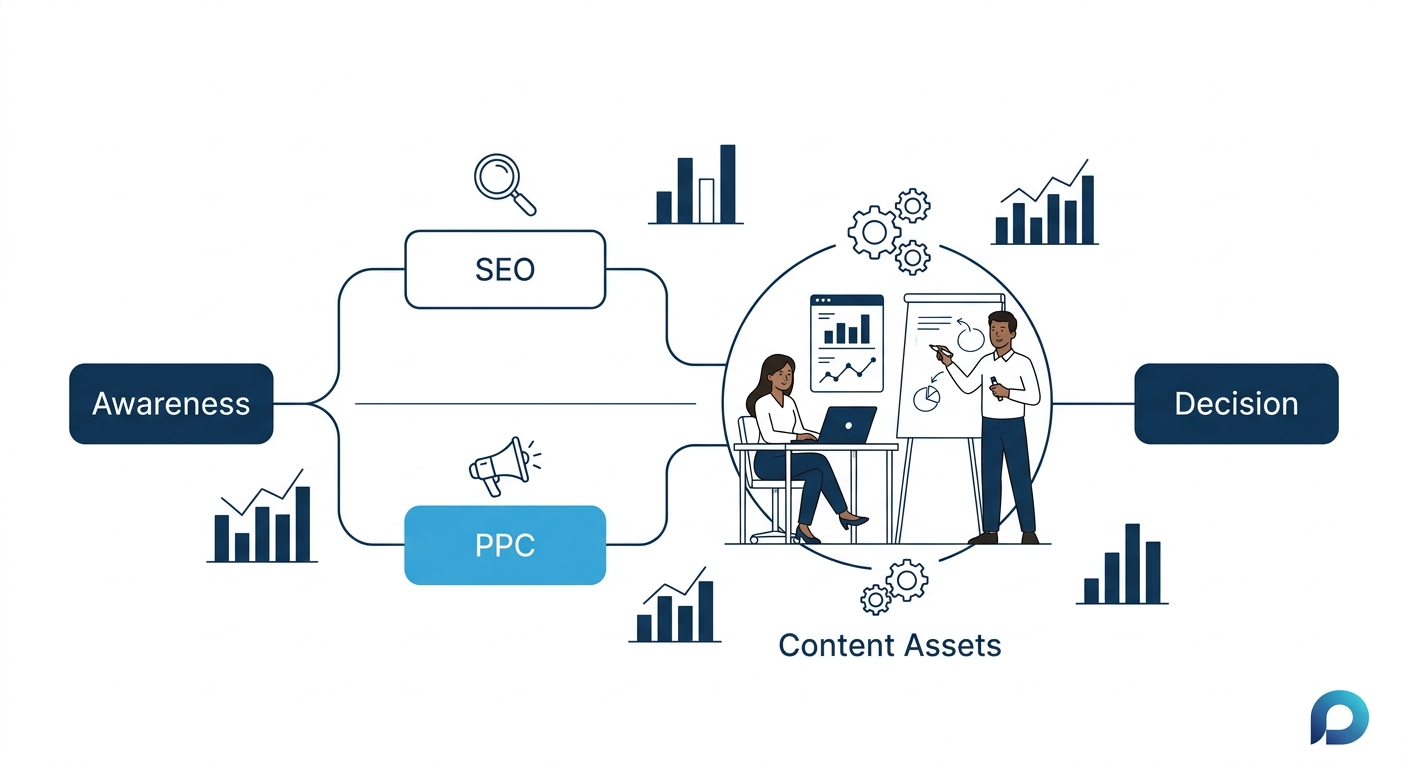
AI search strategy alignment requires a shared model that both SEO and PPC teams can plan against. The framework we recommend maps every target query across three dimensions: intent stage, channel assignment, and asset type. We call it the Intent-Channel-Asset Framework, and the discipline it enforces is what separates enterprise search orchestration from two teams accidentally competing with each other.
| Intent Stage | Primary Channel | Supporting Channel | Asset Type | AI Optimization Priority |
|---|---|---|---|---|
| Awareness / Informational | SEO | PPC (display/video) | Long-form guide, explainer | Structured for AI citation: clear headings, scannable lists, cited sources |
| Consideration / Commercial | Both (split by CPC threshold) | Content remarketing | Comparison page, case study | E-E-A-T depth, named expert quotes, original data |
| Decision / Transactional | PPC | SEO (branded defense) | Landing page, product page | Fast load, conversion-optimized, schema markup |
| Post-Purchase / Loyalty | Content / Email | PPC (suppression lists) | Knowledge base, onboarding | FAQ structure for AI assistants |
The critical column is “AI Optimization Priority.” Every asset now needs to serve three audiences: the human reader, the Google ranking algorithm, and the LLM that may cite it in an AI Overview or answer engine response. Building your content strategy around revenue-aligned authority topics becomes the connective tissue. Content produced for SEO authority simultaneously serves as high-quality landing pages for PPC, and the conversion data from PPC informs which SEO topics deserve deeper investment.
Content as Shared Infrastructure
Search Engine Journal’s coverage of the integrated search brief frames the concept directly: align SEO, PPC, and content teams with a unified brief that coordinates business objectives, audience intent, and SERP analysis. The brief replaces three separate documents with a single artifact that every team works from.
What goes into that brief matters because the conversion rate gap between channels tells you where to focus. Traditional organic search converts at 2.75%, while AI-cited search converts at 7.48%, according to enterprise SEO conversion data tracked across large client portfolios. Content that earns AI citations converts at nearly three times the rate of content that ranks organically through traditional signals alone.
Content that earns AI citations converts at nearly three times the rate of content that ranks through traditional organic signals alone.
That gap dictates the quality bar. SEO should concentrate on building trust and providing credible, detailed information. Content needs to answer the questions that buyers are researching and feed authority into AI systems. For PPC, those same pages need to function as landing pages with fast load times, clear conversion paths, and relevance scores that maintain quality scores.
Enterprise search orchestration is a content production problem as much as a channel coordination problem. Loto-Québec, operating across more than 35 landing pages, apps, and marketing channels, reduced content deployment time by 40% and increased customer engagement by 25% after adopting a unified content orchestration strategy. The efficiency gains came from eliminating redundant production across channels, not from creating more assets.
Tip: The integrated search brief should include: target query cluster, mapped intent stage, assigned primary and supporting channels, a single content asset spec, AI citation optimization requirements, and shared KPIs. If SEO and PPC can’t evaluate their performance from the same document, the brief isn’t integrated.
Measuring Unified Search ROI
Enterprise stakeholders care about revenue, market share, and customer acquisition costs. They don’t care about impressions, average position, or click-through rate in isolation. The KPIs that matter for unified search ROI connect organic visibility directly to business outcomes: revenue generated from organic channels, customer acquisition cost by channel and intent stage, and the share of AI citations that drive trackable engagement.
When attribution models are in active reconstruction because AI-driven commerce erodes traditional tracking signals, proving unified search ROI requires a different reporting structure. Shared dashboards that overlay organic ranking positions, AI citation status, PPC cost per acquisition, and content conversion rates give marketing leadership the complete picture that siloed reports obscure.
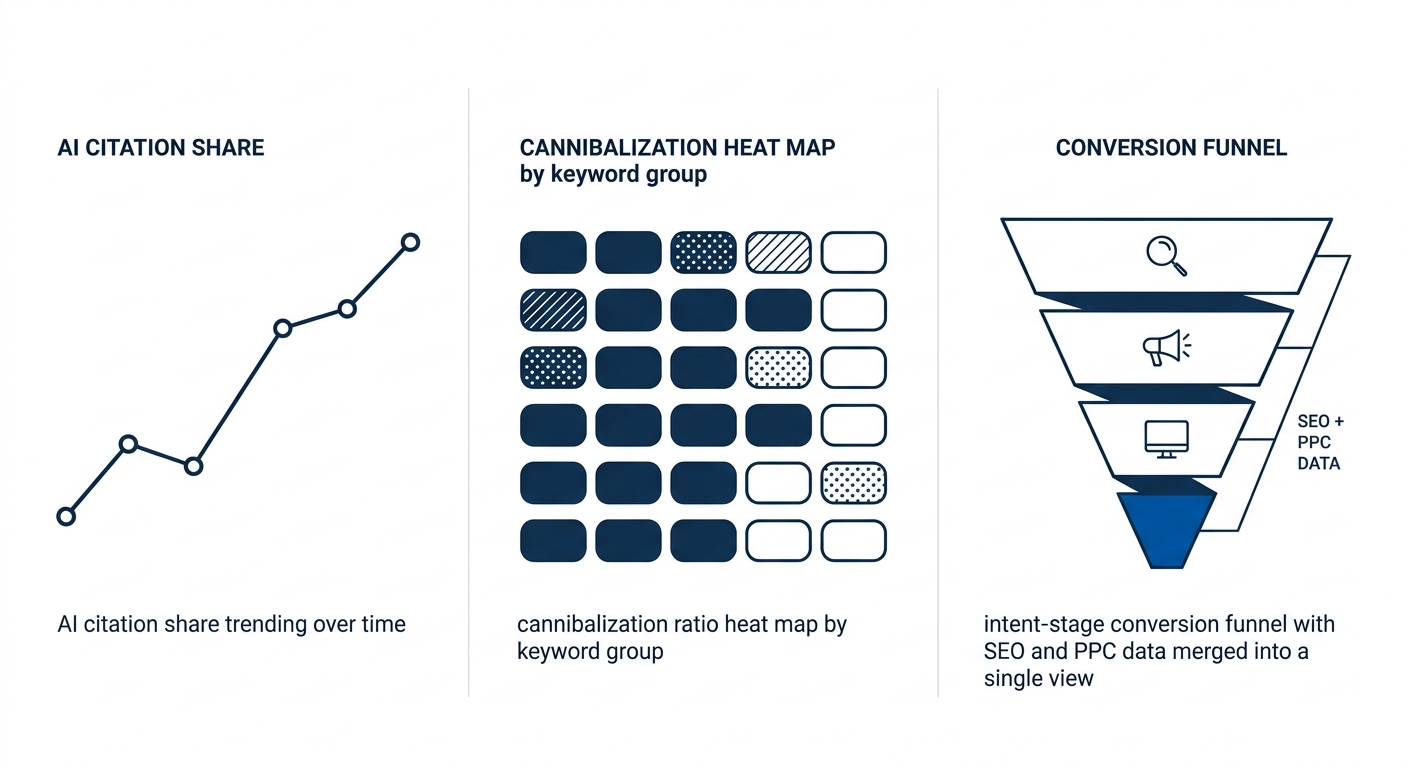
Three metrics deserve particular attention in a unified reporting model:
- AI citation share. What percentage of your target queries return your content in AI Overviews, ChatGPT, or Perplexity? Brands cited in AI Overviews see 35% more organic clicks and 91% more paid clicks, so this metric directly predicts performance in both channels.
- Cannibalization ratio. For how many queries are you bidding on PPC keywords where you already hold top-three organic positions? Each one represents spend that could shift to queries where you lack organic coverage. Most enterprise brands we audit carry a cannibalization rate between 15% and 30%.
- Intent-stage conversion spread. Are your awareness assets actually moving users toward consideration content, and is your consideration content feeding PPC remarketing audiences? If the conversion path breaks at the channel boundary, the investment in upper-funnel content isn’t compounding.
The discipline of connecting descriptive analytics to revenue outcomes applies here with particular force. Surface-level reporting hides the interaction effects between channels. A keyword that looks unprofitable in PPC isolation may be driving the organic authority that generates your highest-converting AI citations.
What the Numbers Still Can’t Answer
The data supporting PPC and SEO coordination is strong and getting stronger. The 18% acquisition cost reduction from unified strategy, the 22% lift in organic leads, the 35%/91% click amplification from AI citation presence all point in one clear direction. But several questions remain open.
Attribution across AI surfaces is still rough. When a buyer reads an AI-generated summary that cites your content, then searches your brand name, then clicks a paid ad, which channel gets credit? Current measurement frameworks handle this poorly, and the 7.48% conversion rate from AI search likely understates the influence because it only captures direct-click attribution.
The stability of AI citation is also uncertain. Google’s AI Mode draws from a different content pool than organic search, with 88% of citations not overlapping with organic rankings for the same query. That pool’s selection criteria are opaque and shift with each model update. Building a strategy around AI citation requires accepting that the rules governing citation selection will change repeatedly over coming quarters.
And the competitive dynamics remain uncharted. When every enterprise brand begins optimizing for AI citations with the same structured-content playbook, the advantage narrows. The brands that will sustain unified search ROI over time are the ones producing genuinely authoritative content with real expertise signals: named experts, original research, documented case outcomes. Structural optimization alone won’t hold, which is why engineering your brand’s presence in AI chatbot recommendations is becoming a distinct discipline.
The integrated search brief is the operational document that holds PPC and SEO coordination together. But the durable advantage lives in what goes into that brief: original research, real subject-matter expertise, and a production process that treats every asset as serving three audiences simultaneously.