The Post-Migration Traffic Recovery Playbook: Why Enterprise Ecommerce Sites Plateau After 6 Months (And How to Sustain Momentum)

The standard enterprise domain migration recovery timeline, the one your agency presented in the project brief, underestimates actual recovery duration by a factor of five. Industry data shows the average enterprise site takes 523 days to recover pre-migration traffic levels, and 17% of migrated sites never recover organic performance even after 1,000 days. The ecommerce SEO migration plateau your brand hits at month six is predictable, structural, and almost always self-inflicted.
TL;DR: Enterprise ecommerce sites plateau after migration because organizations dismantle monitoring infrastructure and declare victory around week 12, when the real recovery timeline stretches past 500 days. The fix is sustained crawl budget optimization after site migration, disciplined internal link maintenance, and treating post-migration organic growth recovery as a multi-quarter program rather than a project with a completion date.
The 523-Day Gap Between Migration Plans and Migration Reality
Every migration brief includes a recovery curve. And nearly every recovery curve is wrong.
Well-executed migrations see a 5–15% traffic dip in the first 30 days and recover to 95–100% of baseline by weeks 8–12, according to platform migration SEO playbook data from Founding Engine. That 12-week window is where the organizational narrative crystallizes: traffic is “back,” the project is “done,” and the cross-functional war room disbands.
But recovering to baseline is a fundamentally different outcome from recovering growth trajectory. Migration performance data shows that fast recoveries (19–23 days) happen only when sites use exhaustive 1:1 permanent 301 redirects paired with daily log-file monitoring. Slow recoveries, the ones stretching past 1,000 days, result from incomplete redirect maps that create 404 loops nobody catches until months later.
As the migration framework at Ecom SEO Co. states plainly: “The goal of an SEO migration is not to gain traffic. It is to not lose the traffic you already have. Any migration that preserves 90%+ of organic traffic within 8 weeks is a success. Gains come later, after the migration stabilizes.”
That distinction between “preserving” and “gaining” is where the plateau originates. Enterprise teams that treat week 12 as the finish line are optimizing for the wrong metric. They’ve recovered the baseline. They haven’t recovered the growth rate.
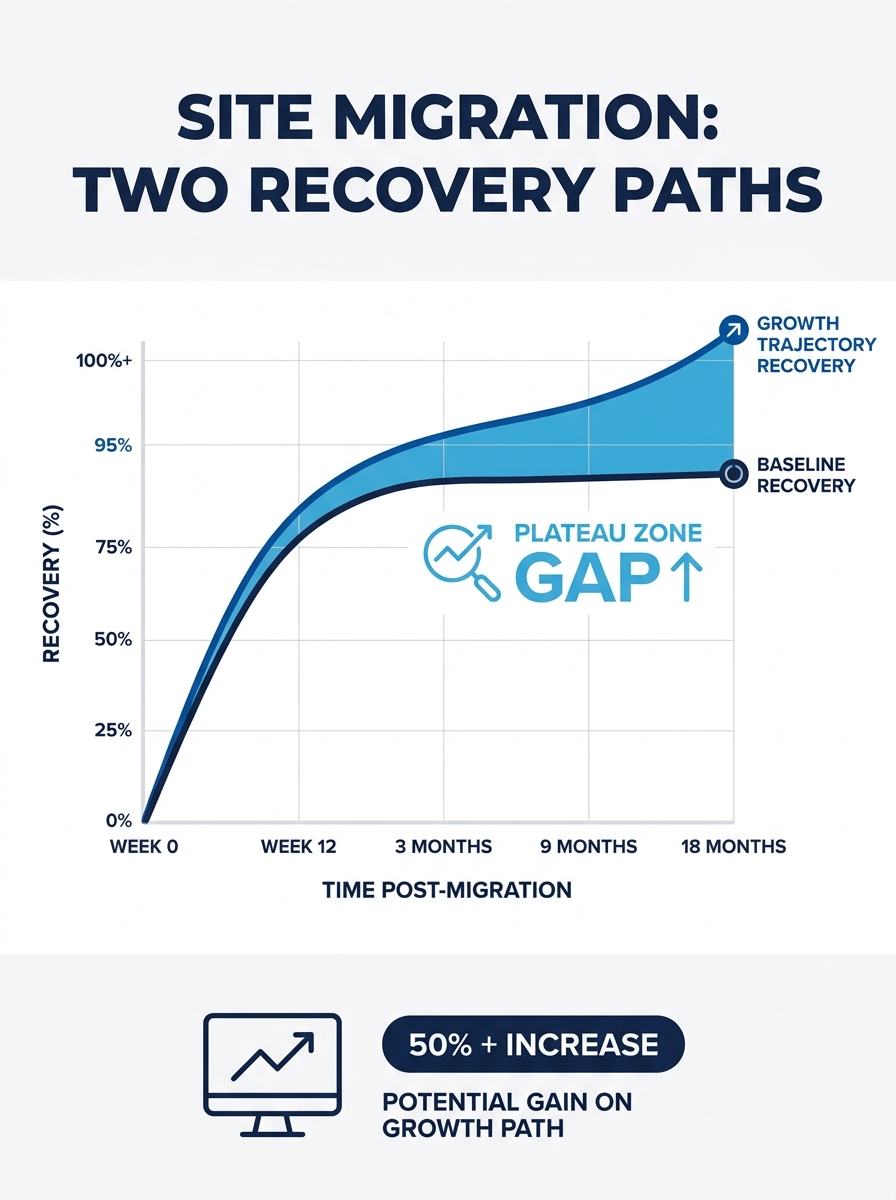
Nine out of ten website migrations damage organic search performance to some degree. The organizations that escape the 6-month ecommerce SEO migration plateau are the ones that understood, before launch, that the real work begins after the redirect map is deployed. If your team’s pre-migration audit and redirect mapping process was thorough, you bought yourself a clean baseline. You didn’t buy sustained momentum.
Crawl Budget Debt Compounds in Silence After Migration
Crawl budget optimization after site migration is where enterprise ecommerce sites bleed the hardest, because the damage is invisible in standard analytics dashboards. It surfaces only in server log files and Google Search Console’s crawl stats reports, both of which most marketing teams stop checking around month three.
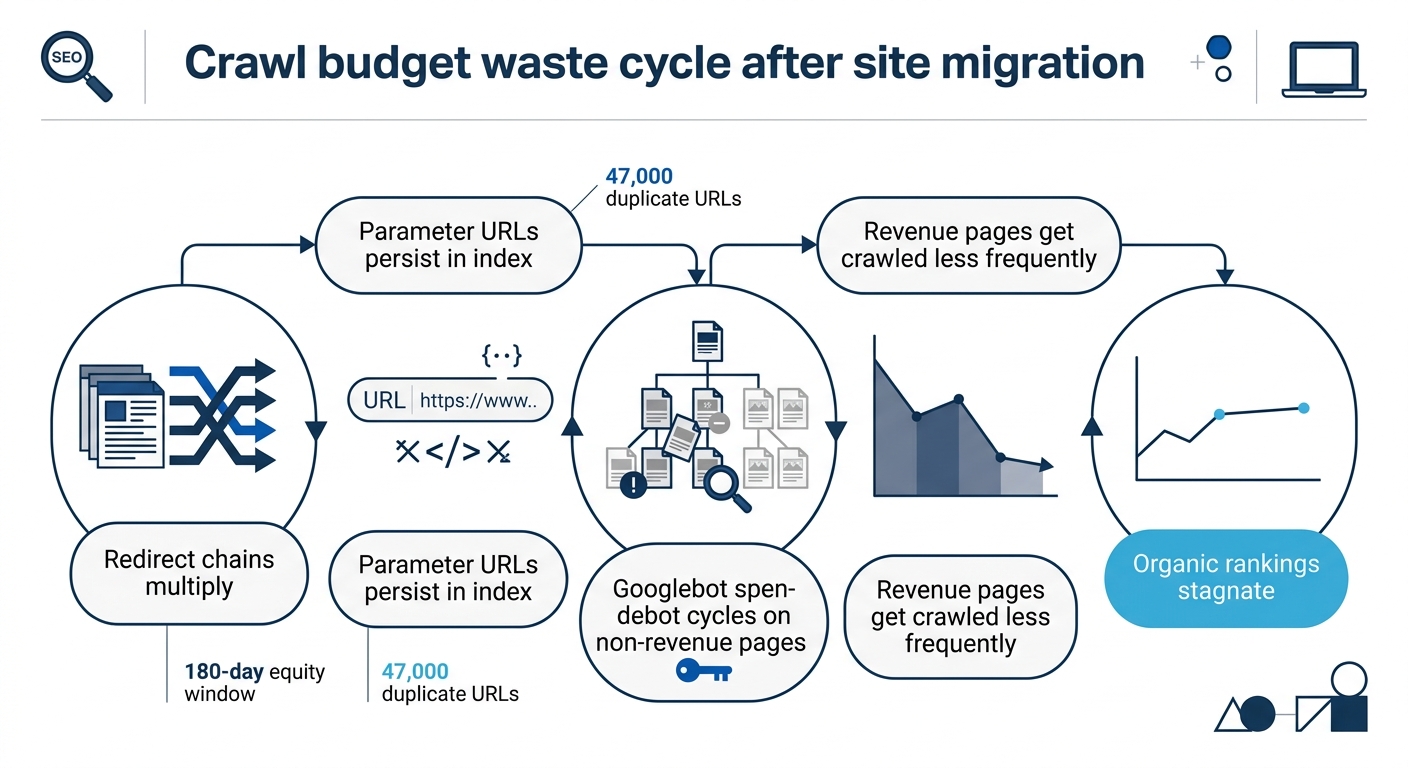
The mechanism is straightforward. During migration, redirect chains multiply. Parameter URLs from the old platform persist in Google’s index. Orphaned pages, the ones that existed on the legacy CMS but weren’t mapped to equivalents on the new platform, sit in a liminal state where Googlebot keeps requesting them, getting redirected or 404’d, and burning crawl cycles that could have been spent on revenue-generating product pages.
A crawl budget optimization framework published by ALM Corp documented that the strongest migration teams “plan crawl efficiency in advance by mapping redirect rules tightly, cleaning old URL pathways, testing rendering output, validating sitemaps early, and monitoring logs as soon as the new environment is live.” Teams that skip this discipline end up with what one documented case revealed as 47,000+ duplicate URLs consuming crawl resources on a single enterprise domain.
One retailer in the migration dataset lost £3.8 million in first-month revenue by simplifying complex redirect mappings to pattern-based rules rather than building 1:1 URL maps. Pattern-based redirects feel efficient at implementation time. They send entire URL directories to category-level pages instead of matching individual product URLs to their new equivalents, and that mismatch erodes page-level authority transfer across potentially thousands of SKUs.
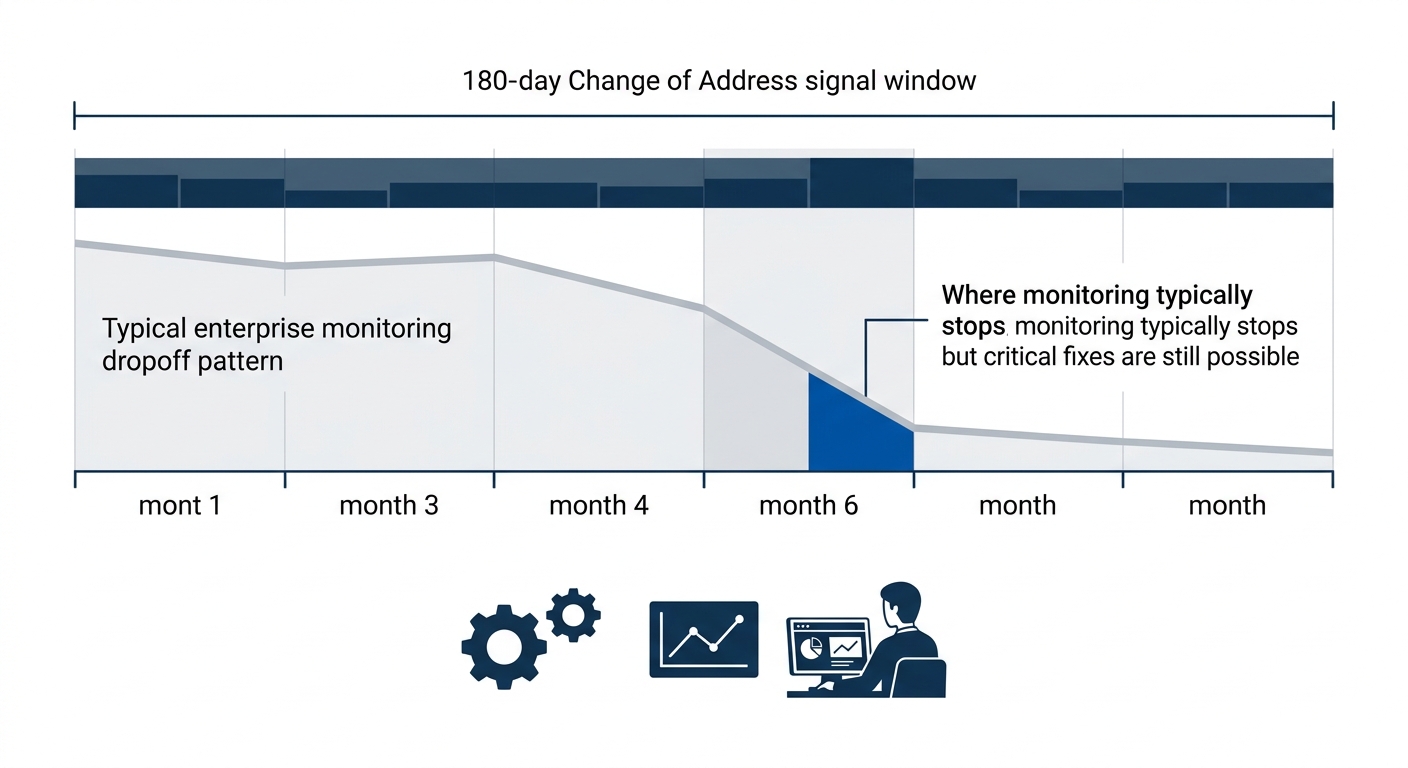
Google’s Change of Address signal in Search Console compounds the problem with a hard expiration: the signal is effective for only 180 days. Redirects discovered after that window lose equity-forwarding value. So if your team identifies broken redirect chains at month seven, the equity-transfer mechanism that would have fixed them has already expired.
This is where enterprise domain migration traffic maintenance becomes a capacity planning problem rather than a technical SEO problem. As we’ve written about in how architecture debt drains crawl budget, collapsing redirect chains demands engineering hours that compete with feature development sprints. Retiring orphaned pages requires someone to decide what to delete, which in many enterprise organizations triggers a months-long stakeholder review. The SEO team knows what needs to happen. The engineering backlog determines whether it actually does.
Warning: If your engineering team consolidated redirect mapping into pattern-based rules during migration, audit the top 500 revenue-generating product URLs individually. Pattern-based redirects are the single most common source of silent authority loss in enterprise ecommerce migrations.
Internal Link Architecture Degrades Gradually, Then All at Once
The third structural driver of the plateau is the most insidious: internal link rot. During migration, teams focus obsessively on inbound link preservation (making sure external backlinks resolve correctly through redirects). The internal link graph, the web of connections between category pages, product pages, blog content, and navigation elements, gets far less scrutiny.
Search Engine Journal’s analysis of 11 common migration failure points identified broken internal links as one of the primary causes of post-migration traffic drops, alongside improper redirects and robots.txt misconfiguration. The problem is that internal link breakage doesn’t happen all at once. It accumulates. New products get added to the catalog without linking them into the existing topical structure. Category pages get reorganized without updating the blog posts that referenced old category URLs. Faceted navigation on the new platform generates URL patterns that the old internal linking strategy didn’t account for.
SEO F1RST’s ecommerce migration case study framework emphasizes that post-migration recovery requires “smart restructuring of site categories for keyword coverage” alongside clean technical execution on redirects, indexing, and schema. Category restructuring sounds like a migration-phase activity. In practice, it’s an ongoing post-migration activity because product catalogs change, seasonal categories rotate, and the keyword landscape shifts underneath you.
The ecommerce SEO migration plateau is an organizational problem wearing a technical costume. The redirects work. The monitoring stopped.
The degradation pattern follows a consistent shape across enterprise ecommerce sites. Weeks 1–12: internal links are intact because the redirect map catches old URLs. Months 4–6: new content gets published linking to old URL structures that resolve through chains. Months 7–12: the accumulated chain depth slows crawl efficiency, dilutes page authority, and creates gaps in the topical link graph that Google interprets as reduced relevance.
Post-migration organic growth recovery depends on treating the internal link architecture as a living system. The internal linking authority framework we’ve outlined applies with particular urgency in the post-migration window, because every new page added to the site either reinforces or weakens the link graph you rebuilt during migration. Teams that approach this with the rigor of ongoing site architecture audits catch degradation early. Teams that don’t discover it around month eight, when the plateau is already baked into their traffic curve.
The Monitoring Protocol That Separates Recovery from Plateau
The operational pattern that distinguishes sites recovering growth from sites stuck at the plateau is straightforward: they never stopped watching. Organizations that commit to a 90-day monitoring protocol and extend observation through month six are the only ones that avoid the organic growth plateau. Teams that verify redirect accuracy within 48 hours of launch catch 80% of problems before rankings are affected.
But month-six monitoring looks different from week-one monitoring. The phased approach maps to specific diagnostic priorities:
| Monitoring Phase | Timeframe | Focus Areas | Key Metrics |
|---|---|---|---|
| Emergency Watch | Days 1–3 | Server logs, 404 spikes, crawl rate | Googlebot requests/day, 4xx error count |
| Indexation Validation | Weeks 1–4 | Top 100 pages indexed, redirect resolution | Pages indexed vs. submitted, chain depth |
| Structural Integrity | Weeks 5–12 | Internal links, content parity, rendering | Orphaned page count, link graph density |
| Growth Diagnosis | Months 4–6 | Pages stuck at 70–80% of baseline | Page-level recovery %, crawl frequency per URL |
| Sustained Optimization | Months 7–12+ | New content integration, category expansion | Growth rate vs. pre-migration trend line |
The critical phase that most teams skip is months 4–6. This is where you diagnose the pages stuck at 70–80% of pre-migration performance. These are pages where redirect chains have introduced latency, where internal links have degraded, or where the new platform’s rendering behavior differs enough from the old one to change how Googlebot parses the page content.
If your site is producing hidden crawl waste through architecture debt, the month 4–6 window is your last realistic chance to fix it before the Change of Address signal expires at 180 days. After that point, the technical instruments available to you narrow significantly, and recovery shifts from a structural fix to a content-and-authority rebuilding effort that takes materially longer.
The Claim, Revisited
Enterprise ecommerce sites plateau after migration because the organization treats migration as a project with a completion date rather than a transition with an 18-month tail. The technical causes are well-documented: redirect chains that compound, crawl budget waste from orphaned URLs, internal link architectures that degrade as new content gets layered onto old structures. The root cause is organizational. The war room disbands. The monitoring cadence drops from daily to monthly to quarterly. Engineering resources allocated to SEO cleanup get reassigned to feature development.
The 523-day average recovery timeline exists because that’s how long it takes for accumulated technical debt to become painful enough that someone re-allocates resources. The organizations that avoid the plateau never stopped allocating those resources in the first place. Their architecture audits run on a recurring cadence rather than as a one-time migration deliverable. Their crawl budget reviews happen monthly. Their internal linking protocols account for every new product, category, and content page added to the domain.
The ecommerce SEO migration plateau is real, predictable, and structurally avoidable. The barrier has never been knowledge of what to do. It’s been organizational willingness to keep doing it for 523 days instead of 90.