High-Volume Content Publishing Now Degrades Enterprise SEO Performance as AI Retrieval Systems Prioritize Semantic Consolidation Over Page Count

The content-volume strategy that drove organic visibility gains for two decades now actively undermines search performance on enterprise sites, according to a Search Engine Journal analysis published June 17. The shift stems from how AI-driven retrieval systems evaluate websites, prioritizing semantic precision and consolidated authority over the raw page count that powered traditional search rankings.
TL;DR: Publishing hundreds of similar articles fragments authority across competing semantic signals, reducing visibility in AI-generated answers even when traditional rankings hold.
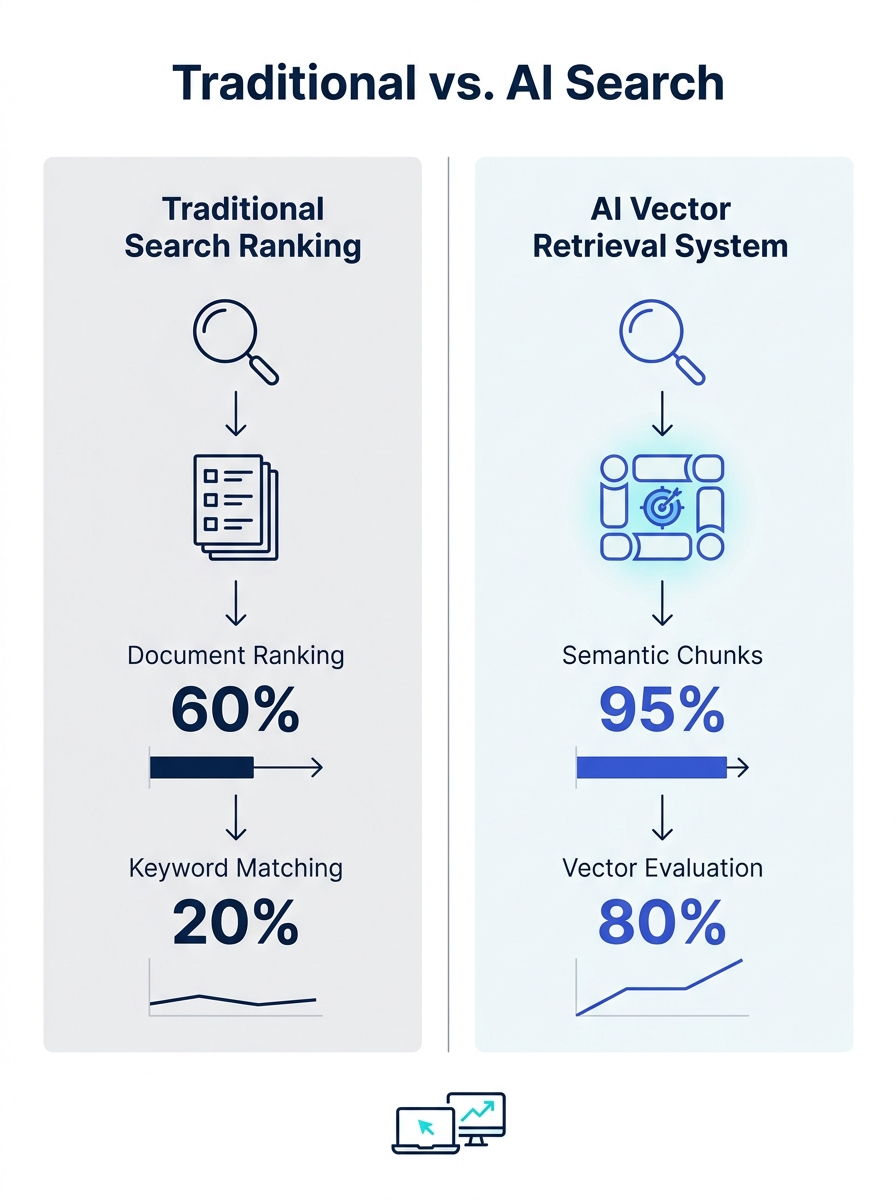
The analysis documents a structural break in the economics of content publishing. Where 2015-era search algorithms rewarded coverage, more pages meant more ranking opportunities, even for mediocre content, modern large language models retrieve passage-level chunks and synthesize answers from semantically precise fragments. Multiple pages targeting adjacent concepts now compete against each other for vector embeddings rather than reinforcing a unified authority position.
Traditional Search Rewarded Document Quantity
Search engines through the mid-2010s evaluated pages largely as standalone ranking documents, the analysis noted. A site with 5,000 pages carried more statistical probability of appearing in results than a site with 50, regardless of content overlap. Publishers built monetization models around this dynamic, creating large libraries of search-optimized content that generated display-advertising revenue from aggregate traffic.
Scale itself functioned as a competitive advantage. Algorithms were less sophisticated at detecting redundancy, topical overlap, or semantic quality across a domain. If multiple pages from the same site ranked for adjacent keyword variations, organizations typically counted that as multiplicative success rather than structural inefficiency.
AI Retrieval Systems Changed Visibility Incentives
Modern AI systems segment documents into passages, embed them as vector representations, evaluate semantic similarity, and synthesize responses from retrieved fragments, according to the report. Visibility increasingly depends on whether retrieval systems can extract a clean, semantically precise answer from content, not whether a page ranks in position three for a specific keyword.
“LLMs retrieve chunks, not whole pages,” the analysis stated. That distinction reverses the old publishing incentives. Where ten similar pages targeting adjacent topic variations might have expanded footprint in document-ranking systems, those same pages now fragment authority, dilute embeddings, and introduce semantic ambiguity that reduces retrieval dominance.
The report characterized this as “semantic dilution”, over-publishing weakens topical precision by scattering signals across multiple partially redundant pages. Embedding systems represent meaning mathematically; when similar ideas are fragmented across many URLs, no single page accumulates dominant semantic weight. Organizations divide authority rather than strengthen it.
Enterprise sites with sprawling content libraries now rank reasonably well in traditional search results while remaining “nearly invisible inside AI-generated answers,” the analysis found. Retrieval systems detect topical presence but cannot determine which fragment represents the canonical or strongest answer. When uncertain, the systems default to the clearest and most consolidated source available, typically not the site with five overlapping blog posts addressing nearly identical questions.
Internal Vector Competition Replaces Keyword Cannibalization
The problem extends beyond traditional keyword cannibalization, according to the report. Pages no longer compete only for rankings, they compete for embeddings. Multiple similar articles create competing semantic representations, and retrieval systems may retrieve none of them strongly because signals are split inconsistently across URLs.
The pattern appears consistently on sites that publish aggressively without consolidation strategies: five blog posts answering essentially the same question, slightly rewritten “ultimate guides,” near-identical location pages, thin supporting articles targeting minor keyword variations, and AI-generated content clusters with minimal differentiation.
The analysis noted that quantity no longer compensates for mediocre quality in AI-driven search environments. Retrieval systems reward clarity, consolidation, and semantic precision. Sprawling redundancy introduces structural problems that weaken visibility even when traditional ranking signals remain intact.
This has particular implications for enterprise marketing teams evaluating content strategy investments and agency performance on organic growth. The shift from document-ranking to chunk-retrieval economics means historical SEO playbooks, often built around aggressive publishing calendars and comprehensive keyword coverage, may now produce results inversely correlated with investment.
Organizations briefing agency partners on organic-growth mandates face a strategic recalibration. The instruction to “publish more content” must be replaced with “consolidate semantic authority,” according to the analysis. That requires different capabilities: semantic audits to identify vector competition within existing content libraries, entity-cohesion mapping to ensure topical signals reinforce rather than fragment, and passage-level optimization for retrieval rather than keyword-level optimization for ranking.
The report aligns with broader industry evidence on how AI systems shift traffic from websites to in-platform answers and the growing importance of retrieval dominance over traditional ranking position.
APAC. Implications
Marketing leaders at Philippines-headquartered enterprises and growth companies evaluating SEO agency partners or organic-growth proposals should audit existing content strategies against retrieval-system incentives rather than legacy volume metrics. Agencies still pitching monthly article quotas or “content velocity” as core deliverables are operating under pre-2026 search economics.
The brief for organic visibility now centers on semantic consolidation audits, identifying and merging redundant content, strengthening entity signals, and optimizing for passage-level retrieval precision, rather than keyword gap analysis and aggressive publishing calendars. Enterprise brands with large existing content libraries face a multi-quarter remediation effort to address years of volume-first publishing that has fragmented topical authority.
For organizations evaluating agency capabilities, request case studies demonstrating semantic-dilution diagnosis, vector-competition resolution, and measurable retrieval-dominance gains. Traditional ranking improvements without corresponding visibility in AI-generated answer environments signal an agency still executing against outdated search models. The economic value of organic traffic increasingly concentrates in retrieval systems; ranking well in traditional results while remaining invisible to LLMs produces diminishing pipeline impact as user behavior continues shifting toward AI-mediated search interfaces.