The Information Architecture Compounding Loop: How Site Structure Multiplies Organic Growth in Enterprise Brands
Adding pages to an enterprise site without fixing its information architecture actively erodes the organic rankings those pages were meant to capture. The compounding effect that makes large sites powerful in search works in both directions: clean taxonomy and internal linking strategy compound growth quarter over quarter, while structural debt compounds losses at the same rate.
TL;DR: Enterprise site architecture SEO succeeds or fails based on three linked mechanisms: taxonomy design, internal link equity distribution, and URL governance. When all three reinforce each other, each new page strengthens the domain. When any one breaks, every new page dilutes the others. The difference between linear and exponential organic growth lives in this loop.
Why Every New Page Either Multiplies or Divides
Enterprise sites with 100,000+ URLs carry a structural weight that smaller sites never encounter. Each page added to a well-architected site inherits authority from its parent taxonomy, passes equity through internal links to related pages, and signals topical depth to crawlers. Each page added to a poorly architected site does the opposite: it fragments crawl budget, creates orphan nodes, and dilutes the topical signals that existing pages depend on.
One enterprise technical audit documented by Four Dots found that a single site’s faceted navigation had spawned 47,000 duplicate URLs, consuming 34% of the available crawl budget while generating zero organic revenue. That is the default outcome when pages multiply without architectural governance, not an outlier.
Jesse McDonald of Search Engine Journal has noted that organizing pages as topic silos, rather than targeting individual keywords in isolation, creates a unified approach to topical targeting. The implication is direct: when a site’s taxonomy groups content into coherent clusters, Google can identify the domain as a topical authority. When it doesn’t, each page competes alone.
The crawl efficiency revenue impact here is measurable. If search engine crawlers cannot reach a page, that page will never appear in organic results across any query. An enterprise brand running 200,000 URLs where 35% of crawl budget goes to non-revenue pages is effectively invisible on 70,000 pages it paid to create. Every dollar spent publishing those 70,000 pages was a dollar spent making the rest of the site marginally worse.
Internal Linking as Equity Distribution, Not Decoration
The phrase “internal linking strategy” undersells what’s happening at the architectural level. Internal links in an enterprise context function as equity allocation decisions. Every link from a high-authority page to a deeper page transfers ranking signals. The question for marketing leadership is whether that transfer is intentional or accidental.
Research tracked by enterprise SEO practitioners shows that implementing strategic internal links to underperforming pages produced a 9,500 weekly increase in organic traffic, equating to roughly 150,000 additional sessions annually, within just three weeks of deployment. Separately, ecommerce brands that adjusted internal linking from level-one category pages to deeper level-two and level-three subcategories saw a 24% increase in organic traffic to those deeper pages.
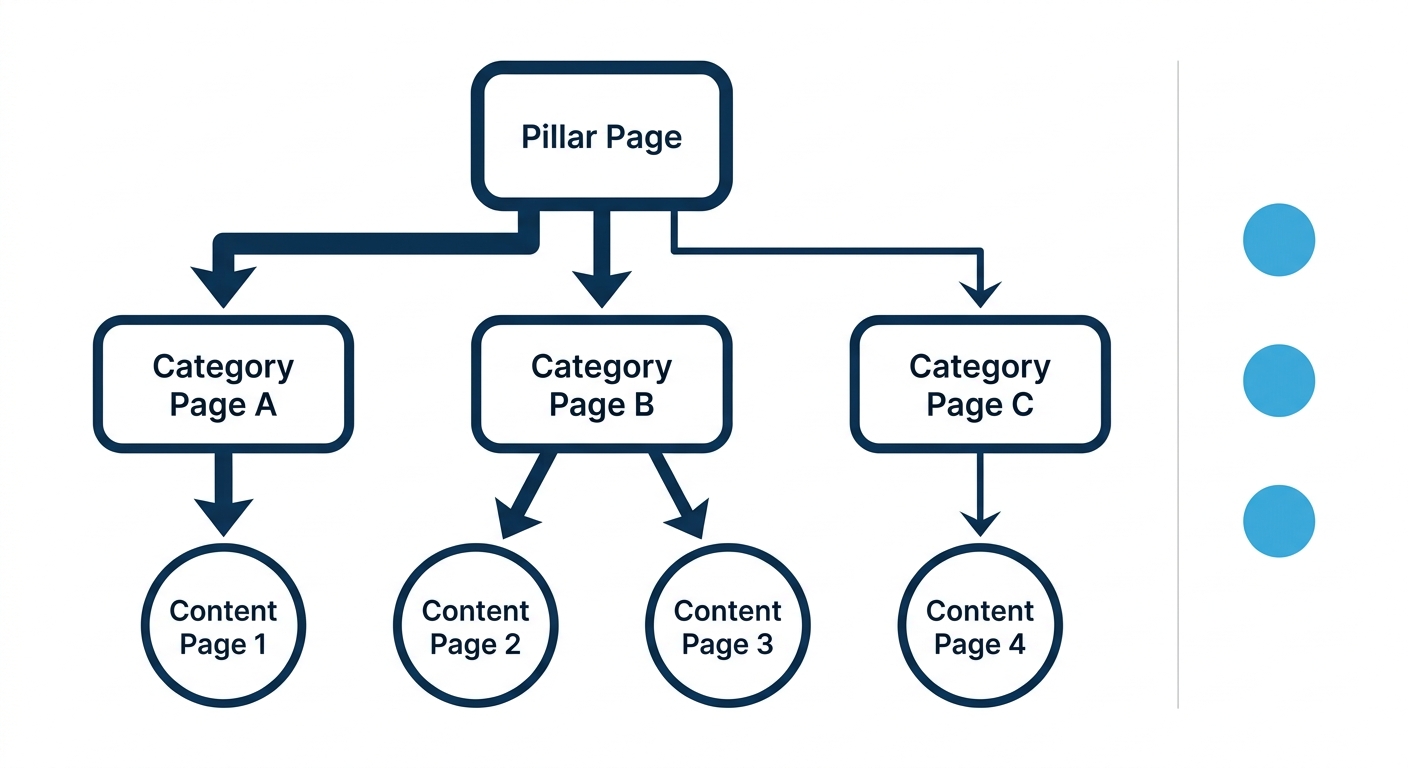
These numbers illustrate why information architecture organic growth is a compounding function rather than a linear one. When a level-one category page with strong external backlinks sends internal links to 15 subcategory pages, those subcategories inherit a portion of the parent’s authority. When those subcategories then link to 50 product or content pages beneath them, each of those pages receives a fraction of the original equity. Add new content to any level of that tree, and the entire branch benefits. Remove a link or create an orphan page, and the branch loses signal at every node below the break.
This is what makes the loop compound. The architecture doesn’t add value once. It adds value every time Google crawls the site, every time a new page enters the taxonomy correctly, and every time an external backlink lands on any page in the cluster. Fractl’s research on integrating SEO and digital PR drives this point home: earning a backlink from The Wall Street Journal doesn’t help much if the page it links to is deindexed, slow to load, or disconnected from the rest of the site’s link graph.
For B2B digital marketing services where sales cycles stretch across months and organic visibility needs to cover dozens of intent variations, this compounding effect matters enormously. A single well-linked pillar page can pass authority to an entire cluster of bottom-funnel content that would otherwise take years to rank independently.
Governance Is the Part Everyone Skips
Technical SEO scalability depends less on initial architecture decisions and more on what happens after the architecture ships. Enterprise sites grow fast. Product teams add landing pages. Marketing launches campaign microsites. Regional teams spin up localized content. Without governance, the taxonomy that worked at 50,000 URLs collapses at 200,000.
The crawl budget prioritization matrix concept addresses one piece of this: identifying which non-revenue URLs consume crawler attention without contributing to organic performance. But governance extends beyond crawl budget. It includes rules for where new pages sit in the taxonomy, which templates generate canonical URLs versus parameter URLs, how redirects chain during site migrations, and who approves structural changes to the site’s navigation.
We’ve written previously about how enterprise site architecture breakdowns cost brands a measurable share of organic revenue. The mechanism behind that revenue loss is architectural entropy. Every ungoverned page addition introduces a small amount of disorder, and at enterprise scale, small amounts of disorder accumulate into significant structural damage within a single fiscal year.
Well-designed information architecture supported by UX governance can improve conversion rates by 200% to 400%, according to industry analysis of IA’s impact on user experience and findability. That conversion lift comes from reduced cognitive load (users find what they need faster) and from improved crawl coverage (search engines index the right pages). Brands that treat IA as a one-time design exercise miss both benefits within 12 to 18 months as the site outgrows its original structure.
The SEO audit workflow for diagnosing revenue loss is where governance failures surface. When an audit returns hundreds of orphan pages, thousands of redirect chains, and tens of thousands of parameter URLs consuming crawl budget, the root cause is almost always the same: no one owned the architecture after launch.
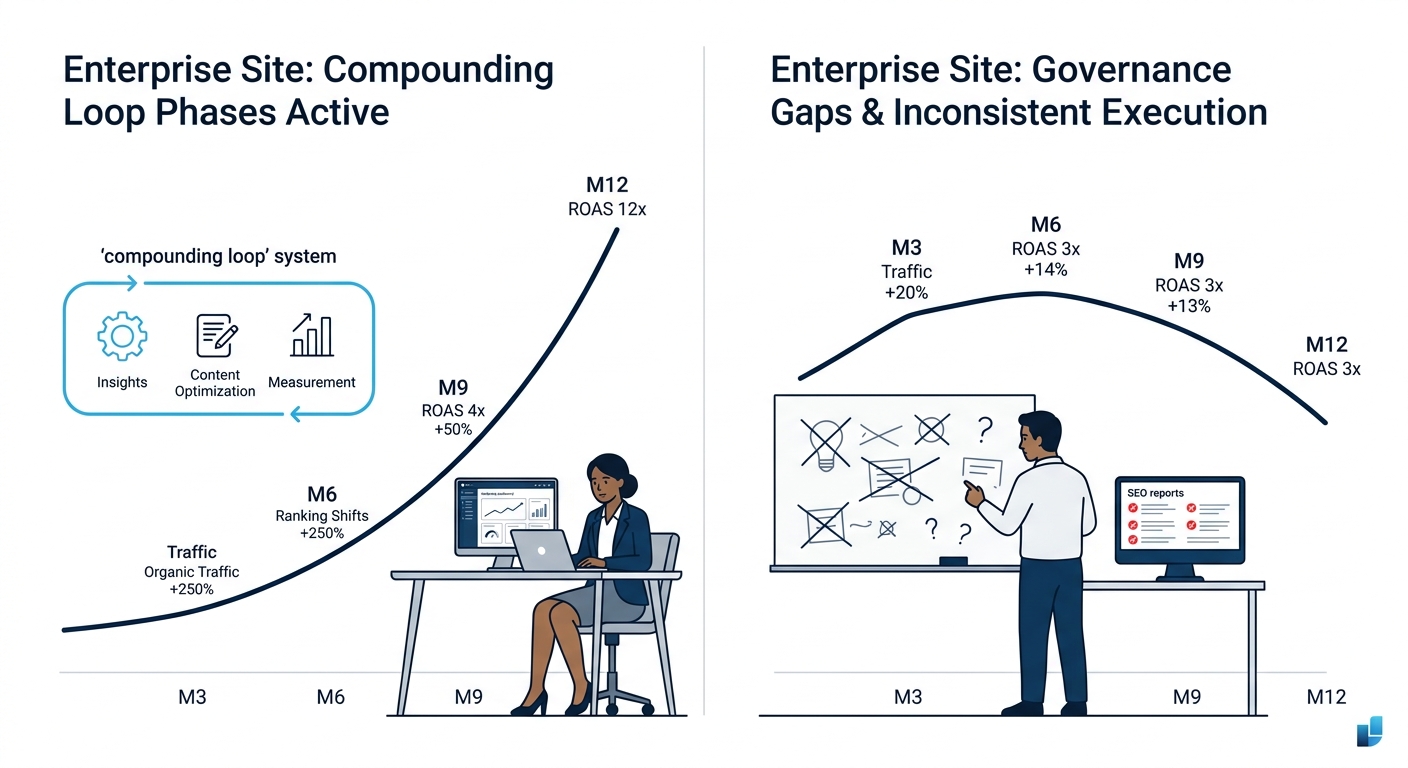
The compounding loop works in both directions. Clean architecture compounds growth. Architectural entropy compounds losses. The differentiator is governance.
The Three-Phase Loop, Defined
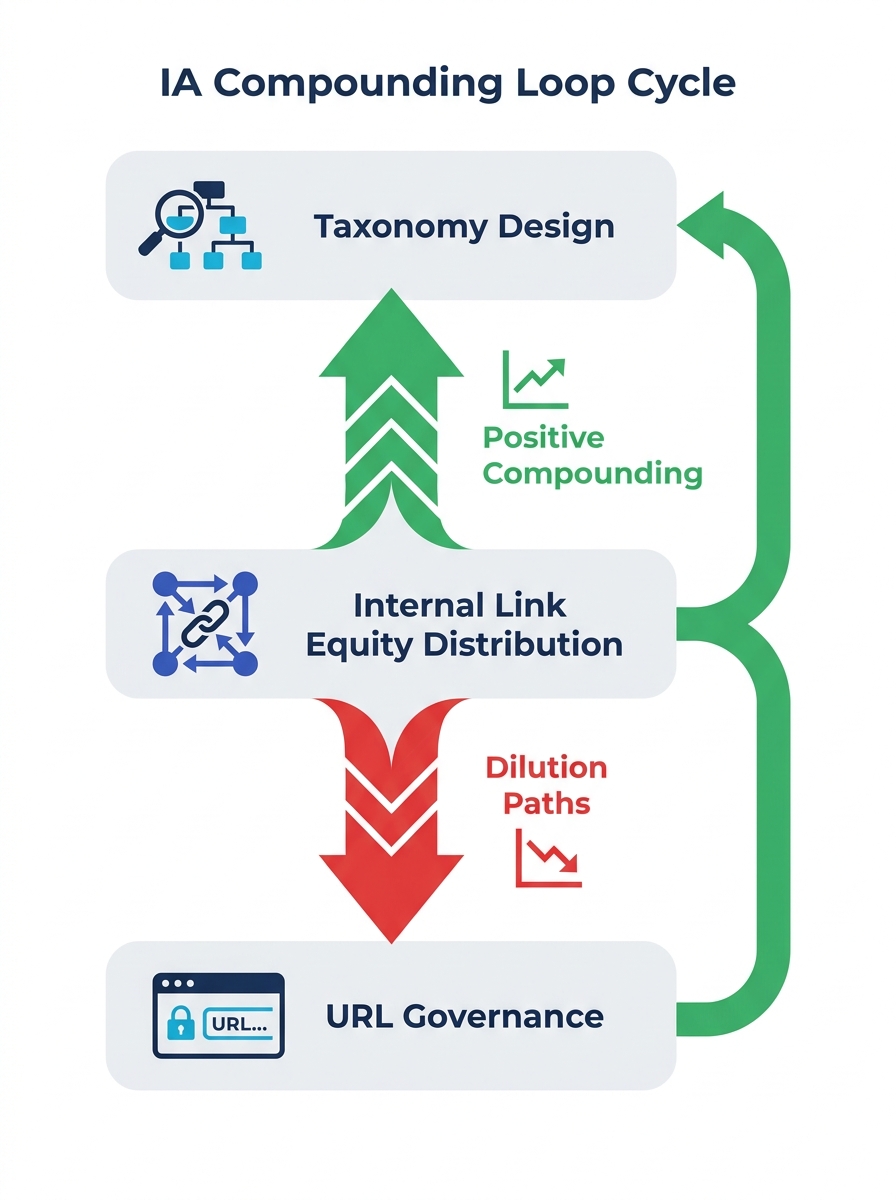
Here’s the framework that ties the three evidence threads together. The Information Architecture Compounding Loop operates on three mechanisms that feed each other continuously:
Phase 1: Taxonomy Design. Pages are organized into topic clusters with clear parent-child relationships. Each cluster targets a topical area where the brand has authority or intends to build it. McDonald’s silo model applies here: content grouped by topic, with internal links reinforcing relevance within each silo. New pages enter an existing silo rather than floating as orphans. The enterprise SEO authority mapping framework we’ve outlined previously details how to align these clusters to revenue goals.
Phase 2: Internal Link Equity Distribution. Links flow intentionally from high-authority pages (pillar content, category pages, pages with strong backlink profiles) downward and laterally through the taxonomy. The internal linking multiplier approach details how to map these flows. Every link is a deliberate equity allocation, not a sidebar widget or a “related posts” module firing at random.
Phase 3: URL Governance. A defined process prevents new pages from breaking the first two phases. This includes canonicalization rules, parameter handling, redirect protocols, and approval workflows for structural changes. Governance is what makes the first two phases durable across years of site growth.
When all three phases operate together, each new page added to the site makes every other page in its cluster slightly stronger. When any phase breaks (taxonomy gets ignored, internal links go unmaintained, governance lapses), the loop reverses, and the very act of publishing new content accelerates organic decline.
The Claim, Revisited
The contrarian position here is straightforward: adding content to an enterprise site without maintaining its architectural loop is worse than adding no content at all. Every orphan page, every redirect chain, every parameter URL that crawlers waste cycles on actively subtracts from the organic performance of the pages you already have.
The brands that compound organic growth year over year aren’t necessarily producing more content than their competitors. They’re producing content into a structure that distributes authority predictably, crawls efficiently, and scales without entropy. The enterprise information architecture framework gives you the structural blueprint, but the blueprint only works if governance keeps the loop running after the architects leave.
Enterprise site architecture SEO is, at its core, a maintenance discipline disguised as a design discipline. The design gets all the attention at kickoff. The maintenance determines whether the design compounds or decays. Brands that internalize this distinction tend to see organic growth that accelerates over time rather than flattening after the first year of investment, and the gap between them and their competitors widens with every quarter that the loop stays intact.