From AI Overviews to Answer Engines: Rebuilding Your Enterprise SEO Strategy for Post-Search Visibility
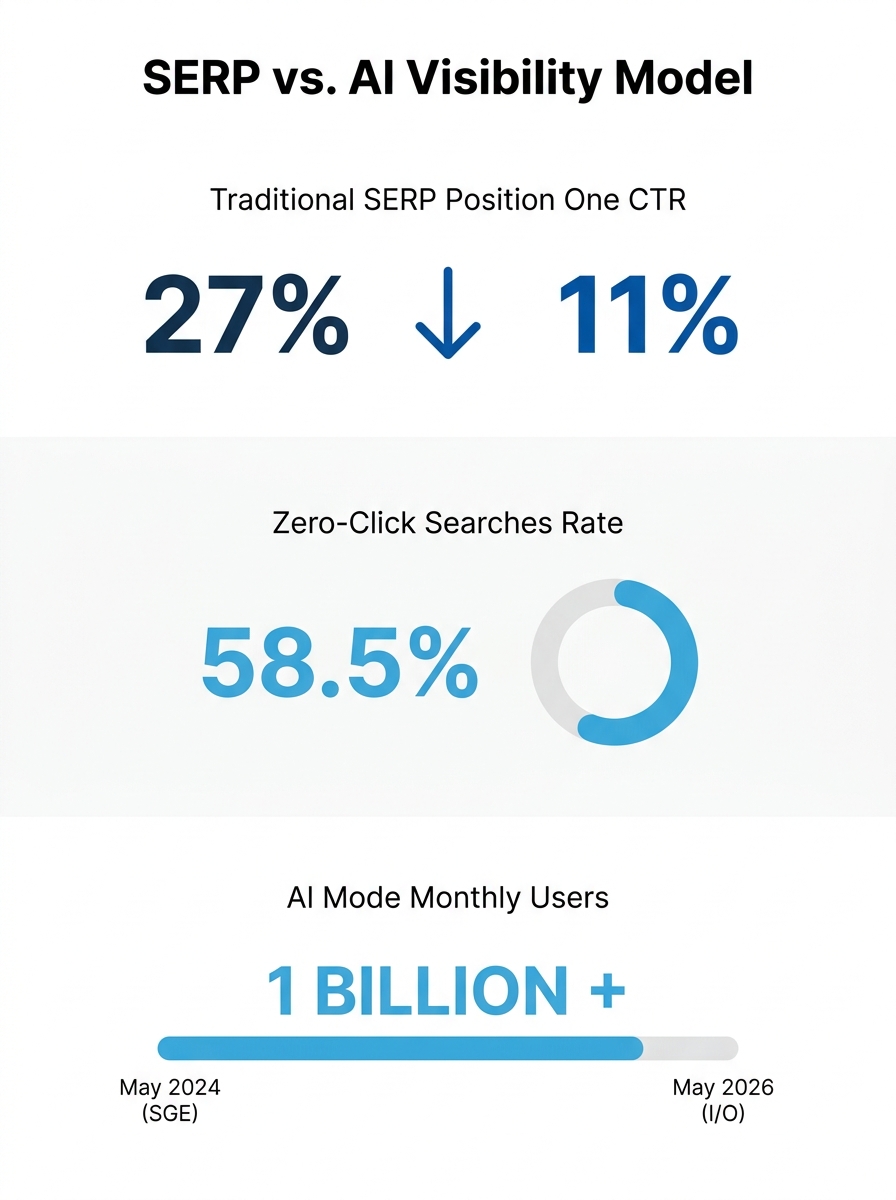
Optimizing for position one on Google’s traditional results page is now an exercise in diminishing returns for enterprise brands, and the March 2026 core update made the math worse. Zero-click searches account for 58.5% of all US Google queries, position-one CTR on AI-affected queries has dropped from 27% to 11%, and AI Mode has crossed one billion monthly users with queries doubling every quarter.
TL;DR: The primary visibility layer for enterprise SEO is shifting from ranked blue links to AI-generated citations across Google AI Overviews, AI Mode, ChatGPT, and Perplexity. Brands that earn citations get 35% more organic clicks than those that don’t. Winning requires structural, entity-level, and cross-platform changes that differ from traditional ranking work.
The Surface Enterprise Brands Optimized For Is Contracting
Google’s I/O 2026 keynote on May 19 introduced AI Mode with Gemini 3.5 Flash as the global default model, replacing the traditional search box with a multimodal interface that accepts text, images, and Chrome tabs. When a user enters AI Mode, the ten-blue-links SERP disappears. Brands are either cited inside the generated answer or they’re invisible. There is no position two and no “above the fold.”
The scale here is extraordinary. AI Mode’s one billion monthly users didn’t accumulate gradually. Queries have doubled every quarter since launch, and Google simultaneously expanded Personal Intelligence to 200 countries and 98 languages, linking search results to user Gmail, Photos, and Calendar data. The search engine your teams have optimized against for a decade now has a parallel interface that a growing share of users prefer, and that interface has entirely different visibility rules.
Even outside AI Mode, AI Overviews continue eroding the traditional click surface on standard SERPs. These generated summaries appear on 4.5% to 12.5% of queries according to seoClarity’s impact research, and that range has been climbing since Google rebranded Search Generative Experience as AI Overviews in May 2024 and rolled it out to all US users by default. For enterprise brands whose site architecture was built around organic revenue from high-volume informational queries, the traffic math has deteriorated. The old model rewarded ranking. The new model rewards being the source an AI decides to cite.
Citation Mechanics Diverge From Ranking Mechanics
Why does earning an AI citation require different work than earning a ranking? Because the signals AI answer engines extract from a page differ from the signals Google’s traditional index weighs.
Google VP Liz Reid stated in a May 2024 blog post that “we see that the links included in AI Overviews get more clicks than if the page had appeared as a traditional web listing for that query.” That’s an encouraging data point for brands that do get cited. But getting cited depends on structural extractability and entity authority, two dimensions that many enterprise sites neglect.
The 2024 Princeton/Georgia Tech GEO paper, whose findings have held through 2026, measured which content modifications boost LLM citation rates. Adding direct quotations to content produced a 42.6% lift. Adding statistics with named sources produced a 32.8% lift. And 44.2% of all citations came from the first 30% of each content section, meaning where you place your answer within a page matters as much as whether the answer exists at all.
This is where Generative Engine Optimization and Answer Engine Optimization AEO diverge from conventional SEO execution. Traditional SEO rewards thorough, long-form pages that satisfy intent broadly. AEO rewards pages that deliver extractable, self-contained answers at the section level. Every H2 needs to function as its own answer unit, opening with a direct, citable response to the question the heading implies.
Google’s own documentation on optimizing for generative AI features reinforces this direction. The guidance emphasizes semantic structure, clean metadata, and freshness, but also stresses that content needs to be written so AI systems can pull authoritative fragments without requiring full-page context. Enterprise sites with deep but poorly structured content libraries are losing citations to smaller publishers that format their pages for extraction.
The old model rewarded ranking. The new model rewards being the source an AI cites.
For marketing leaders evaluating their current agency’s work, this creates a clear diagnostic. Pull up your top 50 landing pages by organic traffic. Check whether each one opens with a direct answer in the first 40–75 words of every section. Check whether the page includes named expert attribution, specific statistics with sources, and structured data markup. If the answer is no on more than half, your content library is optimized for a visibility model that’s contracting.
The Citation Readiness Score
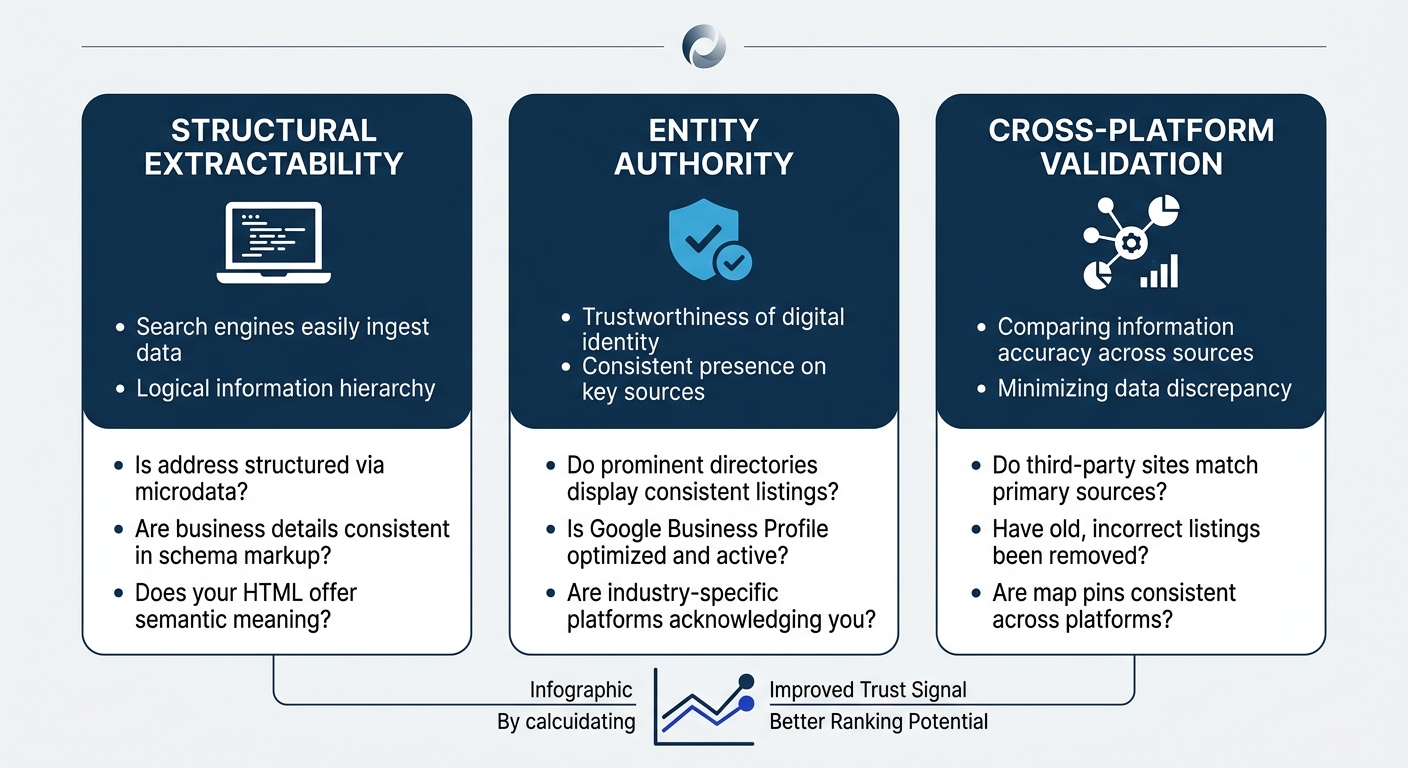
We’re proposing that enterprise teams evaluate content against what we’re calling the Citation Readiness Score, assessed across three axes:
| Axis | What It Measures | Signs of Weakness |
|---|---|---|
| Structural Extractability | Can an LLM pull a clean, self-contained answer from the page? | Answers buried in paragraph 3+; no direct-answer lede; H2s that don’t resolve a clear question |
| Entity Authority | Does the content establish named expertise and institutional credibility? | No named expert quotes; no attributed statistics; no linked sources |
| Cross-Platform Validation | Is the brand’s claim confirmed on third-party surfaces? | Zero mentions on forums, social, or independent review sites; no entity presence outside owned media |
The third axis matters more than enterprise teams typically realize. ALM Corp’s 2026 analysis of search-everywhere optimization observed that “if users validate your claims on third-party platforms, then your search strategy must include visibility there too.” AI answer engines don’t evaluate pages in isolation. They cross-reference entity mentions, brand sentiment, and third-party corroboration when deciding which sources to cite.
This maps directly to how major brands have started engineering AI chatbot recommendations through deliberate entity strategies. The brands that appear consistently in ChatGPT and Perplexity answers have built verifiable entity footprints across multiple platforms beyond their Google rankings.
APAC Search Fragmentation Adds a Third Layer
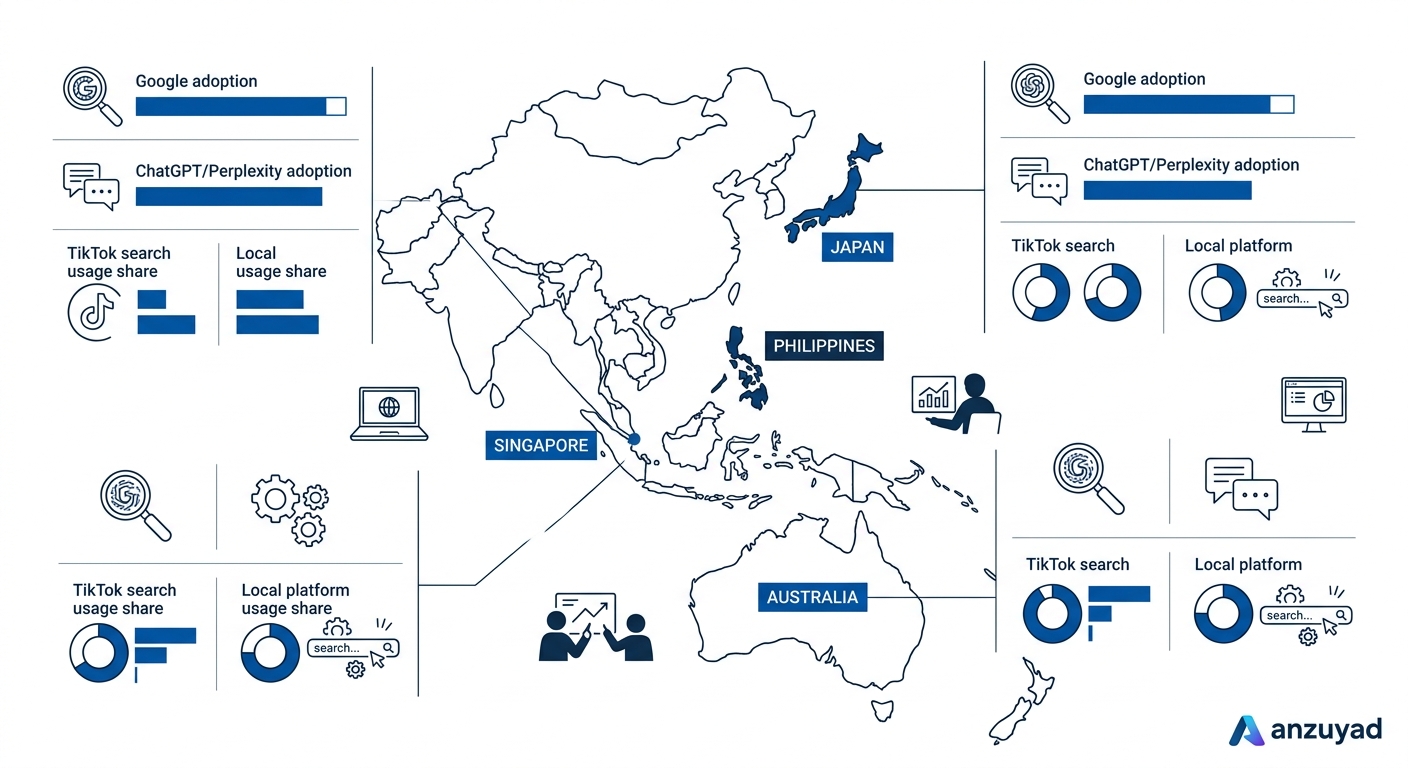
For enterprise brands operating across the Philippines and broader APAC markets, multi-platform search visibility APAC introduces challenges that US-centric AI Overviews content strategy guidance doesn’t address. Juni Son, writing for The Egg’s APAC SEO team in January 2026, documented that generative AI search engines powered by large language models are “fundamentally changing how users interact with search engines” across the region, with adoption patterns varying sharply by market.
In the Philippines, Google dominates but ChatGPT, Perplexity, and TikTok search are growing as parallel discovery channels. Enterprise brands that rely on a single-platform SEO strategy are underexposed on at least two surfaces where their target buyers are actively searching. This is a measurement problem as much as a visibility one, because standard analytics dashboards don’t track AI citation appearances at all.
The Google AI search redesign impact extends beyond organic rankings into how enterprise brands think about their content architecture. Pages built for traditional crawl-and-rank logic need restructuring for AI extraction logic. Content that served as deep pillar pages in 2024 now needs to function as modular answer libraries where each section is independently citable. That’s a meaningful shift in how information architecture should be designed for organic growth.
Google’s I/O announcement of Information Agents adds yet another dimension. These autonomous agents perform passive, 24/7 background discovery on behalf of users, surfacing information without any active search query. When Google confirmed AI Mode had crossed one billion users, the subtext was unmistakable: the infrastructure for a post-search discovery model is already deployed at scale, and the enterprise brands still optimizing exclusively for query-triggered results are watching a smaller portion of total discovery.
Info: Enterprise teams across APAC should audit their brand’s presence in ChatGPT, Perplexity, and Gemini for their top 20 commercial queries. If the brand doesn’t appear in AI-generated answers for its own category terms, that gap is now a direct visibility loss, and closing it requires entity-level and structural work that sits outside traditional SEO scopes.
The Claim, Sharpened
The position this article opened with was that optimizing for traditional SERP position one is diminishing-returns work for enterprise brands. Four weeks after Google I/O 2026, the evidence supports that claim from three directions: the click surface is measurably shrinking (58.5% zero-click, 11% position-one CTR on AI-affected queries), citation mechanics require structurally different work than ranking mechanics (42.6% lift from quotation density alone), and APAC market fragmentation means enterprise brands need visibility across surfaces that traditional SEO doesn’t reach.
None of this means traditional SEO is dead. CXL’s 2026 guide on Answer Engine Optimization is right that strong SEO practices—semantic structure, authority building, technical cleanliness—remain foundational for AEO. The foundation holds. But the structure on top of it has changed shape, and enterprise teams still allocating 90% of their organic budget to ranking work are funding yesterday’s visibility model.
The Atlantic’s reporting from this week on search results getting “sloptimized” captures the industry’s anxiety well. The brands that approach this transition with structural rigor rather than panic, though, will earn the citations competitors are scrambling for. That means auditing content for extractability using something like the Citation Readiness Score, investing in entity authority across platforms, and accepting that the search interface your enterprise strategy was built around now has a parallel layer operating on different rules. The brands that made this shift earlier in 2026 are already seeing their content surface inside AI-generated answers at materially higher rates than category peers. The brands that wait until the traffic decline becomes a board-level conversation will be rebuilding from behind.