AI Agent Search Volume Quadruples Task-Focused AI Queries as Marketing Automation Demand Surges

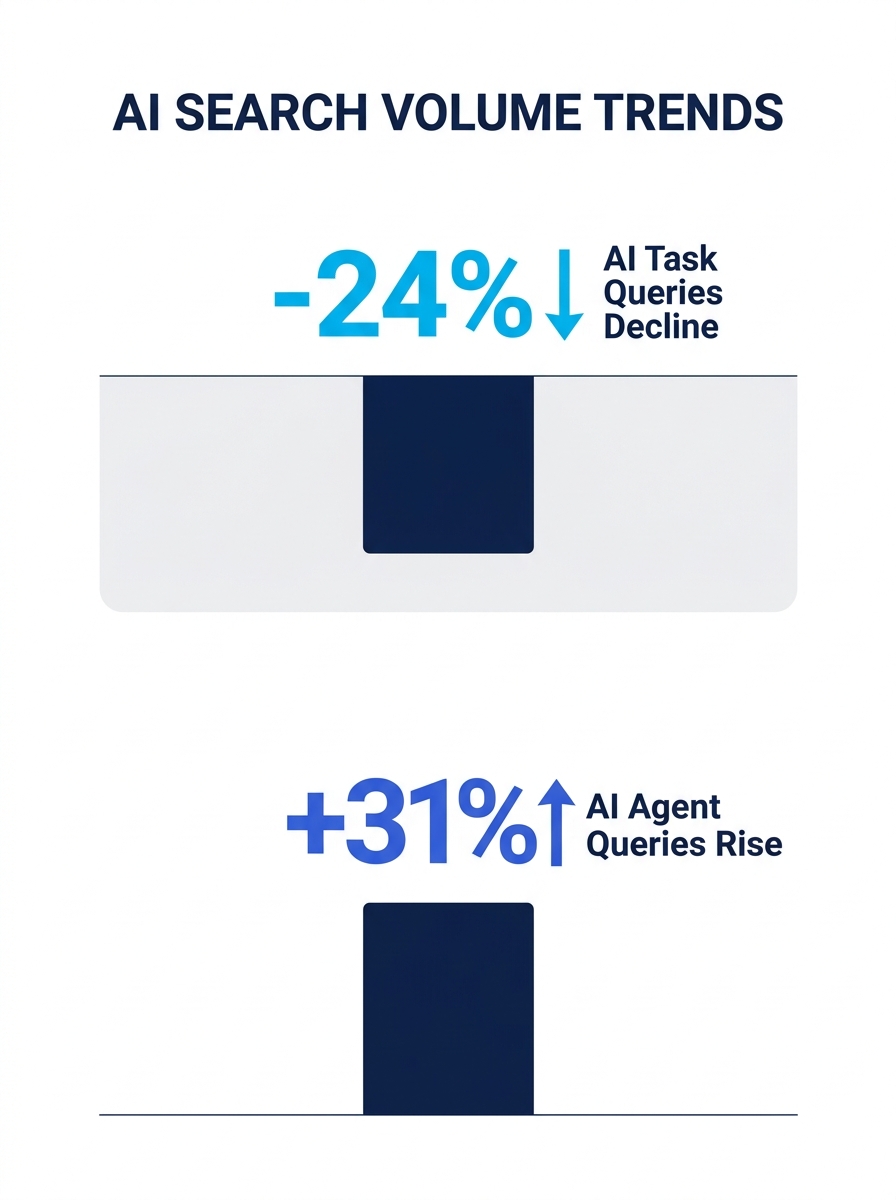
Search volume for AI agent and automation queries now pulls roughly four times the monthly traffic of traditional “AI for task” searches, according to a twelve-month Google search data study published June 14 by Lilach Bullock, an AI implementation consultant. Every one of 16 task-focused searches Bullock tracked declined year-over-year by a median 24%, while all nine agent and automation terms climbed by a median 31%, signaling a market shift from evaluating AI capabilities to deploying autonomous systems.
TL;DR: A year-on-year analysis of 30 AI search terms shows task-focused queries (“AI for marketing”) down 24% while agent/automation queries (“agentic AI”, “AI agents for business”) rose 31%, now representing 251,000 monthly searches versus 61,000 for the task category.
The Volume Redistribution
The study, which analyzed DataForSEO historical search data for Google in the United States through June 2026, compared average monthly search volume for the most recent three months against the same period one year earlier. Agent and automation terms collectively generated approximately 251,000 searches per month, compared with 61,000 for the entire “AI for a task” category, Bullock’s analysis shows.
“Agentic AI” recorded 110,000 searches monthly, up 39%, while “AI agents” reached 60,500, up 15%. “AI agents for business” climbed 210% year-over-year, and “autonomous AI agents” rose 770% from a smaller base, according to the filing. On the declining side, “AI for marketing” fell 38%, “AI for ecommerce” dropped 50%, and “AI chatbot for business” declined 39%.
Generic AI awareness terms remain robust—five high-volume keywords tracked in the study collectively pulled more than three million searches monthly, up a median 16% year-over-year. “AI chatbot” alone registered 1.8 million monthly searches. “The top of the funnel is wider than ever,” Bullock wrote in the report. “What has changed is the next click. People arrive curious and immediately want the thing that does the work, not another explainer.”
What Marketing Leaders Should Brief For
The search pattern shift has a direct corollary in how enterprise marketing teams should evaluate and brief agency partners in 2026. Eighteen months ago, agency scopes frequently included AI tool training and prompt optimization for in-house teams. Current briefs increasingly center on end-to-end process automation—systems that qualify inbound leads, schedule discovery calls, update CRM records, and trigger nurture sequences without manual intervention.
Agencies positioning around “AI for marketing” capabilities risk anchoring to a query category in structural decline, while those building agent-based workflow automation align with demand growing at double the rate. For marketing directors overseeing agency relationships, the distinction matters when evaluating proposals: a scope that promises “AI-assisted content creation” addresses a 38% declining search category; a scope that automates the entire content calendar workflow through multi-agent orchestration addresses the 31% growth segment.
The brief should specify which repetitive processes the agency will fully automate, what handoff triggers remain for human review, and how hours saved will be measured. “The only number that matters is how much of your week you got back,” Bullock noted in the study. Performance metrics tied to feature adoption or tool usage reflect the prior era; the relevant KPI is process completion without manual input.
Platform Implications and Agency Selection
For brands evaluating whether an agency partner can deliver on AI SEO services or AI-augmented campaign management, the study suggests a specific due-diligence question: does the agency build autonomous agents that execute tasks end-to-end, or does it provide AI tools that assist existing manual processes? The search data indicates the market has moved past the latter.
Bullock’s analysis used DataForSEO historical search volume data for Google in the United States, pulled in June 2026, comparing three-month rolling averages. The study grouped 30 keywords into three baskets: 16 “AI for a task” terms, nine “AI agent and automation” terms, and five large generic terms for context. The fact that all 16 curiosity-phase terms moved down while all nine agent terms moved up represents the directional signal, Bullock wrote, rather than any single keyword’s absolute volume.
The shift has second-order effects on how agencies structure service lines. A social media marketing retainer that includes “AI-assisted post drafting” operates in the declining query category; one that deploys agents to monitor brand mentions, draft contextual replies, route escalations to human review, and log engagement data in the client’s dashboard operates in the growth category. The underlying platform capabilities may overlap, but the framing determines whether the agency is positioned around what the market is searching for or what it searched for a year ago.
The Takeaway
Marketing leaders briefing agencies for 2026–2027 planning cycles should evaluate partner capabilities through the lens of full-process automation rather than task-level assistance. The search data published June 14 shows a decisive market preference for agents that execute end-to-end workflows over tools that accelerate individual steps within a manual process. Agencies that frame scopes around the former align with demand growing at 31% year-over-year; those still positioning around “AI for [discipline]” language anchor to a category in median 24% decline. When evaluating proposals, the diagnostic question is straightforward: does the deliverable reduce the number of manual steps you perform, or does it eliminate the process from your workload entirely? The volume redistribution suggests the market has chosen the latter.