The Post-Migration Traffic Plateau: Why Enterprise Sites Stall After Domain Transitions and How to Sustain 6-Month Growth

Nine out of ten website migrations damage organic search performance, and the average enterprise site needs 523 days to recover pre-migration traffic levels. The plateau forms because organizations treat migration as a launch event, then stop monitoring redirects, crawl behavior, and indexation status within weeks of go-live.
The Reindexing Gap Nobody Budgets For
Enterprise site migration recovery stalls when teams assume the technical cutover is the finish line. Google still has to recrawl and reindex every URL on the new domain or the new CMS structure. For sites carrying 50,000 or more indexed pages, that reprocessing stretches across months. Errors in redirects, canonicals, or robots.txt during that window don’t just slow things down. They compound into lasting visibility losses that become harder to diagnose with each passing week.
HireRoad offers one of the better-documented examples of what disciplined post-migration execution looks like. The company merged three separate domains into a single unified site while rebranding at the same time. One year after migration, their organic traffic exceeded projections by 14.5%, and performance never dipped below anticipated levels during the transition. Numen Technology’s analysis of the case noted that HireRoad “tested almost 1,000 strategic redirects” before launch, verifying that each old URL passed its accumulated authority to the correct new destination. That kind of pre-launch rigor is the exception, though. The typical enterprise migration skips granular redirect testing in favor of pattern-based rules, which is where the trouble starts.
The window between “site is live” and “Google fully trusts the new domain” typically runs 4 to 8 weeks for light platform updates and 6 to 12 months for large-scale CMS changes or domain swaps. During that window, the site is fragile. Any technical regression (a staging noindex tag left in production, a canonical loop introduced by the new CMS, a CDN rule that blocks Googlebot) doesn’t slow recovery. It resets the clock. And 17% of migrated sites never recover their pre-migration traffic even after 1,000 days, according to the same Numen Technology research. In most of those cases, the errors went undetected during the reindexing window. By the time someone investigated, Google had already devalued the affected URLs.
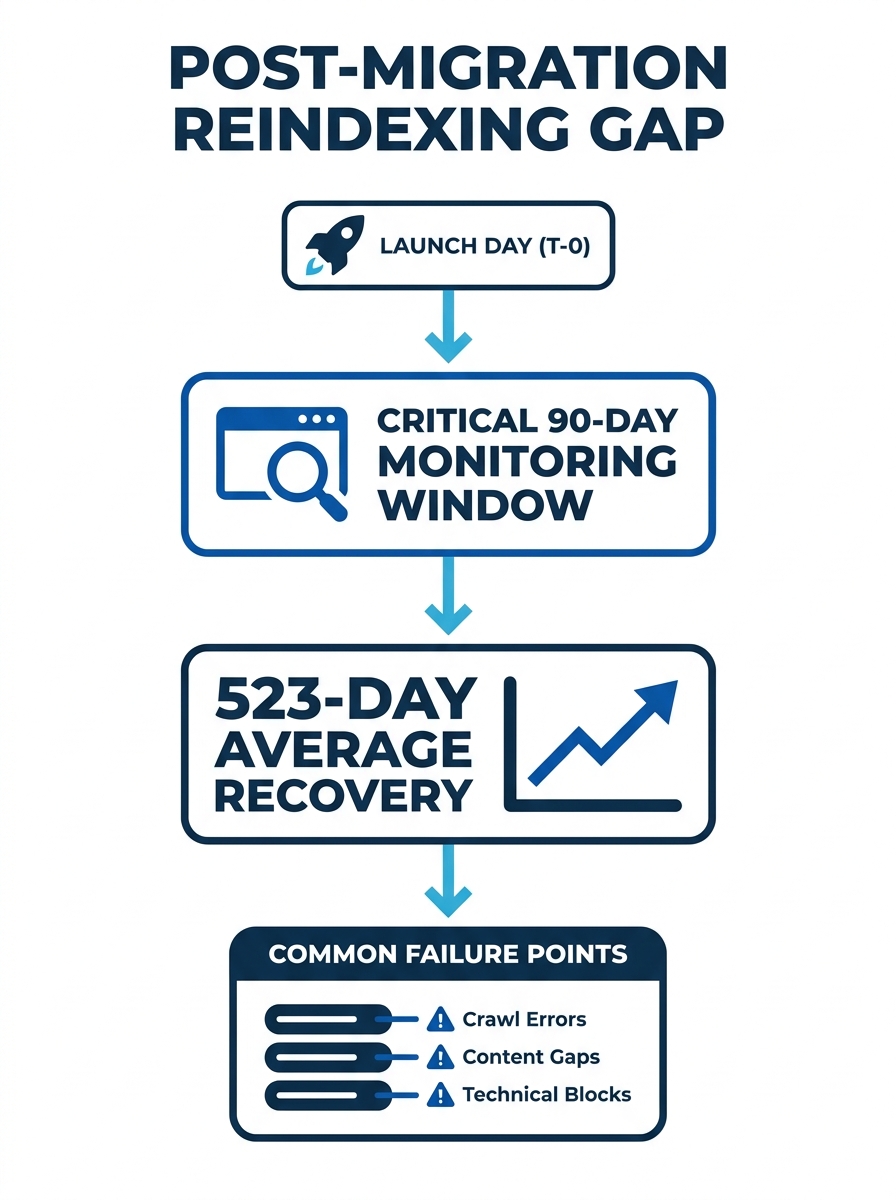
This is where an enterprise SEO services engagement earns its fee during a migration. The agency doesn’t disappear after launch day. It monitors Search Console indexation reports, crawl stats, and ranking movement daily for weeks, then weekly for months. That sustained attention is the difference between catching a redirect chain on day 3 and discovering a 30% traffic drop on day 90.
Redirects Are the Whole Migration
DigitalSkillEarnHub’s 2026 migration recovery guide put it bluntly: “Rankings cannot exist without indexation.” And indexation after a migration depends almost entirely on redirect accuracy. Every 301 redirect acts as a bridge. It tells Google that a specific old URL now lives at a specific new URL, and that the authority, backlinks, and ranking signals attached to the old page should transfer to the new one. When those bridges are missing, broken, or misconfigured, the new pages launch with zero history in Google’s eyes.
Search Engine Journal’s Ask an SEO column explained the stakes clearly: “Missing or incorrect redirects are one of the top causes of traffic loss after a migration. Each redirect is a connection that ensures the SEO equity of your old pages gets passed on to your new ones.” The common failure mode is predictable. An IT team receives a detailed 1:1 URL mapping from the SEO team, decides the document is too complex to implement page by page, and replaces it with a handful of pattern-based redirect rules. One retailer’s decision to simplify redirect mappings this way cost roughly £3.8 million in first-month revenue, according to Numen Technology’s case documentation.
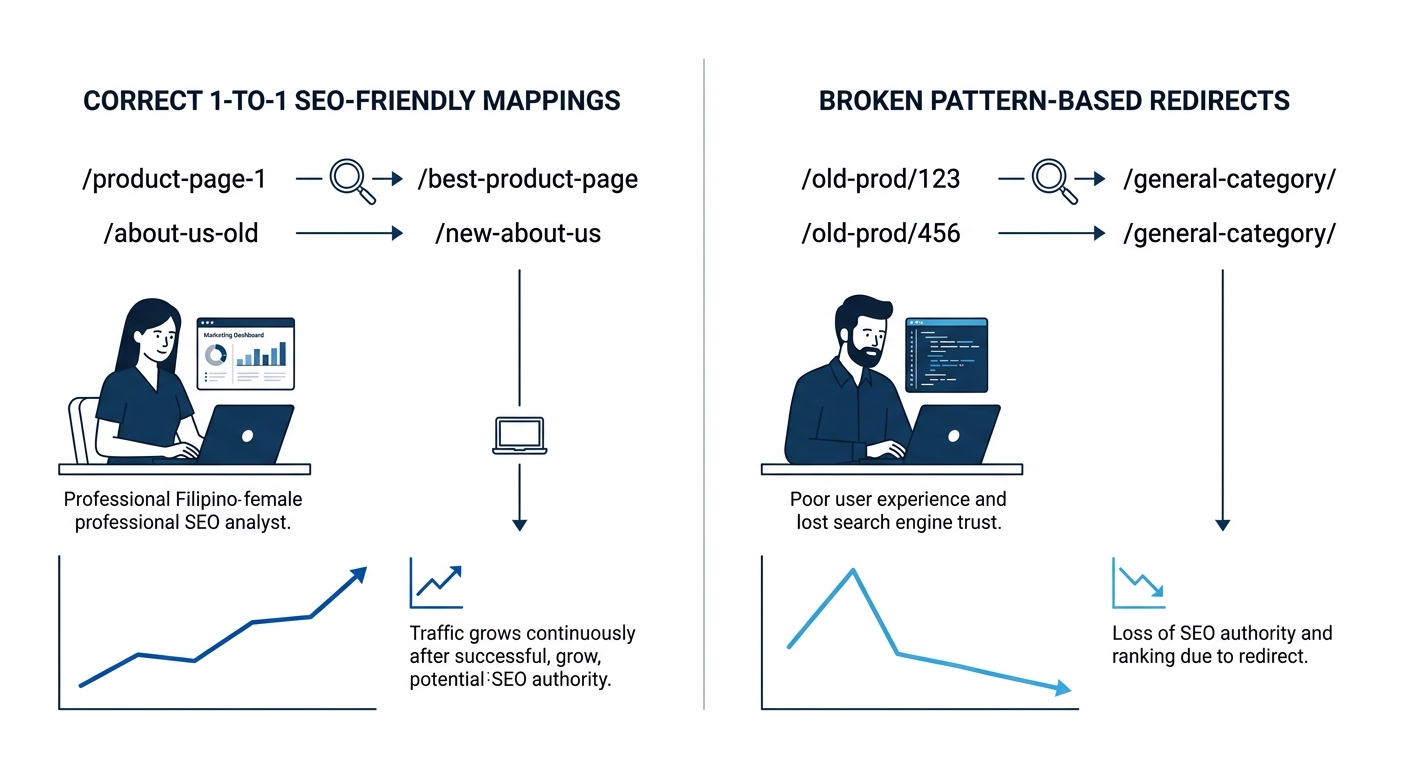
Builtvisible’s organic recovery guide reinforced this point, stating that a correctly implemented redirect mapping “is an integral part of any website migration which will help you avoid lots of issues post-migration.” The guide recommends that the first post-launch diagnostic should be a full verification of whether the redirect mapping was executed as planned. That means crawling the old URL list, confirming each one returns a 301 to the correct new destination, and flagging any that return 302 temporary redirects, 404 errors, or redirect chains longer than two hops. The teams that do this within the first 48 hours catch 80% of problems before they affect rankings. The teams that wait two weeks catch the same problems, but only after Google has already started devaluing the affected pages.
This connects directly to the broader question of how crawl budget affects enterprise visibility. If Googlebot spends its allocation following broken redirects or crawling soft 404 pages, it has fewer resources left to index the pages that actually drive organic revenue. One enterprise e-commerce audit found that 47,000 duplicate URLs consumed 34% of crawl budget while generating zero organic sessions. Post-migration sites are especially vulnerable to this kind of waste, because the migration itself often doubles the number of URLs Google sees (the old URLs that should redirect, plus the new URLs that should index).
What the Six-Month Window Actually Requires
Post-migration SEO momentum doesn’t sustain itself. It requires deliberate, structured work across three distinct phases after launch day, and each phase addresses a different failure mode. Organizations that commit to a 90-day monitoring protocol, then extend observation through month six, are the ones that avoid the organic growth plateau prevention problem that traps most enterprise migrations.
The first phase covers weeks one through four. This is the active remediation period: daily checks on Search Console’s indexation and crawl stats, monitoring for spikes in 404 errors or unexpected crawl rate drops, and verifying that the site’s core pages (top 100 by organic traffic) are indexing correctly on the new domain. Any high-traffic page returning a 404 or a redirect chain needs a fix within hours, not days. The Iriscale troubleshooting guide recommends diagnosing breakpoints in a specific order: technical first, then indexing, then content, then authority. Skipping ahead to content changes while indexation issues persist wastes effort on pages Google hasn’t even processed yet.
The teams that verify redirect accuracy within 48 hours of launch catch 80% of problems before they affect rankings. The teams that wait two weeks catch the same problems, but only after Google has started devaluing the affected pages.
The second phase runs from week five through week twelve. By now, the acute technical fires should be out. The focus shifts to validating that internal linking structures survived the migration intact. Many CMS migrations break internal links silently, because the new platform generates URL paths differently than the old one did. A product page that once received 40 internal links might now receive 4 because the new navigation template, breadcrumb logic, or related-products module doesn’t reference it. We’ve written before about how information architecture compounds organic growth over time. The same principle works in reverse: broken internal linking decays authority quickly. And this is the phase where content teams should evaluate whether high-performing pages lost content during the migration. Template changes, widget removals, and CMS field mapping errors can strip 30% or more of a page’s word count without anyone noticing.
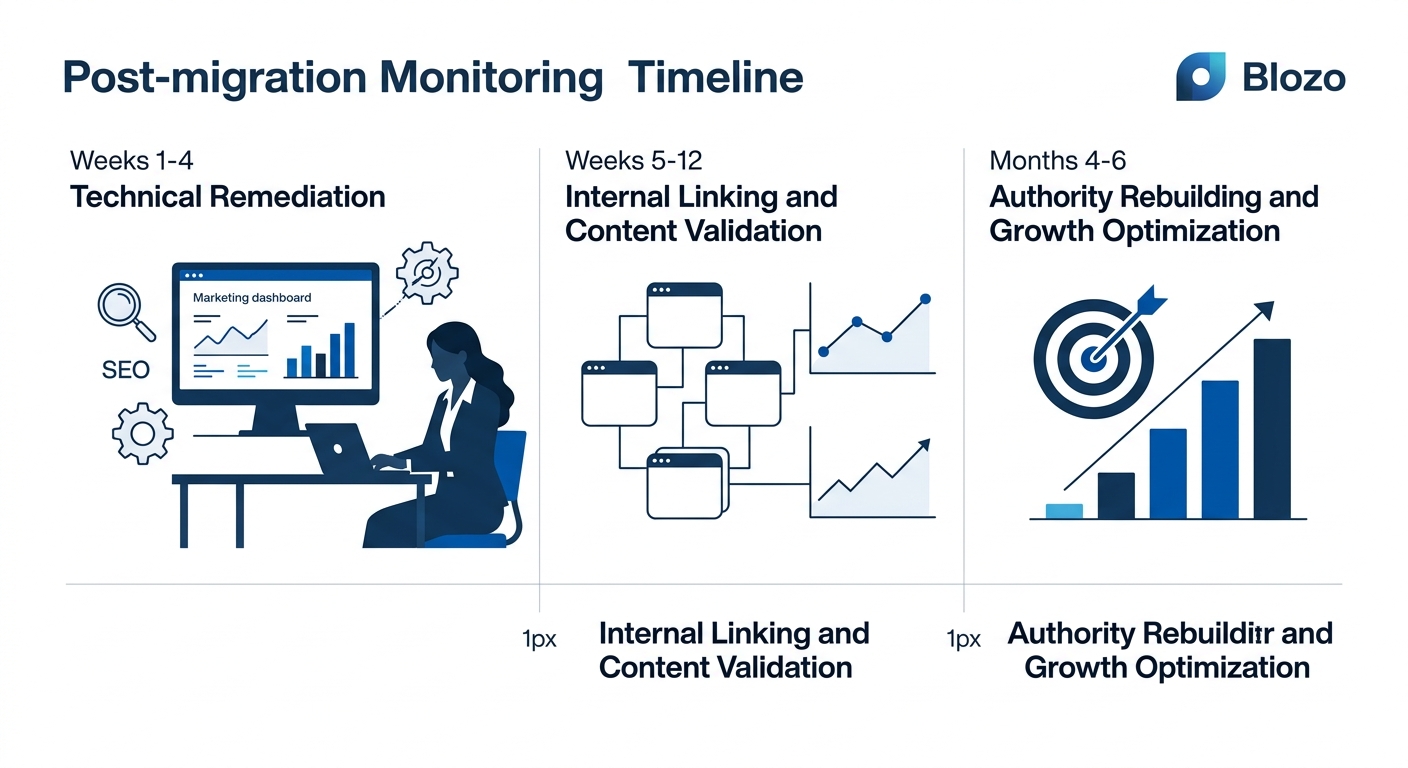
The third phase covers months four through six. The site should be technically stable by now, and the focus shifts to growth. This means identifying pages that recovered to 70-80% of their pre-migration performance but stalled there, then diagnosing why. Common causes include lost backlinks (referring domains that still link to old URLs returning 404s instead of 301s), thin content on migrated pages, or cannibalization between old and new URL versions that both remain indexed. This is also the phase where a content marketing agency typically adds the most value, because the content gaps revealed by migration data point directly to the topics and pages that need attention. Running your post-migration diagnostics through an SEO audit workflow designed around revenue impact keeps the team focused on fixes that actually move organic traffic rather than chasing low-priority technical warnings. Migration traffic sustainability in the APAC market particularly depends on this structured approach, since enterprise sites serving multiple country domains face compounded complexity in redirect mapping and hreflang implementation across regional subdomains.
The Part That Remains Uncomfortable
For all the process discipline described above, a persistent uncertainty hangs over every enterprise migration. The 523-day average recovery timeline and the 17% permanent-loss rate suggest that even well-executed migrations carry real risk. A shopping mall website that increased organic traffic by 5x post-migration proves the ceiling is high. HireRoad’s 14.5% beat of projections proves that careful planning works. But the base rate for the industry is still 90% failure, and no amount of redirect mapping eliminates every variable.
Part of the discomfort comes from organizational dynamics. The SEO team’s influence over the migration typically peaks during the planning phase, then declines sharply once development takes ownership of the build. By launch day, the people who understand redirect mapping and canonical configuration may have limited access to the deployment pipeline. And the 90-day monitoring protocol described above requires sustained executive sponsorship that most organizations struggle to maintain once the “migration project” is officially closed in the project management tool.
The other uncomfortable truth is that Google’s own reprocessing timeline is opaque. Google doesn’t publish a guaranteed reindexing schedule for migrated sites. The 4-to-8-week window for light migrations and 6-to-12-month window for large CMS changes are industry observations, not Google commitments. A site can do everything right and still experience a plateau simply because Google’s crawler prioritized other domains that month. Adapting to how Generative Engine Optimization and AI-driven search are reshaping visibility adds another layer of unpredictability, since LLM-based search systems may reprocess domain authority signals on entirely different timelines than traditional search. The SEO debugging pyramid we’ve outlined elsewhere helps teams work through these ambiguities systematically, but it doesn’t remove them. An enterprise migration remains one of the highest-stakes initiatives a marketing organization can undertake. The difference between a site that plateaus permanently and one that surpasses its pre-migration baseline comes down to whether the team treats the six months after launch as the real project, rather than the aftermath of one.