The Internal Linking Authority Ladder: How Enterprise Brands Compound SEO Growth Through Strategic Link Architecture

Rewiring internal links across a retail e-commerce site, without publishing a single new page or earning a single new backlink, produced 9,500 additional organic visits per week. Oscar Carreras documented the case in his enterprise SEO playbook: the entire lift came from restructuring how existing pages passed authority to each other through a pillar-cluster link architecture.
This article dissects that case, phase by phase, to show how an internal linking strategy at enterprise SEO scale turns a flat collection of URLs into a compounding growth engine.
The Flat Link Graph That Starved Category Pages
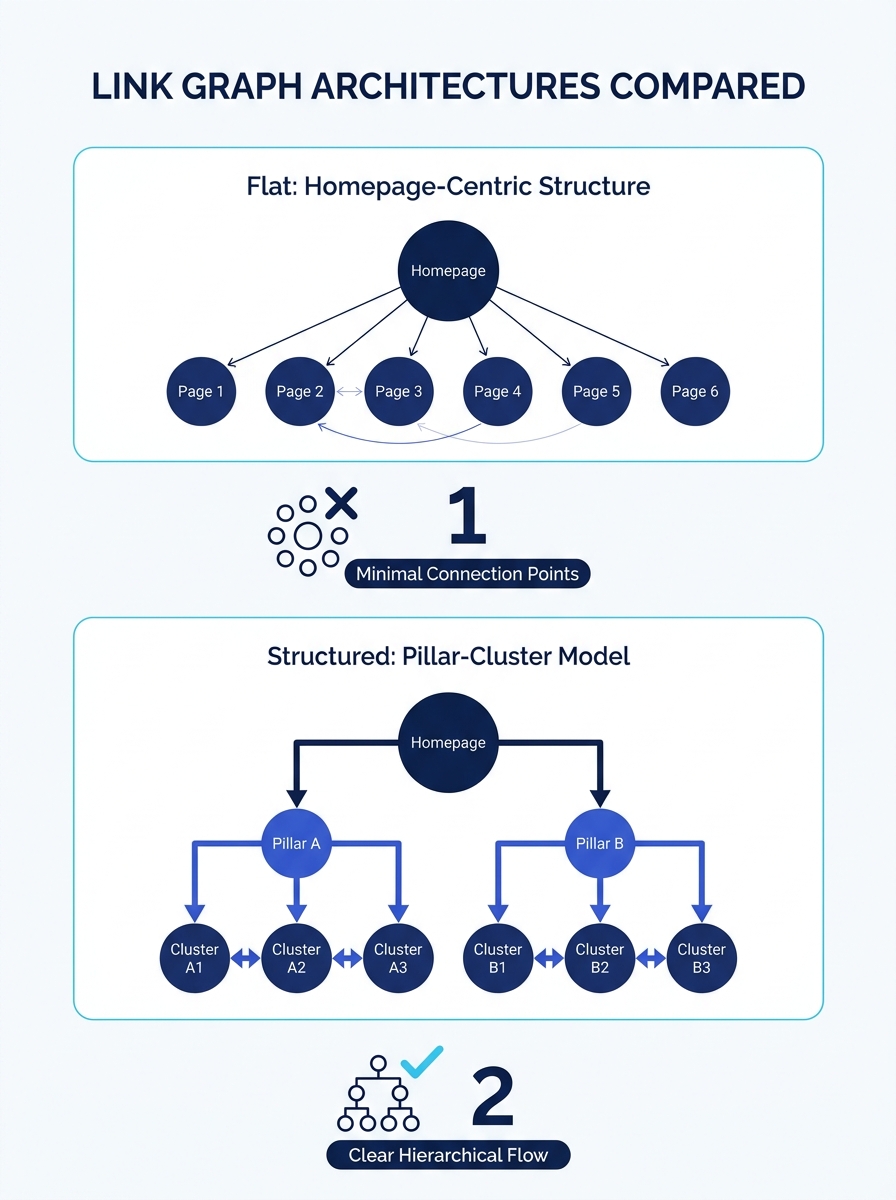
Before the restructuring, the retail site had a common enterprise problem: tens of thousands of product pages linked to the homepage and to themselves, but the connections between related category pages and their supporting product URLs were thin or nonexistent. Search Engine Land’s internal linking guide describes this exact failure mode, noting that weak internal linking means “pages on your site sit in isolation, orphaned, or connected only through generic navigation, without meaningful contextual links that pass authority and signal relevance.”
The practical consequence was predictable. Deeper category pages (those sitting three or four clicks from the homepage) received almost no internal PageRank from the site’s stronger pages. Products within those categories didn’t surface in organic results because Google’s crawler had no clear path to reach them, index them, and understand their topical relationship to the category above. The site was generating content at volume, but its link architecture meant that organic growth stalled because authority pooled at the top level and evaporated below.
Enterprise brands running 50,000 or more indexed URLs hit this pattern frequently. A synthesis of 2026 enterprise SEO studies found that structured internal linking strategies produce 25 to 60% ranking improvements and up to 30% more indexed pages compared to sites relying on ad-hoc or navigation-only linking. The gap between a flat link graph and a structured one is the difference between a site that adds pages and a site that compounds authority with every page it adds.
Diagnosing Where Authority Leaked
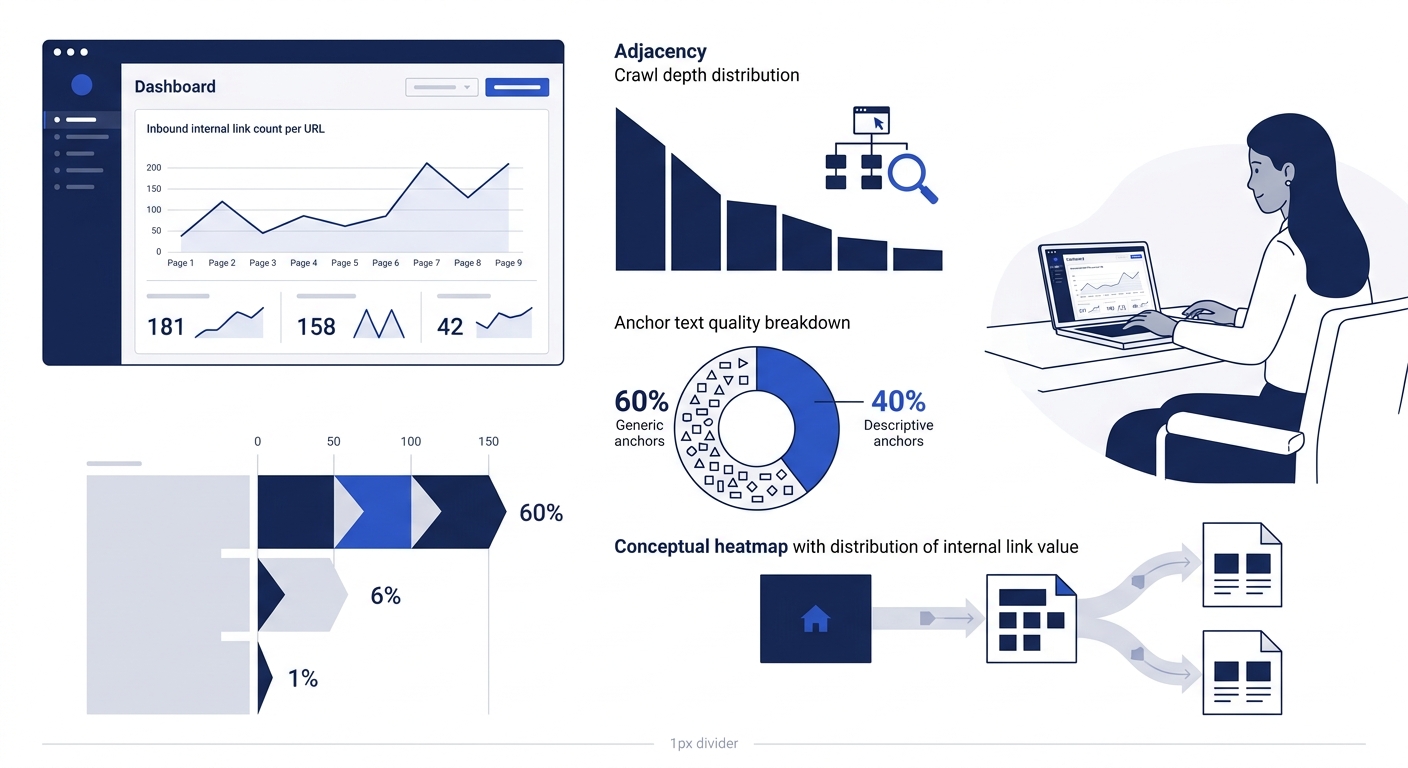
Carreras’s team ran an internal link audit that mapped every URL’s inbound internal link count, its crawl depth from the homepage, and its topical relationship to the pillar categories the brand wanted to rank for. The findings confirmed what the traffic data suggested: category pages sitting at crawl depths of four or more clicks received 70 to 80% fewer internal links than category pages at depth two.
The 2026 SEO Content Clusters guide from Digital Applied frames this as a topical authority clustering problem, stating that “bidirectional linking, pillar to cluster and cluster to pillar, distributes PageRank and reinforces topical signals to crawlers.” When the audit revealed that link flow was almost entirely top-down (homepage to category, category to product) with almost no lateral or bottom-up linking, the diagnosis was clear. The site had content depth but no effective PageRank distribution through internal links connecting that depth to the pages that needed ranking strength.
The audit also uncovered anchor text problems. Across the site’s internal links, roughly 60% used generic anchors like “shop now,” “see more,” or “click here.” Best practice guidance from multiple enterprise SEO sources recommends descriptive, keyword-relevant anchor text and warns that generic anchors waste the topical signal internal links carry. Carreras noted in his published playbook that “semantic linking” requires anchors that tell both crawlers and users what the destination page covers, reinforcing the site’s topical map rather than diluting it.
If you’ve worked through aligning site structure with organic growth goals, this audit phase will feel familiar. The difference here is that the navigation-level architecture was technically sound. The failure was entirely in the contextual, in-content link layer that drives topical authority signals and ranking consolidation.
Rewiring 8,000 Links Across the Pillar-Cluster Model
The implementation followed the pillar-cluster model that has become the dominant link architecture for enterprise SEO. Each major category page became a pillar, linking down to 8 to 25 supporting cluster pages (subcategories, buying guides, comparison content) that in turn linked back up to the pillar and horizontally to each other. The brand used AI-assisted tools to identify optimal link placements at scale, prioritizing positions in the top 30% of each page’s content, where enterprise SEO research indicates links carry more weight with crawlers.
Three constraints governed the rebuild. First, crawl depth stayed at a maximum of three clicks from homepage to any indexed URL. Second, no page carried more than 150 internal links, a threshold above which authority dilution accelerates. Third, every internal link used a descriptive anchor containing a semantic variation of the destination page’s target keyword, eliminating the generic “see more” and “click here” patterns the audit had flagged.
The team rewired approximately 8,000 internal links over a 10-week sprint. The SEO Playbook from SEOBot AI provides the theoretical foundation, explaining that “topical authority is an extension of PageRank” and that ranking depends on “your authority within specific topics.” The pillar-cluster model is the structural implementation of that principle. Each cluster reinforces the pillar’s domain-level authority in its topic, and each pillar concentrates that authority into rankings for the highest-value head terms.
Info: For brands recovering from site architecture breakdowns that [erode organic revenue](/blog/enterprise-site-architecture-seo-organic-revenue), the pillar-cluster rewiring addresses the root cause rather than patching symptoms. And for teams running [authority mapping exercises to align content with revenue goals](/blog/enterprise-seo-authority-content-revenue), the internal link layer is where the map becomes operational.
150,000 Annual Visits From Zero New Pages
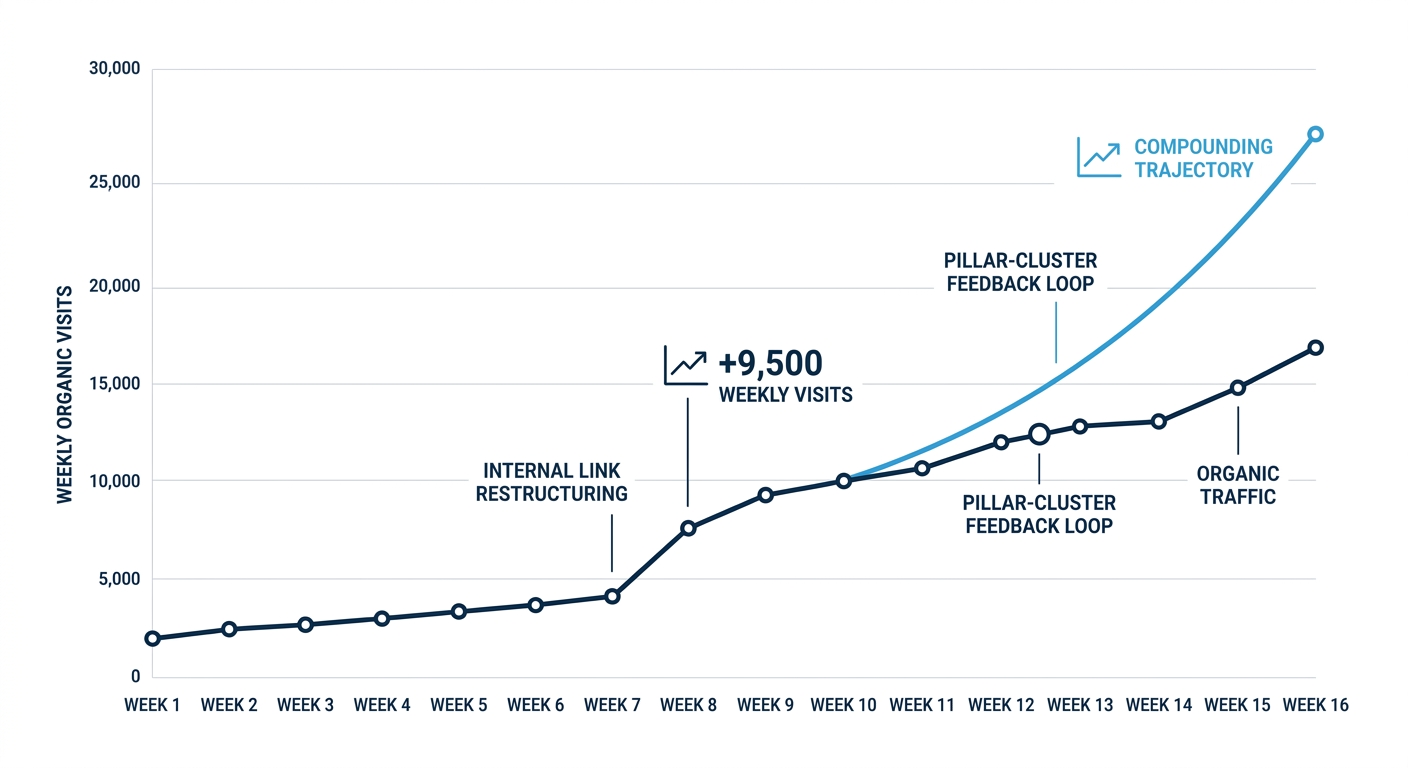
The results arrived in stages. Within eight weeks of completing the link restructuring, the retail site recorded 9,500 additional organic visits per week, translating to approximately 150,000 incremental annual visits. Deeper category pages, the ones that had been starved of authority in the flat link graph, saw a 24% traffic increase. A separate marketplace client that Carreras documented applied the same geographic clustering approach to city-level landing pages and achieved a 100% increase in discovered keywords, meaning Google recognized and indexed terms the site had never ranked for despite having relevant content live for months.
A third enterprise case from the same research saw a 23% traffic increase by redistributing internal links specifically to products that had previously ranked well but lost visibility as the site grew and diluted their inbound link count. The pattern across all three cases is consistent: the link architecture, not the content production calendar, was the binding constraint on link architecture organic growth.
The link architecture, not the content production calendar, was the binding constraint on organic growth across all three enterprise cases.
The broader data reinforces these case-level findings. Enterprise brands implementing structured internal linking strategies report 40 to 80% growth in organic sessions, according to 2026 enterprise SEO study compilations. Organic traffic growth, as ClusterMagic AI’s research documents, “compounds when content, authority, and internal linking reinforce each other.” The word “compounds” is precise here, because the pillar-cluster model creates a feedback loop: as the pillar ranks higher, it attracts more external backlinks, those backlinks flow through internal links to cluster pages, cluster pages rank higher and send more engagement signals back to the pillar. That feedback loop is what separates a one-time traffic bump from sustained, multi-quarter growth.
The Architecture That Survived the May 2026 Core Update
Google confirmed its May 2026 core update complete after a 12-day volatile rollout. Sites that had been publishing high-volume content without structural linking saw significant ranking erosion, a pattern consistent with Google’s increasing preference for what IdeaMagix’s 2026 SEO guide calls “a clearly structured ecosystem” where “brands that implement structured internal linking strategies see higher rankings, deeper indexing, stronger authority, and measurable revenue growth.”
The retail site in Carreras’s case study held its gains through the update. The reason is structural: a well-built pillar-cluster architecture aligns with how Google’s systems evaluate topical authority. Entity-first SEO, as Search Engine Land’s guide on Knowledge Graph alignment explains, works by “building a mini Knowledge Graph where each node (page) reinforces your overall topical authority” through internal links, schema relationships, and contextual connections. The pillar-cluster model is the internal linking expression of that entity graph.
For marketing leaders evaluating whether to invest in link architecture improvements versus producing more content, the Carreras case offers a direct comparison. The retail brand’s 150,000 annual visit increase came from reorganizing existing pages, not from the multi-month editorial calendar and production cost that new content requires. When content volume alone has started degrading enterprise SEO performance in an era where AI retrieval systems prioritize semantic consolidation over page count, the link architecture becomes the higher-return investment.
The compounding effect also extends into AI search surfaces. InNoPulse’s Knowledge Graph optimization research recommends connecting “service to case studies to team to methodology to proof” through internal links, a chain that helps generative AI features lift and synthesize brand information. As AI Overviews and answer engines extract content from well-structured sites, the internal linking layer determines which pages surface and how confidently the AI system attributes authority to the brand. And if you’re already rebuilding crawl efficiency through a prioritization audit, layering the pillar-cluster link model onto that work multiplies the return on both investments.
Every SEO practitioner knows internal linking matters. The Carreras case demonstrates something more specific: a disciplined internal linking strategy at enterprise SEO scale, one that enforces crawl depth limits, descriptive anchors, bidirectional pillar-cluster connections, and systematic PageRank distribution through internal links, produces compounding link architecture organic growth that holds through algorithm volatility. It holds because it aligns with the structural signals Google’s systems are built to reward, not because it games them.