Answer Engine Optimization for Enterprise B2B: Building Content Authority Beyond Google Rankings
ChatGPT, Perplexity, and Gemini now send measurable pipeline to enterprise B2B websites. Data from 312 B2B technology firms shows AI-referred visitors convert at 14.2% — roughly 5x the 2.8% rate of traditional Google organic traffic. Three distinct approaches have emerged for answer engine optimization (AEO), and each demands different investment, timeline, and technical depth.
TL;DR: Enterprise B2B SEO strategy in 2026 requires AI search visibility beyond Google. The three paths — structural extractability, evidentiary credibility, and semantic content architecture — differ sharply in setup cost and defensibility. Most brands need a weighted combination, but the starting point depends on current content maturity.
Where Enterprise B2B AEO Diverges From Consumer Search
B2B buying committees don’t ask AI for product recommendations the way consumers do. They ask for definitions, framework comparisons, vendor evaluations, and regulatory context. If your content doesn’t surface in those responses, you lose influence at the earliest stage of a long sales cycle. As HubSpot’s B2B AEO analysis found, “if their expertise isn’t surfaced, summarized, or cited by answer engines, they risk disappearing from the earliest — and most influential — stages of the buying journey.”
The scale of the shift is hard to overstate. Referral visits from AI platforms increased 357% year-over-year as of June 2025, according to Brosch Digital’s aggregated traffic data. By January 2026, AI traffic had grown to 6.4% of total sessions, up from less than 1% twelve months prior. And AI referrals contributed 19% of qualified inbound pipeline for the firms tracked in the 312-company study.
But here’s the tension: 92% of pages cited in AI Overviews already rank in Google’s top 10 organic results. Traditional SEO still serves as the foundation. The question is what you build on top of it.
We’ve covered this dynamic before in our breakdown of rebuilding enterprise strategy for post-search visibility, and in our analysis of how trust graph architecture builds discoverability beyond rankings. The three approaches below represent the practical choices enterprise marketing leaders face when briefing agency partners or internal teams.
Structural Extractability Through Schema and Direct Answers
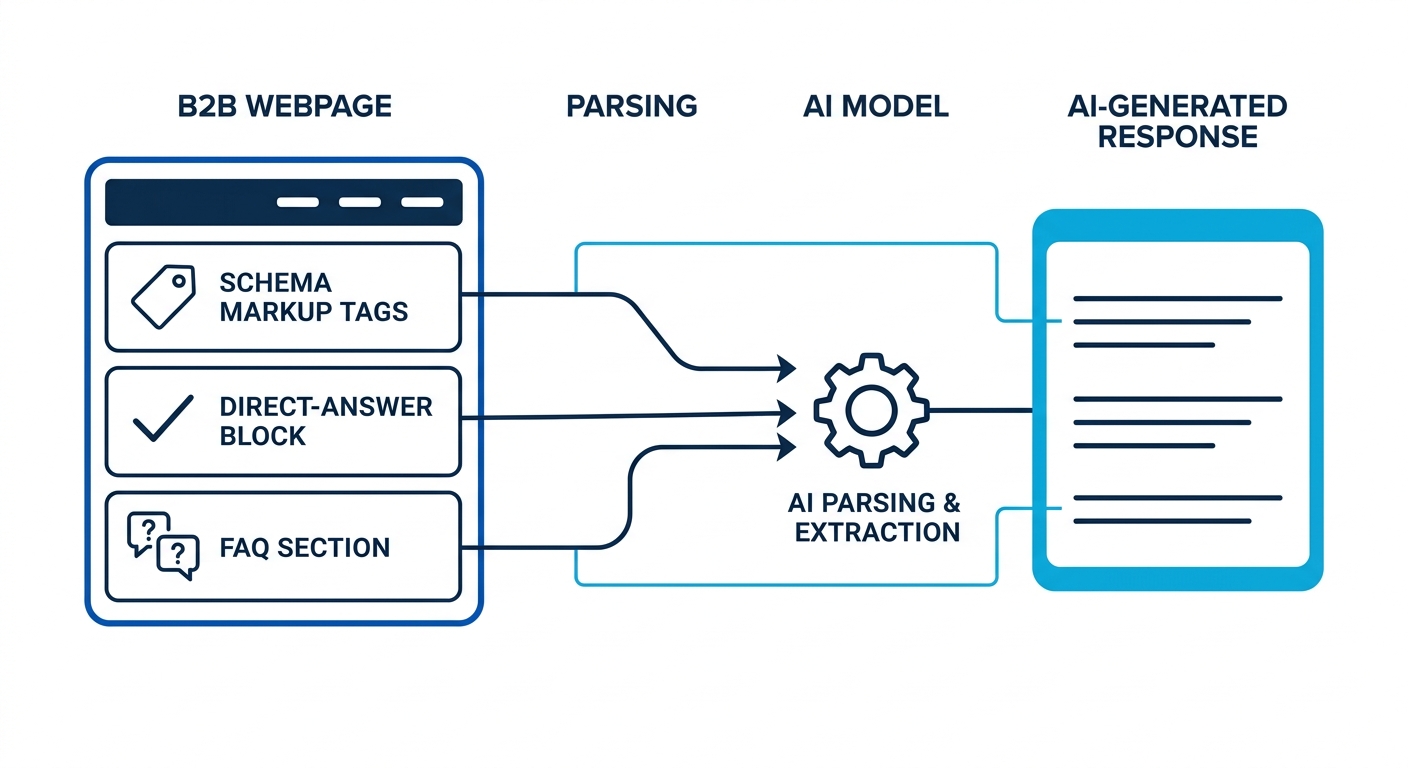
This approach focuses on making your existing content machine-readable so AI systems can parse, extract, and cite it accurately. It’s the fastest to implement and produces measurable results within weeks, but it offers the least competitive moat.
Schema markup for AI agents is the backbone. As NP Group’s analysis explains, schema markup is “a form of structured data that helps search engines and AI systems understand the content of a website.” It was launched by Google, Bing, Yahoo!, and Yandex in 2011 as part of Schema.org, and it remains the primary way machines interpret page-level meaning.
For B2B enterprises, the highest-impact schema types include Organization (company details and authority signals), FAQPage (question-answer pairs that AI systems extract directly), HowTo (process documentation), and Article with author and datePublished attributes. According to Stackmatix’s 2026 structured data guide, different schema types drive different levels of AI citation impact, with FAQPage and HowTo delivering the strongest extraction rates for informational queries.
The validation step matters. As the Webyes structured data guide puts it, “Go to Schema Markup Validator and enter your URL or snippet. It parses your page the way a machine does and flags issues. If it can’t find your markup, an AI agent won’t find it either.” Brands that skip validation often discover their schema is malformed or invisible to crawlers after months of wasted effort.
Beyond schema, structural extractability means formatting content for direct extraction. Place 40-60 word direct answers immediately after question-based headings. AI systems pull from these answer blocks preferentially. Brands not cited in AI responses suffer a 58% reduction in organic click-through rates for position-one content. Those earning citations see 35% more organic clicks and 91% more paid clicks, because AI mentions function as a trust signal that amplifies performance across channels.
The tradeoff is clear: structural extractability is table stakes. Your competitors can replicate your schema implementation in a sprint. It creates visibility, but it doesn’t create defensibility. If your site architecture already leaks value through hidden debt, schema won’t compensate for deeper structural problems.
How Evidentiary Credibility Earns AI Citations
Evidentiary credibility operates on a different principle. Instead of making content easier to parse, it makes content harder to ignore. AI models assign higher confidence to content that carries expert attribution, specific data, and inline citations. The GEO research from Princeton and Georgia Tech measured these effects precisely: adding expert quotes delivers a 41% visibility lift, clear statistics add a 30% lift, and inline source citations produce another 30% lift.
For enterprise B2B, this translates into a specific content production standard. Every whitepaper, solution page, and thought leadership article should carry named-expert attribution, verifiable data points, and links to primary sources. The Demand Gen Report’s AEO coverage reinforces this: “Understanding AI bot traffic on the site, looking at responses on the answer engines to see if there are any that could be influenced, and studying the effect of answer engines on the customer journey are all important inputs to a good AEO strategy.”
The production workflow changes significantly. Content teams need access to subject matter experts willing to be quoted by name and title. They need data sources that can be cited with specific numbers, not rounded approximations. And they need editorial processes that fact-check every claim before publication, because AI platforms cross-reference assertions against external signals. Inflated or inconsistent claims damage trust scores across AI systems, as the Stackmatix schema guide documents for review data.
AI models assign higher confidence to content that carries expert attribution, specific data, and inline citations — and the measured lifts are 41%, 30%, and 30% respectively.
This approach takes longer to implement than schema markup. Building a library of expert-attributed, data-dense content requires months of coordinated production. But it compounds over time. AI systems develop entity-level trust, and once your brand becomes a preferred source for a topic, displacement requires a competitor to out-credential you — not just out-format you.
The risk: evidentiary credibility depends on publishing velocity and expert access. Enterprise brands with deep bench strength (internal researchers, named executives willing to publish) have a structural advantage here. Brands that rely on ghostwritten content from generalist writers will struggle, which is why human creative oversight remains critical for differentiation even as AI content generation costs drop toward zero.
Semantic Architecture as the Long-Term Defensible Play
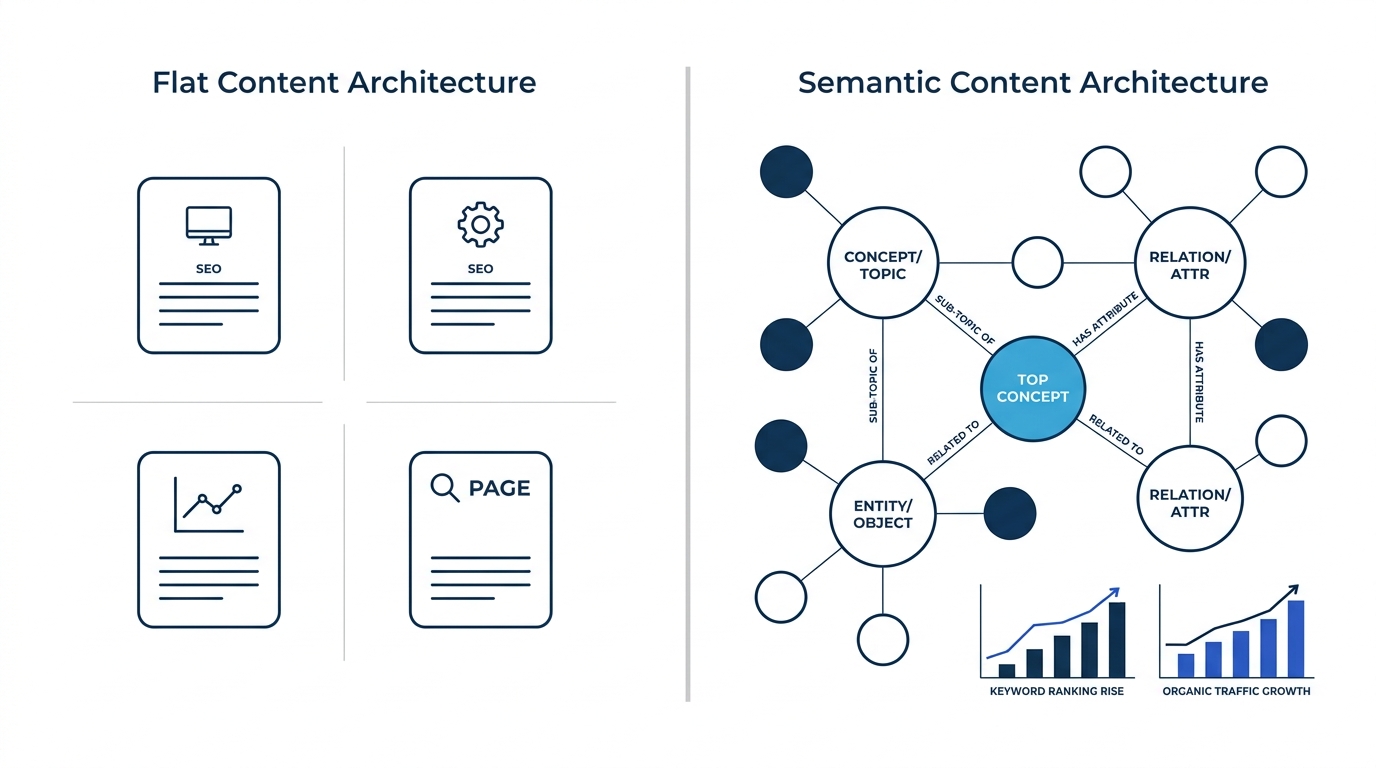
Semantic content architecture is the slowest to build and the hardest to replicate. It involves organizing your entire content library around a structured knowledge graph — interconnected topics, entities, and relationships that AI systems can traverse as a unified body of expertise rather than a collection of isolated pages.
Enterprise Knowledge defines a semantic architecture as a system where a semantic layer “holds all required metadata from all involved enterprise systems and stakeholders to facilitate communication, planning and coordination.” In scaled enterprise implementations, this typically includes a graph database for storing knowledge relationships, a taxonomy management layer, and text analytics for applying metadata consistently across content management systems.
For B2B marketers, the practical translation involves three things. First, mapping your content to an explicit topic taxonomy where every page connects to defined parent topics, sibling topics, and supporting entities. Second, maintaining entity consistency across your website, LinkedIn presence, Google Business Profile, and industry directories. AI systems lose confidence when business details, value propositions, or expertise claims conflict across platforms. Third, consolidating thin or overlapping content into authoritative hub pages — a principle we’ve explored in detail through the lens of why publishing more pages kills enterprise rankings.
The measured impact is significant. AI search platforms don’t rank pages the way Google does. They build confidence in entities — organizations, people, concepts — and draw from whichever sources reinforce that confidence most consistently. A semantic architecture tells AI systems, “This organization has deep, structured, internally consistent knowledge about these specific topics.” That signal is expensive to manufacture and extremely difficult for competitors to copy quickly.
The Spot’s coverage of AI answer engine optimization reinforces the prioritization logic: “By identifying where you are missing from the conversation, you can prioritize your optimization efforts for the greatest immediate impact.” The gap analysis itself requires understanding which topics your brand should own, which it currently surfaces for, and where competitors are being cited instead.
The tradeoff: semantic architecture demands cross-functional coordination between content, SEO, product marketing, and IT. Implementation timelines stretch across quarters, not weeks. And the ROI is difficult to measure in the short term because AI citation metrics are still maturing. Brands that want a search everywhere strategy beyond Google rankings will find that semantic architecture is the layer that makes all other AEO work compound faster.
Who Should Pick Which
The honest answer is that most enterprise B2B brands need all three. But resource constraints force sequencing decisions, and starting in the wrong place wastes budget.
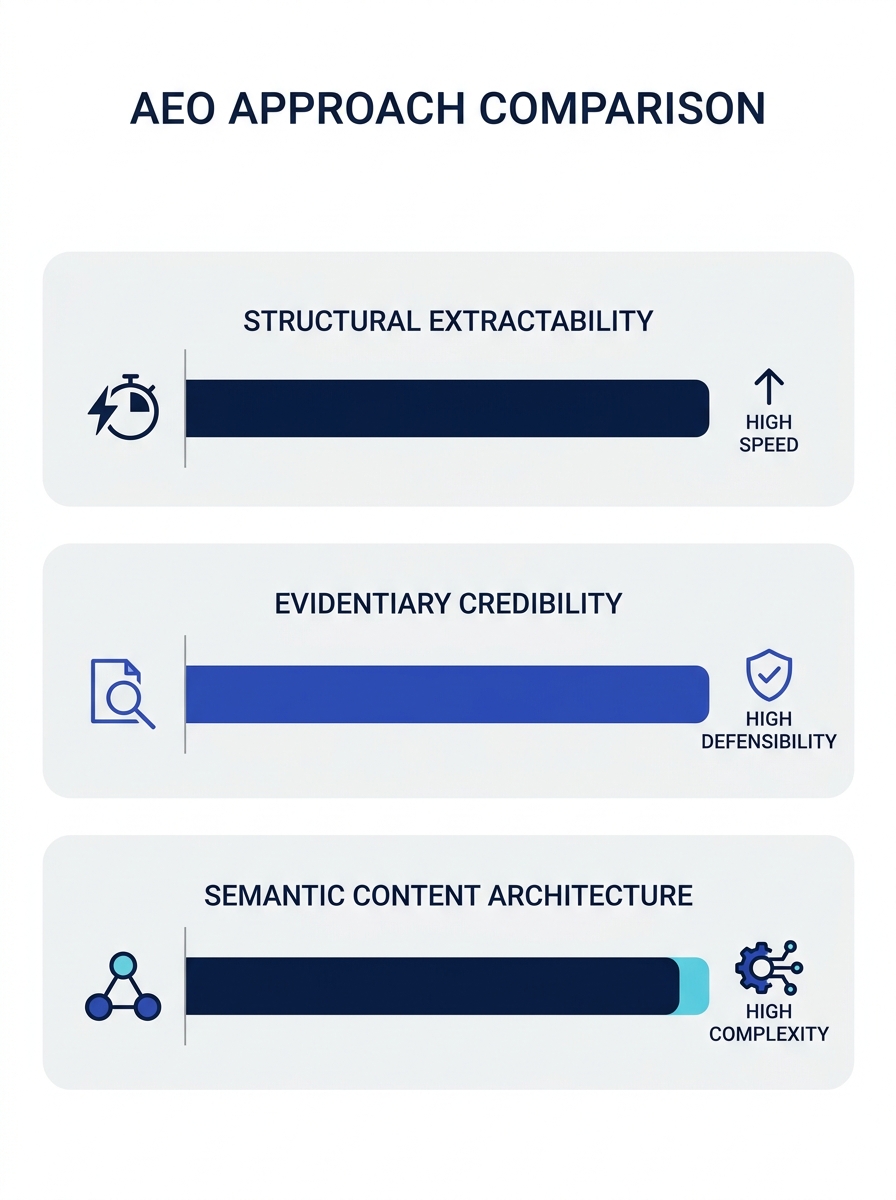
| Attribute | Structural Extractability | Evidentiary Credibility | Semantic Architecture |
|---|---|---|---|
| Time to first impact | 2-4 weeks | 2-4 months | 6-12 months |
| Technical complexity | Low to moderate | Low (editorial process change) | High (requires taxonomy + graph) |
| Competitive defensibility | Weak — easily replicated | Moderate — depends on expert access | Strong — expensive to copy |
| Best fit | Brands with existing ranked content but low AI citation rates | Brands with subject matter experts and data assets | Brands building long-term topical authority in defined verticals |
| Primary risk | Becomes commodity quickly | Requires sustained expert participation | Long payback period, cross-team coordination |
If your content already ranks in Google’s top 10 for your core terms, start with structural extractability. You already have the raw material. Schema markup and direct-answer formatting will make that content visible to AI systems within weeks. Layer evidentiary credibility into your editorial standards simultaneously.
If you’re building a new content program or entering a topic area where you lack ranked pages, lead with semantic architecture. Define the topic graph first. Build content into that structure from the start. This avoids the architectural debt that drains organic visibility and forces expensive retroactive cleanup later.
Tip: Ask your agency partner to run an AI citation gap analysis before choosing a starting approach. Tools like HubSpot AEO now show where your brand surfaces across ChatGPT, Perplexity, and Gemini compared to competitors. The gaps tell you whether your problem is extractability, credibility, or topical coverage.
And regardless of which path you lead with, the monitoring infrastructure needs to change. Traditional rank trackers measure Google positions. AI citation tracking requires a separate layer that monitors mention frequency, citation accuracy, and share of voice across AI response surfaces. Brands running an enterprise B2B SEO strategy in 2026 without this dual measurement approach are flying with instruments that show half the airspace.
The enterprise brands pulling ahead right now aren’t choosing between Google and AI search. They’re building content systems that perform across both — structured enough for machines to parse, credible enough for AI to cite, and architecturally deep enough that the competitive gap widens with every piece they publish.