Sponsored Google Ads: Complete Guide

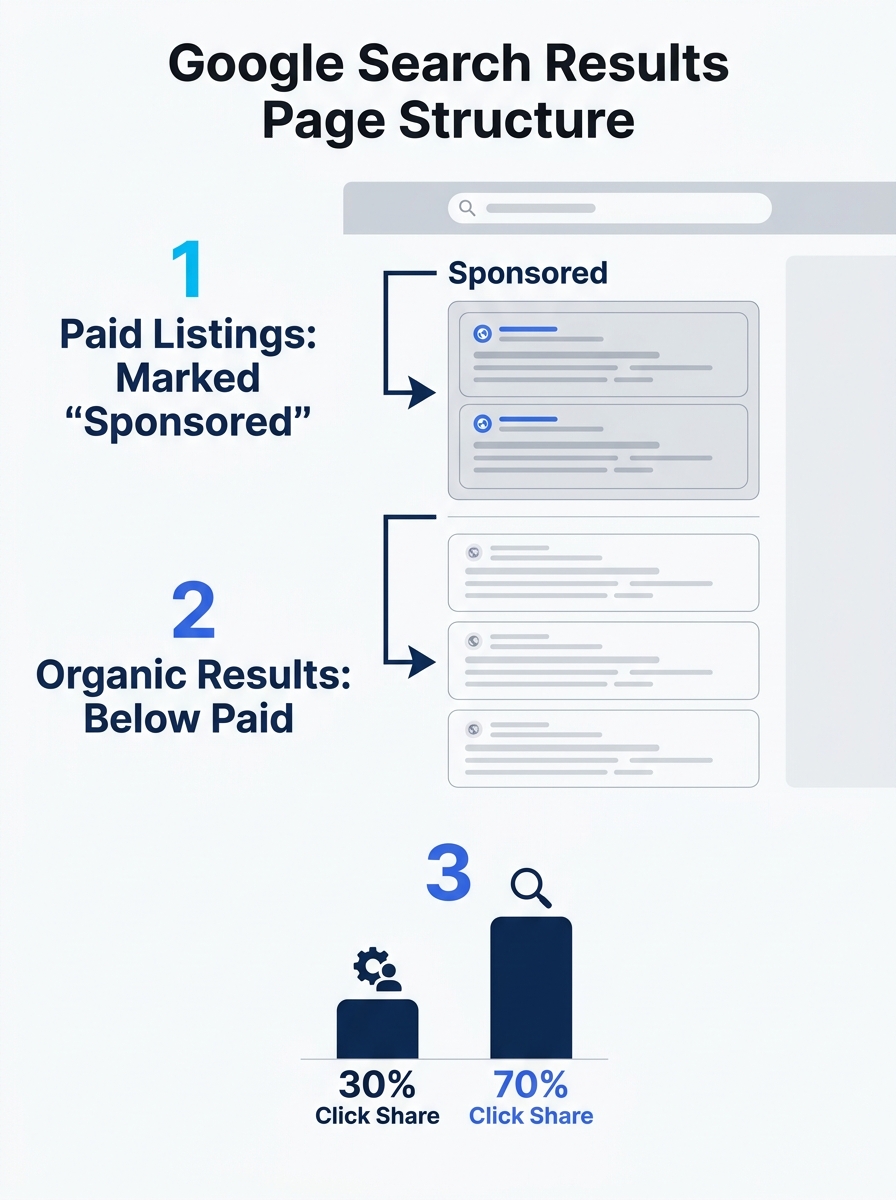
Sponsored Google ads are paid listings that appear above and below organic results, marked with a bold “Sponsored” label, generated through a real-time auction that runs every time someone types a query. The label replaced the older “Ad” tag in 2024, but the underlying mechanism, an auction combining bid amount, ad quality, and expected impact, has governed ad placement since Google AdWords launched in 2000.
TL;DR: Google determines which sponsored ads appear, and in what order, through a three-part auction: your maximum bid, your Quality Score (a 1–10 rating of ad relevance, landing page experience, and expected click-through rate), and the resulting Ad Rank calculation. A higher Quality Score can win a better position at a lower cost per click than a competitor who simply bids more.
What “Sponsored” Means on a Google Results Page
The “Sponsored” label on Google identifies a listing that an advertiser paid to place through Google Ads. The label carries regulatory weight: the U.S. Federal Trade Commission and equivalent regulators worldwide require search engines to visually distinguish paid placements from organic results. Google’s compliance has evolved, from colored background shading in the early 2000s, to a small green “Ad” badge, to the current bold “Sponsored” text that sits above the listing URL.
Google Ads operates on a pay-per-click model, meaning advertisers are charged only when someone clicks their ad. No click, no charge. This makes sponsored ads fundamentally different from traditional brand advertising where you pay for exposure regardless of engagement.
Advertisers bid on keywords, the search terms they want their ads to match, write ad copy, and set daily budgets. But the bid alone doesn’t determine who wins the top position. That’s where the auction gets interesting and where most misunderstanding begins.
The Real-Time Auction Behind Every Search
Every Google search triggers an instantaneous auction among advertisers whose keywords match that query. The auction completes in milliseconds. By the time the results page loads, winners have been selected, ranked, and slotted into position.
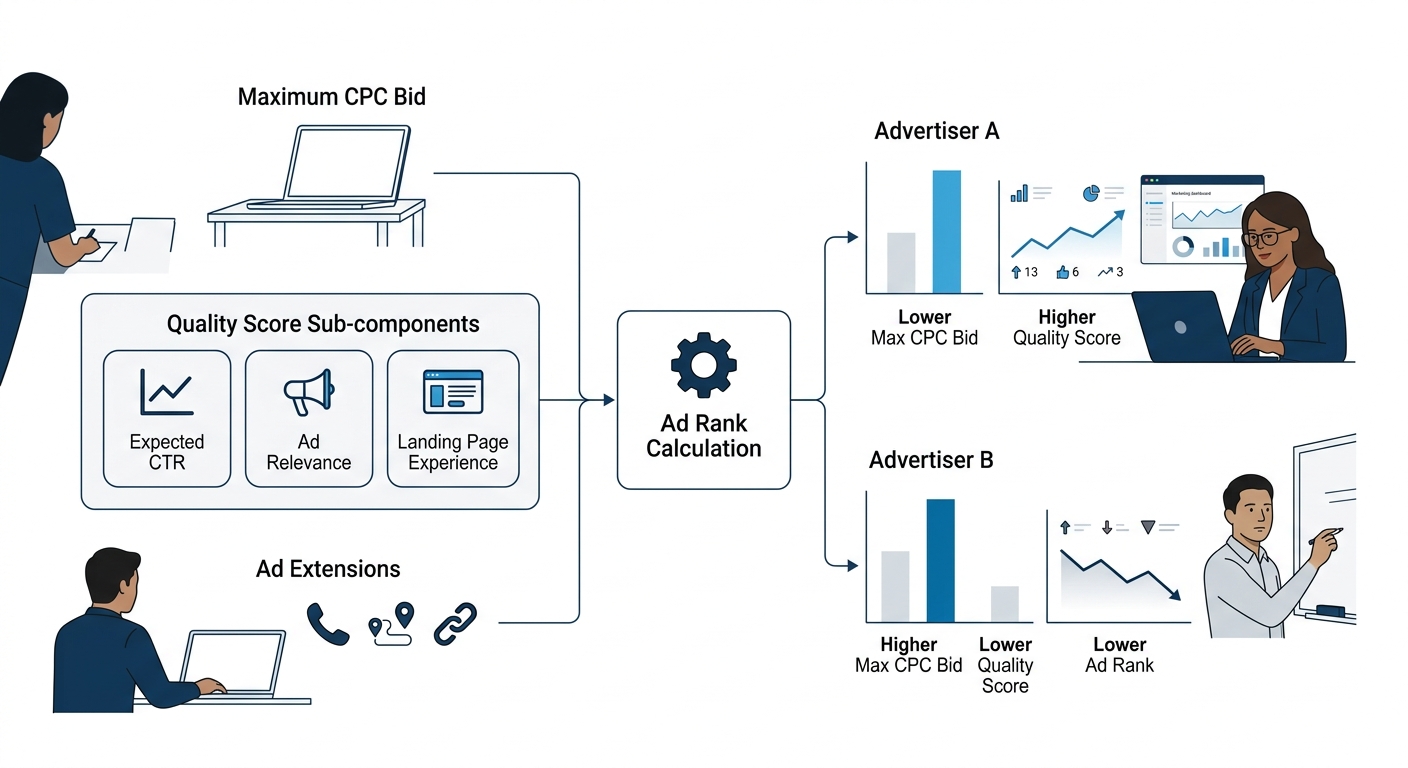
The auction evaluates three inputs for each competing advertiser:
Maximum CPC bid is the highest amount an advertiser is willing to pay for a single click. This is a ceiling, not the actual price paid. Google uses a second-price auction model: you pay just enough to outrank the advertiser below you, not your full bid.
Quality Score is Google’s 1-to-10 rating of how relevant and useful your ad and landing page are to the person searching. It’s built from three sub-components: expected click-through rate, ad relevance (how closely your ad copy matches the intent behind the query), and landing page experience (how useful and fast the destination page is after the click).
Ad extensions and format impact represent Google’s estimate of how much your sitelinks, callouts, structured snippets, and other extensions will improve performance.
These inputs combine into a single number: Ad Rank. The simplified formula: Ad Rank = Maximum CPC Bid × Quality Score. (Google’s actual calculation folds in contextual signals like device, location, time of day, and competitive dynamics.) The advertiser with the highest Ad Rank gets position one.
The critical insight: an advertiser with a lower bid can outrank a higher bidder by having a better Quality Score. Google has a financial incentive to reward relevance. A relevant ad gets clicked more often, generating more revenue per impression for Google than a high-bid ad that users scroll past. This is where understanding your core marketing fundamentals, positioning, messaging, audience alignment, directly shapes paid search outcomes.
Quality Score: The Mechanism That Rewards Relevance Over Budget
Quality Score is the single most misunderstood element of sponsored Google ads. Many advertisers check it once and ignore it. It is the primary mechanism through which Google controls ad quality while maximizing its own revenue.
A score of 1 means Google considers your ad barely relevant to the keyword. A score of 10 signals strong alignment between keyword, ad copy, and landing page. The practical impact is real: an advertiser with a Quality Score of 8 and a moderate bid consistently outranks an advertiser with a Quality Score of 3 and an aggressive bid. Here’s how the three sub-components work:
Expected click-through rate draws on historical performance data. If your ad for “accounting software Philippines” has earned a strong CTR in past auctions, Google predicts it will continue performing well for similar queries. New advertisers get estimated CTRs based on account history and industry averages.
Ad relevance measures how directly your ad copy addresses the searcher’s query. If someone searches “enterprise payroll system” and your ad talks about “small business bookkeeping,” your relevance score drops, even if you bid on the keyword.
Landing page experience evaluates what happens after the click. Google’s systems assess page load speed, mobile-friendliness, the presence of original content related to the ad’s promise, and navigation clarity. As PPC strategists at HawkSEM advise, optimization should start with “a high-level audit or check of your campaign-level settings, double-checking your conversion tracking, and making sure that you have the ideal bidding strategy selected for your particular objectives.” A landing page that aligns tightly with your ad copy strengthens Quality Score; a generic homepage that ignores the searcher’s intent weakens it.
For marketing leaders reviewing agency-managed campaigns: ask about Quality Score trends at the keyword level during reporting. A declining Quality Score often signals a disconnect between the keywords being targeted, the ad copy being served, and the landing page, a problem more budget won’t solve.
Search Ads vs. Display Ads: Two Different Machines
Sponsored ads on Google run through two fundamentally different delivery systems. Confusing them leads to misallocated spend.
The core distinction, as Informatics Inc. describes it, is the difference between “push” and “pull” advertising. Search ads are pull: they respond to demand someone has already expressed through a query. Display ads are push: they interrupt someone browsing a website, watching YouTube, or using an app, with no active search intent behind the impression.
| Attribute | Search Ads | Display Ads |
|---|---|---|
| Trigger | User’s search query (active intent) | Browsing behavior, demographics, or interests (passive) |
| Format | Text-based, resembles organic listings | Visual banners, responsive images, video |
| Placement | Google search results pages | Google Display Network: 2M+ websites, apps, YouTube |
| Typical CTR | Higher (users are actively searching) | Lower (users aren’t looking for your product) |
| Primary use | Capturing existing demand, driving conversions | Building awareness, retargeting past visitors |
| Auction factor | Keyword bid + Quality Score | Audience targeting + bid + ad creative quality |
For Philippine brands working with an agency, this distinction matters when reviewing media plans. If your agency proposes allocating significant budget to Display without a clear awareness or retargeting objective, that’s worth questioning. Display campaigns targeting cold audiences for direct conversions typically underperform search campaigns against the same budget because the intent signal isn’t there.
An advertiser with a lower bid can outrank a higher bidder by having a better Quality Score. Google rewards relevance because relevant ads get clicked more, generating more revenue per impression.
How AI Max and Smart Bidding Reshaped the Auction
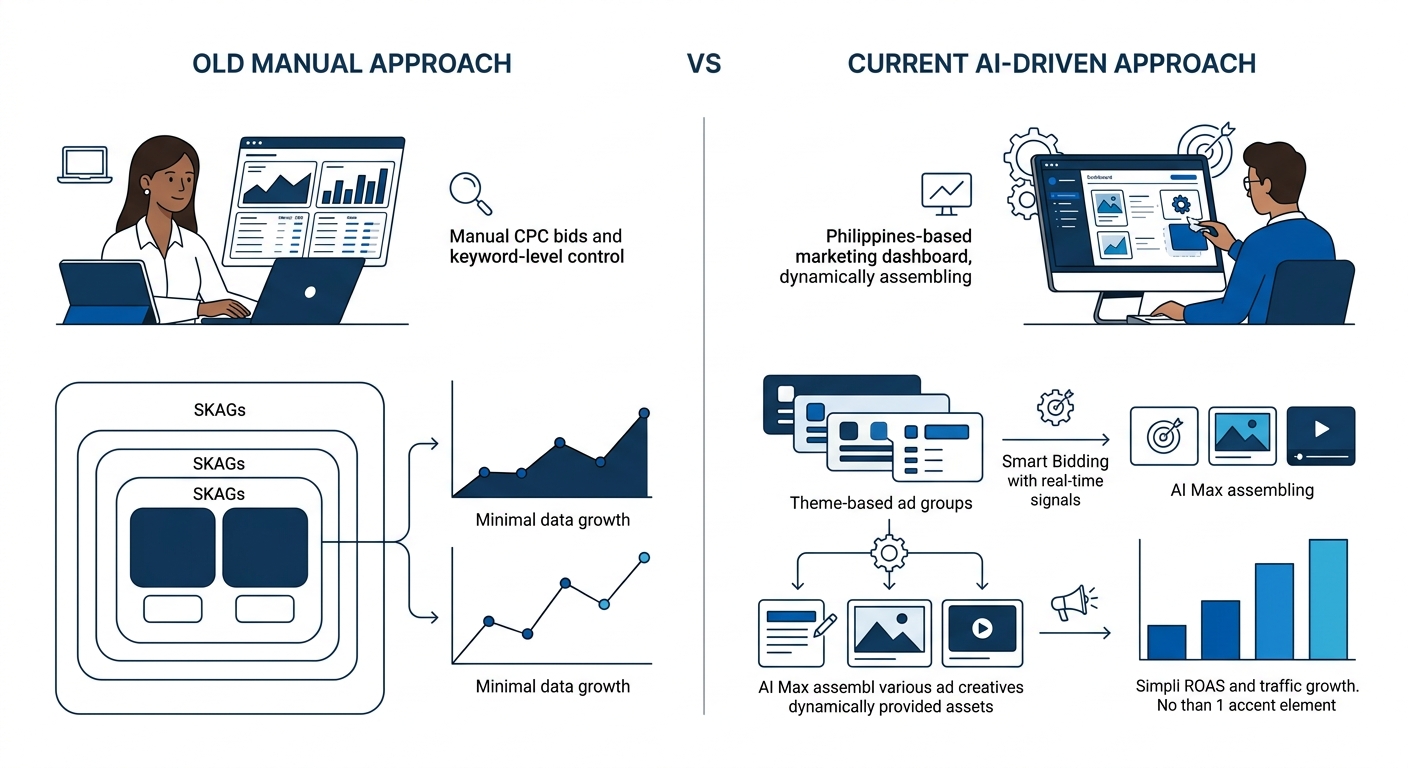
Google’s rollout of AI Max and the maturation of Performance Max (PMax) campaigns have shifted sponsored Google ads from manual keyword-by-keyword control toward algorithm-driven optimization. The auction mechanism underneath remains the same. What’s changed is how advertisers interact with it.
Single Keyword Ad Groups (SKAGs) are obsolete. The practice of isolating individual keywords into their own ad groups, once standard best practice, starves Google’s machine learning algorithms of the data volume they need to optimize bidding. The current standard is theme-based campaigns with consolidated ad groups of 5–15 keywords, giving Smart Bidding enough signal to learn effectively.
Smart Bidding dominates over manual CPC. Manual CPC bidding ignores real-time auction signals like device type, geographic location, time of day, and browsing history, signals Google’s algorithms evaluate in every single auction. The recommended approach: launch with Maximize Conversions for two to four weeks to establish a learning baseline, then layer in target CPA or target ROAS constraints.
PMax now offers genuine transparency. Performance Max campaigns, which automate ad placement across Search, Display, YouTube, Gmail, and Discover, were criticized as a “black box” at launch. Google has since added asset-level performance visibility, clearer placement reporting including Search Partners breakdowns, and built-in support for creative A/B testing.
AI Max handles keyword matching and ad assembly. Success under AI Max depends on providing strong creative inputs, filling all 15 headline slots and 4 description slots with independently strong copy, and feeding the system accurate conversion data. The algorithm optimizes asset combinations, but the raw material has to be good.
For marketing leaders evaluating how an agency manages their Google Ads, the practical question has shifted. Instead of “which keywords are you bidding on?” the more useful question is “what conversion data are you feeding the algorithm, and how are you structuring creative inputs?” This is where the connection between your content strategy and production and paid media performance becomes concrete. The quality of landing pages, ad copy, and creative assets directly shapes algorithmic outcomes.
Where the Auction Model Breaks Down
The Google Ads auction is elegant in theory. In practice, several boundary conditions produce counterintuitive results that marketing leaders should understand before increasing investment.
Competitive saturation in narrow verticals. When a dozen advertisers bid aggressively on the same high-intent keywords in a small market, “condo for sale BGC” or “corporate lawyer Makati”, cost per click escalates quickly regardless of Quality Score. According to SHOPLINE’s 2026 pricing breakdown, individual CPCs range from under a dollar to over six dollars depending on vertical, and categories like legal services, insurance, and real estate sit consistently at the high end. In these concentrated markets, the auction can stop rewarding relevance and start rewarding budget endurance.
Conversion tracking gaps corrupt Smart Bidding. Smart Bidding optimizes toward conversions. If your tracking is incomplete, capturing form submissions but missing phone calls, or counting pageviews as conversions, the algorithm optimizes toward the wrong signals. Server-side tagging with enhanced conversions and offline conversion imports are baseline requirements. When performing analytics for your business, verifying that every meaningful conversion action feeds back into Google Ads is the first audit step.
The learning phase punishes impatience. Whenever a campaign launches or undergoes significant changes (new bid strategy, restructured ad groups, changed conversion actions), Google enters a learning phase where performance fluctuates as the algorithm gathers data. Making daily tactical tweaks resets this phase repeatedly. The recommended cadence: daily monitoring for spend anomalies, weekly negative keyword reviews, bi-weekly strategic bid adjustments, and monthly deep dives into account structure.
Brand cannibalization is real. Running sponsored ads on your own brand terms captures clicks you would have received organically for free. The counterargument, that competitors will bid on your brand terms if you don’t defend them, holds in some verticals but is overstated in others. Whether branded search campaigns represent protective spending or wasted budget depends entirely on competitive dynamics you can measure.
AI Overviews compress available ad inventory. As Google expands AI-generated answer boxes at the top of search results, the visible space for both organic and sponsored listings shrinks. Brands investing in an enterprise SEO program alongside paid campaigns maintain a dual path to visibility, but click-through dynamics across both channels are shifting. Understanding how AI search citations work is becoming relevant even for paid media planning as the results page evolves.
Warning: Data-driven attribution through GA4 is now preferred over last-click attribution for Google Ads. Last-click inflates the value of branded search and bottom-funnel campaigns while undervaluing the top-of-funnel efforts that generated demand in the first place.
Common Questions
Are sponsored Google ads the same thing as Google Ads?
Yes. “Sponsored” is the label Google displays on search results to identify paid listings. Google Ads is the platform advertisers use to create and manage those listings. When someone refers to “sponsored ads Google shows at the top of search,” they’re describing the output of a Google Ads campaign.
Does a higher bid guarantee the top position?
No. Google calculates Ad Rank from your bid, Quality Score, and expected extension impact. An advertiser with a lower bid but a significantly higher Quality Score will regularly outrank a bigger spender. The auction rewards relevance, not budget size alone.
How is the actual cost per click calculated?
Google’s second-price auction means you pay the minimum amount necessary to maintain your Ad Rank above the advertiser ranked below you. If you bid five units and only need three to hold your position, you pay slightly above three.
Do sponsored ads affect organic rankings?
No. Google has maintained since the early days of AdWords that paid campaigns have no influence on organic rankings. They’re separate systems. But the keyword and audience data you collect from paid campaigns can inform organic strategy and editorial content services by revealing which terms and messages actually convert.
What’s the difference between sponsored search ads and Shopping ads?
Shopping ads, the product listings with images and prices at the top of product queries, are a specific format within Google Ads. They’re driven by your product feed in Google Merchant Center rather than keyword bids and carry the same “Sponsored” label, but the auction weighs product data quality (title, description, images, pricing) more heavily than traditional keyword-based Quality Score.