Meta and Google Deploy AI Campaign Automation as Advertising Platforms Shift Manual Tasks to Algorithmic Systems

Automation across Meta and Google advertising platforms now handles campaign setup, bid optimization, and creative asset generation, but marketing leaders must supply higher-quality conversion data and strategic inputs to maintain performance, according to platform analysis published by IUS Digital Solutions on August 16.
TL;DR: Meta and Google deployed AI-powered capabilities across campaign creation, attribution, search automation, and creative generation in 2026, reducing manual management while increasing the importance of data quality and strategic direction from advertisers.
Both platforms introduced machine-learning systems designed to automate tasks previously managed by practitioners—selecting audiences, adjusting bids in real time, testing creative combinations, and interpreting user intent from search queries. The shift transfers optimization responsibility from human operators to platform algorithms while requiring marketers to provide clearer business objectives, conversion signals, and creative inputs that automated systems can interpret.
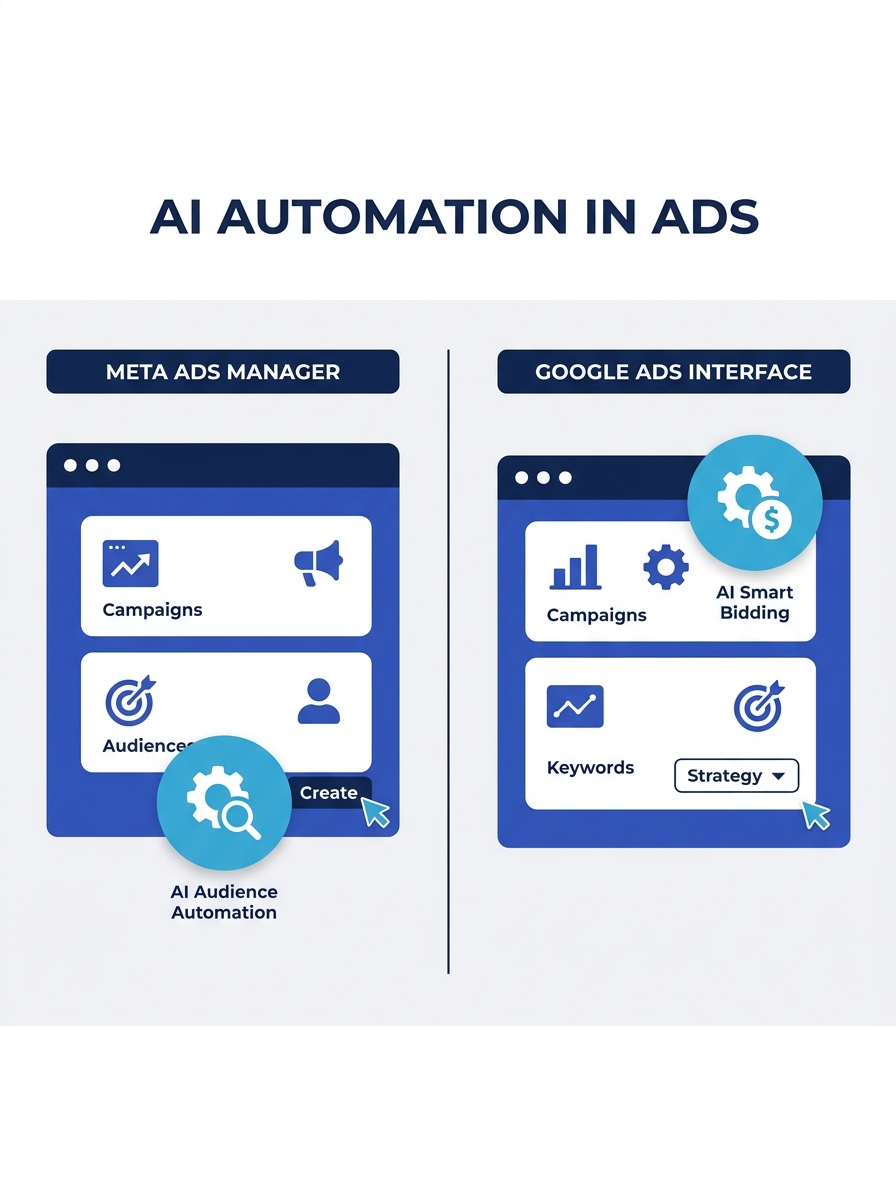
The changes affect how marketing leaders brief agencies, what deliverables they should expect, and which measurement frameworks will accurately track performance when platforms control more of the execution layer.
Meta Campaign Setup Uses Historical Account Data to Guide Configuration
Meta introduced personalized campaign recommendations that analyze previous account performance to suggest objectives, settings, and optimization approaches, according to the IUS analysis. The system draws on historical conversion patterns, audience engagement data, and campaign results to propose configurations aligned with past success patterns.
Small and mid-sized advertisers benefit from automated guidance when internal teams lack dedicated performance-marketing specialists. Enterprise brands, however, should validate platform recommendations against profit margins, customer acquisition cost targets, and customer lifetime value before implementation. Meta’s algorithms identify which campaign structures generate higher conversion volume but do not automatically prioritize the conversions most valuable to the business model.
Marketing directors overseeing agency partners should require testing protocols that compare automated recommendations against current performance baselines before full deployment.
Attribution Models Expand Beyond Last-Click to Multi-Touch Incrementality
Meta refined attribution measurement to account for customer journeys spanning multiple touchpoints and channels, moving beyond models that assign disproportionate credit to final interactions. A typical conversion path may begin with a Meta campaign, continue through organic content consumption and website visits, include a branded Google search, and conclude with a paid-search click—traditional last-click attribution overlooks the awareness and consideration stages.
The platform’s incrementality-focused measurement attempts to isolate advertising’s actual contribution to conversions by comparing exposed and unexposed user groups. Marketing leaders should avoid relying exclusively on platform-reported metrics. Combining Meta campaign data with Google Analytics 4, CRM records, qualified-lead tracking, and sales outcomes provides more accurate performance views.
This measurement approach matters most for B2B services and high-consideration products where customer journeys extend across weeks and multiple brand interactions.
Google Search Campaigns Use AI Max to Interpret Broader Contextual Signals
Google’s AI Max capabilities expanded automated search-campaign management by using contextual signals beyond rigid keyword-to-ad matching, the analysis shows. The system evaluates search intent, user context, and landing-page relevance to determine which queries should trigger ads, which messaging variants to display, and which destination pages best match searcher needs.
Campaign performance increasingly depends on the quality of information surrounding the account. Website content structure, landing-page clarity, existing advertising assets, conversion-tracking accuracy, and account history all provide signals that help automated systems understand business offerings and customer needs. This creates operational dependencies between paid media execution and website optimization work—unclear positioning or poor on-site experience limits what algorithmic optimization can achieve.
Marketing leaders should audit website service pages, value propositions, and conversion funnels before relying on Google’s automated bidding systems, which enforce stated performance targets more strictly as of August 17.
Generative AI Scales Creative Asset Production and Testing
Both platforms deployed generative-AI tools to create, adapt, and combine advertising assets—headlines, descriptions, visual variations—reducing the manual production required to test multiple creative approaches, according to IUS. Marketers can now test broader creative ranges without proportional increases in design and copywriting resources.
The efficiency gain introduces a new risk: generative AI scales weak messaging as readily as strong messaging. Platforms require better creative inputs—value propositions, customer pain points, product benefits, testimonial language, objection handling, offer structures, and brand guidelines. Customer reviews and previous high-performing creatives provide the language that resonates with target audiences.
AI functions as a creative multiplier, not a substitute for positioning research. Marketing directors briefing social media marketing agencies should specify the strategic inputs and brand guardrails that automated creative generation must respect, particularly for enterprise brands where off-brand messaging creates reputational risk.
Google already requires AI disclosure across advertiser creative as of July 2026, adding compliance requirements for synthetically generated assets.
APAC. Implications
Marketing leaders at Philippine enterprises overseeing Meta and Google campaigns should revise agency briefs to address the changed relationship between strategic inputs and automated execution. Agencies can no longer rely on manual optimization levers that platforms have automated—the deliverable shifts to data quality, conversion-signal accuracy, creative input libraries, and testing protocols that guide algorithmic systems toward business objectives rather than platform-defined proxies.
Budget allocation decisions become more complex when attribution spans multiple touchpoints and platforms control which audiences see which creative at which bid levels. CMOs should require measurement frameworks that combine platform reporting with CRM data and sales outcomes, particularly for high-consideration purchases where the customer journey extends beyond digital channels. The prior practice of evaluating agencies solely on platform-reported ROAS no longer captures their actual contribution to pipeline and revenue.
Enterprises operating across APAC markets face an additional layer: platform automation trained on global data may misinterpret local market signals, customer behavior patterns, or cultural context. Marketing directors should establish testing cadences that validate automated recommendations against market-specific performance before scaling, and require agencies to maintain manual override capabilities when algorithmic decisions conflict with market intelligence.