Marketing Teams Need Three Role Changes to Capture AI Search Traffic, Framework Published August 31 Argues

A framework published on Search Engine Journal on August 31 argues that marketing organizations should reassign three existing roles and reallocate 15 to 20 percent of budget toward AI search visibility programs in the first quarter, citing measurement showing top-ranking pages appear in fewer than half of generative search answers, according to the article. The guidance addresses organizational structure rather than execution tactics, positioning the restructure as a leadership decision for CMOs managing annual planning cycles.
TL;DR: A growth consultant published a framework August 31 recommending marketing teams reassign SEO, content, and PR roles toward AI search visibility, move 15-20% of budget in the first quarter, and let results guide further reallocation.
The framework responds to a visibility gap identified in enterprise audits: companies holding page-one rankings for high-intent queries routinely appear in only a fraction of AI-generated answers. The author cited a Series B software client that ranked on page one for 14 buyer keywords but appeared in only four of 20 answers when the same queries were tested across ChatGPT, Gemini, Perplexity, and Google’s AI Mode. Traditional SEO work—keyword mapping, backlink acquisition, monthly content volume—does not reliably produce the entity signals, structured original content, and third-party citations that generative models extract, the article stated.
Marketing leaders evaluating AI SEO services now face a mismatch between organizational charts designed for Google’s results page and buyer behavior that increasingly bypasses that page entirely. The framework notes that many marketing teams lack a clear owner for AI search visibility, leaving the function distributed across SEO, content, and brand teams without quarterly targets or measurement infrastructure.
Three Role Reassignments Replace New Headcount
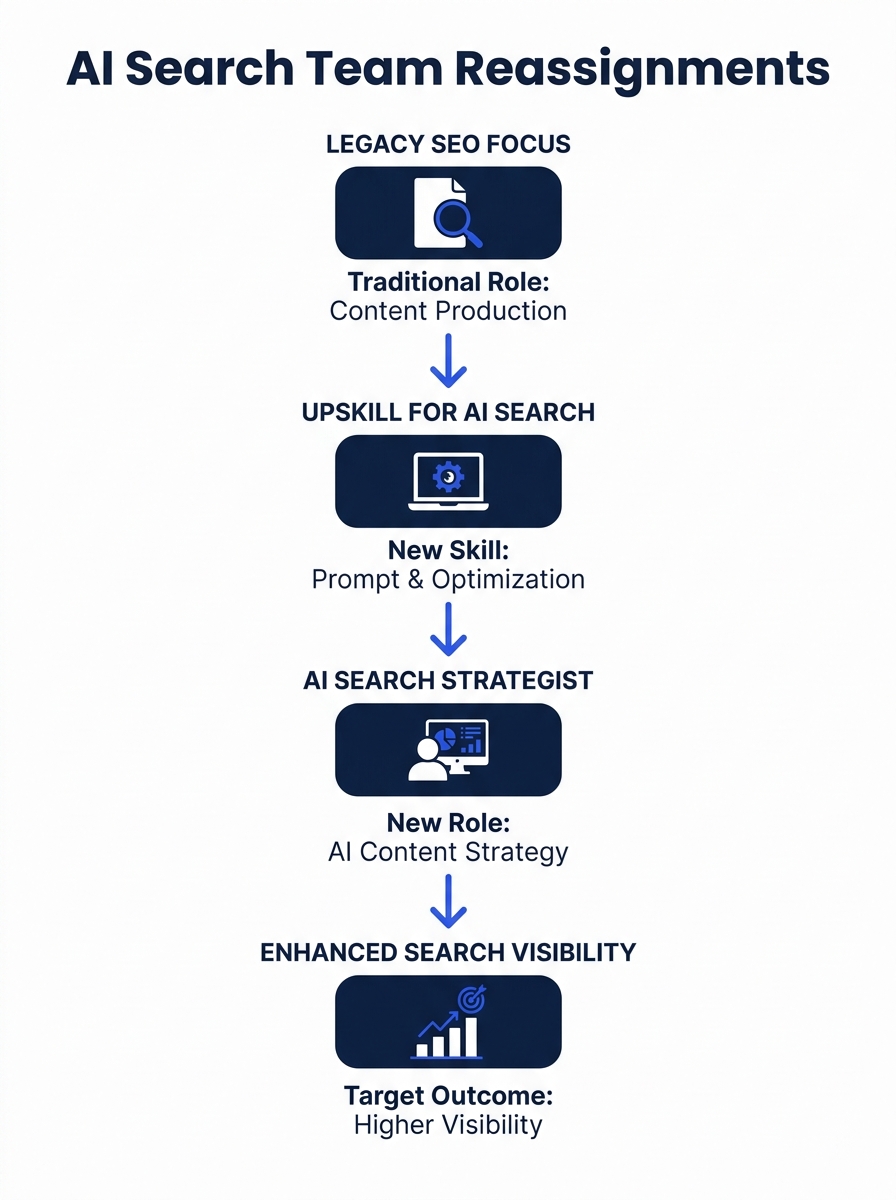
The framework recommends three scope changes using existing personnel rather than adding headcount. The SEO lead’s role expands from rankings to citations, taking ownership of brand entity consistency across every platform generative models index—LinkedIn, review sites, industry directories, Crunchbase, Reddit, and the company’s own domain. Entity fragmentation (inconsistent brand names, multiple domains, conflicting company descriptions) emerged as the most common issue in audits the author conducted, the article stated.
Content teams should reduce publishing volume by half and redirect hours toward work generative engines can quote: original data, customer outcomes with quantified results, expert commentary from named employees, and page structures that allow clean claim extraction, according to the framework. The guidance scores content teams on citations earned and pipeline influenced rather than monthly post count.
Digital PR shifts from the brand budget to the performance budget under the proposed model. Generative models reward agreement across independent sources, making mentions in trade publications and review platforms function as acquisition signals. The framework assigns quarterly citation targets to PR work and measures it as a demand-generation channel.
The framework recommends AI search visibility report to the demand-generation leader in teams under 20 people, or directly to the vice president of marketing in larger organizations until the program proves results. Placing the function three layers down without executive sponsorship increases the risk it becomes orphaned, the article noted.
Budget Reallocation Example Protects Paid Search While Testing AI Programs
A $60,000 monthly marketing budget outlined in the framework shifted $36,000 in the first quarter. Paid search dropped from $30,000 to $24,000, protecting brand terms and converting non-brand campaigns while redirecting spend. Content production fell from $12,000 to $10,000 as volume decreased. The AI search program received $10,000, covering entity cleanup, structured data implementation, and measurement infrastructure. Digital PR increased from $5,000 to $10,000 with citation-tracking requirements. Tools expanded from $5,000 to $6,000 to add an AI visibility tracker; the framework named Peec AI for citation tracking and noted Semrush added an AI toolkit.
The framework recommends moving 15 to 20 percent of budget in the first quarter and letting evidence guide subsequent shifts, rather than defunding working paid programs on faith. Paid search data remains the cleanest read on which queries carry buying intent, and that query intelligence informs which questions to test across generative assistants, according to the article.
Marketing leaders overseeing enterprise digital marketing services face planning-cycle constraints: allocations set in Q4 lock the prior year’s bet in for 12 months. The framework argues the restructure conversation belongs in the current quarter for teams planning 2027 budgets.
90-Day Implementation Sequence Front-Loads Measurement
The framework outlines a three-phase sequence over 90 days. Weeks one through four establish baseline visibility: marketing teams test the top 20 buyer queries across four major assistants (ChatGPT, Gemini, Perplexity, Google AI Mode) and record every answer, citation, and competitor named. Entity fragmentation fixes occur during this measurement period.
Weeks five through eight run controlled experiments: teams publish structured content pieces with clear claims, quantified outcomes, and expert attribution, then retest queries to measure citation lift. Digital PR placements launch with citation targets rather than reach metrics.
Weeks nine through twelve scale tactics that demonstrated citation gains and prepare quarterly reporting for stakeholders. The framework notes that most CMOs require evidence before reallocating further budget from established channels.
The guidance advises against reorganizing roles on day one. Baseline measurement protects teams from restructuring based on assumptions rather than their specific visibility gaps, the article stated. Organizations currently engaging digital marketing consultation partners to audit AI search performance can use baseline data to brief agency teams on which queries matter most to the business.
Reading Between the Lines
The August 31 framework addresses a question marketing leaders increasingly face when briefing agency partners or evaluating content marketing services: which internal team owns whether generative assistants cite the brand, and how does that ownership map to budget authority? The visibility gap the framework identifies—page-one rankings that do not translate to AI citations—exposes a planning problem more than an execution problem. Marketing organizations structured around Google’s results page carry role definitions and success metrics that no longer align with how buyers research purchases.
The framework’s recommendation to move 15 to 20 percent of budget in the first quarter rather than wait for annual planning cycles reflects the pace at which generative search adoption is shifting query volume away from traditional organic and paid channels. Marketing leaders who defer restructuring until the next fiscal year lock in another 12 months of spending against declining channel effectiveness. The guidance to protect paid search while testing AI programs acknowledges that paid data remains the most reliable signal of buyer intent—removing it entirely eliminates the query intelligence needed to measure AI visibility improvement.
The role reassignments avoid the common trap of treating AI search as a new specialist function requiring dedicated headcount. Expanding the SEO lead’s scope to entity consistency, shifting content teams from volume to evidence, and funding PR with citation targets use existing team structure while changing what those teams optimize for. For marketing leaders evaluating whether to brief an internal team or engage a content marketing agency to execute the shift, the framework’s 90-day sequence provides a testable structure: measure baseline visibility, run controlled content experiments, scale what demonstrates citation lift. The approach reduces restructuring risk by tying budget shifts to evidence rather than faith in a new channel.