Conversion Rate Optimization: Complete Guide for Philippine Websites

Understanding Conversion Rate Optimization
In today’s competitive digital landscape, driving traffic to your website is only half the battle. The real challenge lies in converting those visitors into customers, subscribers, or leads. This is where conversion rate optimization (CRO) becomes essential for Philippine businesses looking to maximize their online potential.
Conversion rate optimization is the systematic process of increasing the percentage of website visitors who take a desired action—whether that’s making a purchase, filling out a form, signing up for a newsletter, or any other goal you’ve defined. For Philippine businesses competing in both local and global markets, mastering CRO can mean the difference between a struggling online presence and a thriving digital business.
The beauty of CRO lies in its efficiency: rather than spending more money to attract new visitors, you’re maximizing the value of the traffic you already have. This approach is particularly valuable in the current economic climate where Philippine businesses are seeking ways to do more with less.
Why CRO Matters for Philippine Websites
The Philippine e-commerce market continues to grow exponentially, with more Filipino consumers shopping online than ever before. However, average conversion rate optimization benchmarks show that many Philippine websites leave significant money on the table by not optimizing their conversion funnels.
Consider this: if your website receives 10,000 visitors per month with a 1% conversion rate, you’re generating 100 conversions. By improving that rate to just 2%, you double your results without spending a single peso more on advertising. That’s the power of CRO.
The return on investment for conversion rate optimization is exceptional because you’re extracting more value from your existing traffic rather than constantly paying for new visitors. This is particularly important in the Philippine market where advertising costs continue to rise across platforms like Facebook, Google, and TikTok.
According to recent industry benchmarks, typical e-commerce conversion rates range from 2% to 3%, while the best performers achieve 5% or higher. Many Philippine websites currently operate below these benchmarks, representing a significant opportunity for improvement.

Key Elements of Effective Conversion Rate Optimization
1. A/B Testing: The Foundation of CRO
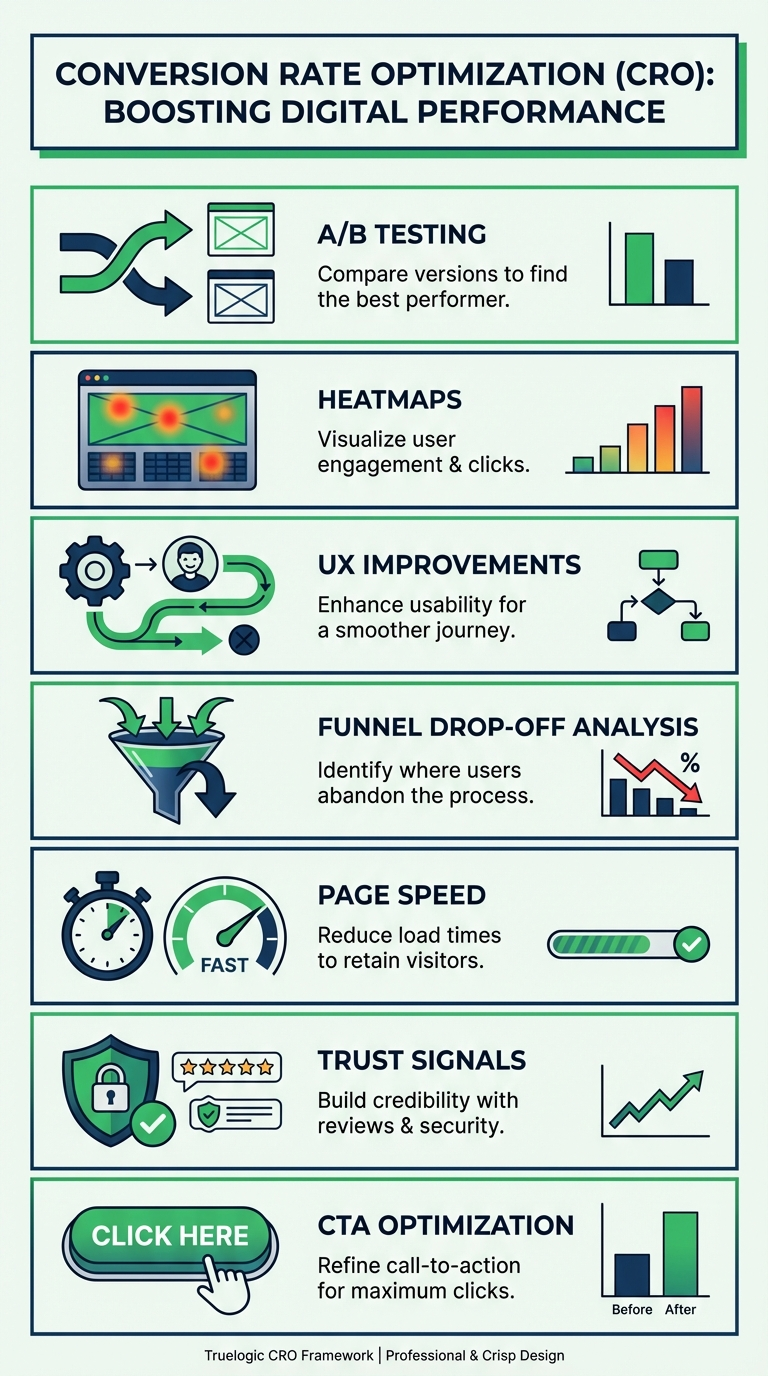
A/B testing, also known as split testing, is the cornerstone of any successful conversion rate optimization strategy. This method involves creating two versions of a webpage, email, or other marketing asset and testing them against each other to see which performs better.
For Philippine websites, effective A/B testing might include:
- Testing different headline variations that resonate with Filipino consumers
- Comparing call-to-action button colors and text
- Experimenting with different product image arrangements
- Testing price presentation formats (installment vs. full price)
- Comparing different checkout flow designs
- Testing testimonial placements and formats
- Evaluating different navigation structures
The key is to test one element at a time to clearly identify what drives improvements. Data-driven decisions always outperform assumptions, and Philippine consumers may respond differently to design elements compared to other markets.
When conducting A/B tests, ensure you have sufficient traffic to achieve statistical significance. A test that runs too short may produce misleading results, while one that runs too long wastes potential conversions on underperforming variants.
2. Mobile Optimization: A Non-Negotiable Priority
In the Philippines, mobile internet usage dominates, with over 70% of web traffic coming from smartphones. This makes mobile optimization absolutely critical for conversion rate optimization success.
Key mobile optimization strategies include:
- Responsive design: Ensure your website adapts seamlessly to all screen sizes
- Touch-friendly elements: Buttons and links should be easily tappable with a minimum size of 44×44 pixels
- Simplified navigation: Mobile users need quick access to key pages through hamburger menus and sticky headers
- Streamlined checkout: Reduce form fields and enable mobile payment options like GCash and Maya
- Fast-loading mobile pages: Philippine mobile networks can be inconsistent, so lightweight pages are essential
- Thumb-friendly design: Place important elements within easy reach of the user’s thumb
Google’s mobile-first indexing means your mobile site is now the primary version for search rankings. A poor mobile experience not only hurts conversions but can also damage your SEO performance.
3. Page Speed Optimization
Google’s Core Web Vitals directly impact both search rankings and conversion rates. Studies consistently show that slower pages lead to higher bounce rates and fewer conversions. In fact, every second of additional load time can reduce conversions by up to 7%.
For Philippine websites, where internet speeds can vary significantly, page speed optimization is even more critical. Best practices include:
- Compressing and optimizing images using modern formats like WebP
- Minimizing HTTP requests by combining files
- Using a content delivery network (CDN) with nodes in Asia
- Enabling browser caching for static resources
- Minimizing and deferring CSS and JavaScript files
- Implementing lazy loading for images and videos below the fold
- Reducing server response time through efficient hosting
Aim for a page load time under 3 seconds, with Core Web Vitals metrics all passing Google’s thresholds. Tools like PageSpeed Insights, GTmetrix, and WebPageTest can help you identify specific areas for improvement.
4. Clear and Compelling Calls-to-Action
Your call-to-action (CTA) buttons are the conversion triggers on your website. Optimizing them is one of the most impactful conversion rate optimization strategies you can implement.
Effective CTA optimization includes:
- Action-oriented text: Replace generic “Submit” buttons with specific phrases like “Get Your Free Quote” or “Start Saving Today”
- Visual contrast: Your CTA should stand out from the page background—consider using your brand’s accent color
- Strategic placement: Position CTAs above the fold and repeat them at logical points throughout longer pages
- Urgency elements: Where appropriate, add time-sensitive language like “Limited Time Offer”
- Benefit-focused copy: Emphasize what the user gains by clicking, not just what action they’re taking
- Sufficient size: Make buttons large enough to be easily clickable on all devices
5. Social Proof and Trust Signals
Filipino consumers, like shoppers worldwide, look for validation before making purchasing decisions. Incorporating social proof throughout your website can significantly boost conversion rates.
Effective trust-building elements include:
- Customer testimonials with real names and photos
- Product reviews and ratings from verified purchasers
- Trust badges and security certifications (SSL, PCI compliance)
- Client logos and partnerships
- Case studies with measurable results
- Media mentions and awards
- Social media follower counts and engagement
- Real-time purchase notifications
Implementing a CRO Strategy for Your Philippine Business
Step 1: Establish Your Baseline
Before you can improve, you need to know where you stand. Set up proper analytics tracking to measure your current conversion rates across all key pages and funnels. Identify your most important metrics and track the right KPIs for your business.
Essential baseline metrics include overall conversion rate, funnel conversion rates at each stage, bounce rates by page, exit rates, and average session duration. This data provides the foundation for measuring improvement.
Step 2: Identify Conversion Barriers
Use tools like heatmaps, session recordings, and user surveys to understand why visitors aren’t converting. Common barriers for Philippine websites include:
- Complicated checkout processes requiring too many steps
- Limited payment options (missing GCash, Maya, or bank transfer)
- Unclear or surprising shipping costs revealed late in checkout
- Lack of local customer support options
- Trust concerns with unfamiliar brands
- Confusing navigation or site structure
- Slow page load times on mobile networks
Step 3: Prioritize Improvements
Not all optimizations are equal. Focus on changes that will have the biggest impact with the least effort. A common prioritization framework considers potential impact, confidence level, and implementation ease.
Start with quick wins—simple changes that can be implemented rapidly and show immediate results. These build momentum and buy-in for larger optimization projects.
Step 4: Test, Measure, and Iterate
Conversion rate optimization is not a one-time project—it’s an ongoing process. Continuously test new ideas, measure results, and build upon what works. What works today may not work tomorrow as consumer preferences and market conditions evolve.
Document all tests and results, building an institutional knowledge base of what works for your specific audience. This prevents repeating failed experiments and accelerates future optimization efforts.
Advanced CRO Techniques for 2026
Personalization
Advanced CRO strategies increasingly leverage personalization to deliver tailored experiences. This might include showing different content to first-time visitors versus returning customers, or customizing product recommendations based on browsing behavior.
Personalization can extend to geographic targeting (showing Manila-specific content to Metro Manila visitors), behavioral segmentation, and even real-time personalization based on current session behavior.
AI-Powered Optimization
Machine learning algorithms can now analyze user behavior patterns and automatically optimize elements for better conversions. These tools can identify opportunities that human analysts might miss and can conduct multivariate testing at scales previously impossible.
Checkout Optimization
Streamlining the checkout process remains one of the highest-impact CRO activities. For Philippine businesses, this means:
- Offering guest checkout options
- Supporting local payment methods (GCash, Maya, bank transfers)
- Providing clear shipping cost information upfront
- Enabling address autocomplete for Philippine locations
- Offering buy-now-pay-later options popular in the local market
- Minimizing form fields to essential information only
- Providing progress indicators through multi-step checkouts
Measuring CRO Success
Success in conversion rate optimization requires tracking the right metrics:
- Conversion rate: The percentage of visitors who complete your desired action
- Revenue per visitor: Total revenue divided by total visitors
- Bounce rate: The percentage of visitors who leave after viewing only one page
- Average order value: The average amount spent per transaction
- Cart abandonment rate: The percentage of shoppers who add items but don’t complete purchase
- Customer lifetime value: The total revenue you can expect from a single customer
- Time to conversion: How long it takes for visitors to convert
- Micro-conversion rates: Smaller actions that lead to macro conversions
Partner with CRO Experts
While some CRO improvements can be implemented in-house, partnering with experienced professionals can accelerate your results. A dedicated conversion rate optimization team brings specialized expertise, proven methodologies, and advanced testing tools that can transform your website’s performance.
Professional CRO partners can provide comprehensive audits, implement enterprise-grade testing platforms, and apply learnings from hundreds of previous optimization projects—advantages that are difficult to replicate internally.
Conclusion
Conversion rate optimization is no longer optional for Philippine businesses serious about online success. By implementing the strategies outlined in this guide—from A/B testing and mobile optimization to social proof and streamlined checkouts—you can significantly increase the return on your digital marketing investments.
Remember, CRO is a continuous journey of testing, learning, and improving. Start with your highest-traffic pages, implement data-driven changes, and watch your conversion rates climb. The businesses that master conversion rate optimization will be the ones that thrive in the increasingly competitive Philippine digital marketplace.
The time to start optimizing is now. Every day without CRO improvements is a day of lost conversions and revenue. Begin with the fundamentals outlined in this guide, and progressively implement more advanced techniques as your optimization maturity grows.