Marketing Content Strategist: Roles, Skills & Career Path

A marketing content strategist owns editorial direction, channel selection, audience segmentation, and performance accountability across every piece of content a brand publishes. Glassdoor pegs the average U.S. salary at $95,336 per year, with senior leadership roles clearing $175K. The content marketing industry overall is projected to grow at a 13.9% CAGR through 2029, according to Technavio.
TL;DR: The marketing content strategist role bridges editorial and commercial functions, requiring SEO literacy, analytics fluency, and cross-functional leadership. Entry-level salaries start around $49,587 (PayScale); experienced strategists average $95,336 (Glassdoor). The career path runs from content creator to strategist to director, typically requiring 3-5 years per transition. AI fluency and Generative Engine Optimization are now table-stakes competencies.
The seven rules below define what makes a marketing content strategist effective — whether you’re hiring one, becoming one, or evaluating whether your current content operation has the right person in the seat.
Separate strategy from writing on day one
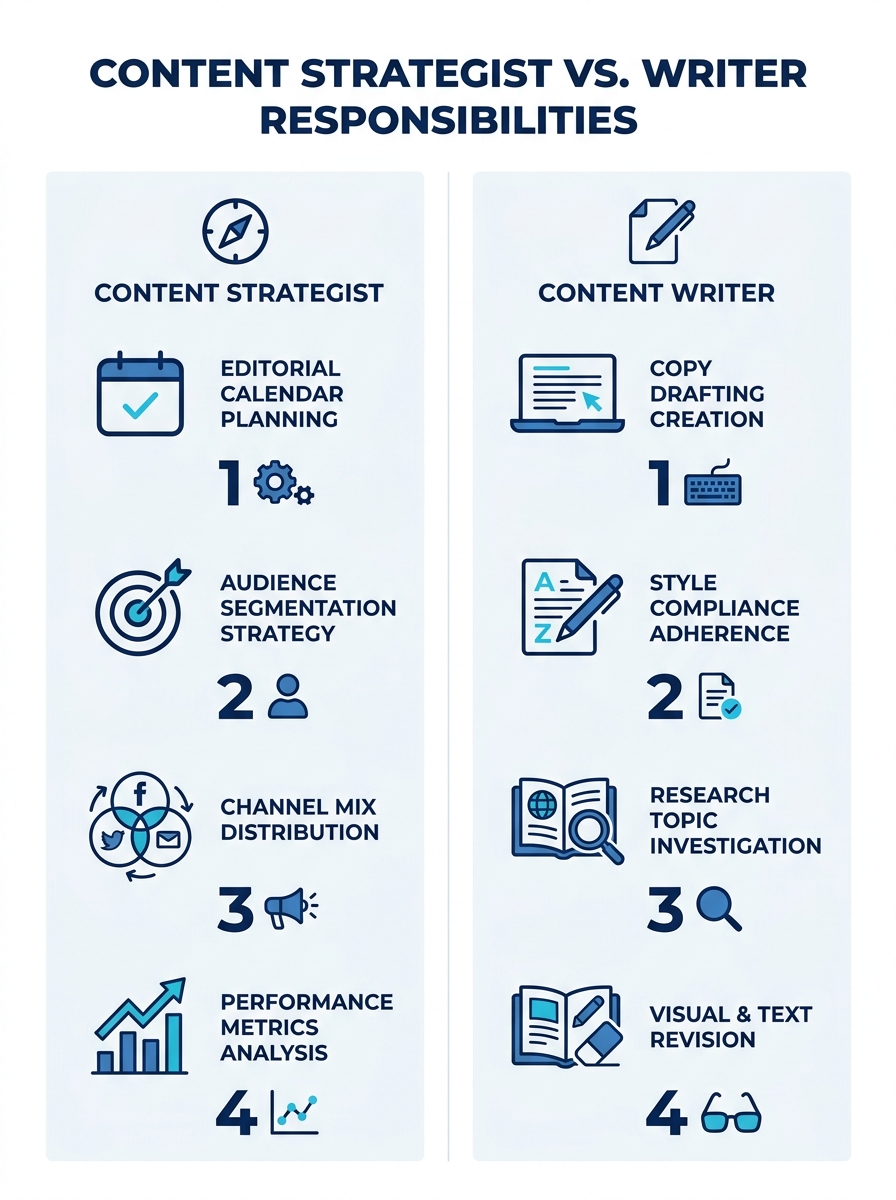
The single most common mistake in content hiring is treating the strategist and the writer as the same person. A content writer produces copy. A marketing content strategist determines what to write, for whom, in what format, on which channel, and against which KPI — then measures whether it worked. As one analysis on Medium noted, the strategist “oversees every aspect of content from end to end, involving in both inbound and outbound strategy crafting as well as strategy implementation.”
This distinction matters for reporting structure and budget. If your strategist spends 80% of their time writing blog posts, they aren’t doing strategy. The strategist’s deliverables are the editorial calendar, the content brief, the channel plan, the audience framework, and the performance dashboard. The writer’s deliverable is the copy itself.
When you’re working with a content marketing agency, this split becomes even more critical. The agency should have a strategist who maps your content program to business outcomes, separate from the writers and designers who execute. If the same person doing keyword research is also drafting 4,000-word articles, the strategic layer collapses into production.
Audit the existing content library before producing anything new
Why do content programs stall within their first two quarters? Because the strategist starts creating before understanding what already exists. As Champlain College’s career guide puts it, strategists “need to understand the current status of the website in question, including both successes and potential areas for improvement” before deciding which content types are needed.
A proper content audit covers three dimensions: what’s performing (by traffic, engagement, and conversion), what’s cannibalizing (multiple pages targeting the same keyword cluster), and what’s missing (topics your competitors rank for that you don’t). The audit output is a prioritized list — keep, consolidate, update, retire, create — that becomes the first 90 days of the editorial calendar.
This is where the marketing content strategist role intersects with an enterprise SEO program. Content audits done in isolation from technical SEO miss critical signals: indexation issues, internal linking gaps, and cannibalization patterns that only surface when you examine site architecture as a whole. GE’s multi-platform content operation, which we’ve analyzed as a case study in editorial scale, succeeded partly because its content strategy was architected around platform-specific audience behavior rather than raw volume.
Tie every editorial decision to a business metric
Content strategies that report only on pageviews and social shares eventually lose their budget. The marketing content strategist’s job is to connect editorial output to pipeline, revenue, or retention — depending on which funnel stage the content targets. ZipRecruiter data shows the 25th percentile salary for marketing strategists sits at $51,400, while the average lands at $95,336 according to Glassdoor. The strategists earning at the higher end can typically demonstrate direct content attribution to business outcomes.
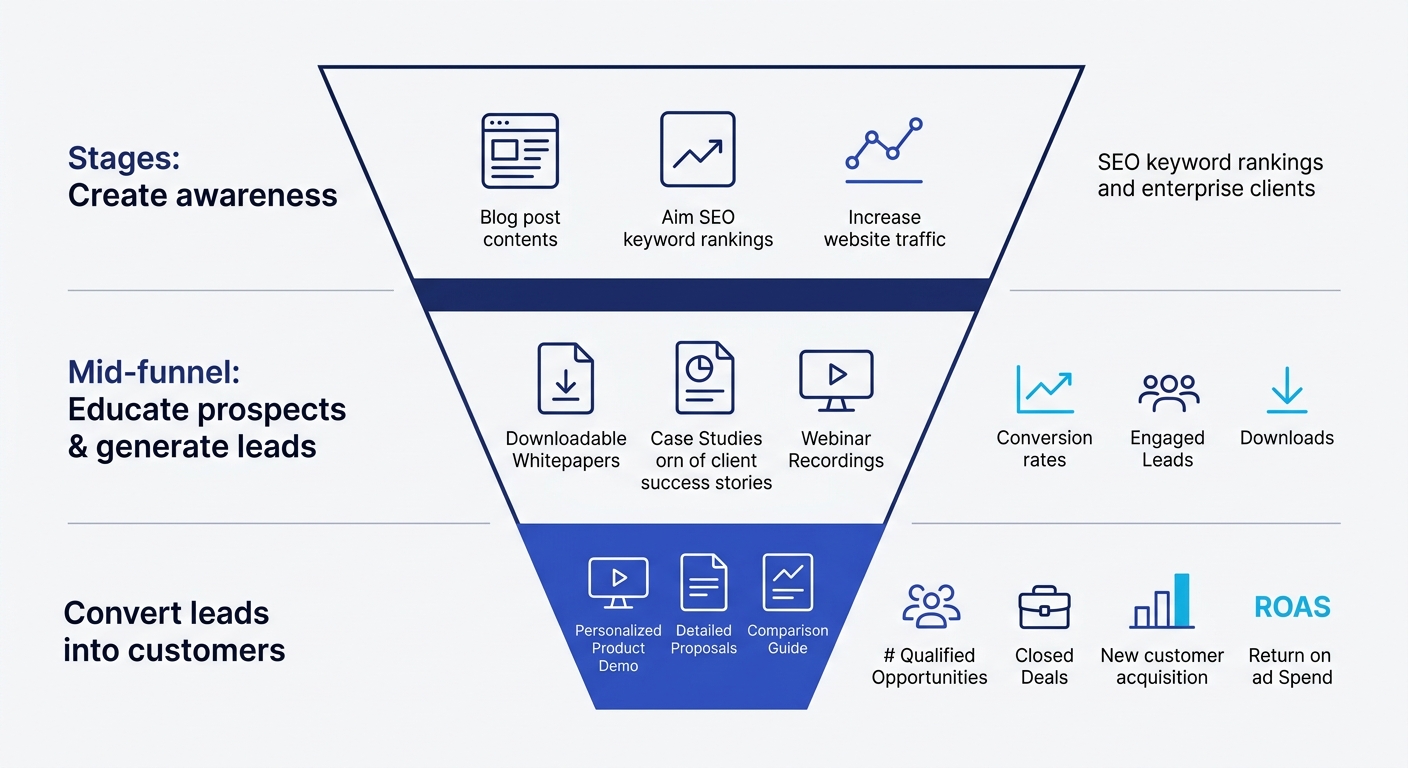
That means your content strategy document should specify, for every content type, what metric it moves. Top-of-funnel blog content targets organic sessions and email capture rate. Mid-funnel comparison guides target assisted conversions and time-to-SQL. Bottom-funnel case studies target influenced pipeline and deal velocity. And the strategist needs access to the analytics infrastructure that connects those dots, which is why the role increasingly requires working knowledge of GA4, CRM attribution, and multi-touch reporting.
The ongoing breakdown in marketing measurement frameworks makes this harder. As AI-driven commerce erodes traditional attribution signals, content strategists who can articulate content’s business value through alternative measurement approaches command premium compensation. PayScale reports that early career strategists with 1-4 years earn an average of $62,731; the jump to $95K+ happens when you prove you can measure and defend content ROI.
Treat SEO and analytics as non-negotiable foundations
The Reddit content marketing community frames it plainly: “Learn the basics of SEO, content marketing, and analytics — free resources like HubSpot Academy, Ahrefs blog, and Google Analytics Academy are gold.” That advice holds at every seniority level. A marketing content strategist who doesn’t understand keyword research, search intent mapping, and content performance analysis is making editorial decisions without the data that should inform them.
Here’s what “SEO literacy” means for a strategist in practice: you don’t need to write schema markup or configure server-side rendering. You do need to understand how entity clarity drives brand authority in organic search, why certain content formats earn featured snippets, and how Google’s core updates — like the May 2026 rollout — redistribute visibility across the index. You need to read a Search Console report and distinguish queries that represent opportunity from those that represent noise.
Analytics fluency runs deeper. Coursera’s content strategist career guide identifies content auditing, campaign scheduling, and topic research as core activities — all of which depend on data interpretation. The strategist who can pull a content decay report, identify pages losing traffic quarter-over-quarter, and prescribe an update cadence beats the one who only generates new ideas.
A marketing content strategist who doesn’t understand keyword research, search intent mapping, and content performance analysis is making editorial decisions without the data that should inform them.
Build AI fluency into your workflow now
The content marketing industry’s projected 13.9% CAGR through 2029 is driven in significant part by AI-augmented content operations. Generative Engine Optimization — structuring content so LLMs can interpret and cite it — has become a core strategist competency. The marketing content strategist now optimizes for two audiences simultaneously: human readers and AI discovery engines.
In practical terms, AI fluency for a strategist looks like this: using generative tools for audience research, competitive gap analysis, and first-draft acceleration, while reserving human judgment for strategic alignment, tone calibration, and the EEAT signals (Experience, Expertise, Authoritativeness, Trustworthiness) that Google and LLM-based search tools increasingly weight. The strategist acts as a creative director for AI-assisted workflows, setting guardrails and quality thresholds.
This is where content production bottlenecks compound. Teams that lack a strategist with AI fluency default to one of two failure modes: they reject AI tools entirely and fall behind on production velocity, or they adopt them without editorial governance and produce undifferentiated output that tanks their authority signals. The strategist’s job is to define the human-AI boundary within the content operation — which tasks benefit from automation, which require original thought, and how quality control works across both tracks.
Tip: When evaluating a marketing content strategist candidate, ask them to walk through a specific AI-assisted workflow they’ve managed. The answer reveals whether they understand the strategic layer or are treating generative AI as a faster typewriter.
Earn cross-functional trust before asking for budget
Content strategy lives at the intersection of marketing, product, sales, and customer success. A marketing content strategist who operates in a silo — producing content that marketing likes but sales never uses — is burning resources. Indeed’s updated job description lists collaboration with the marketing team as a core success factor, and Monster’s template emphasizes “strong problem-solving skills to address challenges related to content creation, distribution, and audience engagement.”
The cross-functional piece is where many content strategists, especially those promoted from writing roles, stumble. Building trust with sales means understanding objection-handling needs and producing battle cards and comparison content mapped to deal stages. Building trust with product means interpreting roadmap priorities into editorial angles without compromising accuracy. Building trust with executives means presenting content performance in business terms — pipeline influenced, deals assisted, retention impacted — rather than traffic and shares.
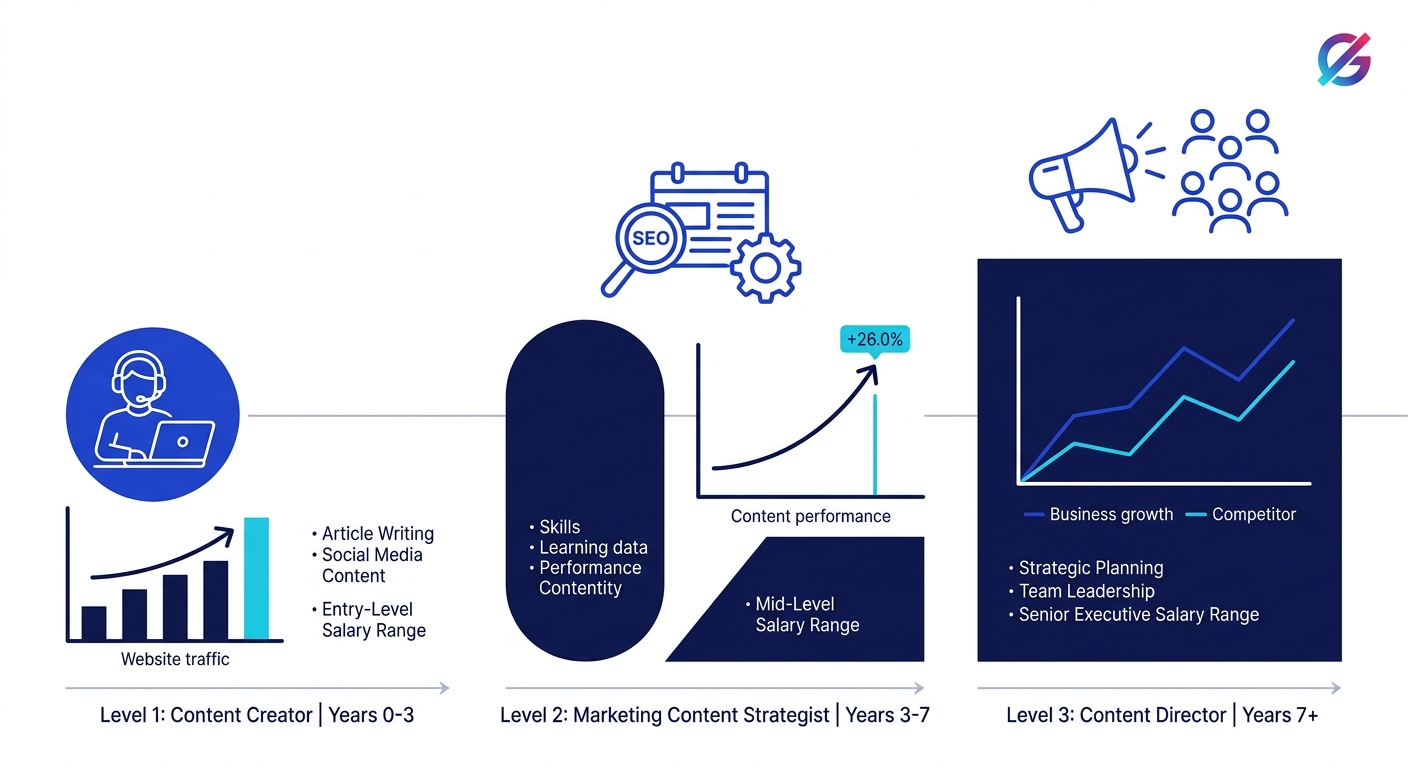
The career path here typically follows creator to strategist to director, with each transition requiring 3 to 5 years of experience. Coursera’s career guide notes that a degree in marketing or business provides the foundation, but cross-functional credibility is what unlocks the senior roles. The strategists who reach director-level and command salaries above $175K have almost always built deep relationships outside the marketing department.
Match the strategist’s profile to your content maturity
Not every content operation needs the same type of strategist. An early-stage program — one with fewer than 50 published pieces, no editorial calendar, and no documented content-to-revenue attribution — needs a strategist who builds from scratch: audit, strategy, governance, measurement framework, then production. A mature program with hundreds of published assets, an established editorial voice, and working attribution needs a strategist who optimizes: testing formats, expanding channels, improving conversion rates on existing content, and managing a team of writers and designers.
Hiring a senior optimization-focused strategist for an early-stage program wastes their skills and your budget. Hiring a junior build-from-scratch strategist for a mature program means they’ll be overwhelmed by the operational complexity. The match between strategist profile and content maturity determines whether the hire pays off within the first year or generates friction and turnover.
When you’re engaging content strategy and production through an agency, this matching happens at the engagement level. A good agency scopes the strategist’s involvement based on your content maturity, not on a one-size template.
When These Rules Collapse
These rules assume a content operation with organizational buy-in, a budget that extends beyond a single quarter, and access to the analytics infrastructure needed for measurement. When any of those conditions is missing, the rules bend.
A marketing content strategist in an organization with no analytics stack can’t tie editorial decisions to business metrics, so they should build the measurement layer first, even if that means publishing less content in the first 90 days. A strategist with quarter-to-quarter budget uncertainty can’t plan a 12-month editorial calendar, so they should build a modular content system where individual pieces justify their existence independently. And a strategist working without executive sponsorship will need to prove value through a single high-visibility project before implementing the full framework.
The industry’s growth trajectory suggests demand for this role will keep accelerating. The strategists who earn that demand are the ones who adapt these principles to the constraints they face, rather than waiting for conditions that rarely arrive on their own.