Generative Engine Optimization vs. SEO: What Philippine Businesses Need to Know

If you have invested in SEO for your business, you have likely heard the term generative engine optimization come up in recent conversations. It sounds technical, and the comparisons between GEO versus SEO can feel confusing. Do you need to start over? Is your current strategy still worth the investment?
The short answer is no, you do not need to start over. But you do need to understand what is changing and why it matters for how your business shows up online.
What Is GEO in SEO?
Generative engine optimization, or GEO, is the practice of optimizing your content so it gets cited or surfaced by AI-powered search tools. These include platforms like Google’s AI Overviews, ChatGPT, Perplexity, and Gemini.
Whereas traditional search engines give users a ranked list of links, generative AI tools synthesize information from different sources and deliver a single, coherent answer. GEO is about making sure your content is one of the sources that response draws from.
It is a newer discipline, but it builds on principles that SEO practitioners have followed for years. Our AI search optimization guide covers the full picture, but the key distinction here is how AI tools evaluate and use content compared to how traditional search engines rank it.
GEO vs. SEO: What Changes and What Stays the Same
At its core, the debate between generative engine optimization and traditional SEO is not about which one wins. Both aim to get your content in front of the right person at the right moment. The difference is in how each one works.
Traditional SEO focuses on signals like keyword relevance, backlinks, page speed, and technical health. The measure of success is a ranking position on a search results page.
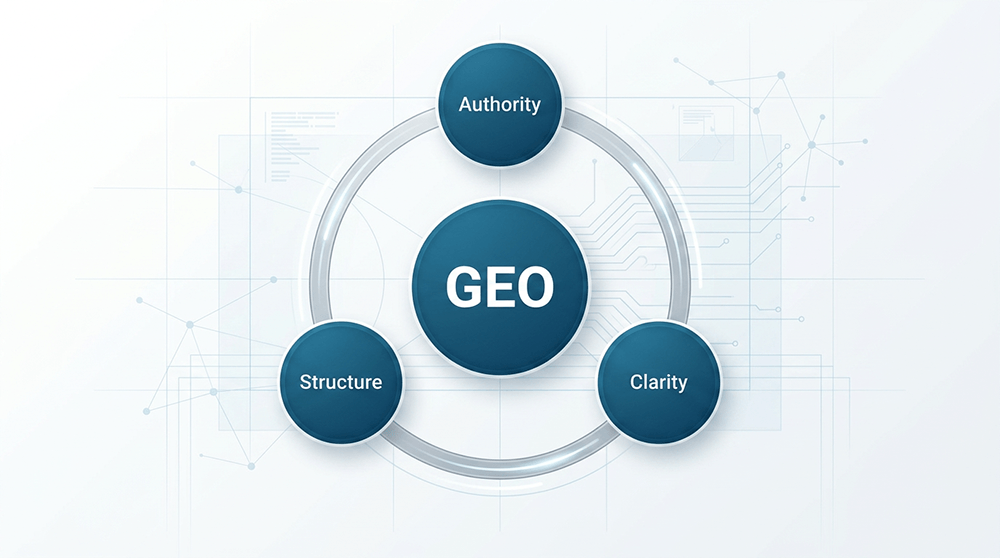
GEO shifts the focus toward authority, clarity, and structure. AI tools are not looking for the highest-ranking page. They are looking for the most credible, clearly written, well-organized source to pull an answer from. Factors such as E-E-A-T, entity recognition, structured data, and direct question-and-answer formatting carry more weight in a GEO context.
That said, the fundamentals of good SEO–strong content, technical health, and credible backlinks–still apply. GEO does not replace SEO. It extends it.
GEO vs. SEO: Key Differences at a Glance
|
Factor |
Traditional SEO |
Generative Engine Optimization |
|---|---|---|
|
Primary goal |
Rank in search results |
Get cited in AI-generated answers |
|
Success metric |
Rankings and organic traffic |
Citations, visibility in AI responses |
|
Content focus |
Keyword relevance and depth |
Authority, clarity, and direct answers |
|
Key signals |
Backlinks, page speed, technical health |
E-E-A-T, entity recognition, structured data |
|
Format preference |
Long-form, keyword-optimized content |
Clear, well-structured, question-answer format |
|
Tools evaluated by |
Google, Bing, and other search engines |
ChatGPT, Perplexity, Gemini, Google AI Overviews |
How GEO Affects Your Existing SEO Strategy
GEO is not here to replace SEO. It is additive. Most of what makes a page perform well in traditional search also improves its chances of being cited by AI tools.
Where businesses need to adjust is in how they structure and frame their content. AI tools favor content that answers questions directly, uses clear headings, and demonstrates genuine expertise. A page that buries its main point in the fifth paragraph is less likely to be cited than one that leads with a clear, authoritative answer.
Schema markup and structured data also become more important under GEO. These help AI systems understand what your content covers and how it relates to a given query, improving the accuracy of the information pulled from your site.
The practical adjustment for most businesses is not a complete overhaul. It is a refinement. Review your existing content for clarity and structure, add FAQ sections where they fit naturally, and make sure your brand is consistently represented across credible online sources.
GEO and SEO: Better Together
GEO and SEO are not competing strategies. They are complementary ones. The businesses that will perform best in AI-driven search are those that build on their existing SEO foundation while adapting their content for how AI tools evaluate and use information.
If you are unsure where your current strategy stands, our AI SEO services can help you identify the gaps and build a plan that works for both traditional and AI-powered search.